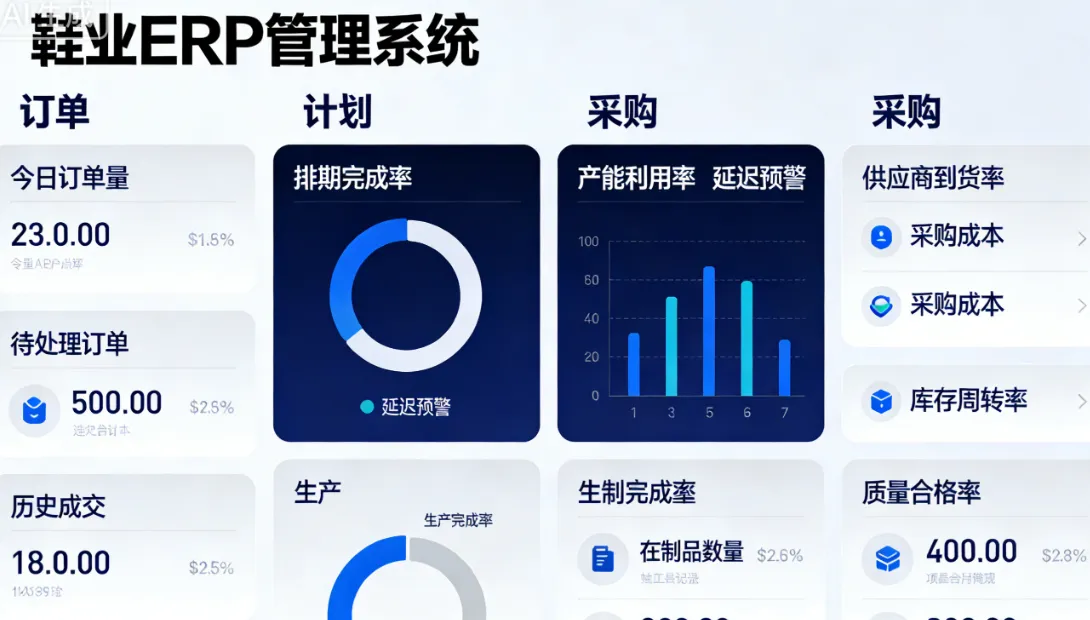
Breaking through the ERP system in the footwear industry: When multi-level BOM encounters non-standard production, who will connect the entire chain?
Under the dual driving force of consumer upgrading and personalized demand, the footwear market is accelerating its transformation from "large-scale mass production" to a non-standard production mode of "small batch, multiple varieties, and fast delivery". The birth of a pair of shoes is hidden behind a multi-level bill of materials (BOM) from finished products to accessories. When complex multi-level BOMs encounter flexible and variable non-standard production, the shortcomings of traditional ERP systems are completely exposed - inaccurate material calculation, chaotic production scheduling, lagging integration, and data gaps, becoming the core bottleneck restricting the efficiency improvement and cost control of shoe enterprises. The breakthrough battle of footwear ERP is essentially a "data collaboration revolution" centered on multi-level BOM, which connects the entire chain of design, planning, procurement, production, and warehousing.
The production logic of the footwear industry determines that the complexity of BOM management far exceeds that of ordinary manufacturing. Unlike products assembled from a single material, the BOM of a pair of shoes presents a clear "nested doll like" multi-layer structure: beneath the finished shoe, there are core semi-finished products such as the upper, sole, and heel; Further disassembly reveals basic materials such as fabric, lining, outsole, and midsole; Ultimately extending to various accessories such as shoelaces, shoe buckles, stitching, glue, etc., the level generally reaches 3-5 levels. What is even more challenging is that shoe production naturally carries a "non-standard gene" - the same shoe model needs to be adapted to multiple sizes, colors, and materials, and there are "up and down code" differences in the amount of materials used for different sizes. Customer customization demands also lead to exponential growth in the combination of craftsmanship and materials, which makes the single-layer or simple level BOM modeling capabilities of traditional ERP systems inadequate.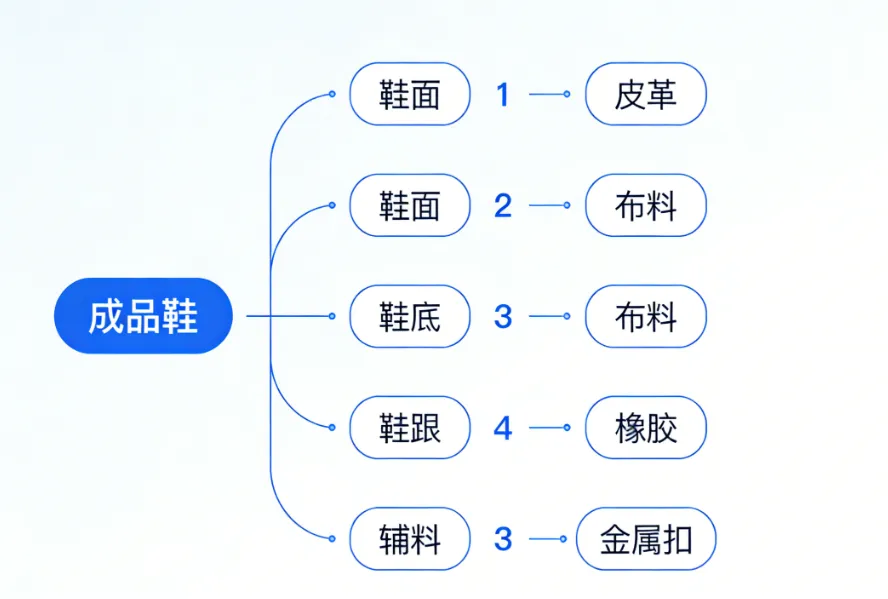
When the "complexity" of multi-level BOM meets the "flexibility" of non-standard production, the full chain management of shoe enterprises is trapped in multiple difficulties. At the BOM management level, deep hierarchy, diverse versions, and frequent changes have become the norm: separate BOM maintenance is required for spring/summer and autumn/winter versions, standard and customized versions of the same shoe, and frequent material substitutions and process adjustments often lead to asynchronous BOM updates, resulting in production errors and cost accounting deviations; Manually maintaining the BOM and material calculation for a massive number of SKUs is not only inefficient, but also prone to omissions and miscalculations, putting subsequent production processes in a passive position. At the production and supply chain level, the dilemma is further transmitted: due to the distortion of demand calculation in multi-level BOM, MRP (Material Requirements Planning) cannot accurately generate procurement and production instructions, resulting in material backlog and shortage coexisting - a shortage of shoelaces of a certain size or shoe buckles of a certain style may lead to the production stoppage of the entire order; The data gaps in the design, planning, procurement, and production processes, coupled with repeated input and verification, have become the norm. This not only prolongs the delivery cycle but also deprives cost control of its grip.
Behind the pain points, the core issue lies in the traditional ERP system's inability to adapt to the industry characteristics of the footwear industry, and its failure to create a multi-level BOM as a data base for the entire chain. In fact, the breakthrough of footwear ERP does not require disrupting the existing system. It only needs to build a full chain solution with multi-level BOM as the core, which includes "data homology, process closed-loop, and flexible adaptation". This can enable non-standard production to move from "chaos and disorder" to "structured and controllable".
The structured modeling of multi-level BOM is the foundation for breaking through the game. Shoe companies need to establish a BOM management system that supports unlimited levels, presenting a clear hierarchical structure of finished products, semi-finished products, and raw materials in a tree like visual manner. At the same time, it supports dynamic calculation of material usage based on size, color, and process dimensions, accurately solving the pain points of "lift code" and segment code differences. To address the issues of confusion and uncontrolled changes in BOM versions, it is necessary to establish a comprehensive version management and engineering change (ECN) mechanism, so that multiple versions of BOM for the same shoe can be archived in an orderly manner. Change instructions can be automatically synchronized to all relevant links such as production planning, procurement, and inventory, and a complete audit trajectory should be retained to avoid information deviation. In addition, the built-in material substitution rules and selection management functions are also crucial - when a certain type of fabric or sole is in short supply, the system can automatically recommend alternative materials and update costs synchronously, while supporting customer customized selection, balancing standardization and flexibility. More importantly, it is necessary to deeply bind shoe specific processes such as cutting, needle sewing, and molding with the BOM level, forming an integrated data of "BOM+process", providing accurate basis for subsequent production scheduling and dispatching.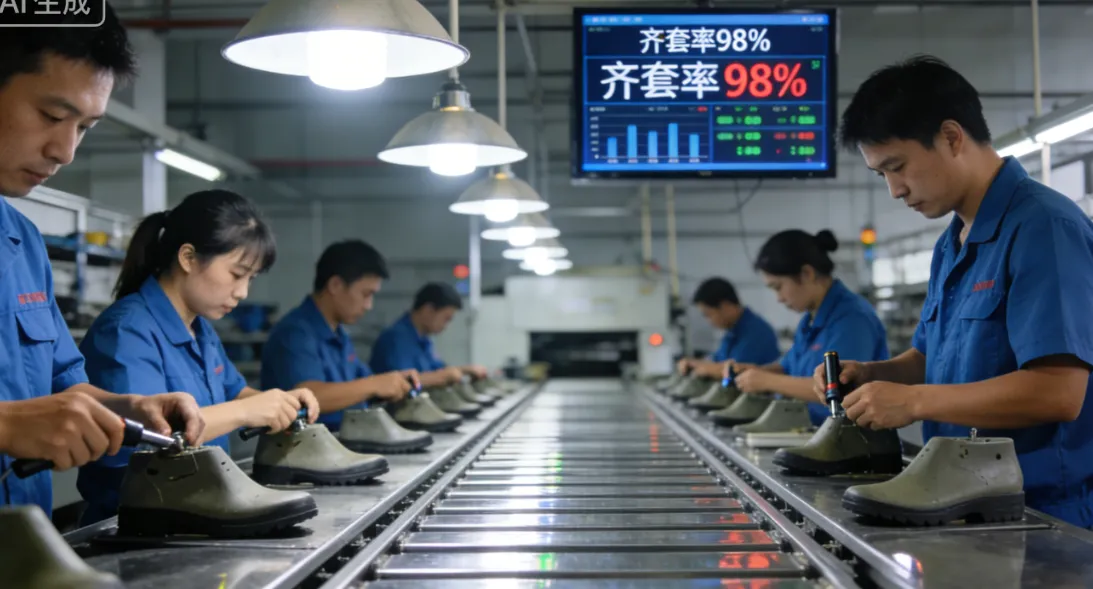
Based on multi-level BOM, connecting the collaborative link between production and supply chain is the key to breaking the deadlock. In the material supply process, it is necessary to rely on multi-level BOM to achieve intelligent MRP calculation. The system automatically expands the full level BOM according to orders, and combines inventory, in transit, and in production material information to generate accurate procurement and production requirements by size and material, controlling material calculation errors within 3%; At the same time, establish a real-time monitoring system for the complete set rate, visually display the complete set status of materials according to the dimensions of orders, work orders, and sizes, provide early warning of material shortages, prioritize the supply of bottleneck materials, and fundamentally eliminate "waiting for materials to stop production". In the production execution stage, it is necessary to adapt to the flexible requirements of non-standard production, use visual Gantt chart scheduling, support one click rearrangement of inserting and changing orders, and synchronously issue adjustment instructions to the workshop; Promote paperless management in the workshop, associate BOM and work orders through scanning codes and RFID technology, achieve precise material requisition by process and workstation, prevent material errors and over issuance, and track the status of work in progress in real time to reduce backlog of work in progress. In the cost control process, relying on multi-level BOM to automatically collect materials, labor, and manufacturing costs, real-time accounting of single shoe and single order costs is achieved, providing data support for product pricing and quotation decisions.
In terms of system selection, shoe companies do not need to blindly pursue "big and comprehensive", but should choose suitable solutions based on their own scale and non-standard degree. For small and medium-sized shoe enterprises, as well as those with a high degree of standardization and a pursuit of rapid online deployment, out of the box industry-specific ERP systems (such as Kingdee AI Star and Yonyou Shoe and Clothing Edition) are the best choice. Their built-in shoe BOM and process templates can significantly shorten implementation cycles and control costs; For large and medium-sized shoe companies with prominent non-standard needs and special production processes, low code platform customization (such as movable type grids) has more advantages. It can fully fit the production logic of the enterprise, flexibly build multi-level BOM and business processes, have fast iteration speed, and low transformation costs. Dongguan Ruilian has built a shoe ERP with low code, shortening the development cycle by 70% and achieving automatic data flow throughout the entire chain; In addition, the hybrid mode of universal ERP+low code BOM modules can also balance system stability and business flexibility, making it suitable for shoe companies in the transition period.
It is worth noting that the breakthrough of shoe ERP is not achieved overnight, and its implementation needs to follow a scientific path. Firstly, it is necessary to standardize and sort out the BOM, unify the BOM hierarchy, coding, and usage rules by shoe type and category, clean up historical erroneous data, and lay the foundation for subsequent system operation; Secondly, it is necessary to reconstruct the business process centered on BOM, break through the closed loop of "order → planning → procurement → production → warehousing → cost", and reduce manual data breakpoints; Once again, make sure to select and configure the system, prioritizing systems that support multi-level BOM, version management, substitute materials, and footwear processes, or customizing core modules through low code; Then, integrate with PLM, MES, WMS, and supply chain systems to ensure data is of the same origin and synchronized in real-time; Finally, establish a continuous optimization mechanism through BOM change analysis, complete set rate analysis, and cost analysis, using data-driven scheduling and supply chain optimization to gradually improve the efficiency of the entire chain.
When multi-level BOM is no longer a "management burden", but becomes the data core of the entire chain, non-standard production is no longer an "efficiency bottleneck", but a competitive advantage for shoe companies, and the breakthrough of shoe ERP is truly achieved. Practice has proved that by building a full chain solution with multi-level BOM as the core, the material demand error of shoe enterprises can be reduced to within 3%, stagnant materials can be reduced by 20% -30%, downtime can be reduced by more than 50%, delivery cycle can be shortened by more than 30%, and per capita efficiency can be improved by more than 20%. This not only achieves cost control, but also takes the initiative in the market competition of small batches, multiple varieties, and fast delivery.
The competition in the footwear industry has long extended from product and channel competition to supply chain and management efficiency competition. When multi-level BOM encounters non-standard production, it is not an "unsolvable problem", but a "must answer question" for shoe companies' digital transformation. Only by using multi-level BOM as the starting point, breaking through the data collaboration of the entire chain, and breaking down departmental barriers and data gaps, can ERP systems truly adapt to the industry characteristics of the footwear industry, become the core support for shoe enterprises to reduce costs, increase efficiency, transform and upgrade, and achieve high-quality development in the industry transformation.