ERP report: Empowering enterprise management with full chain data, in-depth analysis of financial modules
In the digital age, Enterprise Resource Planning (ERP) systems have become the core hub of enterprise management, and ERP reports, as the data output carrier of the system, run through the entire business chain of "people, finance, materials, production, supply, and sales" of the enterprise, serving as a key bridge connecting business execution and business decision-making. It integrates data from various modules to generate accurate and real-time statistical and analytical reports, providing operational guidance for frontline executives, process monitoring basis for departmental management, and decision-making support for senior management, helping enterprises optimize management, reduce costs, and improve efficiency. Among them, financial statements serve as the core pillar of ERP reporting, and all data from business modules will ultimately be collected in the financial module, achieving the integration of business and finance. They are the "core ledger" of the enterprise's operating conditions, as well as the core basis for calculating profits, regulating management, and formulating strategies. This article will comprehensively analyze the overall framework of ERP reports, and focus on breaking down the core content and application value of financial reports in depth.
1、 The overall framework of ERP reports: a "data dashboard" covering the entire business chain
ERP reports are not a collection of single reports, but a multidimensional reporting system built based on the entire business process of the enterprise. According to business modules, they can be divided into seven core categories, and each module is interconnected and data communicates with each other, jointly forming the "data panorama" of enterprise operation, adapting to management needs at different levels:
1. Financial statements: Core core, focusing on core financial indicators such as funds, costs, profits, assets, etc., to achieve integrated accounting and monitoring of business and finance;
2. Sales reports: Focus on the revenue side, covering dimensions such as orders, performance, customers, products, etc., monitor sales progress, and analyze market demand;
3. Procurement reports: Focus on the procurement side, covering purchase orders, suppliers, material acceptance, etc., to control procurement costs and ensure material supply;
4. Inventory reports: Focus on material output, monitor inventory quantity, turnover, and changes, optimize inventory structure, reduce backlog and stockouts;
5. Production reports: Suitable for styling enterprises, covering production planning, execution, losses, etc., monitoring production progress, and improving production efficiency;
6. Human resources reports: focusing on human assets, covering employee management, attendance, compensation, performance, controlling labor costs, and optimizing labor structure;
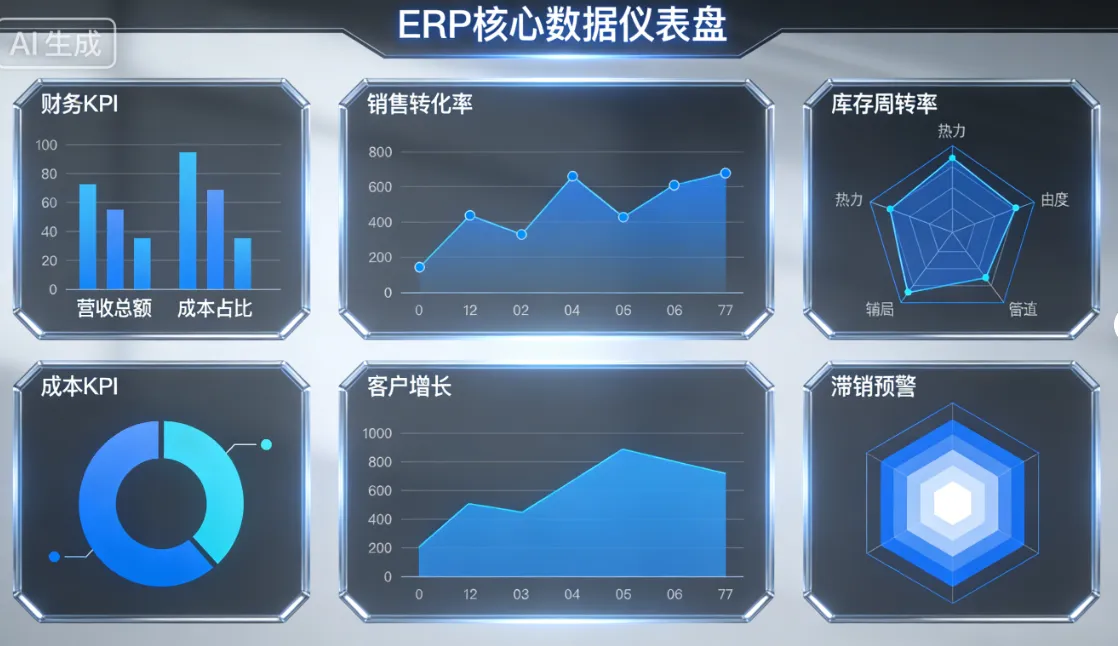
7. Business decision-making reports: Integrate multiple module data and present core KPIs in a visual form to provide comprehensive support for high-level decision-making.
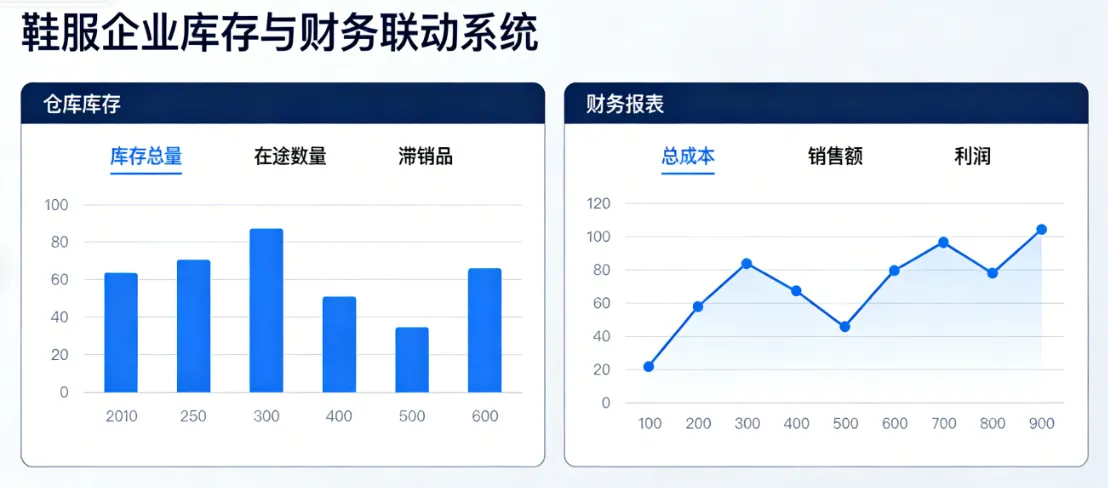
ERP reports from different industries will focus on their own business characteristics, such as strengthening SKU sales and store inventory reports in the footwear and apparel industry, production planning and cost reports in the manufacturing industry, and procurement, sales, and inventory related reports in the commerce industry. However, regardless of the industry, financial reports are an indispensable core module that runs through every aspect of enterprise operation.
2、 Core analysis: ERP financial statements - the "core ledger" of enterprise operations
The core value of ERP financial reports is "automatic collection of business data, accurate and efficient financial accounting, and real-time monitoring of business risks". It breaks the pain point of traditional finance and business disconnection, and realizes "financial accounting when business occurs". All business operations such as procurement, sales, and production consumption will be automatically synchronized to the financial module to generate corresponding financial data, ensuring the authenticity, real-time, and accuracy of financial data. Financial statements cover the full dimensions of funds, costs, profits, transactions, and assets, and can be divided into four categories based on their functions. Each category of report has a clear application scenario and core role. The following provides a detailed analysis:
(1) Core Accounting Report: The 'Final Presentation' of Enterprise Operating Results
The core accounting report is the foundation of enterprise financial accounting, as well as the core basis for external tax reporting and internal analysis. It strictly follows accounting standards, focuses on the overall assets, profits, and cash flow status of the enterprise, and is a direct reflection of the enterprise's "wealth" and "performance".
1. Balance sheet: It reflects the assets, liabilities, and owner's equity of a company on a specific date (such as the end of a month, quarter, or year), with the core principle of "assets=liabilities+owner's equity". On the left side of the report, all assets of the enterprise are listed, including current assets (monetary funds, accounts receivable, inventory, etc.) and non current assets (fixed assets, intangible assets, etc.), reflecting the "amount of assets" of the enterprise; On the right side, liabilities (current liabilities, non current liabilities) and owner's equity (paid in capital, surplus reserves, undistributed profits, etc.) are listed, reflecting how much debt the enterprise owes and the net assets that truly belong to the enterprise. Through the balance sheet, management can quickly understand the asset structure and debt level of the enterprise, judge the debt paying ability and financial stability of the enterprise. For example, the "asset liability ratio" (total liabilities/total assets) can be used to determine the financial risk of the enterprise, and the "current asset turnover ratio" can be used to determine the liquidity of assets.
2. Income Statement (Profit and Loss Statement): It reflects the operating results of a company for a certain accounting period (such as month, quarter, or year), with the core principle of "revenue cost expense=profit". The report presents items such as operating income, operating costs, taxes and surcharges, period expenses (management expenses, sales expenses, financial expenses), investment income, and non operating income and expenses from top to bottom, and finally calculates operating profit, total profit, and net profit. The income statement is the core report for assessing a company's profitability. Management can use it to understand the company's sources of revenue, cost composition, and expenses, accurately locate profit growth and loss points. For example, by using the "gross profit margin" ((operating revenue - operating costs)/operating revenue) to determine the profit margin of a product, and by using the "period expense ratio" (period expenses/operating revenue) to monitor the effectiveness of expense control.
3. Cash flow statement: It reflects the inflow and outflow of cash in a certain accounting period of an enterprise, and the core is to distinguish between the three categories of cash flows: operating activities, investing activities, and financing activities, reflecting the "cash flow health" of the enterprise. The cash flow from operating activities (such as cash received from selling goods and cash paid for purchases) reflects the daily cash inflows and outflows of the enterprise and is the core source of the enterprise's cash flow; The cash flow from investment activities (such as the purchase of fixed assets and cash received from external investments) reflects the income and expenditure of a company's long-term investments; The cash flow from financing activities (such as cash received from absorbing investments, borrowing, and paying debts) reflects the cash inflows and outflows of a company's financing and debt repayment. The core function of a cash flow statement is to assess a company's liquidity and debt paying ability, avoiding the risk of "book profit but cash flow rupture". For example, by using "net cash flow from operating activities" to determine whether a company can generate sufficient cash in its daily operations to support its normal operation and development.
(2) Daily operating financial statements: the "basic support" for financial accounting
Daily operating financial statements are the foundation for financial personnel to carry out daily reconciliation, accounting, and bookkeeping work, covering the financial records of every economic transaction of the enterprise, ensuring the accuracy and traceability of financial data, and serving as the data source for core accounting reports.
1. Account balance sheet: It displays the opening balance, debit amount, credit amount, and closing balance of all accounting accounts of the enterprise, and is the core tool for financial reconciliation. It covers all accounts including assets, liabilities, owner's equity, costs, and gains and losses. Financial personnel can quickly verify the data of each account through the account balance sheet, discover reconciliation differences, and ensure consistency between the general ledger and the detailed accounts. For example, checking whether the balance of the "accounts receivable" account matches the data in the accounts receivable report, and checking whether the balance of the "inventory goods" account matches the data in the inventory report.
2. Subsidiary ledger/general ledger: Subsidiary ledger records detailed information of each economic transaction by accounting subject, including transaction date, voucher number, summary, amount, counterparty account, etc. It is the original basis for financial accounting; The general ledger summarizes and records the current period's expenses and ending balances according to accounting subjects, and is the basis for preparing core accounting statements. The two work together to ensure the completeness and accuracy of financial records, for example, by using the "accounts receivable detailed account" to query every debt record of a customer and trace the collection status; By using the 'Management Expense Detailed Account', you can query the expenditure details of each management expense and monitor the usage of expenses.
3. Profit and loss statement: It is a refined extension of the profit and loss statement, which breaks down the various indicators of the profit and loss statement into more specific items, helping management accurately locate the sources and loss points of profits. For example, breaking down "operating income" into the operating income of each product, region, and customer, breaking down "operating costs" into the production costs of each product, and breaking down "period expenses" into specific expense items such as wages, rent, advertising expenses, etc. Through the profit and loss statement, enterprises can clearly understand which products, regions, and customers contribute the main profits, and which expense items have excessive expenditures, providing a basis for optimizing product structure, adjusting sales strategies, and controlling expense expenditures.
(3) Transactions and Fund Reports: Real time Monitoring of Corporate Capital Flow
The statement of transactions and funds focuses on the company's financial inflows and outflows, as well as current and current payments. Its core is to monitor fund liquidity, control payment risks, plan payment rhythms reasonably, and ensure the stability of the company's fund chain. It is the core tool for financial department fund management.
1. Accounts receivable report: It is a core report for controlling collection risks, which calculates information such as accounts receivable amount, received amount, unpaid amount, overdue amount, and overdue days based on dimensions such as customer, payment period, and product. Enterprises can clearly understand the debt situation of each customer through this report, focus on overdue accounts receivable, analyze the reasons for overdue (such as customer financial constraints, untimely reconciliation, etc.), and develop targeted collection strategies, such as sending collection notices to customers with longer overdue periods and providing certain preferential policies to customers with timely collection, thereby reducing bad debt risks and improving the efficiency of fund recovery. At the same time, this report can also be used to analyze customers' payment ability and credit rating, providing a basis for customer management.
2. Accounts payable report: Statistics of payable amount, paid amount, unpaid amount, overdue amount, and other information based on dimensions such as supplier, payment period, and materials. The core is to plan payment rhythm reasonably and maintain good cooperative relationships with suppliers. The finance department can use this report to understand the company's outstanding debts to various suppliers, and based on the company's financial situation, develop a reasonable payment plan to avoid penalties for overdue payments. At the same time, by comparing the payment terms and conditions of different suppliers, the supplier cooperation model can be optimized. For example, for suppliers with long payment cycles and good credit, the payment deadline can be appropriately extended to alleviate the financial pressure on the enterprise; Timely payment is made to suppliers with short payment cycles and good material quality to ensure material supply.
3. Fund Daily/Monthly Report: Real time statistics of the company's fund balance and income and expenditure details, including the beginning balance, current/current month income, current/current month expenses, and ending balance of various types of funds such as bank deposits, cash, and acceptance bills. The fund daily report is mainly used for daily fund monitoring. The finance department and management can use the daily report to understand the daily fund flow situation and timely detect fund abnormalities; The monthly fund report is used for monthly fund analysis, summarizing the rules of fund income and expenditure, predicting the next month's fund demand, and providing a basis for fund scheduling and financing decisions. For example, if a company discovers excessive monthly capital expenditures through its monthly financial report, it can plan financing in advance to avoid a shortage of funds; Discovering idle funds, it is possible to arrange financial management and improve the efficiency of fund utilization.
(4) Cost accounting report: the "core tool" for enterprises to reduce costs and increase efficiency
The cost accounting report focuses on the cost composition and consumption situation of the enterprise, with the core of accurately calculating product costs, monitoring cost losses, providing data basis for product pricing, cost reduction and efficiency improvement, especially suitable for enterprises that require refined cost management such as manufacturing, footwear and clothing.
1. Product Cost Detail Table: Decompose the cost composition of unit products into three categories: "materials, labor, and expenses" (direct materials, direct labor, and manufacturing expenses), and provide a detailed breakdown of the direct material consumption amount, direct labor expenses, and manufacturing expense allocation amount for each product. Finally, calculate the unit product cost and total cost. Direct materials refer to materials directly used in product production (such as raw materials for manufacturing enterprises, fabrics and accessories for shoe and clothing enterprises); Direct labor refers to the salaries, bonuses, etc. of employees directly involved in product production; Manufacturing costs refer to indirect expenses incurred for organizing and managing production activities, such as equipment depreciation, workshop rent, utilities, etc. Through this report, enterprises can clearly understand the composition of product costs and determine which cost items are too high. For example, if a product is found to have excessive direct material consumption, the procurement process can be optimized, material loss can be reduced, and cost reduction goals can be achieved; At the same time, this report is also the core basis for product pricing, ensuring that product pricing covers costs and achieves reasonable profits.
2. Sales Cost Report: Statistics the sales costs of each order, product, customer, and region, matches the corresponding sales revenue, and calculates the gross profit of each dimension. The core function of this report is to analyze the profitability levels of different products, customers, and regions. For example, by comparing the sales revenue and sales costs of a certain product, the gross profit margin of the product can be calculated to determine its profit margin; By analyzing the sales costs and revenue of each customer, identify core profitable and loss making customers, and optimize customer structure. At the same time, the sales cost report is also the data source for the "operating costs" item in the income statement, ensuring the accuracy of financial accounting.
3. Period expense report: Statistics the detailed amount of management expenses, sales expenses, and financial expenses incurred by the enterprise during a certain accounting period, classified and summarized by expense items (such as wages, rent, advertising expenses, interest expenses, etc.). Management expenses refer to the expenses incurred by the administrative department of an enterprise for organizing and managing production and business activities; Sales expenses refer to the expenses incurred by an enterprise in the process of selling products and providing services; Financial expenses refer to the expenses incurred by enterprises to raise funds for production and operation, such as interest expenses, handling fees, etc. Through this report, management can monitor the expenditure of various expenses, compare expense budgets, identify projects with cost overruns, analyze the reasons for overspending, and develop cost control measures. For example, if advertising expenses in sales expenses are found to be too high, advertising strategies can be optimized to improve advertising efficiency and reduce expenses.
3、 The core advantages and application value of ERP financial statements
Compared to traditional manual financial reports, ERP financial reports have three core advantages that provide strong support for enterprise management: first, real-time performance. After business operations are completed, financial data is updated synchronously in real time, and report data reflects the enterprise's operating status in real time, avoiding the lag of manual statistics; The second is linkage, where financial statements are linked to business reports such as sales, procurement, and inventory, and support drilling queries. For example, drilling from the "operating revenue" in the income statement to the sales performance report, and then drilling down to specific customer order details, enables data traceability; The third is accuracy. Business data is automatically collected into the financial module, reducing errors in manual input and accounting, ensuring consistency between financial data and business data, and improving the accuracy of financial accounting.
Its application value is mainly reflected in three aspects: for the finance department, it simplifies the financial accounting process, reduces manual workload, improves financial work efficiency, and ensures the compliance and accuracy of financial data; For departmental management, financial statements can provide insights into the department's costs, expenses, and profits, optimize departmental management, and enhance departmental efficiency; For senior executives of enterprises, financial statements can help them grasp the overall operating status of the enterprise, analyze its profitability, debt paying ability, and liquidity, formulate medium - and long-term business strategies, avoid operational risks, and promote high-quality development of the enterprise.
4、 The overall value of ERP reports and industry adaptability
In summary, ERP reports are the core tool for digital management of enterprises, and financial reports, as the core pillar, run through the entire process of enterprise operation and are the key to "understanding the situation, controlling risks, and improving efficiency" for enterprises. In addition to financial statements, reports from other modules such as sales, procurement, inventory, etc. are coordinated with financial statements to form a complete data loop, helping enterprises achieve refined management.
It should be noted that ERP reports are not "one size fits all" for every enterprise. Different industries will optimize their reporting systems based on their own business characteristics. The footwear and apparel industry will focus on strengthening SKU inventory, store sales, and other reports, linking them with financial statements to achieve integrated management of "inventory, sales, and finance"; The manufacturing industry focuses on strengthening reports on production costs, material losses, and accurately accounting for financial data in the production process; The commercial and trade industry will focus on strengthening relevant reports on procurement, sales, and inventory to ensure efficient turnover of funds and inventory; The service industry is weakening its production and inventory modules, focusing on strengthening financial statements such as expense control and performance accounting, and adapting to the light asset operation model.
In the wave of digital transformation, enterprises have achieved data-driven management through ERP reports, and financial reports, as the core data carrier, not only provide support for financial accounting, but also provide accurate basis for business decision-making, helping enterprises achieve cost reduction, efficiency improvement, and stable development in fierce market competition.