
Market Outlook for Footwear ERP Software: In Depth Analysis of Development Trends and Investment Value from 2026 to 2030
Entering 2026, China's footwear industry is standing at a profound crossroads of transformation. On the one hand, as the world's largest footwear producer, China has a complete industrial chain from raw material supply to finished product export, and its industrial scale is still huge; On the other hand, the benefits of traditional extensive management models have been exhausted due to rising labor costs, increased international trade barriers, and intensified order fragmentation. In this context, shoe specific ERP software is no longer an optional information tool for enterprises, but a core infrastructure that determines survival. This report is based on a comprehensive investigation and monitoring of market data in 2026, and provides a deep analysis of the development trends, competitive landscape, and investment value of the footwear specific ERP software market in the next five years.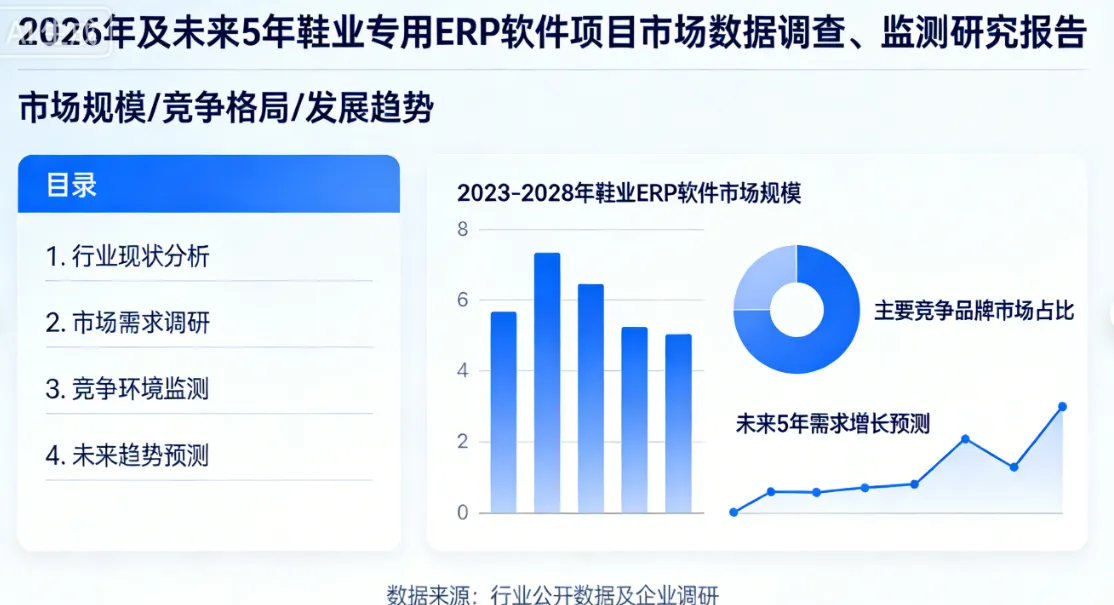
The development of China's footwear industry software industry has always resonated with the national digital transformation strategy. From "Made in China 2025" to the 14th Five Year Plan, policies such as intelligent manufacturing, industrial Internet, and enterprise cloud have been implemented continuously, which has injected strong power into the footwear ERP software market. According to industry monitoring data, over the past five years, the central and local governments have invested more than 20 billion yuan in special funds to support the digital transformation of the manufacturing industry, with a considerable proportion flowing into traditional labor-intensive industries such as shoes and clothing. At the level of tax incentives, eligible software companies can enjoy up to 15% additional deduction for research and development expenses, effectively reducing the innovation costs of footwear ERP manufacturers. Breakthroughs have also been made in the construction of the standard system, with a series of industry standards such as the "General Technical Specification for Footwear Industry Software" being introduced one after another, ending the situation of data silos and chaotic interfaces among various systems in the past, and clearing technical barriers for industrial chain collaboration. The continuous optimization of policy environment has transformed footwear ERP software from optional consumption to mandatory configuration, and the market penetration rate is accelerating towards 70% of shoe enterprises above designated size.
According to the latest market monitoring data, the software market size of China's footwear industry has exceeded 60 billion yuan by 2025, with an average annual compound growth rate of over 15% in the past five years. In the segmented fields, the growth rates of production management software and supply chain collaboration software are the most eye-catching, reaching 18% and 21% respectively, reflecting the urgent need for shoe companies to transition from single link informatization to full process digitization. From a regional distribution perspective, the four major shoe manufacturing industry clusters in Guangdong, Fujian, Zhejiang, and Sichuan account for 78% of the national market share. Among them, county-level production areas such as Jinjiang in Fujian, Huizhou in Guangdong, and Wenling in Zhejiang have a clear trend of centralized procurement, and the regional market is sinking from provincial capital cities to core towns in industrial belts. It is worth noting that with the acceleration of production capacity transfer in Southeast Asia, the demand for cross-border collaborative software serving export-oriented shoe enterprises has surged. Functional modules such as import and export order management, multi currency settlement, and overseas warehouse docking have become the fastest-growing sub sectors in 2025. It is expected that by the end of 2026, the market size of China's shoe specific ERP software is expected to exceed 75 billion yuan, and will maintain an average annual growth rate of 16% to 18% in the next five years. By 2030, the market size will reach a new level of 150 billion yuan. This growth momentum mainly comes from three aspects: information technology tutoring for existing shoe companies, standard procurement for new smart factories, and iterative upgrading of existing systems.
From the demand side, Chinese shoe manufacturers have bid farewell to the era of large-scale and comprehensive general software procurement. Monitoring data shows that the three most important indicators for shoe companies' procurement decisions in 2025 are industry adaptability, low code configurable capability, and interface compatibility with existing equipment. The unique three-dimensional management of shoe color codes, batch traceability, piece rate wages, vulcanization process control and other scenarios force ERP manufacturers to go deep into the front line of the workshop rather than staying at the financial level. The shoe industry specific ERP system launched by a leading manufacturer helps customers increase fabric utilization to 91% and reduce glue waste by 40% through built-in cutting bed layout optimization, real-time monitoring of glue consumption, and vulcanization curve warning functions. These quantifiable benefits have become the core selling points that impress shoe enterprise decision-makers.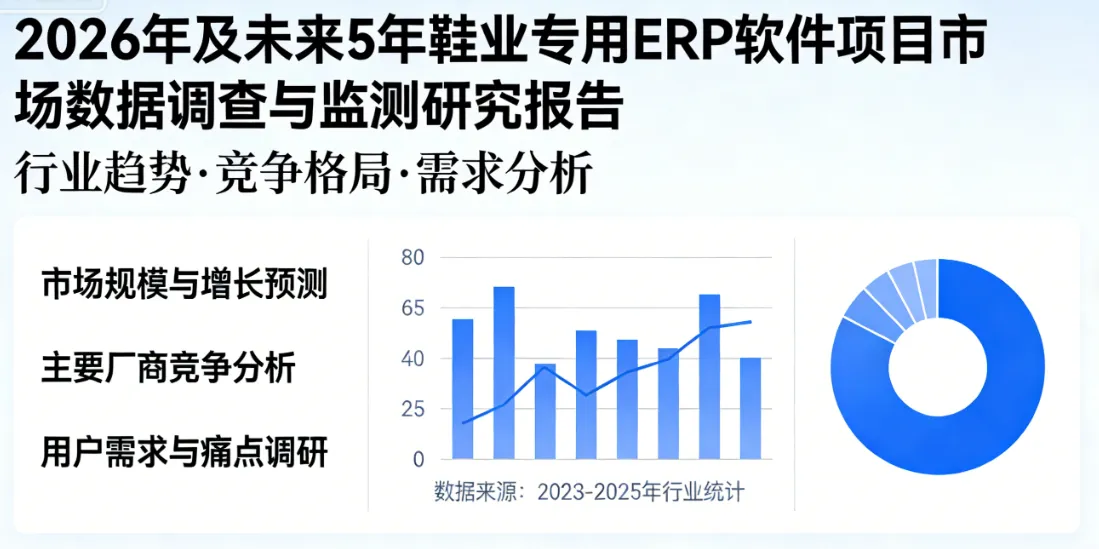
The supply side also presents a highly differentiated competitive pattern. International giants such as SAP and Oracle dominate the large group market with their brand and capital advantages, while local manufacturers dominate the small and medium-sized shoe enterprise market. Comprehensive manufacturers such as UFIDA and Kingdee enter the industry through the plugin model, while vertical manufacturers such as Wanda Treasure and Shuntong Software focus on process details, polishing cutting layout, needle balance, molding scheduling and other scenarios to the extreme. According to incomplete statistics, there are currently over 120 active shoe ERP suppliers in China, but less than 15 have annual revenues exceeding 100 million yuan, resulting in low market concentration. The next five years will enter an accelerated integration period. The SaaS subscription model is rapidly becoming popular, with cloud deployment solutions accounting for 43% by 2025, an increase of 20 percentage points from three years ago, significantly reducing the digital threshold for small and medium-sized shoe enterprises.
The technological evolution of footwear ERP software is showing a trend of three waves overlapping. The first wave is the popularization of cloud native architecture, which enables the system to have elastic scalability and fast iteration capabilities, supporting shoe companies to cope with sudden traffic shocks such as Double Eleven and peak foreign trade seasons. The second wave is the deep embedding of artificial intelligence, where intelligent scheduling algorithms can integrate dozens of parameters such as order priority, equipment status, and material completeness to generate the optimal scheduling plan within five minutes; After the integration of computer vision and the Internet of Things, the cutting machine can automatically recognize the texture of the leather material and optimize the layout density. When the vulcanization temperature curve of the forming production line deviates from the standard, the system automatically locks the work order and pushes a warning. The third wave is the emergence of industrial chain collaboration platforms, where ERP boundaries extend from within the enterprise to suppliers, outsourcing factories, and channel partners, forming a digital ecosystem covering the entire chain.
The investment hotspot is shifting from general software to vertical scenarios. From 2024 to 2025, there were 17 investment and financing events in the footwear ERP field, of which 60% went to manufacturers with low code platform capabilities or AI algorithm accumulation. The logic valued by the capital market is that in the trillion dollar shoe industry, software that can truly help customers reduce three-point losses and shorten five-day delivery times has a much higher value than the linear growth of general-purpose products. At the same time, internationalization capability has become a new valuation anchor. With Southeast Asia and Africa becoming destinations for Chinese shoe companies to transfer production capacity, there is a surge in demand for ERP systems that can support multilingual, multi currency, and cross time zone collaboration. Several local manufacturers that have advanced their overseas capabilities will receive over 100 million yuan in financing in 2025.
Despite the broad market prospects, the popularization of shoe ERP still faces three deep-seated obstacles. Firstly, there is a lack of data governance. Most shoe companies have chaotic material coding rules and incomplete historical data. The cleaning cycle before the system goes online often lasts for several months, and the cost even exceeds the software itself. Secondly, there is resistance to organizational change. Frontline workers have an older age structure and fear of digital tools. Without effective performance linkage and habit cultivation, problems such as data distortion and input delay after the system goes online will continue to plague management for a long time. The third is the quagmire of customized development, where the details of footwear craftsmanship are complex, and excessive customization leads to difficulties in system upgrades, accumulated technical debt, and ultimately stagnation.
Looking ahead to the next five years, footwear specific ERP software will complete its role transition from a management tool to an industrial operating system. On the technical level, Digital Twin will rehearse the production scheduling scheme in the virtual factory. edge computing enables real-time decision-making to sink into every device. Blockchain technology ensures that the supply chain data cannot be tampered with and traceable. At the business level, ERP will become a digital hub connecting shoe companies with raw material suppliers, brands, and logistics service providers. Order information, inventory status, and production capacity load will flow transparently within the ecosystem, and resource allocation efficiency will be improved by orders of magnitude.
For shoe-making enterprises, 2026-2030 will be a critical window period for the differentiation of digital capabilities. Enterprises that dare to invest in data governance and use systems to force process reengineering will use ERP systems to create an efficiency moat that is difficult to replicate. And those enterprises that still view digitization as a cost rather than an investment will gradually be marginalized in the competition of cost transparency and limited delivery time. Software does not produce shoes, but it is determining who can deliver shoes to consumers' feet at lower cost, faster speed, and better quality. This is the core value proposition of shoe specific ERP software in the next five years.