
ERP Three in One: Efficient Management of Business and Financial Integration
Revolutionary integration of enterprise management: from isolation to integration
In traditional enterprise management models, business operations and financial management are often like two parallel but rarely intersecting tracks. The business department focuses on actual business activities such as orders, production, and delivery, formingbusiness flowThe logistics department is responsible for raw material procurement, inventory management, and product distributionLogistics FlowThe finance department independently records fund transactions, cost accounting, and financial statements, formingcash flowThese three key processes have been in a separated state for a long time, leading to many problems in enterprise operations such as inconsistent data, delayed decision-making, and low efficiency. The "three in one" concept proposed by the ERP system is a fundamental change to this traditional management model. By deeply integrating and synchronizing business flow, logistics, and capital flow on a unified information platform, an efficient management system integrating business and finance is created.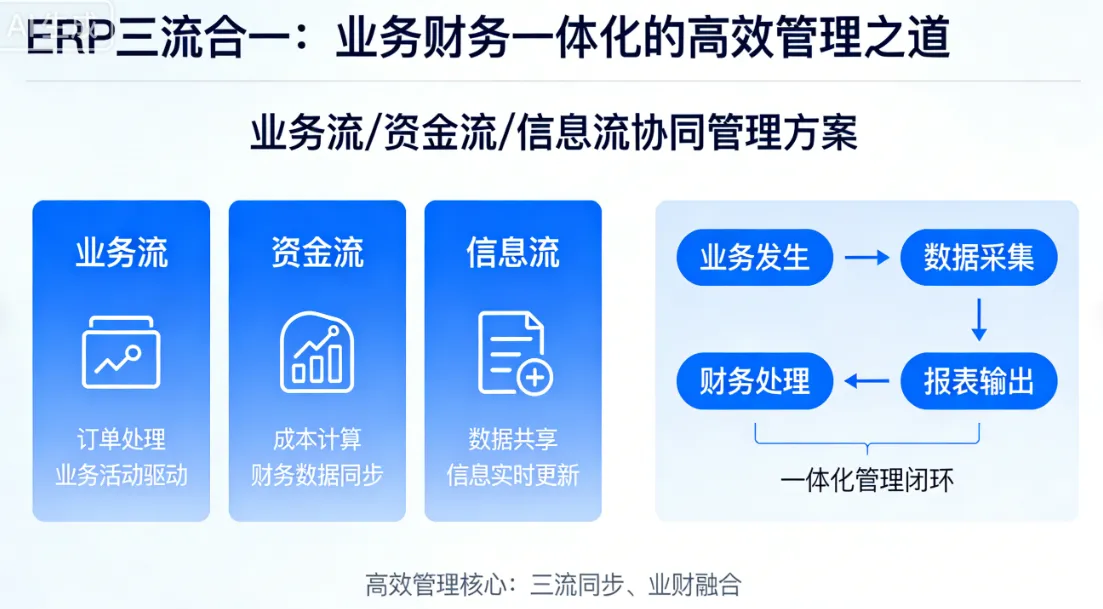
Real time linkage between business flow and financial flow: from business occurrence to financial records
The core breakthrough of ERP's integration of three streams lies in achieving the integration of business activities and financial recordsAutomated synchronization and seamless integrationIn the traditional mode, the completion of a sales order requires multiple business processes such as sales acceptance, production scheduling, and outbound shipping. Finally, the finance department confirms revenue and accounts receivable based on the summarized invoices. The entire process may take several days or even weeks, resulting in serious consequencesInformation lagIn the three in one ERP system, when sales personnel enter orders and confirm shipments in the system, the system will automatically trigger a series of chain reactions: the inventory quantity of goods decreases in real time, logistics information begins to track, and corresponding accounting vouchers are automatically generated - debit accounts receivable, credit main business income and payable taxes. this kind ofBusiness driven financeAutomated processing ensures that every business activity is accurately reflected in financial records at the moment it occurs.
This real-time linkage mechanism has completely changed the financial management mode of enterprises. Financial personnel are liberated from the heavy workload of data entry and verification, and instead engage in more valuable financial analysis, risk control, and decision support work. More importantly, the management can obtain financial information based on the latest business data at any time, and what they see is no longer the historical reports of the previous month or quarter, but a real-time financial picture reflecting the current operating conditions. After implementing the integration of the three streams, a manufacturing enterprise has shortened its financial monthly settlement time from 15 days to 3 days, reduced accounts receivable turnover days by 40%, and significantly improved the company's cash flow situation.
Collaborative optimization of logistics flow and capital flow: from physical movement to value circulation
The collaborative management of logistics and funds is another key dimension of the integration of the three streams. In traditional management, logistics activities such as material procurement, inventory movement, and product sales are often disconnected from corresponding fund settlements, resulting in inaccurate inventory values, unreasonable capital occupation, and imprecise cost accounting. The ERP system tightly links logistics activities with capital flow, achievingThe synchronous mapping of physical movement and value circulation。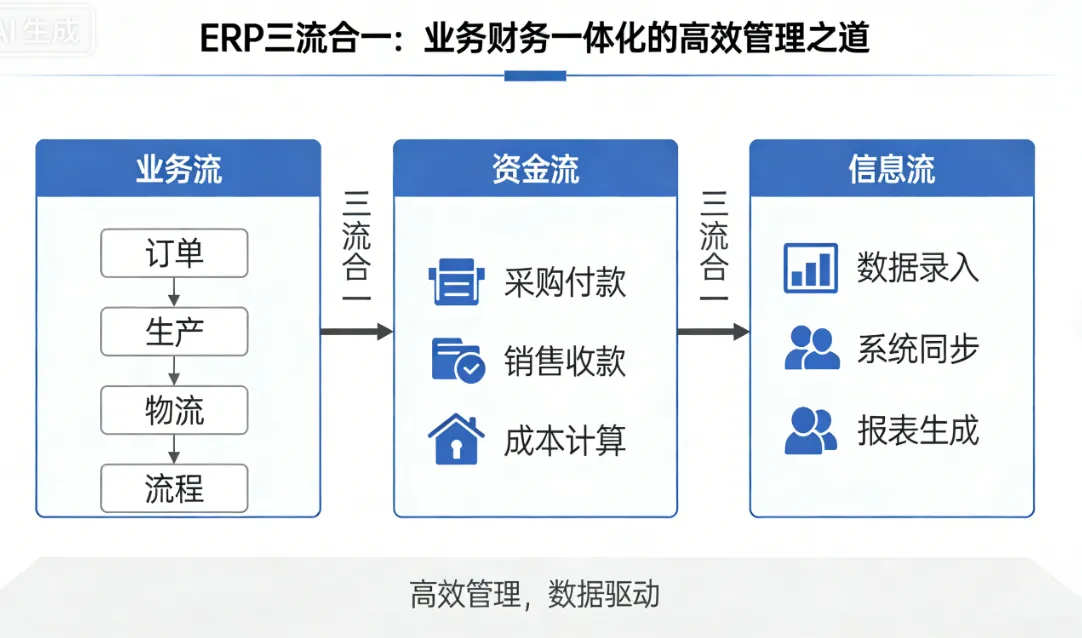
When a purchase order is created in the system, the system not only arranges the logistics department for material procurement and warehousing, but also automatically estimates the impact on accounts payable and cash flow. When materials are received, the system automatically updates the inventory value based on the actual received quantity and quality, and generates corresponding inventory accounting vouchers. When producing materials, the value of raw materials is automatically converted into the cost of the product in progress; When the product is completed and stored, the production cost is accurately transferred to the inventory goods. When selling out of stock, the system synchronously reduces inventory value and carries forward sales costs. This full process value tracking enables enterprises to achieve true meaningReal time cost control和Accurate inventory valuation。
A certain retail enterprise has achieved complete synchronization between inventory value and physical quantity through a three in one system. The system automatically calculates the actual cost of each SKU (inventory unit) based on purchase price, transportation cost, and storage cost. When the goods are sold through the sales terminal, the system deducts inventory in real time and accurately calculates gross profit. This enables enterprises to analyze the profitability of various products on a daily or even hourly basis, adjust procurement and promotion strategies in a timely manner, and increase the overall gross profit margin by 5.2 percentage points.
The cornerstone of integrated management data: master data and process standardization
The foundation for achieving the integration of the three streams lies in establishing an enterprise level systemUnified Master Data System和Standardized business processesMaster data includes core enterprise data such as materials, customers, suppliers, and accounting subjects, and must maintain consistency, accuracy, and completeness across the entire system. Only when all departments use the same set of material codes, the same customer file, and a unified chart of accounts, can business flow, logistics flow, and fund flow be seamlessly integrated on the same data basis.
Standardization of business processes is equally crucial. ERP systems require enterprises to clearly define and solidify the operational norms, approval permissions, and data requirements for each business process. From procurement request to payment, from sales orders to receipts, from production planning to cost accounting, every critical process is designed as an integrated activity of business and finance. This standardization not only improves operational efficiency, but also strengthens internal controls and reduces the risks of human error and fraud. A certain group company has standardized its processes and incorporated the business of its subsidiaries located in more than 20 cities into a unified management framework, achieving real-time aggregation and analysis of third rate data within the group, providing unprecedented transparency and consistency for group management and control.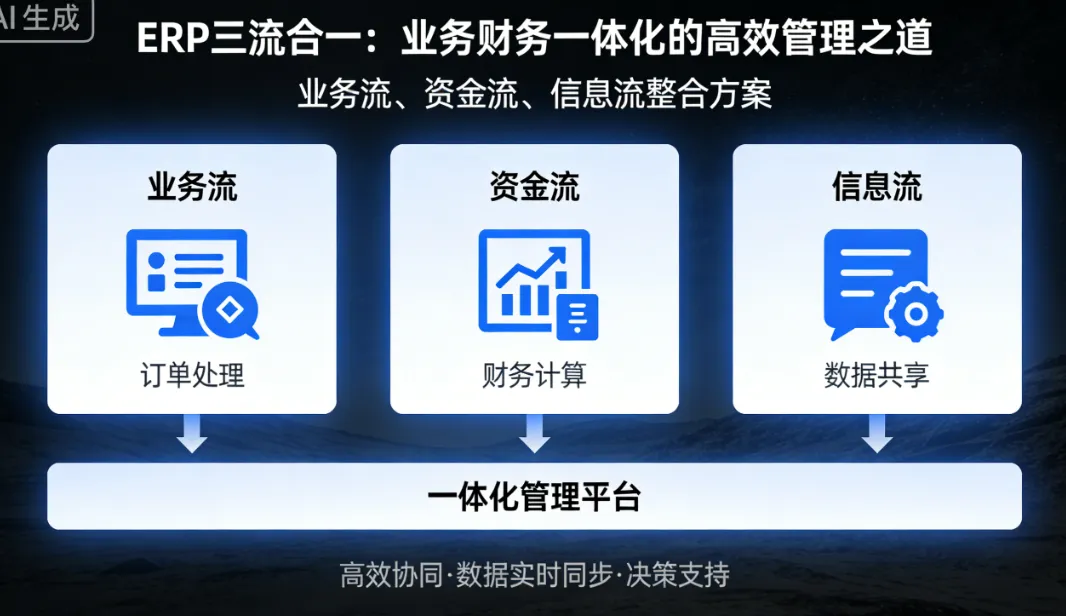
Decision Support and Continuous Optimization: From Data Integration to Intelligent Insights
The most profound impact brought by the integration of the three streams is the fundamental transformation of enterprise management decision-making methods. When business, logistics, and financial data are integrated in real-time on a unified platform, enterprises have a comprehensive and multi-dimensional management perspective. Managers can useIntegrated dashboardSimultaneously examine key indicators such as sales trends, inventory turnover, and cash flow status to discover the intrinsic correlations and underlying patterns between data from different dimensions.
Based on complete third rate data, enterprises can carry out tasks that were difficult to achieve in the pastRefined analysis and predictive simulationFor example, when analyzing the profit contribution of different product lines, multiple factors such as sales price, production cost, inventory holding cost, and capital occupation cost can be comprehensively considered to obtain a true panoramic view of profitability. When optimizing the supply chain, the balance point between logistics efficiency, inventory costs, and capital turnover can be evaluated simultaneously. When formulating pricing strategies, it is possible to simulate the chain effects of different prices on sales volume, costs, cash flow, and final profits.
A certain high-tech enterprise has established a complete system using the three in one systemBusiness Financial Forecasting ModelThe model integrates sales pipelines, production plans, procurement contracts, and funding plans, and can predict the revenue, cost, cash flow, and profit situation for each week of the next 6 months. This enables companies to identify funding gaps in advance and optimize financing arrangements; Anticipate production capacity bottlenecks and adjust production plans; Identify profit risks and adjust strategies in a timely manner. After one year of system launch, the accuracy of enterprise forecasting has increased by 35%, and the efficiency of fund utilization has increased by 28%.
Challenges and Success Factors in Implementation
Realizing true integration of the three streams is not an easy task, as enterprises need to overcome multiple challenges in terms of organization, processes, and technology.organizational changeIt is crucial to break down departmental barriers and establish cross functional collaboration mechanisms;Process ReengineeringIt is the core and requires redesigning end-to-end business processes to ensure the natural integration of the three streams;data governanceIt is the foundation that must establish a strict master data management system and data quality standards;system integrationIt is a technical guarantee that requires seamless integration between the ERP system and various professional systems.
Enterprises that successfully implement the integration of the three streams usually have several common characteristics: firm support and personal promotion from senior leaders; Clear business objectives and value orientation; Gradual implementation path and continuous optimization; And supporting organizational adjustments and personnel training. When these elements are complete, the integration of the three streams can be transformed from a concept into tangible management effectiveness.
Conclusion
The integration of ERP three streams represents the advanced stage of enterprise management from functional segmentation to collaborative integration. It integrates the three core dimensions of enterprise operation - business activities, logistics movement, and capital flow - into an organic whole that is mutually driven and synchronized in real time through technological means. This integrated management not only significantly improves operational efficiency and financial transparency, but more importantly, provides enterprises with decision-making and continuous optimization capabilities based on a complete data foundation. In an increasingly complex and ever-changing market environment, enterprises with the ability to integrate three streams will gain significant competitive advantages: faster market response speed, more accurate resource allocation capability, more robust financial control level, and sharper business insight. In this sense, the integration of three streams is not only a technical feature of ERP systems, but also a necessary way for modern enterprises to achieve efficient management and sustainable development.