
How to solve the contradiction between ERP software and enterprise demand differences? -Shuntong Network Guide
In the process of enterprise digital transformation, the value of ERP software as a core tool for integrating full process resources depends on whether it highly matches the actual needs of the enterprise. However, in reality, most enterprises face a common challenge: the introduced ERP software is either functionally redundant, operationally complex, with many modules unrelated to their own business, increasing learning and operational costs; Either the core functions are missing, the adaptability is insufficient, and it cannot cover the personalized business scenarios of the enterprise, making it difficult to solve the actual management pain points, ultimately leading to ERP software becoming a "decoration" and a serious imbalance between input and output. To solve the contradiction between ERP software and enterprise needs, it is necessary to abandon the "one size fits all" thinking and start from the entire process of demand sorting, selection and adaptation, and implementation optimization, to achieve precise integration between ERP software and enterprise needs, and truly serve the development of enterprises with digital tools.
The core prerequisite for resolving conflicts isAccurately sorting out enterprise needsClarifying 'what you want' is the foundation for avoiding ERP software being disconnected from your needs. Many companies often blindly follow the trend when introducing ERP software, without a clear understanding of their requirements. They either copy the selection standards of peers or are misled by the promotional gimmicks of software vendors, ultimately resulting in the selected software not meeting their own needs. Therefore, before introducing ERP software, enterprises must conduct comprehensive and detailed requirement research and sorting work to achieve "requirement concretization and priority clarification".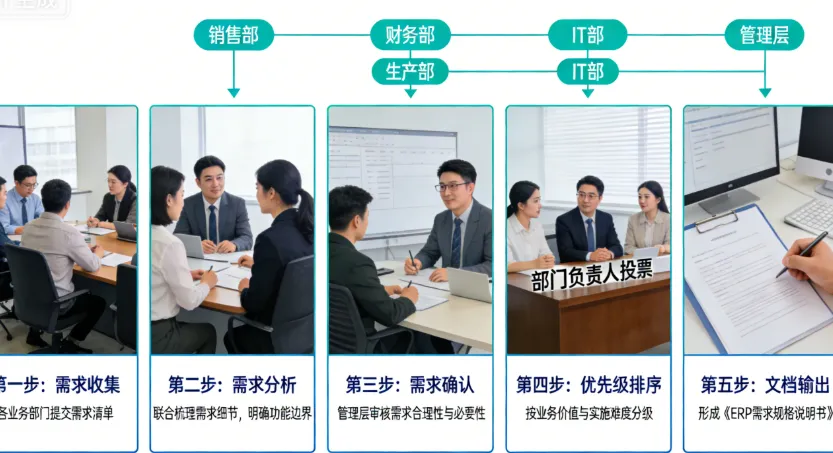
The demand sorting needs to cover the entire business process of the enterprise, linking all relevant departments such as procurement, production, inventory, finance, sales, and personnel, clarifying the core pain points, business processes, and management demands of each department. For example, production-oriented enterprises need to focus on sorting out production plan preparation, process connection, material ratio, quality traceability and other requirements; Trade oriented enterprises need to focus on core demands such as supplier management, order fulfillment, inventory scheduling, and multi-channel docking. At the same time, it is necessary to distinguish between "core essential needs" and "secondary needs". Core essential needs are essential functions for enterprise operations, such as financial accounting and inventory control, and should serve as the core basis for selection and adaptation; The secondary requirement is the functionality that can be further optimized and supplemented (such as personalized reports, extended interfaces), to avoid selection deviation and cost increase due to the pursuit of "big and comprehensive". In addition, demand sorting needs to be combined with the development stage of the enterprise. Small and medium-sized enterprises focus on "standardization and efficiency" and do not need to pursue high-end and complex functions; Large enterprises focus on "scale, refinement, and scalability", and need to reserve space for subsequent upgrades and customization to ensure the scientific and forward-looking nature of demand sorting.
Accurate selection, yesKey steps to avoid differences in demandThe core is to choose the right software and manufacturer, and reject blind and excessive selection. There are various types of ERP software in the current market, including general ERP, industry-specific ERP, and customized ERP. Different types of software are suitable for different enterprise scenarios. If the selection is not appropriate, it will inevitably lead to differences in demand. Therefore, when selecting models, enterprises need to base their selection on the previously sorted list of requirements and conduct targeted screening to avoid falling into the misconception of "the more comprehensive the functions, the better" and "the more expensive the price, the better".
In addition, when selecting, it is important to focus on the manufacturer's strength and service capabilities. High quality manufacturers can not only provide software that meets their needs, but also offer full process services including early consultation, mid-term implementation, and later operation and maintenance, helping enterprises solve adaptation problems during the implementation process; At the same time, the industry experience of manufacturers is also crucial. Manufacturers with rich industry cases can more accurately understand the needs of enterprises, provide more targeted selection suggestions and adaptation solutions, and avoid risks caused by differences in demand. During the selection process, the manufacturer can be requested to provide a demonstration version for each department to conduct practical testing and verify whether the software functions meet the requirements, avoiding "empty talk on paper".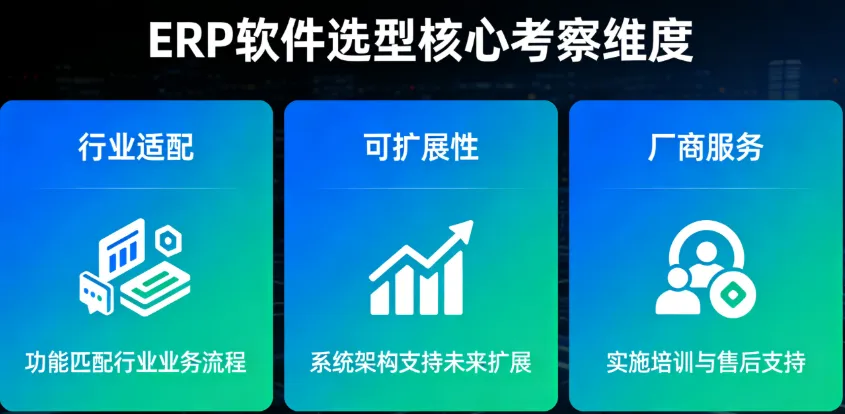
There are three main ways to optimize adaptation, and enterprises can choose according to their own needs and cost budget. The first method is mild configuration adjustment, which adapts to the personalized needs of enterprises through the software's built-in parameter settings, process customization, form design, and other functions, such as adjusting approval processes, modifying report formats, setting inventory warning thresholds, etc. This method is low-cost, efficient, and suitable for scenarios with small differences. The second type is moderate customization development, which focuses on the personalized needs of the enterprise's core. Local customization is carried out on the basis of the existing software, adding specific functional modules or modifying existing functions, such as customizing process traceability function for production-oriented enterprises and multi-channel order synchronization function for trade oriented enterprises. This approach needs to balance customization costs and demand value, avoid excessive customization leading to software instability and difficulty in subsequent upgrades. The third method is business process optimization. If the core functions of ERP software meet the needs of the enterprise and only some business processes do not match the software processes, the enterprise can optimize its own business processes appropriately, standardize management standards, and achieve synergy between business processes and software processes. This method does not require additional costs and can improve the standardization level of enterprise management, but it should be noted that process optimization cannot violate the core interests and operational laws of the enterprise.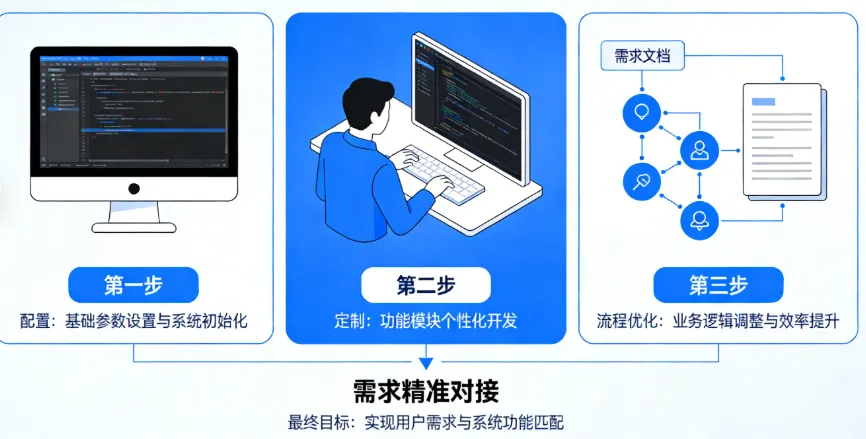
At the same time, enterprises need to establish the core concept of "digital tools serving business", avoid excessive reliance on ERP software, and also avoid blindly pursuing "digital perfection". The core value of ERP software is to improve management efficiency, optimize resource allocation, and solve practical management pain points for enterprises, rather than simply a "digital face project". Therefore, when solving the contradiction of demand differences, it is necessary to focus on core needs, balance costs and values, prioritize the resolution of key differences that affect enterprise operational efficiency and constrain enterprise development, and not overly entangle in subtle, non core differences. ERP software should truly become a driving force for enterprise development, rather than a burden.