
Domestic high-end ERP white paper released: Empowering large enterprises for digital transformation and promoting high-quality development of the digital economy | National Industrial Information Security Development Research Center
Milestones of Autonomy in China's Digital Economy Era
Recently, the National Industrial Information Security Development Research Center officially released the "White Paper on Domestic High end ERP". The birth of this authoritative document marks a significant leap from theoretical exploration to practical guidance in China's core industrial software field. The white paper system elaborates on the current development status, technological path, and future vision of domestic high-end ERP, providing a complete solution framework based on independent technology for the digital transformation of large enterprises. Against the backdrop of the digital economy becoming a national strategy and industry security receiving much attention, the release of this white paper not only has technical guidance significance, but also carries the strategic mission of promoting the independent and controllable development of the industrial chain and empowering the high-quality development of the real economy.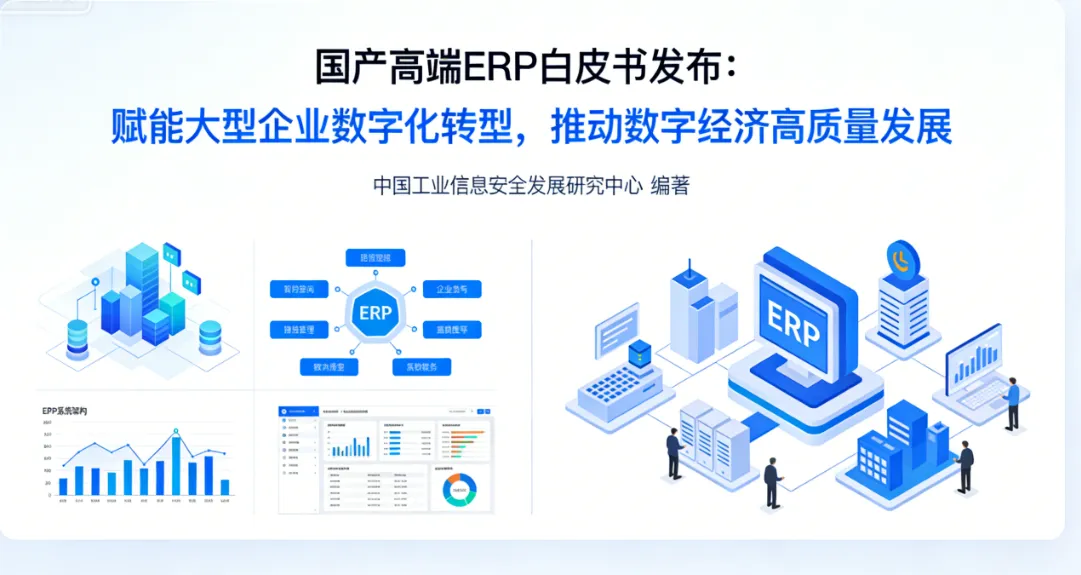
Cracking the bottleneck dilemma: the breakthrough path for domestic high-end ERP
For a long time, the high-end ERP market in China has been dominated by international manufacturers, and large enterprises, especially central and state-owned enterprises, face multiple challenges in digital transformation, such as core technology dependence, data security risks, and high customization costs. The white paper on domestic high-end ERP faces this reality dilemma and systematically analyzes the evolution trajectory of China's ERP industry from learning and imitation to independent innovation. The white paper points out that after years of accumulation, domestic ERP has achieved functional benchmarking in core modules such as finance, supply chain, and production manufacturing, and demonstrated "latecomer advantages" in new generation technology routes such as cloud native architecture, microservices, and middleware.
More importantly, domestically produced high-end ERP systems are deeply integrated into management practices and industry demands with Chinese characteristics. The white paper emphasizes that these systems can better adapt to the organizational structure characteristics, compliance requirements, and business innovation pace of Chinese enterprises. For example, in complex scenarios such as group control, multi organizational collaboration, and industrial chain integration, domestic systems demonstrate stronger adaptability than internationally standardized products. After adopting domestic high-end ERP, a certain energy state-owned enterprise has achieved integrated control over more than 300 subsidiaries, shortening the financial monthly settlement time from 15 days to 3 days, significantly improving the efficiency of group operations.
Technological Architecture Innovation: Deep Integration of Cloud Native and Intelligence
The white paper elaborates in detail on the technological evolution direction of domestic high-end ERP, with the core feature being the deep integration of "cloud native+platformization+intelligence". Based on cloud native architecture, the system achieves elastic scalability, continuous delivery, and microservice governance, meeting the needs of large enterprises for rapid business changes and high concurrency processing. The centralized design of the platform consolidates general business capabilities into reusable service units, ensuring the stability of the core system and supporting flexible innovation in front-end business. Intelligent applications run through all aspects of business processes, from intelligent prediction and automatic scheduling to risk warning and decision assistance, significantly enhancing system value.
It is worth noting that the white paper particularly emphasizes the unique path of domestic high-end ERP in building the industrial ecosystem. Unlike the closed ecosystem of international manufacturers, Chinese ERP companies are building a more diverse and collaborative ecosystem through open platforms, open-source communities, and industry alliances. Basic software vendors such as operating systems, databases, middleware, and application software enterprises form deep cooperation to jointly create a secure and reliable digital base. This ecological development model not only accelerates technological maturity, but also provides users with more complete and autonomous solution choices.
Empowering Large Enterprises: A New Paradigm for Digital Transformation
The white paper demonstrates through numerous case studies that domestic high-end ERP is reshaping the digital transformation paradigm of large enterprises. In the field of intelligent manufacturing, a certain equipment manufacturing enterprise has built a full value chain digital platform based on domestic ERP, achieving end-to-end collaboration from design, planning, production to service, shortening product delivery cycles by 30%, and reducing operating costs by 20%. In terms of group management and control, a multinational enterprise used the unified platform of domestic ERP to achieve standardized management and localized adaptation of global business, effectively supporting the rapid expansion of business along the "the Belt and Road".
The white paper specifically points out that domestically produced high-end ERP plays an irreplaceable role in ensuring the security of the industrial and supply chains. By building an autonomous and controllable digital platform, large enterprises can integrate upstream and downstream enterprises in the supply chain into a collaborative network, perceive changes in supply and demand in real time, and quickly respond to market fluctuations. In the context of global supply chain restructuring in recent years, the collaborative ability of this industry chain based on independent technology has become particularly important. A certain automobile group has connected more than 2000 suppliers through a domestic ERP platform, achieving transparent management and risk warning of the supply chain, significantly improving the resilience of the industrial chain.
The strategic engine for promoting high-quality development of the digital economy
The National Industrial Information Security Development Research Center has clearly stated in its white paper the strategic goal of developing domestic high-end ERP: by 2025, to form 3-5 internationally competitive ERP leading enterprises with a market share of over 50% in key industries; By 2030, establish a complete independent industrial ecosystem and become an important innovative force in the global ERP field. This goal reflects the strategic positioning and firm determination of the country towards core industrial software.
The white paper analysis suggests that the development of domestic high-end ERP will generate multiple strategic values. At the industrial level, it will drive the upgrading of the entire industry chain from chips, operating systems, databases to industry applications, forming a trillion dollar market scale. At the enterprise level, it will empower large enterprises to undergo digital transformation and cultivate new data-driven competitiveness. At the national level, we will enhance the independent and controllable capabilities of the industrial and supply chains, providing a safe and reliable technological foundation for the development of the digital economy. Especially in the current international environment, developing independent and controllable high-end ERP has become an important measure to ensure national economic security and promote high-quality development.
Implementation Path and Policy Suggestions
The white paper concludes with a systematic implementation path and policy recommendations. In terms of technological research and development, it is recommended to strengthen basic theoretical research, break through key core technologies, and establish an independent standard system. In terms of industrial ecology, we advocate building an open and collaborative innovation network to promote deep integration of industry, academia, research, and application. In terms of application promotion, it is recommended to carry out pilot demonstrations in key industries to form replicable and promotable best practices. In terms of policy support, it is called for to increase financial and tax support, improve the talent training system, and optimize the market environment.
The release of this white paper is timely. With the deepening of the Digital China strategy, the digital transformation of large enterprises has entered a deep water zone, and the demand for independent, controllable, secure and reliable high-end ERP is becoming increasingly urgent. Domestic high-end ERP is no longer just an alternative solution for import substitution, but the preferred platform for digital transformation of more and more large enterprises. They are proving through practical performance that China's independently innovated industrial software can fully support the operational management needs of world-class enterprises, and even demonstrate adaptability and innovation beyond similar international products in some aspects.
Looking ahead, the development of domestic high-end ERP will resonate with the evolution of China's digital economy. Under the joint efforts of national strategic guidance, industrial collaborative innovation, and deep application by enterprises, domestically produced high-end ERP will undoubtedly become an important engine to empower large enterprises in digital transformation and promote high-quality development of the digital economy, contributing key forces to building an independent and controllable modern industrial system and achieving the goal of becoming a manufacturing powerhouse. This process will not only reshape the pattern of China's industrial software industry, but also give a loud voice to China in global digital economy governance.