
How can enterprises choose a suitable ERP system?
In today's era where digital transformation has become a necessary path for enterprise development, enterprise resource planning systems have become the core infrastructure for enterprise operation and management. However, facing the dazzling array of ERP products in the market, from international giants to domestic manufacturers, from local deployment to cloud solutions, enterprises often find themselves in a dilemma of choice. An inappropriate ERP system not only wastes a significant amount of investment, but may also disrupt normal operations and even lead to the failure of digital transformation. Therefore, how to scientifically and systematically choose an ERP system that suits oneself has become a strategic decision that enterprises must take seriously.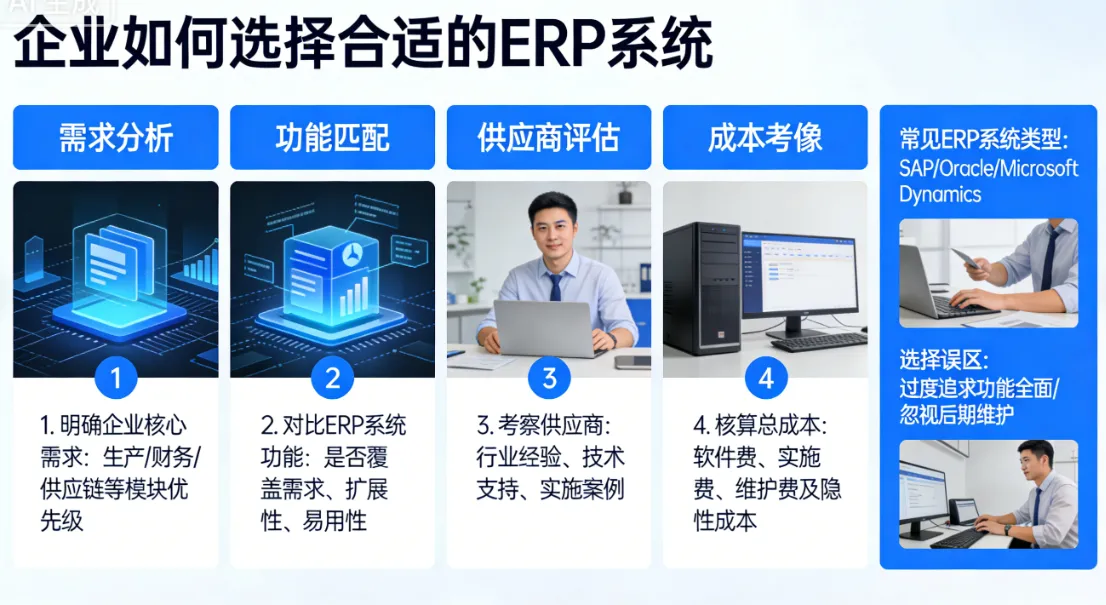
Deeply understand the current situation and needs of the enterprise
The first and most crucial step in choosing an ERP system isThoroughly and thoroughly examine the enterprise itselfThis is not just a simple requirement gathering, but a comprehensive diagnosis of the company's strategic direction, business processes, organizational structure, and technological foundation. Enterprises need to form a cross functional selection team, including senior management, key business department heads, and IT professionals, to jointly answer several core questions: What is the company's development strategy for the next three to five years? What is the most prominent pain point in the current business process? What are the main obstacles to collaboration between departments? What is the condition of the existing IT system?
At this stage, enterprises should avoid falling into the misconception of "comparing function lists". A medium-sized manufacturing enterprise initially requested suppliers to provide more than 500 functional comparisons, but found that most of the functions were not core requirements, and instead ignored the more important system scalability and industry adaptability. A more effective method is to carry outBusiness process sorting and value stream analysisIdentify the core elements that truly impact a company's competitiveness and the areas where ERP systems can create the greatest value. For example, for enterprises with low inventory turnover, the depth and intelligence of the supply chain management module may be more important than the detailed functions of the finance module.
Clearly define selection criteria and priorities
On the basis of fully understanding their own needs, enterprises need to establish a complete ERP system evaluation framework. This framework should cover multiple dimensions such as technology, functionality, services, and cost, and assign different weights based on the specific situation of the enterprise.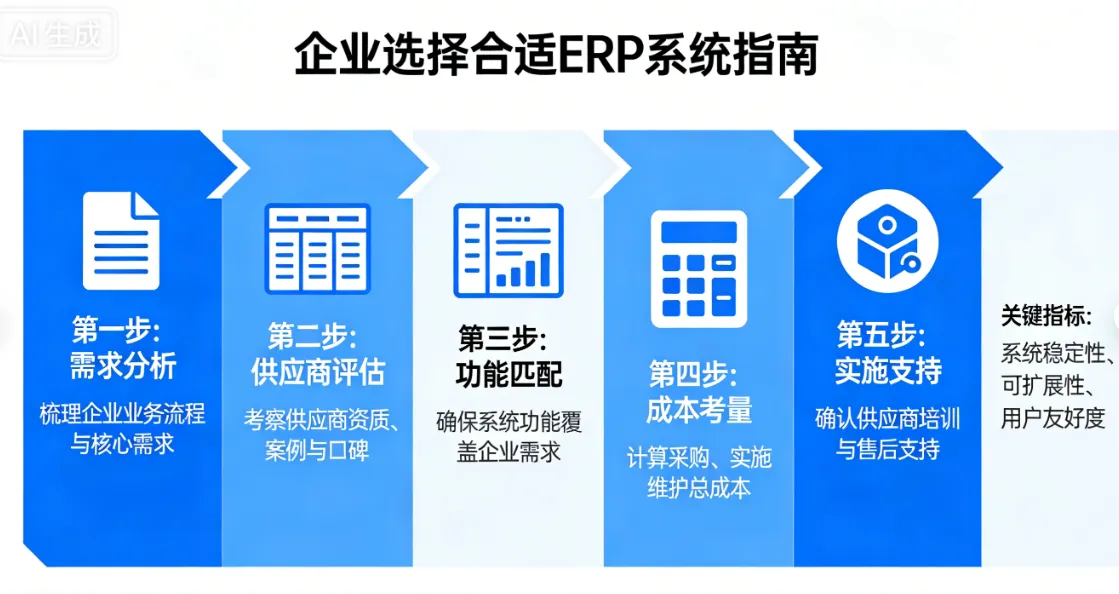
Technical ArchitectureIt is the foundation of evaluation. In today's era where cloud computing has become mainstream, enterprises need to carefully consider the choice of deployment mode. Cloud ERP typically has faster deployment speed, lower initial investment, and more flexible scalability, making it suitable for growing enterprises or environments with rapid business changes; Local deployment provides higher customization freedom and data control, making it suitable for large enterprises with strict regulations or special business processes. The scalability and integration capability of the system are equally crucial. An excellent ERP system should provide open application programming interfaces and flexible integration frameworks, which can seamlessly integrate with the existing systems and potential future professional applications of the enterprise.
Functional compatibilityIt is a core consideration. Enterprises need to distinguish between "essential functions" and "icing on the cake functions", and prioritize ensuring that core business processes receive perfect support. When evaluating, one should not only look at the list of functions, but also demonstrate how the system solves specific business problems through practical scenarios. A retail enterprise required suppliers to simulate the entire process from online orders, warehouse picking to delivery tracking during selection, and discovered the insufficient high concurrency processing capability of a certain system during promotional activities.
Supplier StrengthIt is an important guarantee for long-term success. Enterprises need to evaluate suppliers' industry experience, implementation methodology, successful cases, and long-term service capabilities. A supplier with rich industry experience can not only provide more tailored features, but also share industry best practices to help businesses optimize processes. At the same time, the financial stability and R&D investment of suppliers are also worth paying attention to, which is related to whether the system can continue to receive updates and support.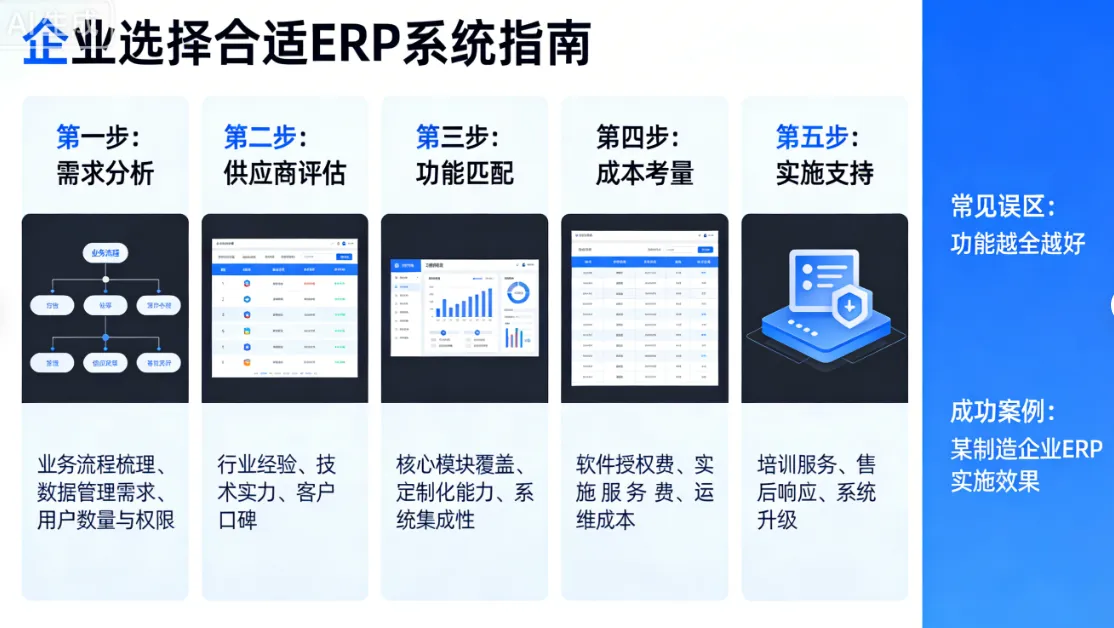
Total cost of ownershipA comprehensive calculation is required. In addition to software licensing and implementation costs, enterprises should also consider long-term costs such as hardware investment, customized development, system integration, training support, and future upgrades. Although the subscription model of cloud ERP has a low initial investment, the long-term usage cost needs to be carefully calculated.
Staged evaluation and verification
After having a clear evaluation framework, companies should adopt a phased evaluation method and gradually narrow down their selection range. In the first stage, 5-7 potential suppliers can be identified through market research, peer recommendations, and preliminary screening. In the second stage, these suppliers will be invited to demonstrate their solutions, with a focus on their understanding of the company's needs and the relevance of their solutions. The third stage involves conducting in-depth evaluations of 2-3 final candidate suppliers.
Multiple verification methods should be adopted during the in-depth evaluation stage.Proof of ConceptSuppliers can showcase how the system handles specific business scenarios within a limited scope based on real enterprise data.Customer reference visitThis is an important way to understand the actual performance of suppliers. Enterprises should communicate with existing customers in the same industry and of similar scale as much as possible, understand the challenges in the implementation process, the effects after going online, and the response speed and service quality of suppliers. During the selection process, a certain engineering company visited three suppliers' clients on site. One of the suppliers' clients generally reported a rapid decrease in consultant support after the system was launched, which ultimately affected the selection decision.
During contract negotiations, companies should pay special attention to several key terms: clear project scope and work instructions to avoid scope creep in the later stages; Detailed service level agreement, especially regarding response time and problem-solving timeliness; Specific arrangements for knowledge transfer and training; And support policies for future upgrades and maintenance. Clear contracts can lay a solid foundation for project implementation and reduce subsequent disputes.
Develop implementation plans and ensure success
Choosing an ERP system should not be seen as the end point of a project, but rather as the starting point for successful implementation. Enterprises should start planning and implementing strategies before making the final decision. This includes determining the scope of implementation (whether it will be fully launched or phased), forming a project team, developing a timetable and budget, and planning organizational changes and training programs.
Successful ERP implementation requires consistent commitment and active participation from all levels of the enterprise. Continuous support from senior management, deep involvement of business departments, adequate personnel training, and gradual change management are all key factors in ensuring project success. Enterprises should recognize that ERP systems are not only technical tools, but also catalysts for management change. The process of system implementation is often a valuable opportunity for enterprises to re-examine and optimize their business processes, and improve their management level.
Finally, companies need to establish reasonable expectations and evaluation mechanisms. The value of ERP systems often takes time to fully manifest. In the short term, it may mainly manifest as efficiency improvement and data transparency, while in the long term, it may bring about decision optimization and business innovation. Enterprises should set phased goals, regularly evaluate system usage and business value realization, and make adjustments and optimizations as needed.
Choosing the appropriate ERP system is a complex system engineering that requires enterprises to conduct systematic evaluations using scientific methods based on sufficient self-awareness, and to be fully prepared for implementation and application. Only in this way can enterprises ensure that this significant investment can truly support business development and steadily advance on the path of digital transformation. A good ERP system choice is not just about choosing a software product, but also about choosing a long-term partner, a digital cornerstone that can accompany the growth of the enterprise and help it cope with future challenges.