
How to reduce the risks encountered in ERP development?
In the wave of digital transformation, the development and implementation of enterprise resource planning systems are often seen as key measures to enhance core competitiveness. However, this process is full of challenges and uncertainties, with a large number of projects failing to achieve expected goals or even completely failing due to various risks. Reducing ERP development risks requires not only careful technical planning, but also the establishment of a comprehensive risk prevention and control system at the strategic, management, and personnel levels. Only by systematically identifying, assessing, and responding to risks can enterprises ensure that this significant investment receives the expected return and truly achieve the transformation goals of digital operations.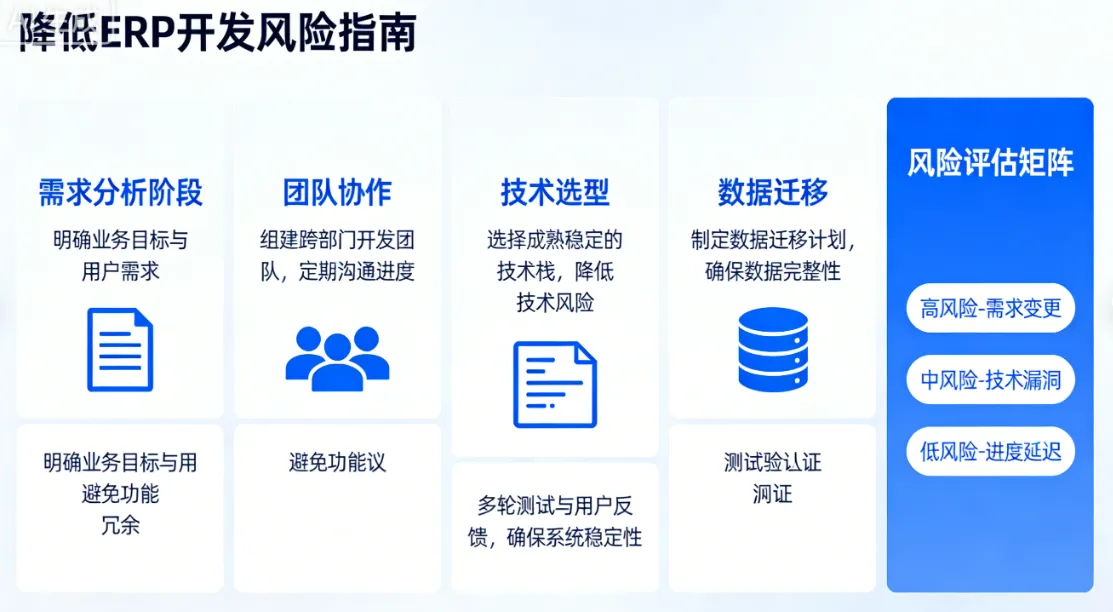
Accurate demand positioning: avoid scope expansion and demand distortion
The most common risk in ERP development comes from improper demand management. Many companies are caught in the dilemma of 'scope creep', where new requirements and functionalities are constantly added during project implementation, leading to project delays, cost overruns, and even ultimately deviating from the initial goals. To reduce this risk, sufficient resources must be invested in requirement research and analysis during the project initiation phase. Enterprises should establish cross departmental requirement teams, thoroughly streamline business processes, distinguish between core and secondary requirements, and establish strict requirement change control processes. Each requirement change should be evaluated for its impact on the overall project and undergo formal approval. In the early stage of ERP development, a manufacturing enterprise clarified 254 core requirements by drawing a complete business process map and stipulated that any new requirements must be reviewed by the project guidance committee. The company successfully controlled the later requirement changes within 10%, ensuring that the project was pushed forward as planned.
Distortion of requirements also poses a significant risk, where the development team's understanding of the requirements deviates from the actual needs of the enterprise. To reduce such risks, enterprises should adopt user stories and prototype design techniques in agile development methods, and continuously verify whether the functionality meets business expectations during the development process. Regularly hold requirement workshops and prototype demonstrations, invite key users to participate in reviews, and ensure that the development direction is aligned with business goals. This iterative requirement confirmation mechanism can detect deviations early and correct them in a timely manner, avoiding costly modifications in the later stages of the project.
Technical Architecture Planning: Balancing Customization and Standardization
The technical risks in ERP development mainly stem from improper architecture design and excessive customization. Many companies attempt to create a "perfect" system by excessively modifying core code to meet every subtle requirement, resulting in a system that is fragile, difficult to maintain, and upgrade. The key to reducing this risk is to find a balance between standardization and customization. Enterprises should prioritize mature technology platforms and frameworks, fully utilize their built-in best practices and configurable features, and only engage in limited customized development for truly differentiated core businesses.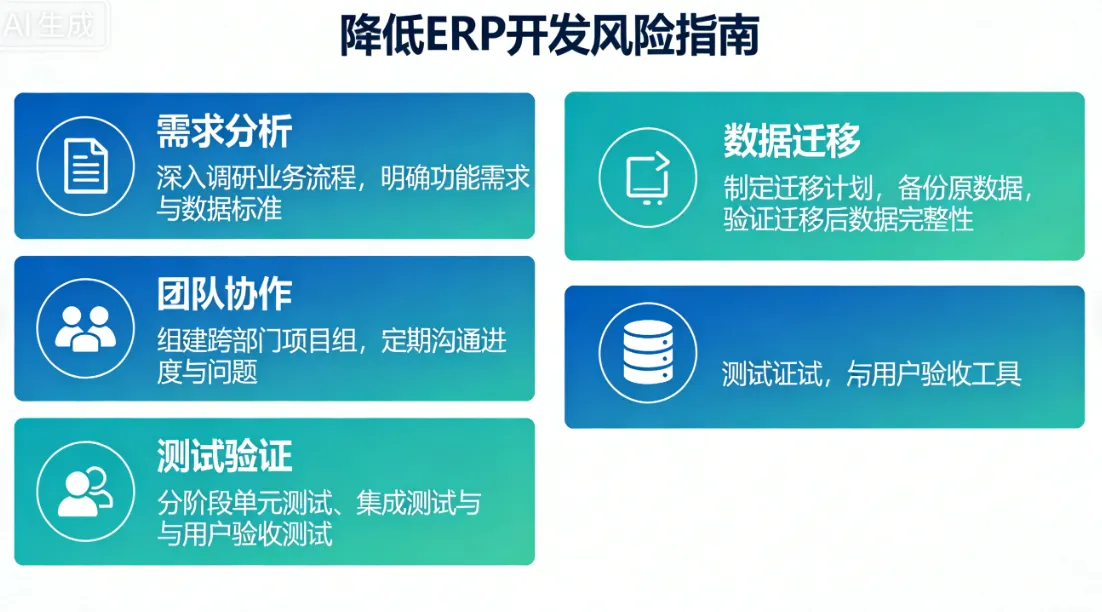
Microservice architecture and modular design are effective strategies for reducing technical risks. Decomposing the system into loosely coupled independent services, with each service focusing on specific business capabilities, not only improves the maintainability and scalability of the system, but also reduces the impact range of single point failures. At the same time, establish strict technical standards and development specifications, including code review, automated testing, and continuous integration processes, to ensure code quality and system stability. A certain retail enterprise adopts a microservice architecture in ERP development, modularizing functions such as order processing, inventory management, and customer service. When promotional activities lead to a surge in orders, the order processing service can be expanded separately without adjusting the entire system, greatly improving the system's flexibility and reliability.
Project Management System: Establishing a Scientific Control Mechanism
Systemic deficiencies in project management are a common cause of ERP development failure. Lack of clear timelines, unreasonable resource allocation, and ineffective communication mechanisms can all lead to project chaos. Establishing a scientific project management system is the foundation for reducing such risks. Enterprises should adopt mature project management methodologies, develop detailed project plans, clarify milestones and deliverables for each stage, and establish regular progress review mechanisms.
Risk management should be integrated throughout the entire project process, from identification and analysis to response and monitoring. The project team should identify potential risks during the initiation phase, assess their likelihood and impact, and develop corresponding response strategies. For example, for the risk of key personnel resigning, a knowledge sharing mechanism and successor plan can be established; For technical difficulties, technical validation or alternative solutions can be prepared in advance. During the project, risk indicators should be continuously monitored and response measures should be adjusted in a timely manner. A certain financial service enterprise has established a risk register in its ERP development project, regularly assessing and updating the risk status, enabling the project team to proactively respond to challenges rather than passively dealing with crises.
Effective communication mechanisms are equally crucial. ERP development involves multiple stakeholders, including senior management, business departments, IT teams, and external suppliers. Establishing transparent and efficient communication channels can ensure consistent information and timely resolution of issues. Regularly holding project meetings, releasing project status reports, and using collaborative tools to share information are all effective ways to reduce communication risks.
Data Migration Strategy: Ensuring Data Quality and Consistency
Data migration is one of the most challenging aspects in ERP development and also a high-risk area. Poor data quality, uncontrolled migration process, and loss of historical data may all prevent the new system from functioning properly after it goes live. Reducing the risk of data migration requires careful planning and strict execution. Enterprises should start evaluating the current status of data, identifying data quality issues, and developing cleaning and transformation strategies early in the project.
Data migration should adopt a phased and gradual approach, rather than migrating all at once. You can first migrate master data and core business data, verify the migration effect, and then process historical transaction data. Establish a data verification mechanism to ensure the integrity and accuracy of migrated data, including data integrity checks, consistency verification, and business rule validation. In the ERP data migration of a certain manufacturing enterprise, the main data of materials, customers, and suppliers were first migrated. After three rounds of verification and correction, the transaction data of the past three years was migrated to ensure the reliability of the system data after going online.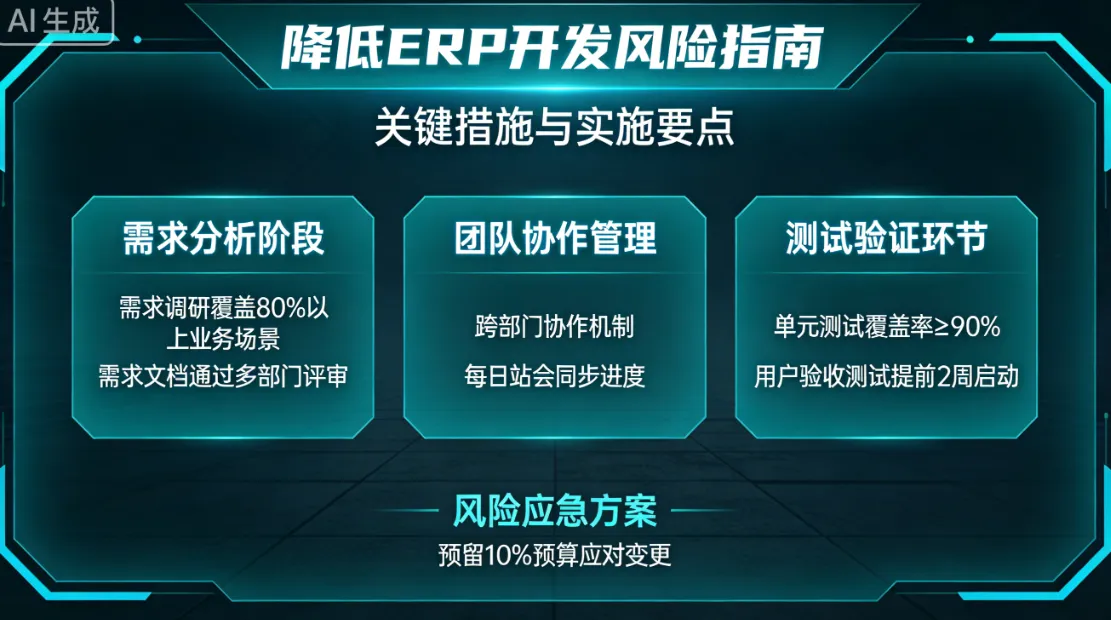
Organizational change management: addressing personnel resistance and skill gaps
Technical risks are often easy to identify and respond to, while risks at the personnel and organizational levels are more hidden and have far-reaching impacts. The introduction of ERP systems will inevitably bring about changes in work methods, processes, and power, which may lead to employee resistance and negative responses. Reducing such risks requires a systematic change management strategy. Enterprises should initiate change management early in the project, communicate the value and impact of ERP systems to employees, understand and address their concerns.
Training is a key link in reducing personnel risks. The training plan should be tailored to different roles and skill levels, including multiple levels such as system operations, business processes, and management concepts. Training should not be limited to before the system goes live, but should run through the entire project cycle, and even continue after the system goes live. A certain chemical enterprise has established a "Super User" plan in its ERP project, selecting key personnel from various departments to participate in system design and testing, making them internal experts and change drivers, effectively reducing user acceptance barriers.
At the same time, enterprises should establish appropriate incentive mechanisms to encourage employees to actively participate and adapt to the new system. Incorporate the effectiveness of system usage into performance evaluation, reward employees who actively apply the system to improve their work, and create a positive atmosphere for technology application. This cultural shift is crucial for the long-term success of ERP systems.
Continuous optimization mechanism: Beyond the endpoint thinking of project launch
Many companies view system deployment as the endpoint of ERP projects, which is an important misconception that leads to long-term risks. In fact, the system launch is just the beginning, continuous optimization is necessary to ensure that the ERP system continues to create value. Enterprises should establish a system operation and continuous improvement mechanism, regularly evaluate system performance, collect user feedback, and identify optimization opportunities.
Establish a monitoring system for key performance indicators and track the level of support of the ERP system for business objectives. These indicators should cover multiple dimensions such as operational efficiency, cost savings, and service quality, and be aligned with the company's strategic goals. Regularly analyzing this data can identify issues and areas for improvement in system usage. After launching ERP, a logistics company continuously monitored order processing time and inventory turnover rate. Through data analysis, process bottlenecks were identified and optimized, resulting in a 30% increase in order processing efficiency.
In addition, establish knowledge management and inheritance mechanisms to ensure that systematic knowledge and best practices are not lost due to personnel turnover. Develop an internal consultant team that can independently solve common problems, conduct small-scale optimizations, and reduce long-term dependence on suppliers. The construction of internal capabilities is an important guarantee for ensuring that ERP systems can continuously adapt to business changes and reduce long-term risks.
The risk management of ERP development is a systematic engineering that requires multidimensional collaboration between technology, management, and humanities. Only by facing these risks and taking systematic preventive and response measures can enterprises steadily move forward in this complex digital transformation, ultimately realizing the full potential value of ERP systems and laying a solid digital foundation for sustainable development of enterprises.