
How can ERP systems optimize enterprise management?
The digital innovation engine of enterprise management
In today's rapidly changing and fiercely competitive business environment, enterprise management is facing unprecedented complexity and challenges. The problems of inter departmental information silos, fragmented business processes, lagging decision data, and inefficient resource allocation generally constrain the operational efficiency and competitiveness improvement of enterprises. As an integrated management platform, the enterprise resource planning system is fundamentally reshaping and optimizing the enterprise management mode through its comprehensive functional architecture, promoting the profound transformation of enterprises from traditional experience driven to data-driven, and from decentralized management to integrated collaboration.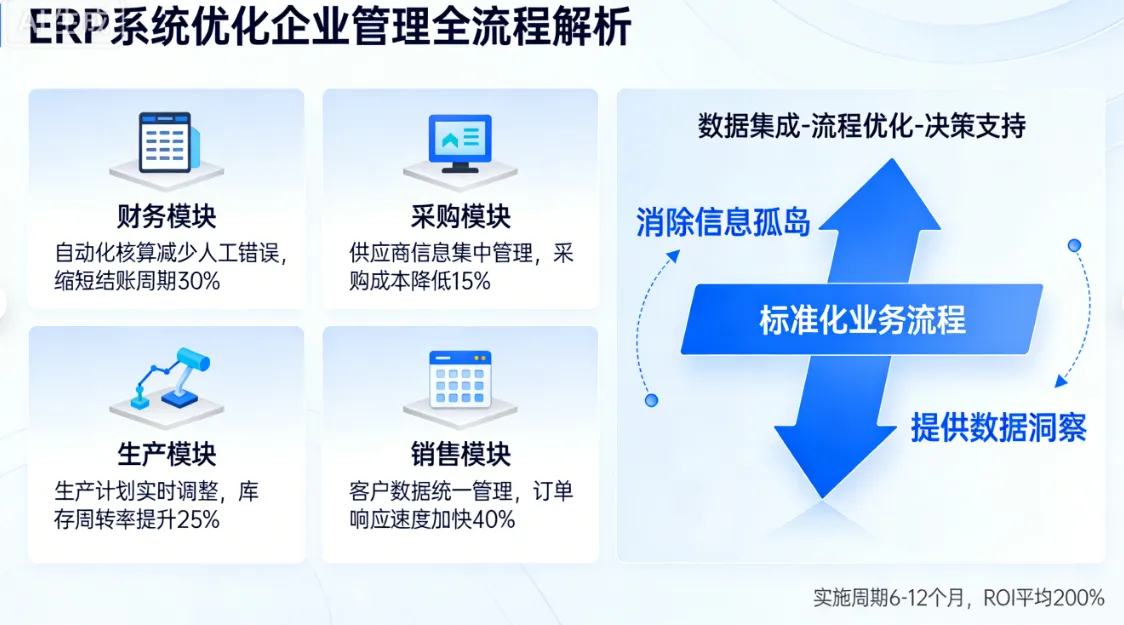
Standardization and Automation of Processes: Building a Foundation for Efficient Operations
The most intuitive optimization of enterprise management by ERP system is reflected in the standardization and automation of business processes. Under the traditional management model, each department of the enterprise often forms its own independent working methods and data recording methods, resulting in information gaps, repetitive labor, and efficiency losses when the same business flows between different departments. The ERP system helps enterprises redesign and solidify management processes, eliminate non value added links, and achieve end-to-end process automation through built-in industry best practice templates and configurable workflow engines.
Taking the procurement to payment process as an example, without an ERP system, the entire process from demand application, supplier selection, order issuance, goods acceptance to final payment settlement involves the circulation of paper documents and manual data entry from multiple departments, which may take several weeks and be prone to errors. The ERP system can fully digitize and automate this process: the demand department submits applications online, and the system automatically matches the budget and triggers the approval process; The procurement department selects the optimal supplier based on the supplier performance data provided by the system; Automatically synchronize order information to the finance and warehousing modules; After the goods arrive, scan the code for acceptance, and the system will automatically generate a storage record and trigger the payment process. This automated processing not only shortens the procurement cycle by more than 50%, but also significantly reduces human errors and compliance risks, allowing managers to free themselves from tedious transactional work and focus on more strategically valuable tasks.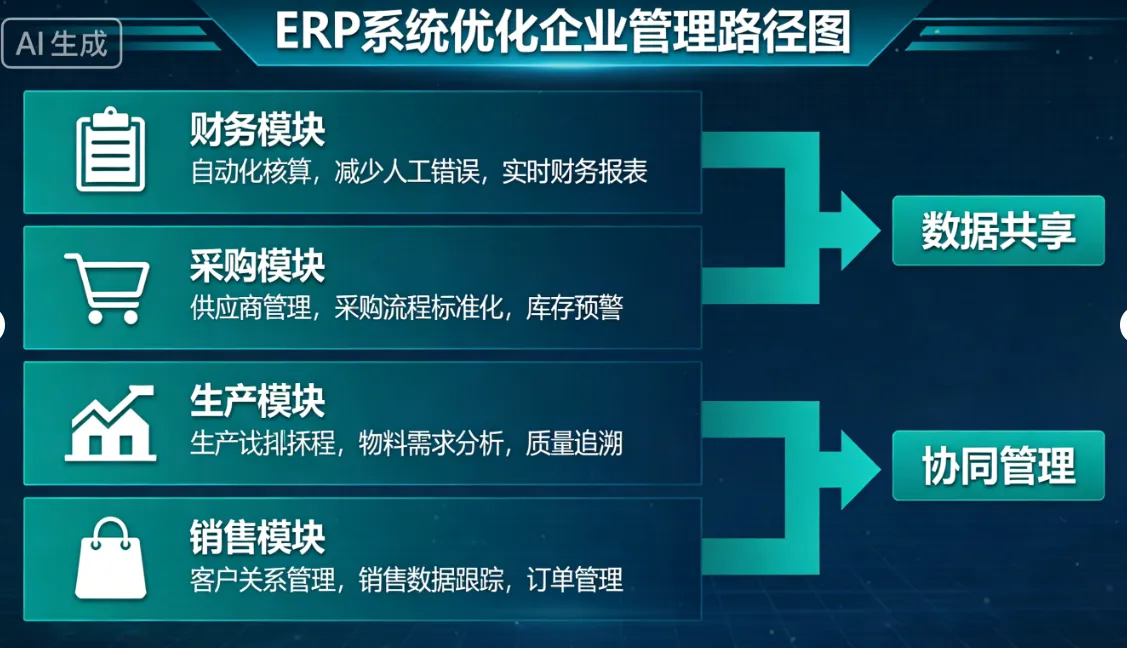
Data integration and real-time visualization: improving decision quality and speed
Information opacity and decision-making lag are pain points in traditional enterprise management. The use of independent systems by various departments leads to data silos, and management often makes decisions based on incomplete and untimely information. The ERP system integrates all key business data such as finance, sales, procurement, production, inventory, and human resources by establishing an enterprise level unified data platform, forming a single trusted data source.
This data integration has brought about a revolutionary improvement in management transparency. Enterprise managers can view the overall business situation at any time through the real-time dashboard and reports provided by the ERP system: key indicators such as current sales, inventory levels, cash flow status, production progress, and order delivery rate are clear at a glance. After a consumer goods enterprise launched an ERP system, the management was able to track the sales dynamics and profit contributions of each product in real time, identify unsold products in a timely manner, and adjust promotional strategies, resulting in a 35% reduction in unsold inventory and a 28% increase in sales of high profit products.
The deeper optimization lies in the multi-dimensional data analysis capability supported by the ERP system. Through built-in business intelligence tools, enterprises can conduct cross departmental and cross period data correlation analysis, revealing business insights that are difficult to discover with traditional methods. For example, analyzing the relationship between customer purchasing behavior and supply chain response speed, evaluating the impact of marketing activities on inventory turnover, identifying the main driving factors of production costs, etc. This data-driven decision-making model has shifted enterprise management from relying on experience to relying on data, significantly improving the scientific and accurate nature of decision-making.
Resource optimization and allocation: improving overall operational efficiency
Enterprise management is essentially the optimization and allocation of limited resources, and ERP systems are powerful tools for achieving this goal. Through fully integrated resource management functions, ERP systems help enterprises achieve optimal allocation and efficient utilization of various resources such as manpower, materials, equipment, and funds.
In terms of human resource management, ERP systems closely integrate human resource planning with business needs. Based on sales forecasting and production planning, the system can simulate future manpower demand, helping enterprises plan recruitment, training, and scheduling in advance. A certain service enterprise has achieved intelligent matching between employee skills and customer needs through the human resources module of the ERP system, which has increased customer satisfaction by 20% and reduced labor redundancy costs by 15%.
In terms of material and equipment management, ERP systems optimize resource allocation through advanced planning and scheduling algorithms. The material requirement planning module accurately calculates procurement requirements and time based on sales forecasts, production plans, and current inventory levels, minimizing inventory occupancy while ensuring production continuity. The preventive maintenance module predicts possible failures based on equipment operation data and arranges maintenance plans to reduce unexpected downtime. After implementing an ERP system in a manufacturing enterprise, the comprehensive utilization rate of equipment increased by 25%, and the inventory turnover rate increased by 40%, significantly improving asset utilization efficiency.
Financial business integration: strengthening risk management and control capabilities
The separation of finance and business in traditional enterprise management often leads to lagging risk control. The ERP system integrates business and finance design, incorporating risk management into daily business processes, achieving full process risk management including pre prevention, in-process control, and post analysis.
In the procurement process, the system automatically checks the credit status and historical performance of suppliers to avoid cooperation with high-risk suppliers; In the sales process, based on customer payment history and credit rating, automatically control the credit limit and payment period; In the production process, monitor the difference between material consumption and standard cost in real time, detect abnormalities in a timely manner, and take measures. A certain engineering company has achieved real-time profit and loss analysis for each project through the project cost control module of the ERP system. Once a trend of cost overruns is detected, the system will automatically warn and prompt adjustment plans, controlling the fluctuation of project profit margins within 3% and significantly improving the company's profit stability.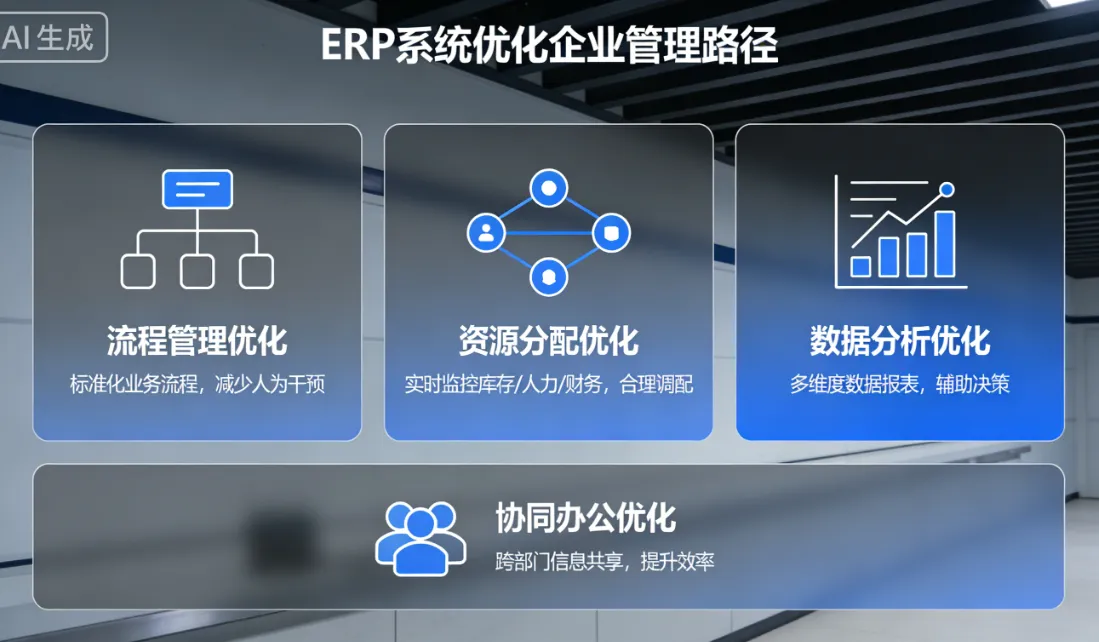
In addition, the ERP system provides complete audit tracking functionality, recording all key business operations and system changes, meeting compliance requirements while also providing reliable basis for internal control and risk analysis. This embedded risk management mechanism enables enterprises to maintain stable operations in an increasingly complex business environment.
Promote organizational collaboration and knowledge management
The ERP system optimizes the organizational collaboration model of enterprises by breaking down departmental barriers and promoting information sharing. A unified platform and standardized processes enable different departments to work based on the same information foundation and collaboration rules, reducing communication costs and coordination difficulties.
The automation of cross departmental collaboration processes further strengthens organizational collaboration. The new product development process involves multiple departments such as research and development, procurement, production, and marketing. ERP systems can design this process as an automated collaborative workflow, with clearly defined tasks, responsibilities, and time nodes for each link. The system automatically tracks progress and reminds relevant personnel. A certain technology company managed the new product development process through an ERP system, which reduced the average time to market for products by 30% and improved cross departmental collaboration satisfaction.
ERP systems have also become an important platform for enterprise knowledge management and inheritance. Best practices, solutions, and lessons learned can be accumulated in the system, forming organizational memory. New employees can quickly understand business processes and work methods through the system, accelerating their ability development. A certain group company has established a standardized management process library and case library through an ERP system, which has shortened the management integration time of newly acquired subsidiaries from an average of 18 months to 9 months, significantly improving the efficiency and consistency of group management.
Support strategic execution and continuous improvement
Modern ERP systems have surpassed operational optimization and become a support platform for enterprise strategic execution and continuous improvement. By breaking down strategic goals into executable and measurable performance indicators and integrating them into daily business processes, ERP systems help businesses ensure effective implementation of strategic intentions.
The balanced scorecard and other strategic management tools can be deeply integrated with ERP systems, transforming the strategic goals of finance, customers, internal processes, and learning and growth into specific system indicators and action plans. The management can monitor the completion status of these indicators in real time, detect deviations in a timely manner, and take corrective measures. A certain retail enterprise tracked the correlation between non-financial indicators such as "customer satisfaction" and "employee skill improvement" and sales revenue through an ERP system, adjusted the focus of resource investment, and increased the achievement rate of strategic goals by 40%.
At the same time, the process performance data provided by the ERP system provides direction for continuous improvement of the enterprise. By analyzing process indicators such as order processing time, product defect rate, and supplier on-time delivery rate, enterprises can identify bottlenecks and waste and implement targeted improvement measures. This data-driven continuous improvement cycle enables enterprises to continuously optimize management efficiency and maintain a competitive advantage.
Adapting to Change and Promoting Innovation
In the rapidly changing business environment, the adaptability and innovation speed of enterprises have become key competitive advantages. ERP systems help enterprises quickly respond to market changes and support business model innovation through flexible architecture and configurable features.
When enterprises enter new markets or launch new products, ERP systems can adapt to new business needs through rapid configuration without the need for large-scale system upgrades. A certain food enterprise completed the management integration of newly acquired brands within two weeks through the rapid configuration function of the ERP system, supporting the company's rapid expansion strategy.
Meanwhile, the integration capability of ERP systems with emerging technologies provides a technological foundation for enterprise innovation. The connection with IoT devices enables enterprises to monitor the production process in real-time; Combining with artificial intelligence analysis to support predictive maintenance and intelligent scheduling; The integration with blockchain platforms enhances supply chain transparency. The integration and application of these technological innovations on the ERP platform continuously expands the boundaries of enterprise management optimization.
Conclusion: Building sustainable management advantages
The optimization of enterprise management by ERP system is comprehensive and in-depth. It improves operational efficiency through process automation, enhances decision quality through data integration, strengthens competitiveness through resource optimization, ensures stable operations through risk management, promotes knowledge sharing through organizational collaboration, and drives continuous improvement through strategic support. These optimization effects reinforce each other and jointly build a sustainable management advantage for the enterprise.
However, the process of optimizing ERP system management is not achieved overnight. It requires companies to have clear strategic goals, firm implementation determination, sustained investment, and an adaptive organizational culture. When the integration of technology and management reaches a certain level, ERP systems will no longer be external tools, but become part of the DNA of enterprise management, continuously driving enterprises to maintain agility, efficiency, and innovation in complex business environments, ultimately achieving long-term excellent performance and sustainable development. In this sense, ERP system is not only a tool for optimizing enterprise management, but also an important force for shaping future enterprises.