
Cloud ERP vs Local ERP: A Comprehensive Comparison and Selection Guide for Performance, Cost, Flexibility, and Security
In the wave of digital transformation, enterprise resource planning systems have become an indispensable core support for modern enterprise operation and management. However, in the face of increasingly complex technological environments and diverse business needs, enterprises are facing a critical choice in their ERP deployment model: whether to adopt cloud computing based cloud ERP or adhere to traditional local ERP deployment? These two modes have their own characteristics in terms of performance, cost structure, flexibility, and security, forming a selection matrix that requires enterprises to carefully weigh. A deep understanding of the essential differences between the two and making wise decisions based on the company's own situation directly affects the effectiveness and return on investment of digital transformation.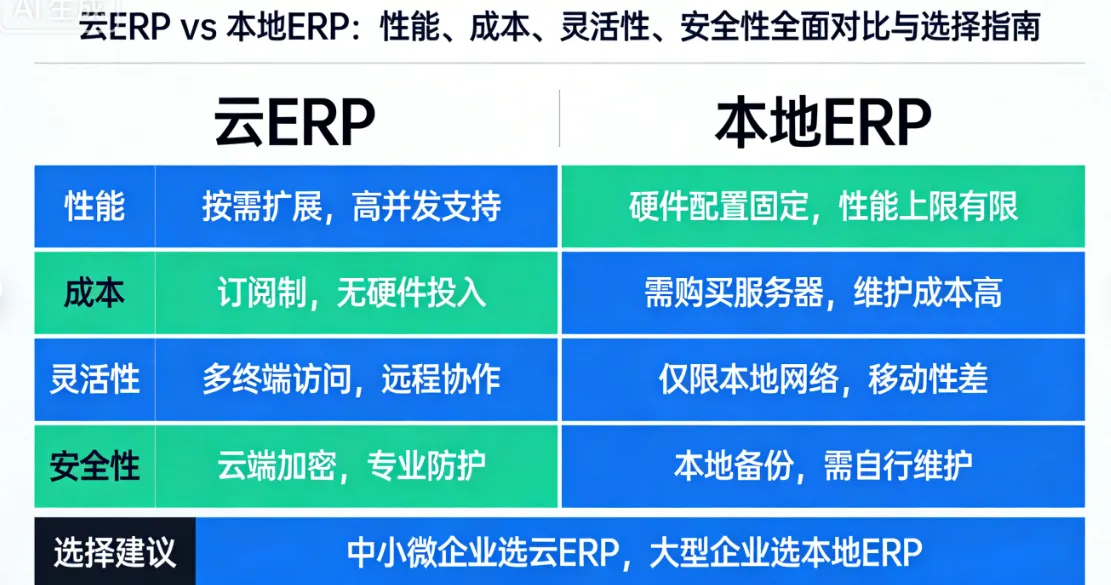
Dimension Analysis of Performance Performance: Balancing Elastic Scalability and Exclusive Resources
In terms of performance comparison, cloud ERP presents completely different characteristics and advantages compared to local ERP. The core advantage of cloud ERP lies in itsElastic and scalable architectureEnterprises do not need to invest in expensive hardware equipment in advance. Cloud service providers such as Amazon AWS, Microsoft Azure, or Alibaba Cloud can dynamically allocate computing, storage, and network resources based on the actual load of the enterprise. When facing business peaks such as Double Eleven, month end settlement, or quarterly reports, the system can automatically expand within minutes to ensure response speed and service continuity; Automatically release excess resources during business downturns to achieve cost optimization. This "on-demand access" model is particularly suitable for enterprises with significant business fluctuations or in a period of rapid growth.
In contrast, the performance of local ERP depends entirely on the enterprise's own capabilitiesInfrastructure investment and technical management capabilityEnterprises need to make a one-time investment to purchase servers, storage devices, and network infrastructure, and form a professional team for daily maintenance and performance tuning. Its advantage lies in the fact that enterprises have complete control over hardware resources, allowing for deep optimization for specific applications and avoiding the potential impact of "neighbor noise" caused by shared resources. However, the scalability of this model is often limited - upgrading hardware requires new procurement, deployment, and debugging cycles, making it difficult to quickly respond to sudden business growth. For large group enterprises with stable and predictable performance requirements, local deployment can provide more predictable performance.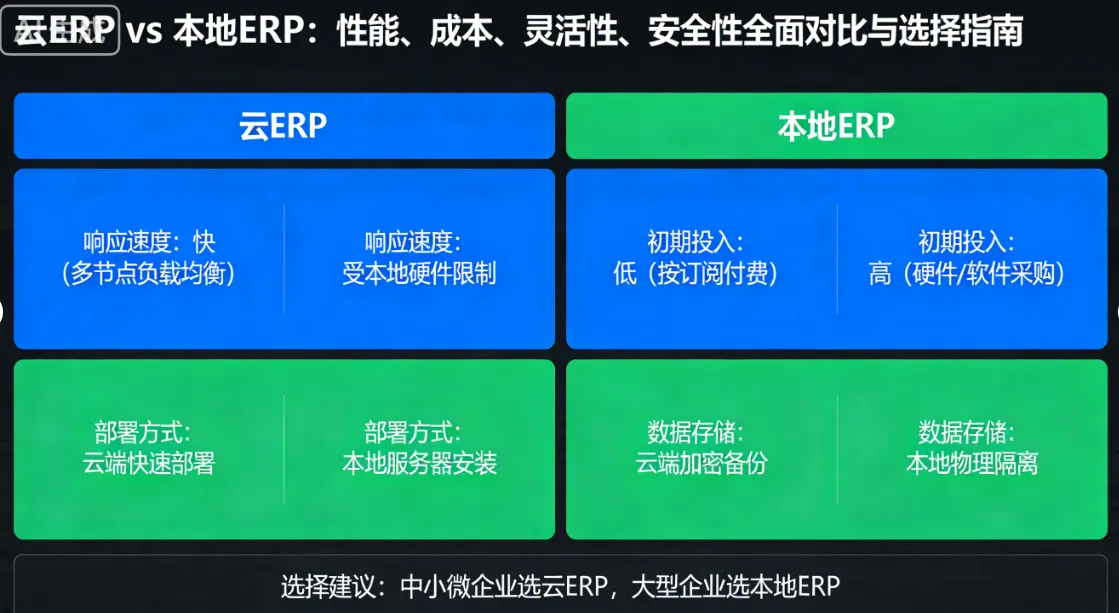
The essential difference in cost structure: paradigm shift from capital expenditure to operating expenditure
Cost is one of the most sensitive considerations for enterprises in ERP selection, and the two models form a fundamental difference in this regard. Cloud ERP typically usesSubscription based charging modelConvert large initial capital expenditures into predictable monthly or annual operating expenses. Enterprises pay regular fees based on the number of users, functional modules, or data storage capacity, which typically include a full range of services such as software licenses, infrastructure, security maintenance, technical support, and regular upgrades. This model significantly reduces the start-up threshold and financial risks for enterprises, making cash flow management more flexible, especially favored by small and medium-sized enterprises and startups.
Local ERP follows the traditional approachCapital expenditure modelEnterprises need to invest a large amount of funds at once for software licensing, server hardware, network equipment, data center construction, and initial implementation services. In addition, enterprises also need to continuously bear operational expenses such as hardware maintenance, system upgrades, security protection, and labor costs. Although in the long run, the total cost of ownership of local deployment may be more advantageous for large-scale and stable usage scenarios, its high initial investment and potential hidden costs (such as upgrade failure risk and technology obsolescence risk) pose significant financial challenges. A manufacturing enterprise found that the total cost of using local ERP was about 40% higher than that of cloud ERP in the first three years, and it was not until the fifth year that the cost advantage began to emerge.
The competition between flexibility and scalability: the choice between quick adaptation and deep customization
The rapid changes in the business environment require enterprise IT systems to have high flexibility and scalability, and the two ERP models provide different solutions in this regard. The flexibility of cloud ERP is reflected inQuick deployment, seamless upgrades, and easy integrationThree aspects. Due to the lack of local hardware preparation, the deployment time of cloud ERP is usually calculated in weeks or months, far less than the months or even years of local deployment. The service provider is responsible for all updates and upgrades, and the enterprise can always use the latest version of features without worrying about technical debt accumulation. At the same time, mainstream cloud ERP platforms provide rich application programming interfaces and pre built connectors, making it easy to integrate with various SaaS applications and third-party services.
The advantage of local ERP in terms of flexibility is reflected inDeep customization and complete controlUp there. Enterprises have complete ownership and control over system code, databases, and infrastructure, and can customize development to any extent based on unique business processes, without being limited by service providers' standardized product roadmaps. This model is particularly suitable for industries with extremely unique business processes, strict compliance requirements, or absolute control over data sovereignty, such as some financial institutions, defense units, and large multinational manufacturing enterprises. However, this flexibility comes with high maintenance costs and upgrade challenges - each system upgrade may require re adaptation of custom code, resulting in heavy technical debt.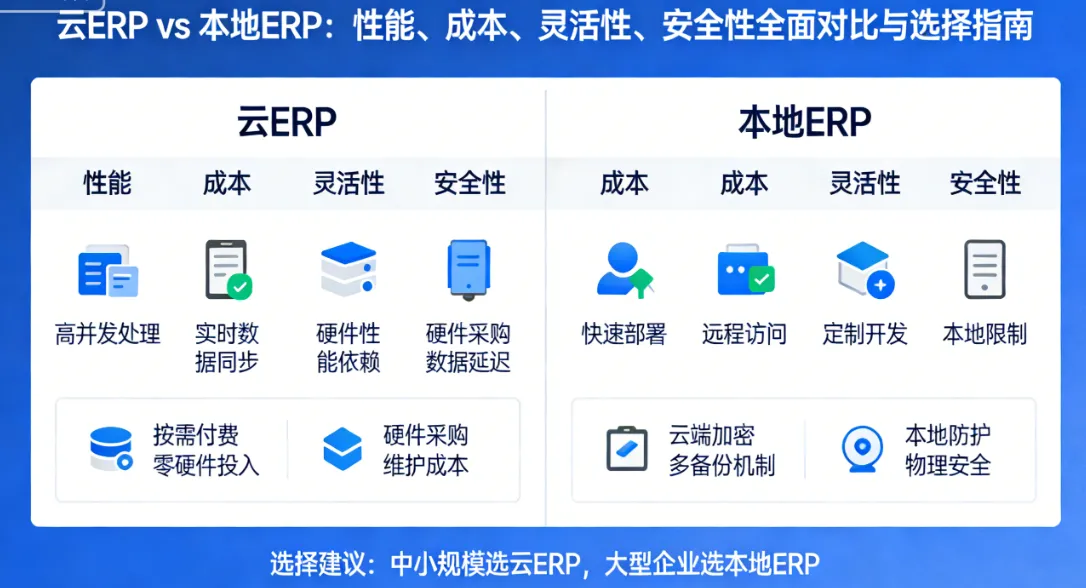
Dual perspectives of security and compliance: balancing professional protection and autonomous control
Security and compliance are the most common concerns for enterprises regarding cloud ERP, and have long been areas of pride for local ERP. However, the actual situation is far more complex than surface perception. Modern cloud ERP providersProfessionalism and resource investment in security protectionIt has far exceeded the self built capabilities of most enterprises. A leading cloud service provider has a global security team that implements a multi-layered defense system, including physical security, network security, application security, and data encryption, and continuously monitors and responds to emerging threats. They usually have obtained multiple international and domestic security certifications such as ISO 27001, SOC 2, GDPR, and Level 3, providing customers with infrastructure that meets strict compliance requirements.
Local ERPThe security advantage lies in the physical control and autonomous management of dataEnterprise data is completely stored in its own or controllable data centers, without the need to transfer it across networks to third-party servers, reducing data exposure risks at the physical level. Enterprises can fully deploy protective measures according to their own security policies and directly control all access permissions. For companies subject to strict industry regulation (such as finance, healthcare, government) or handling highly sensitive data, this level of control is crucial. However, this also means that companies need to independently assume full security responsibility, form professional teams, and invest continuous resources to maintain a level of protection that is in sync with technological progress, which is a huge challenge for many companies.
Strategic Choice Guide: Comprehensive Considerations Beyond Technical Dimensions
Faced with these two deployment modes with their respective advantages, enterprises should not only make choices from a technical perspective, but also consider them as onestrategic decisionTaking into account business characteristics, organizational capabilities, industry environment, and long-term planning.
The characteristics of enterprises suitable for choosing cloud ERP usually includeRapid business growth or significant seasonal fluctuations require elastic expansion capabilities; Limited IT budget or preference for operational expenditure model; Lack of professional IT infrastructure team; Widely distributed business, requiring support for remote work and mobile access; I hope to quickly obtain the latest technological features and maintain a competitive advantage.
Local ERP is more suitable for the following types of enterprisesHaving a stable and predictable business model and IT requirements; The business process is highly complex or unique, requiring deep customization; Being in a strictly regulated industry, there are mandatory requirements for data sovereignty and physical control; We have invested in the construction of a comprehensive data center and IT team; Long term cost-effectiveness is more advantageous after precise calculation.
The hybrid deployment model is becoming a realistic choice for more and more enterprises. This model deploys non core, standardized functions (such as human resource management and collaborative office) in the cloud, while keeping core, sensitive, or highly customized systems (such as core manufacturing and financial general ledger) locally, forming a balanced architecture that balances flexibility and control.
No matter which path is chosen, the key to success lies in clear business goals, meticulous implementation planning, and continuous optimization management. The boundary between cloud ERP and local ERP is blurring, and it may develop towards a more integrated and intelligent direction in the future. The choice of enterprises today should not be a closed endpoint, but a starting point for building a digital foundation that can adapt to future changes and continuously create value. In this rapidly evolving technological era, maintaining an open mind and agile adaptability may be more important than the choice itself.