
What management problems does ERP solve for enterprises? Analysis of Five Major Irregular Phenomena
The Challenges of Enterprise Management and the Path to Digital Transformation
In today's complex and ever-changing business environment, enterprise managers often face a core challenge: how to ensure the standardization, efficiency, and synergy of internal operations within the organization? In reality, many enterprises are plagued by various non-standard phenomena for a long time due to the lack of systematic management tools. These irregularities not only consume enterprise resources and reduce operational efficiency, but may also conceal significant business risks. As a comprehensive management platform, the value of enterprise resource planning system lies in its ability to systematically and fundamentally solve the management pain points that have plagued enterprises for many years, and establish a standardized, transparent, and efficient operational system for enterprises.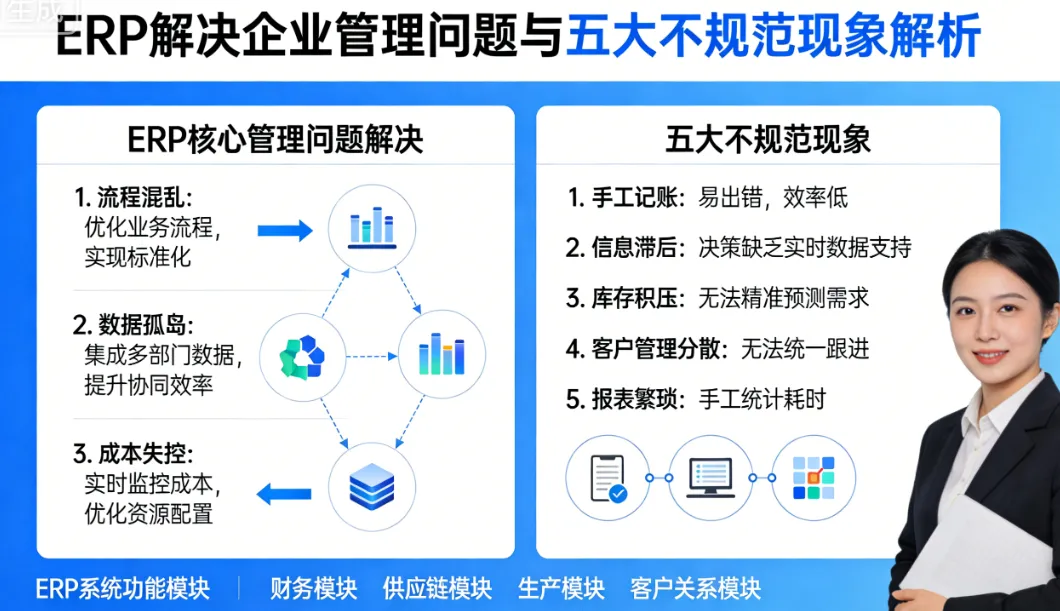
Information silo: data fragmentation and decision-making blind spots
The most common problem faced by many enterprises is the phenomenon of "information silos" between departments. The sales department uses its own customer relationship management system to record orders, the finance department uses independent financial software to process accounts, and the production department relies on production planning tables to schedule tasks. These systems are not interconnected and have different data standards, which results in decision-makers being unable to obtain a comprehensive and consistent business view. When management needs to understand the true profitability of a product, they need to manually integrate sales data, production costs, inventory expenses, and marketing investments, which is often time-consuming, labor-intensive, and difficult to guarantee accuracy.
The ERP system has completely broken down information barriers by establishing a unified data platform. All key business data - from sales orders and purchase contracts to production work orders and financial vouchers - are integrated into the same system using a unified data standard and coding system. When the sales department enters a new order, the production department can see the new production demand in real time, the procurement department can synchronously obtain material demand information, and the finance department can track changes in accounts receivable. This data integration enables management to make decisions based on complete, accurate, and timely information, avoiding misjudgments caused by incomplete information. After implementing an ERP system, a manufacturing enterprise integrated data that was originally scattered across five independent systems, reducing the time for management to obtain comprehensive business reports from three days to real-time availability, and improving decision-making efficiency by over 60%.
Process confusion: Non standardized operations and efficiency losses
Lack of standardized processes is another common phenomenon of management non-compliance. When different departments, branches, or even employees handle the same business, they often adopt their own methods and standards. Taking the procurement process as an example, some departments procure through formal bidding, while others rely on personal relationships; Some strictly implement three-level approval, while others may be fully decided by one person. This inconsistent process not only leads to low operational efficiency, but also easily breeds compliance risks and management loopholes.
ERP systems help enterprises establish standardized and controllable operational systems by solidifying best practices into standard processes. The built-in process engine of the system can define and manage all key business processes from procurement requests, sales orders to expense reimbursements, production scheduling, and more. Each process has clear steps, roles, permissions, and rules to ensure that everyone operates according to the same standards. More importantly, these processes can flow automatically according to business rules, reducing human intervention and waiting time. A certain engineering enterprise has standardized the project cost control process through an ERP system, reducing the average approval time for project changes from 7 days to 1 day, and reducing the proportion of cost overrun projects from 35% to 12%.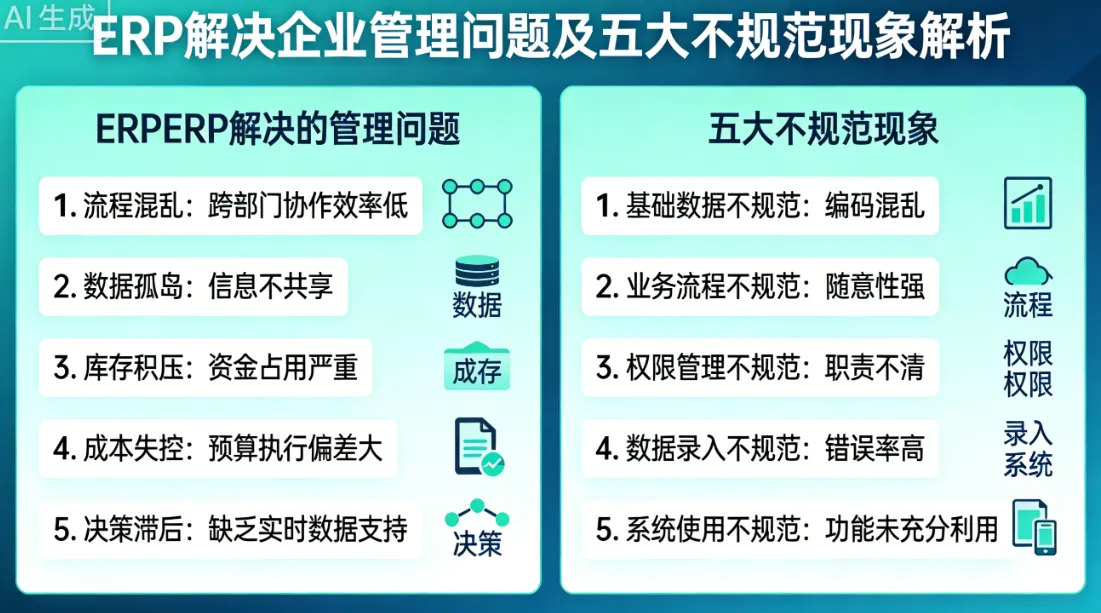
Inventory imbalance: coexistence of excessive backlog and shortage
The non-standard phenomenon in inventory management often manifests as two extremes: on the one hand, certain materials are piled up in large quantities, occupying funds and storage space; On the other hand, there is a frequent shortage of urgently needed materials, leading to production interruptions or order delays. This imbalance usually stems from a lack of accurate demand forecasting and scientific inventory control methods. Purchasing personnel place orders based on experience, production plans rely on rough estimates, sales forecasts are disconnected from physical inventory, forming a vicious cycle.
The material requirement planning and inventory control module of the ERP system achieves scientific inventory management through algorithms and data analysis. The system automatically calculates the future demand for each material based on sales forecasts, production plans, and current inventory levels, and recommends the optimal ordering time and quantity. The safety stock setting is no longer based on empirical values, but on the calculation results of historical consumption data and supply chain response time. After implementing ERP in a certain consumer goods enterprise, the overall inventory turnover rate was increased by 40% through the inventory optimization function of the system. At the same time, the out of stock rate was reduced from 8% to below 1%, significantly improving customer satisfaction while reducing capital occupation.
Cost Out of Control: Hidden Loss and Inaccurate Accounting
The lack of standardization in cost management often manifests as a crude state of "only knowing the total number, not the details". Enterprises may know that overall costs are rising, but it is difficult to accurately identify which links, products, and customers are causing the cost increase. The distribution of production costs among departments is unreasonable, and the allocation of indirect expenses lacks scientific basis. Product pricing is often based on rough estimates rather than precise calculations, resulting in some seemingly profitable products actually consuming enterprise resources.
ERP systems enable enterprises to achieve true cost transparency and control through refined cost accounting and full process cost tracking. The system can track cost occurrence based on multiple dimensions such as product, project, customer, and order, and accurately allocate direct materials, direct labor, and manufacturing expenses to each cost object. Real time data collection and analysis of material consumption, labor input, and equipment usage during the production process enable managers to identify cost anomalies in a timely manner and take corrective measures. A certain food processing enterprise used the cost analysis function of the ERP system to discover that a production line had high unit product costs due to low equipment efficiency. Through targeted improvements, the cost of the product was reduced by 15%, saving over 2 million yuan annually.
Collaboration failure: departmental barriers and slow response
The lack of effective collaboration among various departments within the enterprise is another typical phenomenon of non-standard management. The delivery date promised by the sales department cannot be met by the production department, the materials ordered by the procurement department do not meet the production requirements, and the payment process of the finance department affects the supplier's cooperation enthusiasm. This collaborative failure leads to increased internal friction within the enterprise, slower overall response to market changes, and decreased customer satisfaction.
The ERP system breaks down organizational barriers between departments through process integration and information sharing. The system designs the core business processes of the enterprise as cross departmental collaborative workflows, ensuring that each link can obtain the required information in a timely manner and smoothly transmit it to the next link. Sales orders are automatically converted into production plans, production demands trigger purchase requests, arrival information updates inventory records, and the entire process is transparent with clear responsibilities. A certain electronic enterprise has integrated its sales, production, and procurement processes through an ERP system, reducing the average lead time from orders to delivery from 28 days to 19 days and lowering customer complaint rates by 45%, significantly enhancing its market competitiveness.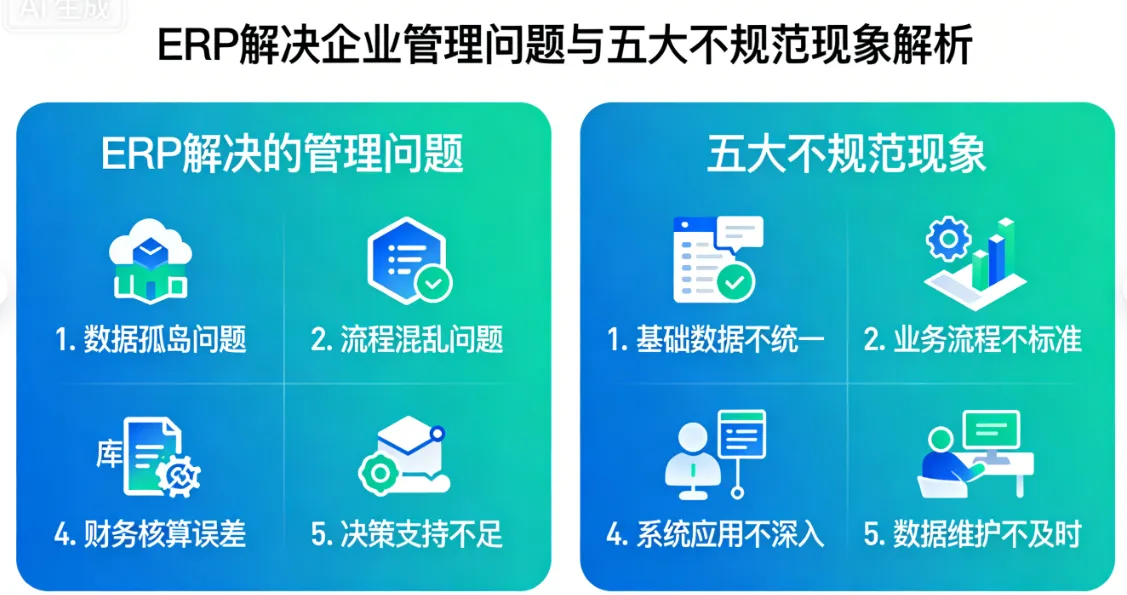
Compliance Risk: Lack of Control and Audit Difficulties
With the increasingly strict regulatory environment, many enterprises are facing greater compliance pressure. Problems such as non-standard financial reporting, opaque procurement processes, and incomplete data recording may not only lead to compliance risks, but also put companies in a passive position when facing internal audits or external inspections. Manually recorded accounts are difficult to trace, scattered stored files are prone to loss, and authorization approval lacks effective control, all of which pose potential legal and reputational risks to enterprises.
The ERP system provides the technical foundation for compliance management for enterprises through its built-in control mechanism and complete audit tracking function. The system can define strict permission control and approval processes to ensure that all critical operations are appropriately authorized and fully documented. The process of generating financial data is fully traceable, with clear records at every stage from the original vouchers to the final reports. After implementing ERP, a pharmaceutical company successfully passed the FDA audit by utilizing the compliance management function of the system, and reduced the manual workload related to compliance by 70%.
The value presentation of systematic solutions
The solution of ERP system to enterprise management problems is not a scattered functional repair, but a systematic reconstruction and optimization. It starts with data integration and breaks down information silos; By standardizing processes, eliminate operational confusion; Using scientific algorithms to optimize resource allocation; Implement precise accounting and achieve cost transparency; Promote cross departmental collaboration and enhance overall efficiency; Strengthen internal control mechanisms and prevent compliance risks. These solutions are interrelated and mutually reinforcing, collectively forming the infrastructure for standardized management in enterprises.
It is worth noting that the successful implementation and application of ERP systems is also a reflection of the standardization level of enterprise management. It requires enterprises to re-examine and optimize business processes, clarify responsibilities and authorities, and establish a data-driven decision-making culture. This process may bring short-term adaptation challenges, but in the long run, it is a key step for enterprises to transition from experience management to scientific management, and from extensive operation to lean operation.
In today's era where digital transformation has become a necessary path for the survival and development of enterprises, ERP systems provide not only a set of software tools, but also a set of standardized management concepts, methods, and practices. For enterprises that hope to establish a lasting competitive advantage and achieve sustainable development, effectively utilizing ERP systems to solve non-standard management problems has become a "must-have" instead of an "option". On the basis of standardized management, enterprises can face market changes more steadily, allocate resources more effectively, create value more sustainably, and ultimately stand invincible in the complex and ever-changing business environment.