
How can ERP systems improve workflow visibility and business efficiency? |Analysis of the advantages of enterprise resource management
The core engine for transparency in enterprise operations in the digital age
In today's complex and ever-changing business environment, the visibility of workflows and the efficiency of business execution have become key components of a company's core competitiveness. The phenomenon of "process black box" commonly found in traditional management models - that is, the business process links are opaque, the status is invisible, and the responsibilities are unclear - is seriously restricting the response speed and resource utilization efficiency of enterprises. The enterprise resource planning system, through its integration, data-driven, and process automation features, provides a technological path for enterprises to break down information barriers and achieve end-to-end process transparency, fundamentally changing the paradigm of enterprise operation and management.
Process Mapping and Visualization: From "Black Box Operations" to "Panoramic Transparency"
The primary mechanism for ERP systems to enhance workflow visibility lies in theirFull process digital mapping capabilityThe system transforms all core business processes of enterprises, from procurement to payment, orders to cash, recruitment to retirement, etc., into structured digital workflows. Each process is broken down into clear steps, roles, rules, and deliverables, forming a visual process map. This mapping not only makes the process itself clear and visible, but more importantly, it makes the process more efficientReal time execution statusBecoming transparent and traceable.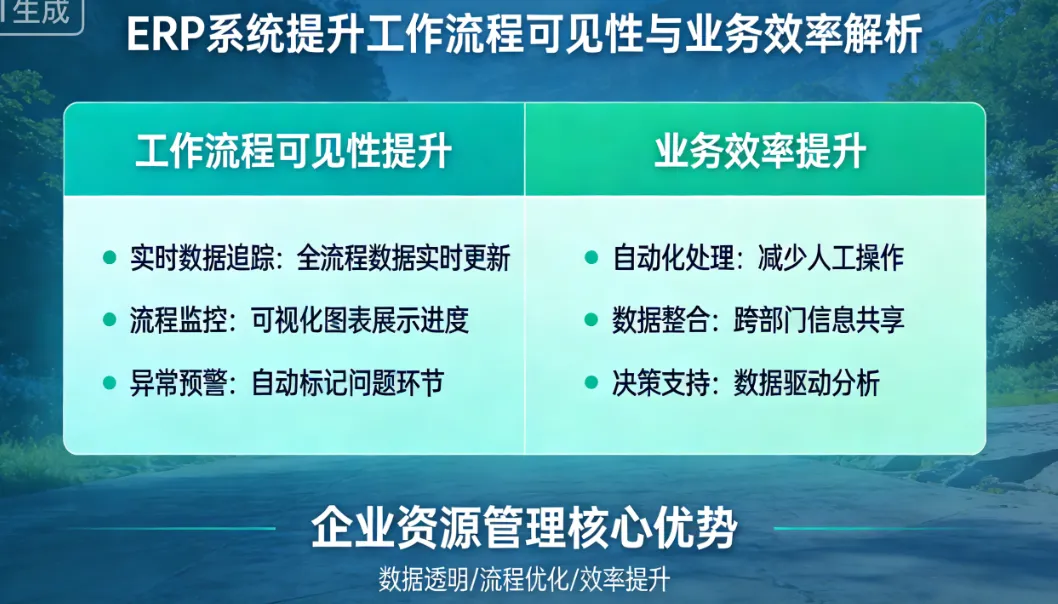
Taking the procurement process as an example, in the traditional mode, a purchase requisition needs to be circulated among multiple departments, and the applicant often cannot know where the approval is going, where it is stuck, or why it is delayed. In the ERP system, every step from requirement proposal, budget check, multi-level approval, supplier selection to order generation is clearly recorded, and all relevant parties can view the progress of the process in real time. After implementing an ERP system in a manufacturing enterprise, the average processing time for purchase orders was reduced from 7.2 days to 1.5 days. The improvement in process transparency directly eliminated about 65% of progress inquiries and reminders, allowing procurement personnel to focus on more valuable supplier management and negotiation work.
Data driven efficiency insights: identifying bottlenecks and optimization opportunities
The direct value brought by process visibility isThe qualitative change in bottleneck identification and efficiency analysis capabilitiesThe ERP system not only displays what is happening in the process, but more importantly, records how long each step takes, who handles it, and how many resources are consumed. These historical data are transformed into actionable efficiency insights through the system's analysis module.
The system can automatically calculate the average processing time, coefficient of variation, and resource consumption of each process step, and highlight efficiency bottlenecks through visual charts. For example, the finance department may find that the most time-consuming step in the monthly closing process is not data verification, but waiting for the business department to submit the original vouchers; The production department may identify that equipment mold change time is the main limiting factor affecting the flexibility of the production line. A logistics company discovered through the process analysis function of its ERP system that there were serious issues of unclear responsibilities and repetitive labor in its order exception handling process. By redesigning the process, the average processing time for exception orders was reduced by 48%, and customer satisfaction increased by 32%.
Furthermore, advanced ERP systems combined with machine learning algorithms canPredicting process performance and providing early warningThe system can establish a predictive model based on historical data, and automatically issue an alert when the actual execution time of a process begins to deviate from the normal mode, prompting managers to intervene in a timely manner. This shift from passive response to active management has significantly improved the operational resilience of enterprises.
Automation and Standardization: Reduce Friction, Accelerate Execution
The improvement of workflow visibility has created a prerequisite for enhancing business efficiency, and ERP systems have achieved this throughWorkflow automation and execution standardizationDirectly convert this potential into actual benefits. The built-in workflow engine in the system can automatically route tasks, allocate resources, trigger notifications, and update status based on preset rules, eliminating a lot of manual coordination and handover work.
Taking the expense reimbursement process as an example, in the traditional mode, employees need to print documents, have their leaders sign them, send them to the finance department, and wait for approval and payment. The entire process is full of uncertainty and waiting time. The ERP system fully automates this process: employees submit electronic invoices and reimbursement forms online, the system automatically checks budget and policy compliance, routes them to relevant approvers according to the preset approval chain, and automatically generates accounting vouchers and triggers payment after approval is completed. After implementing an automated reimbursement process, a multinational company has shortened the average reimbursement cycle from 23 days to 5 days, while reducing the time for financial personnel to process each reimbursement by 70%.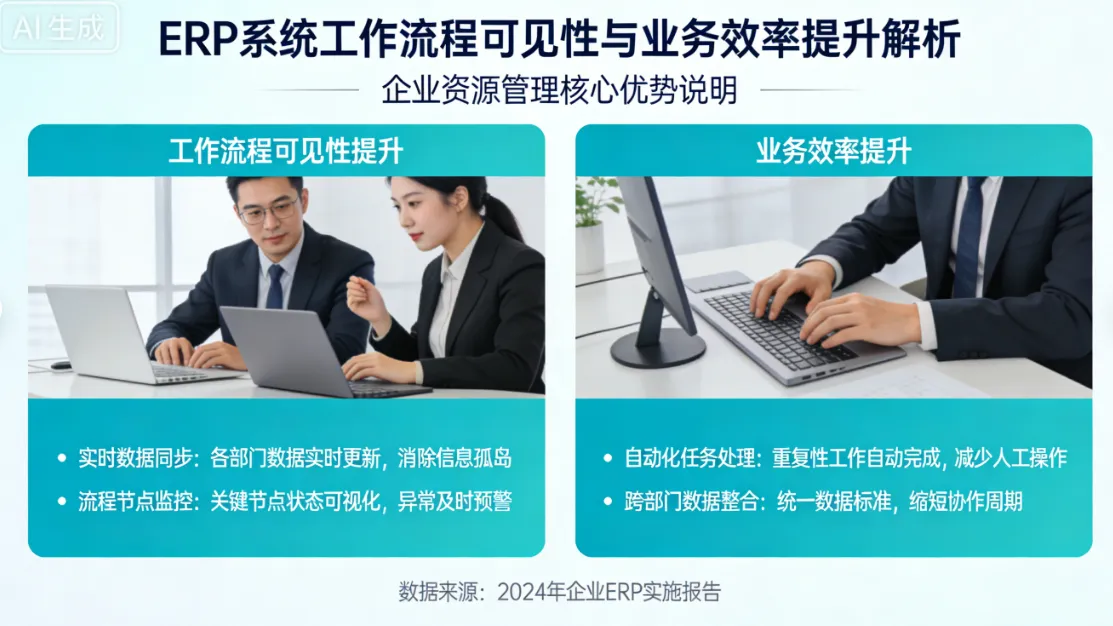
Standardization is another pillar of efficiency improvement. ERP systems solidify the best practices of enterprises into standard operating procedures, ensuring that different departments, branches, and even employees handle the same business in the same efficient manner. This consistency not only reduces errors and rework, but also makes employee training and new business expansion faster and more reliable.
Collaborative efficiency improvement: Breaking down silos and strengthening linkage
An important root cause of low operational efficiency in enterprises isObstacles to interdepartmental collaborationDifferent departments use independent systems, have different data standards, and communication channels are not smooth, resulting in a lot of time and energy being wasted on coordination and information verification. The ERP system fundamentally changes the mode of cross departmental collaboration by providing a unified process platform and data foundation.
When the sales department creates an order in the system, the production department can immediately see the new production requirements, the procurement department synchronously obtains material requirement information, and the finance department begins to track accounts receivable. All relevant departments work based on the same data source, without the need for repeated communication and confirmation. After integrating sales, production, and procurement processes through an ERP system, a certain consumer goods enterprise has shortened the average lead time from orders to delivery from 21 days to 14 days, and reduced cross departmental meeting time by 40%. The team is able to devote more time to value-added activities such as market analysis and customer service.
Mobility further expands the spatiotemporal boundaries of collaboration. Modern ERP systems provide complete mobile application support, allowing employees to participate in real-time process processing, view business status, and make decisions no matter where they are. This ubiquitous access capability is particularly suitable for the new normal of hybrid office, ensuring business continuity is not affected by changes in work location.
Continuous improvement cycle: from data insights to process optimization
The greatest value brought by an ERP system may lie in its establishment of aMeasurable, analyzable, and optimizable continuous improvement cycleThe rich process data accumulated by the system provides an objective basis and direction for enterprise improvement. By regularly analyzing key process indicators, enterprises can quantify improvement effects, verify the effectiveness of optimization measures, and form a virtuous cycle of "analysis improvement measurement re optimization".
A retail enterprise tracked the data of each link in the store replenishment process through an ERP system and found that the average interval from inventory warning to order generation was 2.3 days, while the average interval from order generation to product listing was 1.7 days. Through analysis, it was found that the main bottleneck in the previous stage is the efficiency of regional manager approval, while the latter stage is limited by logistics distribution frequency. After implementing targeted automatic replenishment rules and increasing delivery schedules, the two intervals were shortened to 0.5 days and 1.1 days, respectively. The overall replenishment cycle was reduced by 47%, and the out of stock rate in stores was reduced by 60%.
This data-driven culture of continuous improvement enables enterprises to continuously optimize processes, improve efficiency, and maintain agile response to market changes. When all employees can clearly see how their work affects process outcomes, and when managers can make precise decisions based on real-time data, the enterprise establishes a transparent, efficient, and continuously evolving operational model.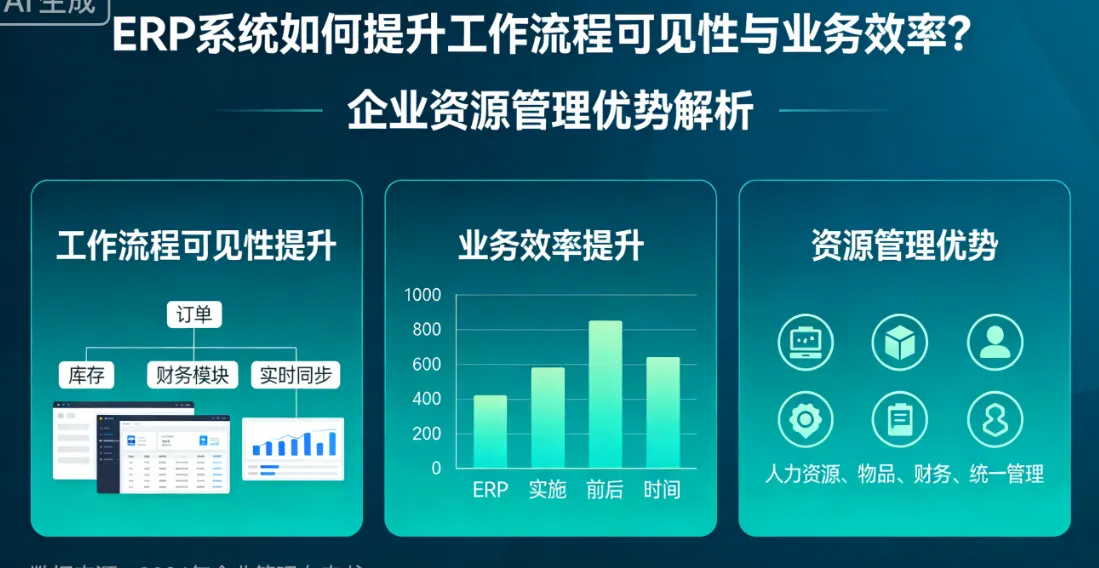
Resource optimization allocation: from local optimum to global optimum
The ERP system not only optimizes the efficiency of individual processes, but more importantly, achievesOptimal allocation of resources across processesThe system ensures the flow of resources to the most valuable and urgent business processes through comprehensive visualization and coordinated scheduling of resources such as manpower, equipment, materials, and funds.
In project-based enterprises, ERP systems can display real-time resource utilization, progress status, and profit prospects of each project, helping managers dynamically adjust resource allocation and ensure that critical projects are not constrained by resources. In manufacturing enterprises, the system comprehensively considers order priority, equipment capacity, material supply, and delivery deadline to generate the optimal production plan and maximize resource utilization. A certain engineering company has increased the utilization rate of key equipment from 68% to 85% through the resource management module of the ERP system, while shortening the average project delivery cycle by 22%.
This global optimization capability enables enterprises to surpass the limitations of local efficiency and maximize overall operational performance. When enterprises can clearly see how each resource unit is utilized and what value is generated, resource allocation decisions shift from empirical judgment to scientific calculation, and from passive response to active planning.
Conclusion: A virtuous cycle of transparency and efficiency
ERP systems have created a platform for enterprises by enhancing workflow visibility and business efficiencyA virtuous cycle of transparency and efficiencyProcess visibility exposes problems and bottlenecks, providing targets for efficiency improvement; The efficiency improvement further strengthens the reliability and predictability of process execution, enhancing overall operational transparency. This cycle drives enterprises to continuously optimize their operational models and build sustained competitive advantages.
In today's era where digital transformation has become a necessary path for the survival and development of enterprises, ERP systems are no longer just tools for recording business, but the core engine driving the transparency, efficiency, and scientific decision-making of enterprise processes. It helps enterprises integrate previously scattered, vague, and inefficient operational activities into a coordinated, clear, and efficient organic whole, enabling them to maintain agility and resilience in complex and changing business environments, and achieve sustainable high-quality development.
Ultimately, ERP systems provide not only a technical solution, but also a management philosophy: only visible processes can be effectively managed, and only measurable efficiency can be continuously improved. When enterprises embrace this transparent and data-driven management model, it lays a solid foundation for occupying an advantageous position in the competitive landscape of the digital age.