
Analysis of the Core Differences between ERP and OA Systems | Enterprise Management Selection Guide
The Two Pillar Systems in Enterprise Digital Transformation
In the field of enterprise management software, enterprise resource planning systems are often compared to office automation systems, but they undertake completely different management missions. As the digitalization process of enterprises deepens, the depth of understanding of these two systems directly affects the effectiveness of technology investment and the success or failure of digital transformation. ERP systems focus on the integration and optimization of core business processes and resources in enterprises, while OA systems are dedicated to improving efficiency and providing collaborative support for daily office affairs. Although the functional positioning, design concepts, and application scenarios of these two have intersections, they fundamentally serve different dimensions of enterprise operations and together form a complete puzzle of modern enterprise digital management.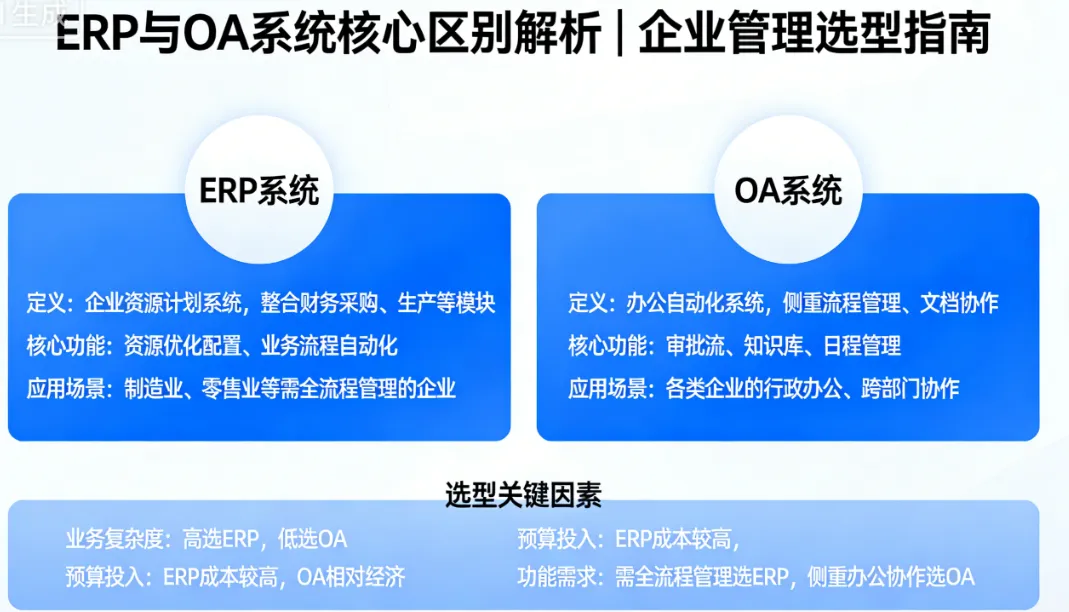
Core positioning difference: the distinction between resource integration and office collaboration
The fundamental difference between ERP system and OA system lies in their core positioning and design goals.The core of an ERP system lies in the comprehensive planning and integration of enterprise resourcesIt focuses on how to systematically allocate key resources such as people, finance, materials, and information of the enterprise to support the achievement of strategic goals. The design concept of ERP system originates from the concept of supply chain management, emphasizing the standardization of business processes, integration of data, and support for decision-making. It attempts to answer fundamental economic questions in business operations: what to produce, how much to produce, when to produce, what resources are needed, and how to control costs.
By contrast,The core positioning of OA system is to enhance the efficiency of collaborative office work within the organizationIt focuses on how to optimize the working methods of knowledge workers, promote information flow and team collaboration. The design concept of OA system originates from organizational behavior and management, focusing on daily office scenarios such as process approval, knowledge management, communication and collaboration, and task coordination. It mainly solves the problem of information transmission efficiency within the organization: how to make the right information reach the right people at the right time and promote efficient execution of actions.
This positioning difference is directly reflected in the frequency of system usage and user range. The typical users of ERP systems are business operators and management decision-makers of enterprises, and the frequency of use is closely related to specific business processes; The users of OA system almost cover all knowledge workers within the organization, with high frequency of use and scattered scenarios. The practice of a medium-sized manufacturing enterprise shows that the daily active users of its ERP system account for about 30% of the total number of employees, mainly concentrated in departments such as production, procurement, and finance; The daily active user ratio of the OA system exceeds 85%, covering almost all functional departments.
Functional architecture comparison: different paths of process driven and information driven
From a functional architecture perspective, ERP systems and OA systems exhibit completely different design logics.The ERP system adopts a process driven architectureBuild functional modules around the core value chain of the enterprise. A typical ERP system includes modules such as finance, procurement, inventory, production, sales, and human resources, which are deeply integrated and share unified master data and business rules. When a sales order enters the system, it will automatically trigger a series of chain reactions: inventory inspection, production planning, material procurement, financial accounting, etc., forming a complete automated business assembly line.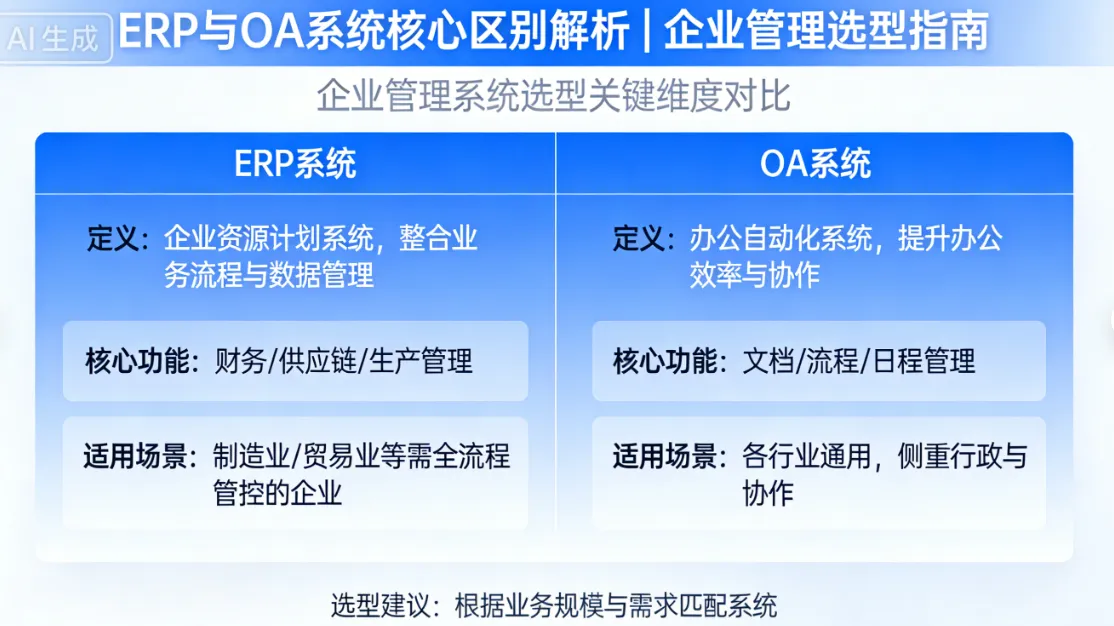
The OA system follows an information driven architectureBuild a functional system with documents, processes, knowledge, and communication as the core elements. A typical OA system includes modules such as process approval, document management, information release, schedule meetings, and task collaboration. These modules are relatively independent and mainly interconnected through information flow rather than data integration. When a leave application is circulated in the OA system, it mainly involves approval permissions and notification mechanisms, rather than directly related to salary calculation in the human resources system or scheduling adjustments in the production system.
This architectural difference is particularly evident when dealing with complex business scenarios. When a consumer goods enterprise is handling the process of launching new products, the ERP system is responsible for managing material procurement, production scheduling, cost accounting, and inventory allocation; The OA system coordinates market proposal approval, cross departmental meeting arrangements, distribution of promotional materials, and project progress tracking. The two have clear division of labor but complement each other: ERP ensures efficient allocation of physical resources, while OA ensures smooth and orderly flow of information.
Data Management Mode: Structured Transactions and Unstructured Collaboration
ERP systems and OA systems present a sharp contrast between structured and unstructured data management.The ERP system is centered around highly structured transaction dataEmphasize neatness, accuracy, and consistency. Every piece of data in the system - whether it's a sales order, purchase invoice, or production work order - has clear formatting standards, validation rules, and associations. This structured feature enables ERP systems to support complex business logic calculations and data analysis, such as cost accounting, profit analysis, and demand forecasting. The integrity, accuracy, and timeliness of data are directly related to the reliability of enterprise operations.
The OA system mainly processes unstructured collaborative information, including documents, emails, instant messages, forum posts, etc. This type of data has diverse formats and loose correlations, and its value is more reflected in the effective transmission of information content and the accumulation and sharing of knowledge and experience. The data management of OA systems emphasizes retrievability, accessibility, and shareability, rather than strict constraints on data consistency and integrity. A project report may contain various elements such as text, tables, charts, etc., which are constantly revised as the discussion progresses. This is in stark contrast to a sales contract in an ERP system that has a fixed format and cannot be changed arbitrarily once confirmed.
This difference in data management determines the different technical implementation focuses of the two systems. ERP systems typically require powerful relational databases to ensure ACID properties (atomicity, consistency, isolation, persistence) in transaction processing; And OA systems can more flexibly adopt technologies such as document databases and full-text search engines to optimize information retrieval and sharing experiences. In practice, more and more enterprises are seeking limited integration of their data, such as viewing key business indicators of ERP in OA systems or embedding OA approval processes in ERP processes, forming a complementary rather than a substitute relationship.
Implementation and application focus: standardized adaptation and flexible customization
There are significant differences in implementation methods and application modes between ERP systems and OA systems.ERP implementation emphasizes the standardization of business processes and the introduction of best practicesSuccessful ERP projects typically require in-depth analysis, redesign, and optimization of existing business processes, and even changes in organizational structure and job responsibilities to adapt to the management concepts embedded in the system. This implementation process is often complex and time-consuming, but once successful, it can bring fundamental operational efficiency improvements to the enterprise. Internationally renowned ERP vendors such as SAP and Oracle have built-in rich industry solutions and business process templates in their products, helping enterprises quickly deploy operational systems that meet industry standards.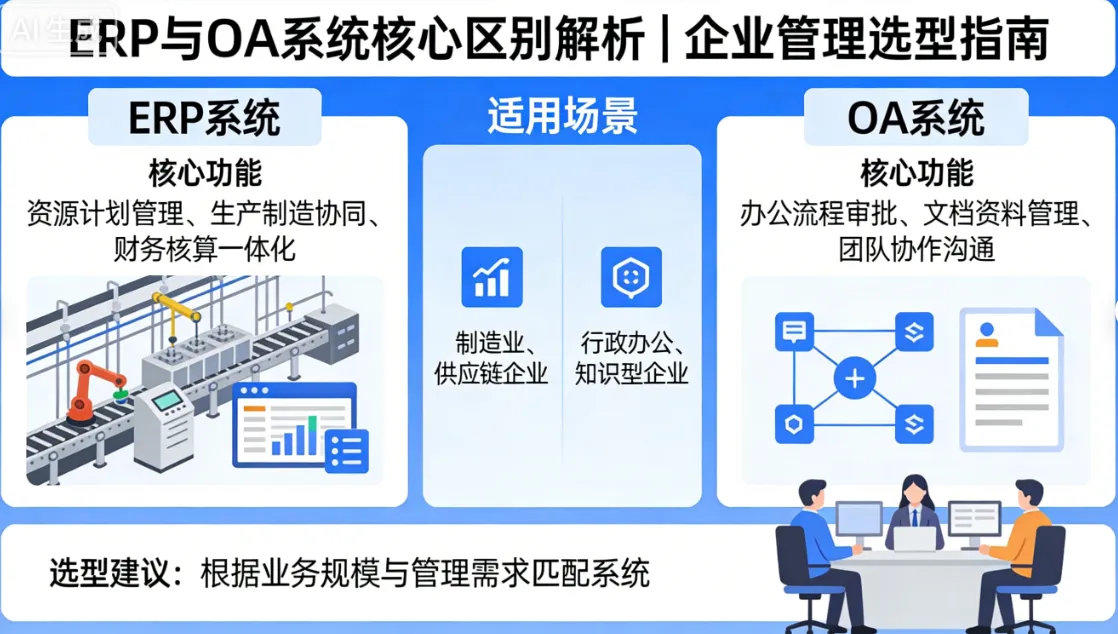
The implementation of OA system is more flexible and gradualUsually, there is no need for large-scale restructuring of the core business processes of the enterprise. Enterprises can selectively deploy functional modules such as process approval, document management, and collaboration platforms based on their own management needs, and gradually expand and deepen their applications during use. Many OA systems provide visual workflow designers and rich integration interfaces, supporting enterprises to quickly customize office processes that fit their own management habits. This flexibility enables OA systems to adapt to the needs of enterprises of different scales, industries, and management styles, but it may also lead to fragmented system functionality and information silos.
There are also differences in the value of investment returns between the two systems. The value of ERP systems mainly lies in the reduction of operating costs, the improvement of resource utilization efficiency, and the enhancement of decision-making quality, which often take a long time to fully manifest. The value of OA systems is more reflected in the improvement of office efficiency, the reduction of communication costs, and the improvement of employee satisfaction, which are usually more easily perceived and measured in the short term. The practice of a certain financial institution shows that one year after the ERP system was launched, the financial monthly settlement time was shortened by 65%, and the inventory turnover rate was increased by 40%; After the OA system was launched for three months, the average approval process time was reduced by 70%, and cross departmental meeting time was reduced by 30%.
Selection Decision Guide: Precise Matching of Enterprise Needs
Faced with the choice of ERP and OA systems, enterprises should not regard them as either or Single choice question, but should formulate reasonable digital strategies according to their own management pain points and development stages. ForEnterprises with high operational complexity, obvious resource constraints, and strong demand for standardizationIn industries such as manufacturing, retail, logistics, etc., ERP systems are usually a priority investment direction. These types of enterprises need to first solidify their operational management foundation through ERP systems, achieve digitalization and standardization of core business processes, and then consider optimizing office collaboration efficiency through OA systems.
ForKnowledge intensive, innovation driven, and relatively flat organizational structure enterprises, such as consulting, design, Internet and other industries, OA systems may be more able to meet their urgent needs for real-time collaboration and information sharing. These types of enterprises can prioritize deploying OA systems to improve daily office efficiency, while gradually introducing specific modules of ERP (such as finance and project management) to strengthen the management of key resources according to business development needs.
More and more medium-sized and large enterprises are choosingCollaborative deployment of ERP and OA systemsThe strategy is to achieve seamless integration between business processes and office collaboration through system integration. Common integration modes include calling ERP business data to assist decision-making in the OA approval process, automatically synchronizing the approval results of OA to ERP to trigger subsequent business operations, and embedding the instant messaging and task allocation functions of OA in the ERP operation interface. This collaborative model not only ensures the standardized and efficient operation of core business, but also takes into account the flexibility and convenience of daily office work, representing the development direction of enterprise digital management.
Regardless of the path chosen, enterprises should avoid falling into the selection trap of "functionality first", and instead return to the essence of management, deeply analyze their own business pain points, and clarify system construction goals. A digital solution that matches the company's strategy, business processes, and organizational culture is far more valuable than a feature rich but impractical technology platform. On the road of digital transformation, ERP and OA are not competitors, but partners who jointly help upgrade enterprise management. Understanding their core differences is the first step to effectively utilize these two systems.