
Clothing ERP Management Software: Improving Management Efficiency and Promoting Enterprise Transformation and Upgrading
Driven by the dual trends of consumption upgrading and digitalization, the clothing industry is undergoing unprecedented changes - transitioning from the traditional "mass production, channel distribution" model to a new model of "flexible production, precision marketing, and rapid response". However, during the transformation process, most clothing companies are plagued by inherent management pain points: poor supply chain coordination, complex and difficult to control inventory SKUs, disjointed order processes, serious data silos, and low efficiency and high error rates in manual management. This not only increases the operating costs of the enterprise, but also restricts its scale development. In this context, clothing ERP management software has emerged as a digital management tool tailored for the clothing industry. It breaks down the barriers of traditional management, achieves full chain, refined, and intelligent management of enterprises, and becomes the core engine for clothing enterprises to improve management efficiency, break through development bottlenecks, and promote transformation and upgrading.
The core pain points of the clothing industry are concentrated in supply chain and inventory management, which are also the core empowerment areas of clothing ERP management software. There are a wide variety of clothing product categories, and a massive number of SKUs can be divided by style, fabric, size, and color. Traditional inventory management relies on manual bookkeeping and inventory counting, which is not only time-consuming and labor-intensive, but also prone to problems such as discrepancies between accounts and reality, inventory backlog, and stockouts. Bestselling items miss market opportunities due to insufficient inventory, while unsold items accumulate for a long time, occupying warehouse space and working capital. Clearance at the end of the season also greatly compresses profit margins; At the same time, the clothing supply chain is lengthy, with information scattered across different departments and personnel from fabric procurement, pattern sampling, production and processing, to finished product warehousing and channel delivery. This lack of unified control leads to procurement delays, production disconnections, and delivery delays, further exacerbating the operational risks of the enterprise.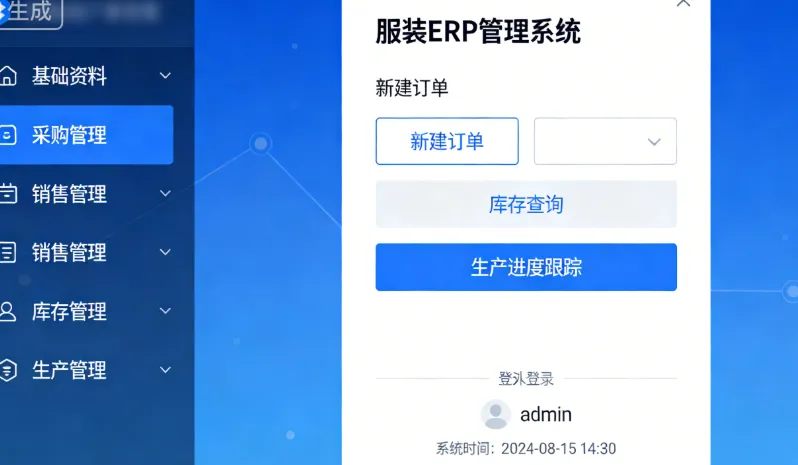
The clothing ERP management software has developed an integrated supply chain and inventory management module to address the aforementioned pain points, achieving full process closed-loop control from the source to the end. In terms of inventory management, the software supports fine-grained filing of all SKUs, establishing unique identifiers for different specifications of each product, and recording real-time lifecycle data such as inbound, outbound, transfer, inventory, and loss. Management personnel can view the real-time status and distribution of all inventory with just one click through the backend, without the need for manual reconciliation. At the same time, the software is equipped with an intelligent inventory warning function. Enterprises can set minimum and maximum inventory thresholds for different SKUs based on sales rhythm and procurement cycle. When the inventory is below the minimum threshold, the system automatically triggers a replenishment warning to remind the procurement department to connect with suppliers in a timely manner; When inventory exceeds the maximum threshold, a backlog warning is triggered to assist the operations department in quickly developing promotional and clearance strategies, achieving dynamic inventory balance, improving inventory turnover, and reducing capital occupation.
In terms of supply chain collaboration, clothing ERP management software has broken down information barriers in various links such as procurement, production, and delivery, achieving real-time data exchange and efficient process collaboration. In the procurement process, the system supports the establishment of a comprehensive supplier file library, which records supplier qualifications, fabric quotations, supply cycles, cooperation history, and other information. Through a data-driven rating system, it automatically scores suppliers based on dimensions such as on-time delivery rate and product qualification rate, helping enterprises quickly screen high-quality suppliers and optimize supplier structure; At the same time, the system can automatically generate procurement plans based on inventory gaps and order demands. After one click approval by management personnel, procurement orders can be directly synchronized to the supplier port. Suppliers receive orders in real time and provide feedback on production and shipping progress. Enterprises can accurately control procurement delivery time without repeated communication, avoiding procurement premiums and delays. In the production process, the system can break down order requirements into production tasks, synchronize them to the production workshop, track production progress, fabric loss, and process completion in real time, promptly identify problems in the production process and make quick adjustments to ensure accurate matching between the production process and order requirements, shorten the production cycle, and improve production efficiency.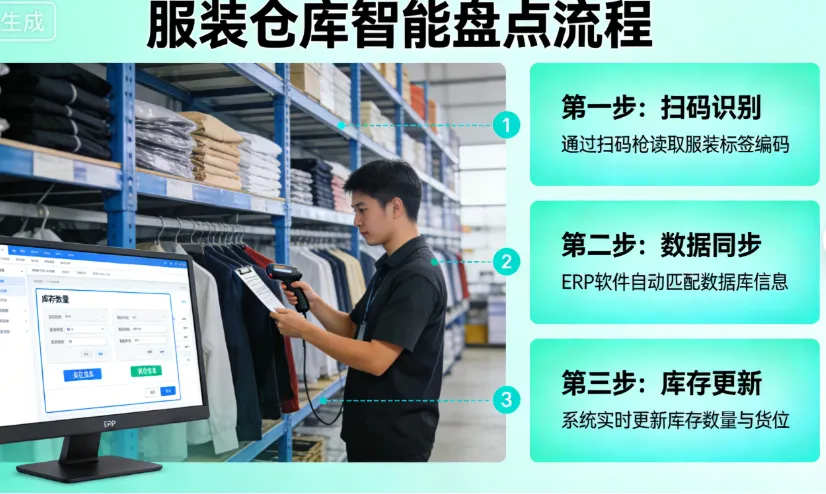
In addition to core supply chain and inventory management, the clothing ERP management software also achieves comprehensive digital management of orders, customers, finance, employees, and other dimensions, further improving the overall operational efficiency of the enterprise. In terms of order management, the software supports unified access to multi-channel orders. Whether it is offline store orders, e-commerce platform orders (Taobao, JD, Tiktok, etc.), or customized orders of key customers, it can be synchronized to the system with one key to achieve centralized statistics and unified processing of order data; During the order execution process, the system automatically matches inventory, pushes production/shipping tasks, and updates order progress in real-time. Management personnel can track the entire process, and customers can also query order status through a dedicated port, reducing communication costs, lowering the probability of wrong or missed orders, and improving customer satisfaction.
In terms of customer and financial management, the customer management module supports functions such as customer information filing, follow-up records, customer ratings, and payment tracking, helping enterprises accurately locate high-quality customers, optimize customer structure, and enhance customer stickiness; The financial management module realizes the full process digitization of procurement payment, sales collection, expense reimbursement, financial reconciliation, etc., automatically generating financial vouchers, profit statements, fund flow, etc., avoiding errors in manual accounting, reducing the workload of financial personnel, and providing accurate financial data support for enterprise managers to assist in scientific decision-making. The employee management module can set operational permissions based on job division, clarify the rights and responsibilities of each department and position, avoid unauthorized operations, and record employee work data to provide objective basis for performance evaluation and enhance team execution.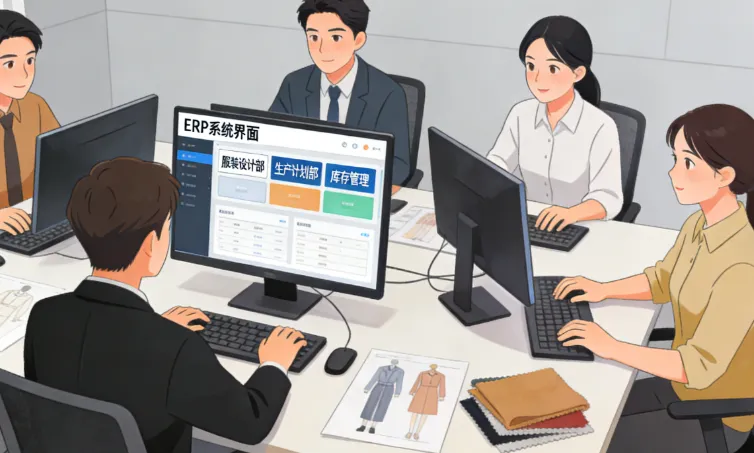
For clothing enterprises, digital transformation is not only about improving efficiency, but also reshaping core competitiveness, and clothing ERP management software is the key carrier to promote this transformation. The management mode of traditional clothing enterprises relies on experience and lacks data support for decision-making, often resulting in the problem of "brainstorming" decisions. However, clothing ERP management software integrates the entire chain data of the enterprise, generates multidimensional reports such as procurement analysis, inventory analysis, sales analysis, profit analysis, etc., and presents the operational status of the enterprise in visual charts, allowing managers to clearly grasp the advantages and disadvantages of the enterprise, and thus formulate more accurate procurement plans, production strategies, and sales plans, realizing the transformation from "experience management" to "data management".
In addition, the flexibility and scalability of clothing ERP management software can adapt to the needs of clothing enterprises of different scales and development stages. For small and medium-sized clothing enterprises, software can help them standardize management processes, reduce operating costs, improve management efficiency, and quickly get rid of the dilemma of manual management; For large and medium-sized clothing enterprises, software can achieve integrated management and control of multiple warehouses, multiple stores, multiple brands, and multiple channels, supporting the scale expansion and refined operation of enterprises, and breaking development bottlenecks. With the rise of flexible production, personalized customization, and fast fashion models in the clothing industry, clothing ERP management software can also be deeply integrated with MES production execution systems, CRM customer relationship management systems, WMS warehouse management systems, etc., further extending management boundaries and achieving digital upgrading of the entire value chain of enterprises.
Currently, the competition in the clothing industry is becoming increasingly fierce, with severe homogenization competition, changing market demand, and continuously rising costs. Digital transformation has become an inevitable choice for the survival and development of clothing enterprises. The clothing ERP management software, through digital and intelligent management methods, not only solves the pain points of low efficiency, chaotic processes, and data silos in traditional enterprise management, but also helps enterprises optimize resource allocation, reduce operating costs, improve market response speed, promote the transformation of enterprises from "traditional manufacturing+distribution" to "digital+intelligent", and achieve high-quality development.
From manual bookkeeping to intelligent control, from information silos to data interoperability, from experiential decision-making to data-driven, clothing ERP management software is reshaping the management mode and development pattern of clothing enterprises. In the future, with the continuous iteration of technologies such as artificial intelligence, big data, and the Internet of Things, clothing ERP management software will be further upgraded and optimized, incorporating more intelligent functions to provide clothing enterprises with more comprehensive and personalized digital solutions. For clothing enterprises, introducing clothing ERP management software is not only a shortcut to improve management efficiency, but also a key step in grasping industry development trends and achieving transformation and upgrading. Only by actively embracing digital transformation and leveraging the power of ERP software can they stand firm in fierce market competition and achieve sustainable development.