
Analysis of the influencing factors of ERP application failure in manufacturing industry - Shuntong Network
The "hidden reefs" and deep-seated problems of digital transformation in manufacturing industry
In the process of intelligent and digital transformation of manufacturing industry, enterprise resource planning system is widely regarded as a core tool to enhance core competitiveness and achieve refined management. However, this important investment comes with a high risk of failure that cannot be ignored. According to research and analysis conducted by Shuntong Network on hundreds of manufacturing enterprises, nearly 40% of ERP projects have not fully achieved their expected goals, and about 15% of projects can be clearly judged as failures. This not only causes direct economic losses of millions or even tens of millions of yuan, but also has a profound negative impact on the stability of enterprise operations and employee morale. These failures often stem not from a single technical flaw, but from the complex interplay of multidimensional factors such as strategy, management, processes, and people.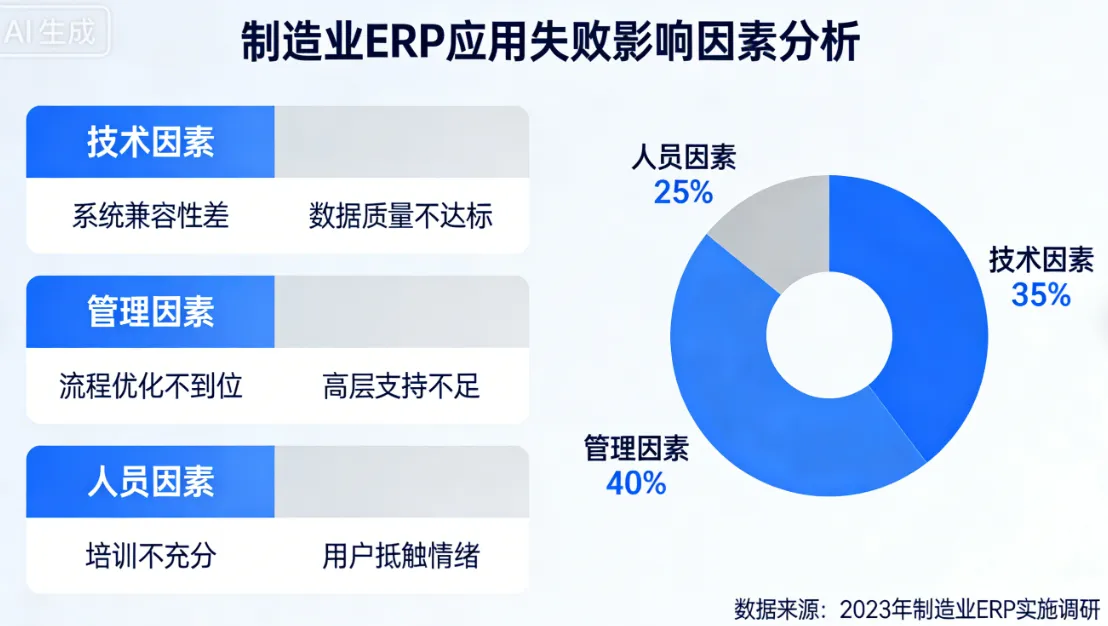
Lost at the strategic level: vague goals and absence of high-level leadership
The failure of ERP applications often lays hidden dangers at the beginning of project initiation.Ambiguity or misalignment of strategic objectivesIt is the primary risk factor. Many manufacturing companies simply equate ERP projects with the "previous set of new software" and fail to deeply integrate them with the company's long-term development strategy and business transformation goals. The project goal setting is too vague, such as "improving management level" or "achieving informatization", lacking quantifiable and traceable specific business indicators. Moreover, the unrealistic expectation of using an ERP system to solve all management problems at once will inevitably lead to the unlimited expansion of the project scope and ultimately lose control.
Accompanying the ambiguity of the goal isSubstantial absence of senior managersIn many failed cases, although the top management of the enterprise expressed support at the start of the project, they failed to continuously invest energy and authority in the implementation process. They completely entrust the project to the IT department or external consultants, keeping themselves out of the matter. However, ERP is essentially a profound processManagement ChangeWhen it comes to process restructuring, redistribution of responsibilities, and even organizational culture adjustment, without the firm push and key decisions from the top management, the project will inevitably face difficulties when it comes to departmental conflicts of interest or major process changes. Shuntong Network once analyzed a failed case of a medium-sized equipment manufacturing enterprise: due to the general manager's failure to personally coordinate the long-term differences in cost accounting rules between the production and finance departments, the project was stalled for six months at a critical stage and ultimately ended hastily. The system was only used for basic data recording.
Resistance to business processes: Failure to touch the core and lack of change management
The manufacturing industry has complex and interconnected business processes, and the key to the success of ERP lies in promoting the optimization and standardization of business processes. However, many failed projects fell through precisely at this point. The most common mistake isAutomated Inefficient ProcessesThe enterprise did not take advantage of the implementation of ERP to deeply diagnose and reconstruct inefficient and redundant existing processes, but instead required the system to fully mimic offline operations. This leads to ERP only becoming an electronic tool that solidifies old drawbacks, unable to bring about a leap in efficiency, and may instead highlight problems due to system rigidity. For example, a parts company's raw material requisition process is chaotic. It should have established a strict work order requisition system through ERP implementation, but chose to replicate the original verbal requisition mode in the system, and the problem of inaccurate inventory remains unsolved.
Meanwhile,Systematic deficiencies in change managementAmplify the resistance to process refactoring. The new processes and rules brought by ERP will inevitably change employees' work habits and vested interests. Lack of effective communication, training, and guidance can make employees feel threatened and confused, leading to negative resistance or even public opposition. Shuntong Network found that successful enterprises will establish a complete change management system: from the early stage of the project, they will clearly communicate "why change" and "what will become", deeply involve key users in process design, provide sufficient and role specific training, and adjust performance evaluation indicators to guide new behaviors. However, failed companies often only provide simple operational training, neglecting the transformation of thinking and culture, resulting in an awkward situation where "the system has been launched, but employees still use old methods".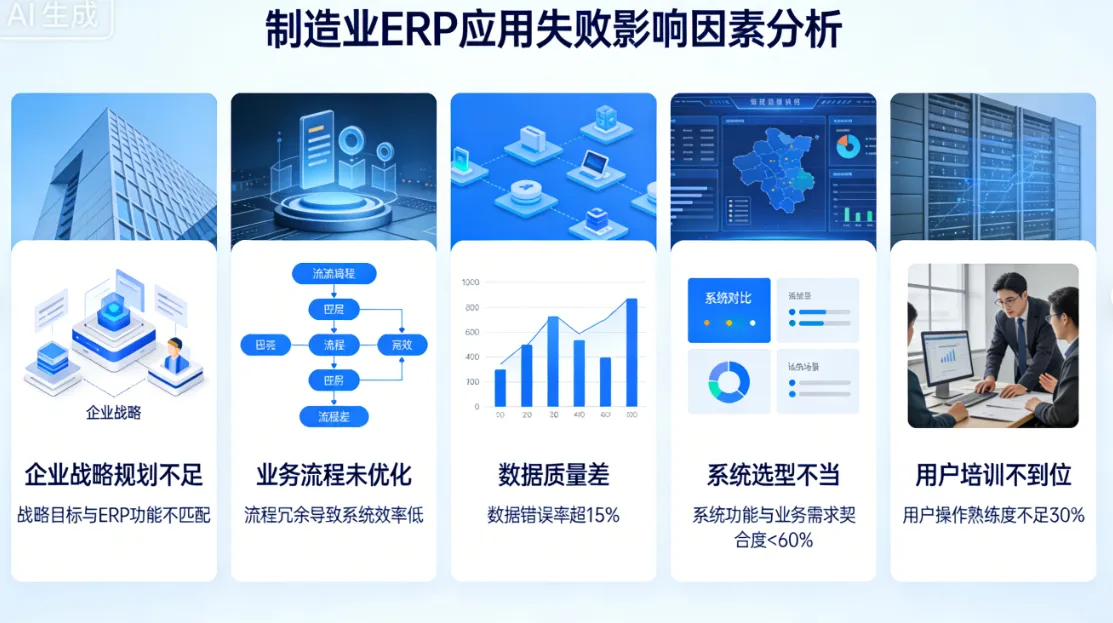
The fragility of data foundation: inadequate preparation and lack of governance
The effective operation of manufacturing ERP systems heavily relies on high-quality, standardized master data and business data.Serious deficiencies in data preparation and long-term deficiencies in data governanceIt is the direct technical reason that causes the system to fail to run or even be abandoned after going online. Many companies are shocked to discover historical legacy issues such as confusion in material coding (multiple codes for one item, multiple items for one code), inaccurate BOM (Bill of Materials), and missing process routes during project initiation. Under time pressure, only rough data cleaning and import can be carried out, planting a "time bomb" for the system. After the system goes online, an incorrect basic material price may lead to distorted monthly cost accounting; An inaccurate BOM will make the MRP (Material Requirements Planning) calculation results completely unreliable.
The deeper problem lies in the lack of sustainedData governance mechanismThe launch of ERP is not the end point of data work, but the starting point. If data ownership, data quality standards, and daily maintenance processes are not established, the data quality within the system will rapidly deteriorate. For example, if warehouse personnel do not enter the warehouse receipt in a timely manner according to regulations, or if procurement personnel create new supplier files without checking for duplicates, the system will quickly lose credibility. Shuntong Network Consultant summarized that data issues are never technical problems, but management problems. An enterprise without a data responsibility system and without incorporating data quality into its assessment is bound to have difficulty in realizing the full value of its ERP system.
Partner selection and project management errors
Misselection and excessive reliance on implementation partnersIt is an external critical risk. Some companies focus too much on low software license fees and overlook the industry experience, methodological maturity, and long-term service capabilities of their implementation consulting teams. A consulting team lacking a manufacturing background may find it difficult to understand industry characteristics such as workshop scheduling, labor rates, and work in progress flow, and their configuration plans may be severely unrealistic. In addition, the mentality of outsourcing the entire project to the enterprise itself is extremely dangerous, leading to insufficient internal knowledge transfer. Once the consultant leaves, no one can maintain and deepen the application of the system.
At the project management level,Time pressure and scope out of control detached from realityIt is a common cause of failure. In order to meet the unrealistic online requirements of the management (such as "must go online before New Year's Day"), the project team compressed key links such as process testing, user training, and data verification, resulting in the system going online with problems and numerous issues. Another situation is that the business department constantly proposes new customized requirements during the implementation process, and the project team lacks a strict change control process, resulting in unlimited expansion of the project scope, budget overruns, and delays in core functions.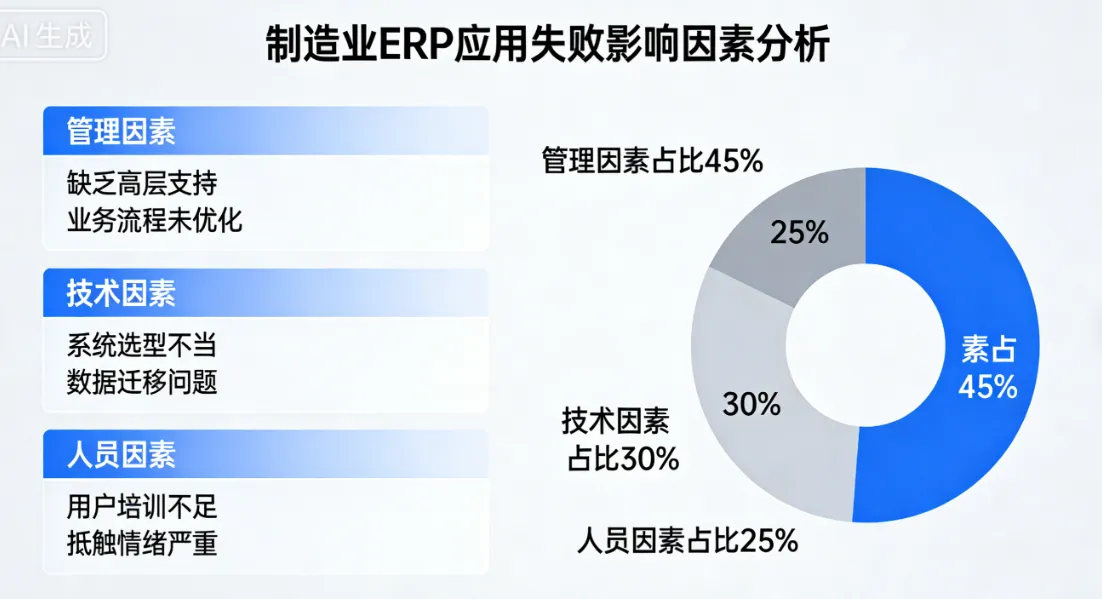
Continuous challenges in technology and operations
Finally,Shortsightedness of technical architecture and lack of operational capabilitiesIt will affect the long-term vitality of the system. For example, choosing outdated technology platforms may make it difficult to integrate new applications such as the Internet of Things and big data analysis in the future; Or initially neglecting system performance and scalability design in order to save costs, resulting in slow system response after business growth. After going online, if a company does not establish an internal operations team with business understanding and technical capabilities, it will not be able to quickly solve daily problems and respond to new user needs. The system will gradually become rigid and disconnected from business development.
Observation and Suggestions on Shuntong Network
Based on years of industry observation and service experience, Shuntong Network believes that the success of ERP applications in the manufacturing industry is not accidental, and it requires enterprises to view it as a key factorStrategic Driven Management Change ProjectAnd not just a simple IT project. Enterprises must be led by the top management, clarify business driven project goals, invest sufficient resources in optimizing and restructuring business processes, and attach great importance to data infrastructure and change management. At the same time, it is important to carefully select partners who truly understand manufacturing and insist on deep team involvement to establish long-term operational and optimization capabilities. Only by avoiding these "reefs" can manufacturing enterprises master the powerful tool of ERP and truly sail towards the deep sea of digital operations and intelligent manufacturing.