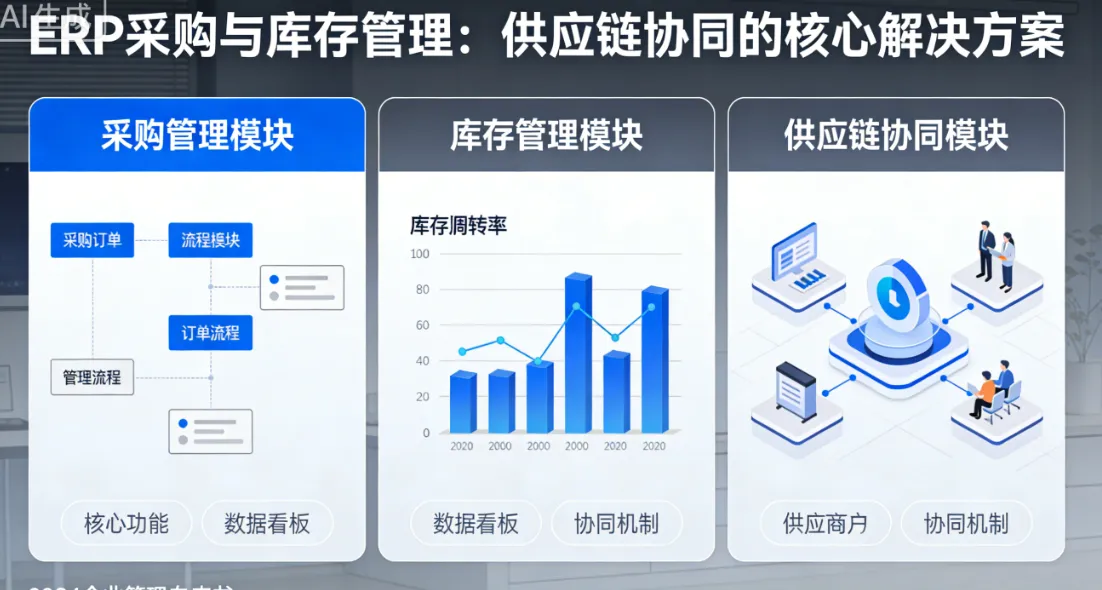
ERP Procurement and Inventory Management: The Core Solution for Supply Chain Collaboration
The core challenges and digital breakthroughs of modern supply chain management
In today's rapidly changing global economic landscape and market demand, the agility, resilience, and efficiency of the supply chain have become key factors determining a company's competitiveness. Under the traditional mode, procurement and inventory management often operate independently, forming information silos, leading to a series of operational difficulties such as distorted demand forecasting, high inventory costs, and slow response times. ERP system, as the digital hub of enterprise operations, is providing a systematic and intelligent core solution for building supply chain collaboration through its integrated procurement and inventory management modules. It not only breaks down departmental barriers, but also reshapes the complete value chain from suppliers to customers.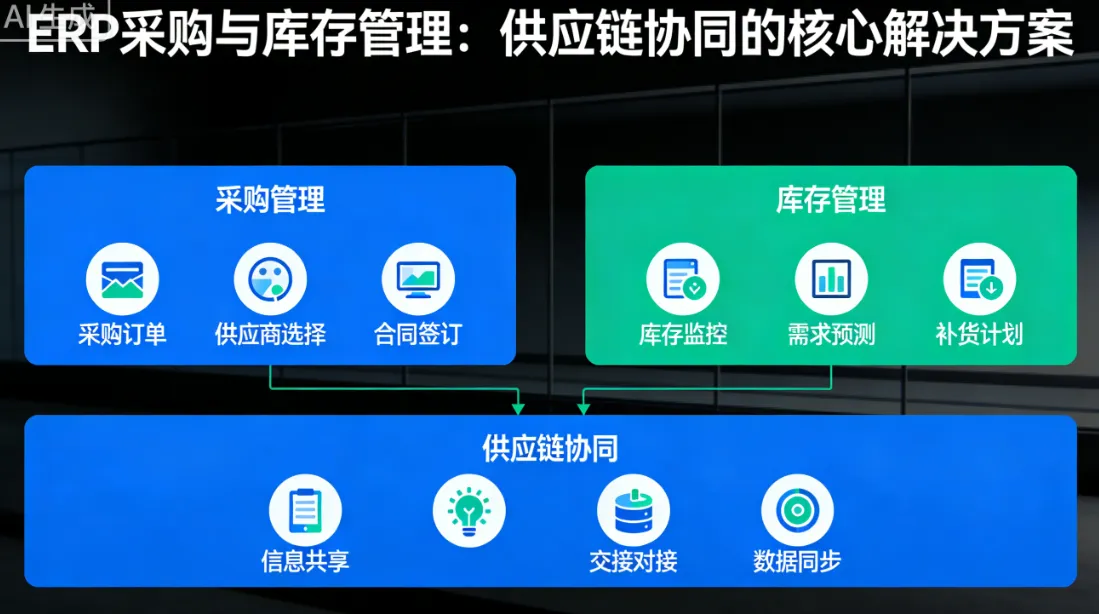
Intelligent transformation of procurement management: from transaction execution to strategic collaboration
Traditional procurement management is often limited to order execution and price negotiation, while ERP systems elevate it to a new level of strategic collaboration. The system has built an intelligent procurement decision support system by integrating historical procurement data, supplier performance evaluation, market intelligence, and internal demand planning. Based on the precise calculation of the material requirement planning module, the system can automatically generate procurement suggestions, taking into account the economic order quantity, supplier delivery cycle, price fluctuation trend, and contract terms, to achieve the optimization of total cost of ownership, rather than just pursuing the lowest purchase unit price.
Supplier relationship management is the deep value of the ERP procurement module. The system has established a dynamic supplier lifecycle file, continuously tracking key performance indicators such as on-time delivery rate, quality qualification rate, response speed, and price stability. Through scientific evaluation models, enterprises can optimize their supplier structure, implement differentiated cooperation strategies, and tilt their procurement share towards high-performance partners. A certain automotive parts manufacturer implemented a supplier collaboration plan through an ERP system, sharing the demand forecast for the next 12 weeks with core suppliers, which shortened the average stocking cycle of suppliers by 30% and reduced production interruptions caused by material shortages by 65%.
The automation and transparency of the procurement process have significantly improved operational efficiency. The entire process, from demand application, sourcing and price comparison, contract signing to order execution, acceptance and payment, seamlessly flows within the system and is visible in real-time. The introduction of electronic procurement platforms enables enterprises to access a broader supplier network and implement advanced procurement strategies such as reverse auctions. Procurement personnel are able to free themselves from tedious transactional work and focus on high-value activities such as strategic sourcing, cost analysis, and supplier development.
Precise control of inventory management: seeking dynamic balance between ensuring supply and optimizing costs
Inventory is the "precipitant" of enterprise liquidity, and the level of inventory management directly affects the efficiency of funds and customer service. The inventory management module of the ERP system establishes a scientific dynamic balance mechanism between ensuring supply and optimizing costs through demand forecasting, safety stock calculation, and inventory classification strategies.
Based on sales forecasts, production plans, and historical consumption data, the material requirement planning engine of the ERP system can accurately calculate the demand for each material in future time periods, and automatically suggest replenishment time points and order quantities. Unlike traditional empirical judgment or static safety stock models, the system dynamically adjusts the safety stock level based on parameters such as demand volatility and supply chain reliability. After implementing ERP inventory optimization in a fast-moving consumer goods enterprise, the overall inventory level decreased by 25% while maintaining a service level of 98%, releasing a large amount of working capital.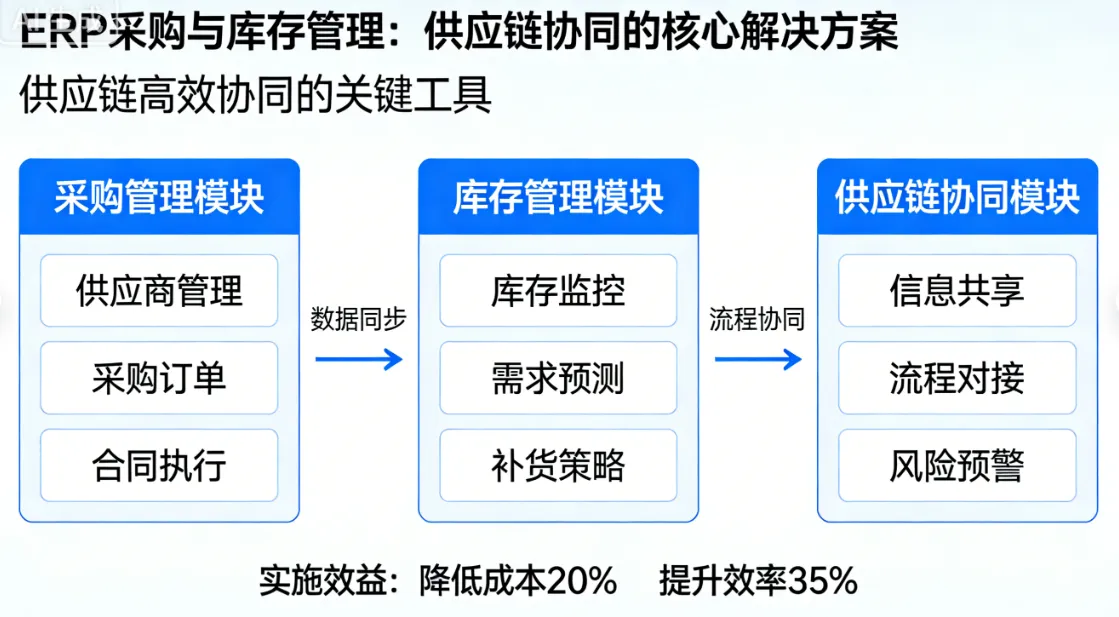
Refined inventory classification management is another advantage of ERP systems. The system can classify materials into ABC-XYZ categories based on multidimensional attributes such as material value, demand frequency, and procurement cycle, and implement differentiated management strategies for different categories. High value critical materials may adopt supplier managed inventory or consignment models, while low value general materials can reduce costs through economic bulk procurement. Real time visualization and unified allocation of omni channel inventory are particularly important in omni channel retail environments. The system can intelligently decide which warehouse or store to fulfill orders from based on real-time inventory data, achieving maximum inventory utilization efficiency.
The digital link of supply chain collaboration: information sharing and process integration
As a digital link for supply chain collaboration, the core value of ERP system lies in achieving cross organizational information sharing and process integration. Through supplier portals or integrated methods such as EDI, enterprises can establish secure and efficient digital connections with upstream and downstream partners.
The collaboration of demand information is the foundation. Enterprises can share the predicted and order information that has been integrated and verified through ERP systems with key suppliers, enabling them to plan production capacity and materials in advance. A certain electronic manufacturing enterprise has increased the sharing granularity of predictive information from "monthly" to "weekly" through an ERP collaborative platform, resulting in a 40% increase in supplier stocking accuracy and an 18% decrease in overall supply chain inventory levels.
The transparency of order execution status enhances collaboration efficiency. Suppliers can view order status, delivery requirements, and payment progress in real-time through the portal, and can self maintain shipping notifications and ASN (Advance Shipping Notification). The recipient can complete the acceptance preparation before the goods arrive, and quickly complete the warehousing through scanning after arrival. The information is automatically synchronized to the financial system to trigger the payment process. This end-to-end automation has reduced the average order fulfillment cycle by over 20%.
At a deeper level, ERP systems supportCollaborative planning, forecasting, and replenishmentWaiting for advanced supply chain models. By sharing point of sale data, inventory levels, and promotional plans, all parties in the supply chain can jointly develop plans based on the same set of data, significantly reducing the "bullwhip effect" and enhancing the overall ability to respond to market changes.
Embedded mechanism for cost control and risk management
The ERP system embeds cost control and risk management into daily operational processes through deep integration of procurement and inventory management. In the procurement process, the system not only manages order prices, but also comprehensively tracks logistics costs, quality control costs, payment terms costs (such as cash discounts), etc., achieving refined management of total cost of ownership. The contract management module ensures that all procurement activities comply with established frameworks and avoid compliance risks.
The analysis and control of inventory holding costs are more refined. The system can accurately calculate and allocate storage occupancy fees, capital interest, insurance costs, and loss costs to each inventory unit, providing a true cost basis for inventory decision-making. A furniture manufacturer found through ERP analysis that the actual holding cost of a certain type of large volume and slow turnover finished product inventory has exceeded its gross profit, and thus decisively adjusted the production and marketing strategy of the product line.
In terms of risk management, the system provides multi-dimensional warning mechanisms. For supply risks, it is possible to monitor the financial health, regional risks, and delivery performance trends of suppliers; To address demand risks, the accuracy of sales forecasts and inventory turnover anomalies can be tracked; For inventory risk, early warning of stagnant materials and expiration date issues can be provided. These warnings enable companies to respond in advance rather than passively.
Data driven continuous optimization and future evolution
The ultimate value of an ERP system lies in its accumulated data assets and the continuous optimization capabilities driven by them. The massive data accumulated by the system, including purchasing price trends, supplier performance, inventory turnover, and demand patterns, can be transformed into profound supply chain insights through built-in business intelligence tools.
Enterprises can analyze the total cost structure under different procurement strategies and identify opportunities for savings; Evaluate the service level and cost-effectiveness of different inventory models, and continuously optimize parameters; By analyzing the impact of material completeness rate on production planning, improve the focus of supplier collaboration. These data-driven analyses make supply chain optimization a measurable, traceable, and modifiable scientific process.
Looking ahead, ERP procurement and inventory management are accelerating their integration with new technologies such as the Internet of Things, artificial intelligence, and blockchain. IoT sensors enable real-time automatic inventory counting and status monitoring of inventory; AI algorithms provide more accurate demand forecasting and anomaly detection; Blockchain technology may reshape the traceability and trust mechanisms of the supply chain. These evolutions will further enhance the intelligence level and collaborative efficiency of the supply chain.
Conclusion: Building a resilient, agile, and efficient modern supply chain
In a business environment full of uncertainty, building a supply chain that is resilient, agile, and efficient has become a strategic priority for enterprises. The ERP system provides a core solution for enterprises to achieve deep collaboration in the supply chain through its integrated procurement and inventory management functions. It not only optimizes internal operational efficiency, but more importantly, connects isolated business entities into a collaborative value network by connecting upstream and downstream information flows and processes. When procurement is no longer a simple transaction, and inventory is no longer a static accumulation, but an organic component of the entire supply chain's intelligent collaboration, enterprises truly gain the ability to continuously create competitive advantages in complex markets. This is not only a technological victory, but also a manifestation of management wisdom and collaborative spirit.