
In which industries is ERP applied
The enterprise resource planning system was originally born as a management tool for the manufacturing industry, but after decades of evolution and development, its application boundaries have far exceeded the walls of factories and penetrated into almost all economic fields that require resource planning and process management. Today, ERP is no longer an exclusive tool for a certain industry, but has become a cross industry universal management language and digital infrastructure. Its core concept - integrating internal and external resources of the enterprise, optimizing business processes, and achieving data-driven decision-making - has universality, but its specific functional modules, implementation priorities, and value realization methods have different emphases in different industry backgrounds.
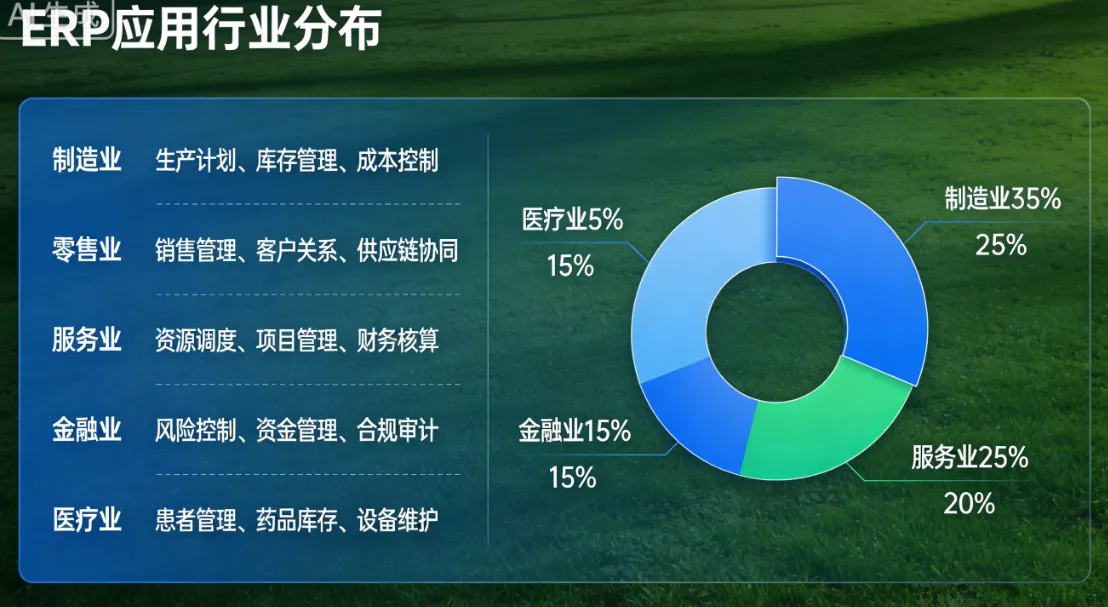
Manufacturing industry: the birthplace and benchmark for deep application of ERP
The manufacturing industry is undoubtedly the oldest and most mature field for the application of ERP systems. This stems from the inherent complexity of the manufacturing industry: it involves a long value chain from raw material procurement, inventory management, production scheduling, quality control to finished product distribution, requiring precise coordination of various resources such as materials, equipment, manpower, and funds. Although the production modes of discrete manufacturing industries (such as automotive, machinery, electronics) and process manufacturing industries (such as chemical, pharmaceutical, and food) are different, they both heavily rely on ERP for management. In the discrete manufacturing industry, the core of ERP is material requirement planning and advanced production scheduling, ensuring that thousands of components arrive at the correct assembly line at the right time; In the process manufacturing industry, ERP focuses more on formula management, batch tracking, compliance, and yield analysis. A large automobile manufacturer can synchronize the delivery of parts from hundreds of suppliers worldwide with the real-time production pace of the final assembly plant through an ERP system, achieving just in time production and minimizing inventory holding costs.
Retail and Distribution Industry: Coping with Consumer Driven Complex Networks
In the retail and distribution industry, ERP systems are the nerve center for dealing with massive SKUs, multi-channel sales, rapid circulation, and fierce price competition. The ERP here is usually deeply integrated with supply chain management, customer relationship management, and e-commerce platforms. Its core value lies in achievingEnd to end inventory visualization and demand perceptionFrom the central warehouse to the regional distribution center, and then to each store or online order fulfillment center, the ERP system provides real-time and unified inventory views, supporting intelligent replenishment, allocation, and omni channel order fulfillment (such as "online ordering, store self pickup"). For fast-moving consumer goods giants, ERP systems can analyze point of sale data, promotional activities, and seasonal factors, generate accurate demand forecasts, drive the collaborative operation of the entire supply chain, and minimize losses and out of season inventory while ensuring shelf availability.
Professional Service Industry: From Project Management to Resource Optimization
The application of ERP in professional service industries such as consulting firms, accounting firms, law firms, and architectural design institutes has overturned the stereotype that ERP is only suitable for the production of tangible products. In these industries where knowledge and human resources are the core assets, ERP has evolved intoA comprehensive operation and management platform centered on projectsThe focus of the system is project management, time and cost accounting, resource scheduling, and customer relationship management. Consultants or engineers record daily work inputs into the system, and ERP can automatically calculate real-time costs, profits, and progress for each project, and associate them with customer bills. This solves the biggest management challenge in the service industry: how to accurately measure the cost and value of intangible services, and how to allocate the most suitable talents to the most suitable projects to achieve maximum resource utilization. An international consulting company has achieved visual pooling of global expert resources through an ERP system, reducing project team formation time by 40% and increasing project profitability by 15%.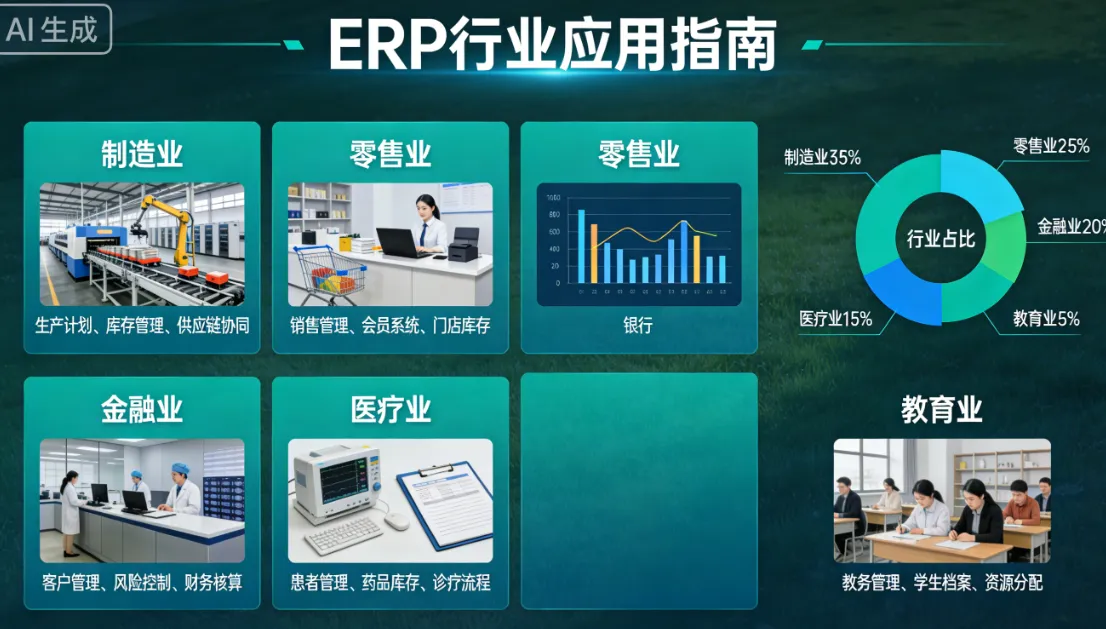
Healthcare and Life Sciences: Pursuing Excellence in Operations under Compliance Constraints
Medical and health institutions (such as hospitals and chain clinics) and life science companies (such as pharmaceuticals and biotechnology) are special but crucial areas for ERP application. These industries are facing extremely strict regulatory oversight (such as GMP, GxP, HIPAA) while pursuing operational efficiency. Therefore, the application of ERP system here isThe dual dance of efficiency and complianceIn hospitals, ERP integrates finance, human resources, supply chain, and asset management to ensure full traceability and cost control from drug and equipment procurement, inventory management to patient billing. In pharmaceutical companies, ERP not only manages procurement and production, but more importantly, supports complete batch records to ensure that every step from raw materials to finished products meets quality standards, providing an immutable data chain for auditing. Compliance has been embedded as part of the system process, rather than an additional check afterwards.
Public sector and non-profit organizations: enhancing efficiency and transparency
Government agencies, education departments, and large non-profit organizations are increasingly becoming important users of ERP. Their demand, although not aimed at profitabilityStrict control of fiscal funds, efficient utilization of resources, and transparency of operationsHas extremely high requirements. In government departments, ERP systems integrate budget preparation, procurement, personnel, and payment processes, strengthen fiscal discipline, and improve the efficiency of public service delivery. In universities, ERP systems (often referred to as campus management systems) manage the entire lifecycle of students from enrollment to graduation, faculty resources, research funding, and campus facilities. It helps these organizations maximize the completion of their social mission within limited budget constraints and provide clear accountability reports to the public or donors.
Penetration of emerging and characteristic industries
The application landscape of ERP is still expanding. inConstruction industry and engineering project managementERP manages complex material procurement, subcontractor coordination, project costs and schedules, and addresses cross regional and long-term operational challenges. inLogistics and Transportation Industry, ERP optimizes fleet management, warehousing operations, freight settlement, and customer service. even inAgriculture and food processingIn the field, modern farms and food companies utilize ERP for planting planning, harvest management, traceability tracking, and supply chain coordination to meet quality and safety requirements from farmland to dining tables.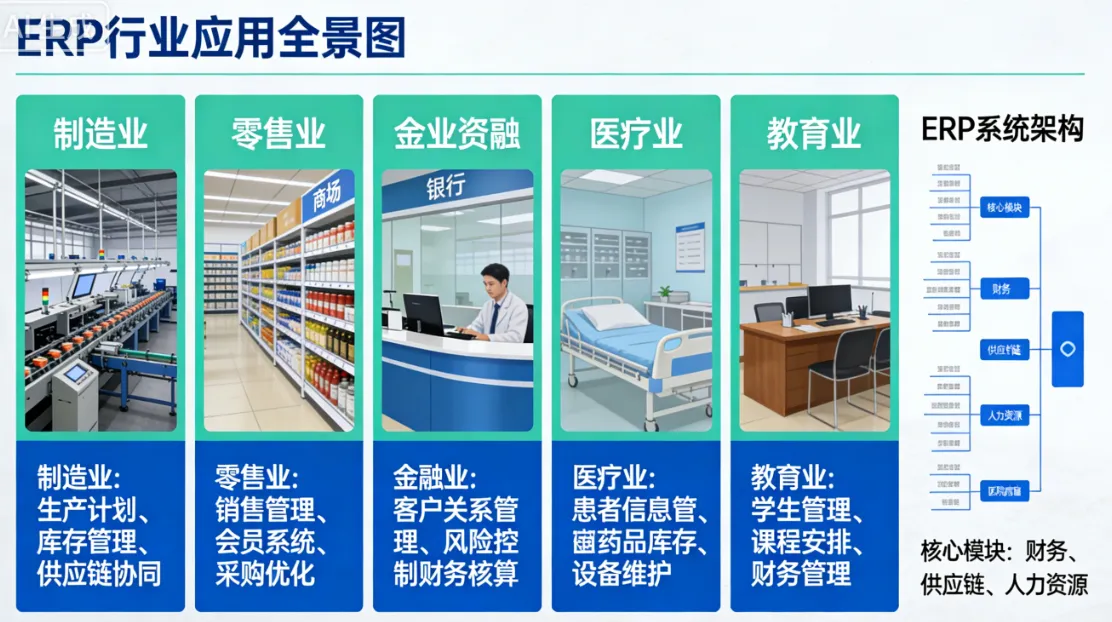
From factory workshops to retail shelves, from hospital wards to university lecture halls, from construction sites to law firms, ERP systems have penetrated into the capillaries of social and economic operations. Behind its widespread application, there are different industries thatStandardization of operations, integration of data, scientific decision-making, and optimization of resourcesThe common pursuit. Although ERP solutions from different industries have diverse functional configurations, their core logic remains consistent: through an integrated system, breaking down departmental walls and data silos, allowing enterprises (or organizations) to operate collaboratively like precision instruments, thereby building unique and sustainable competitive advantages in their respective markets or fields. In the future, with the integration of technologies such as cloud computing and artificial intelligence, the industry adaptability and value creation ability of ERP will continue to deepen and expand.