
Full Analysis of ERP Production Management: Application Guide for Process and Discrete Enterprises | Shuntong Network
In the wave of digital transformation in the global manufacturing industry, production management, as a core value chain link of enterprises, directly determines their market competitiveness in terms of efficiency and flexibility. However, there are essential differences in the production modes of different types of manufacturing enterprises, and their requirements and application paths for ERP systems are also vastly different. Process based and discrete manufacturing, as two fundamental paradigms, form a dual track for the digital upgrading of the manufacturing industry in terms of production logic, management difficulties, and ERP implementation points. Based on years of in-depth service experience with hundreds of manufacturing enterprises, Shuntong Network systematically analyzes the application differences and implementation guidelines of ERP in two types of enterprises, providing professional insights for enterprises to choose and configure solutions that fit their own characteristics.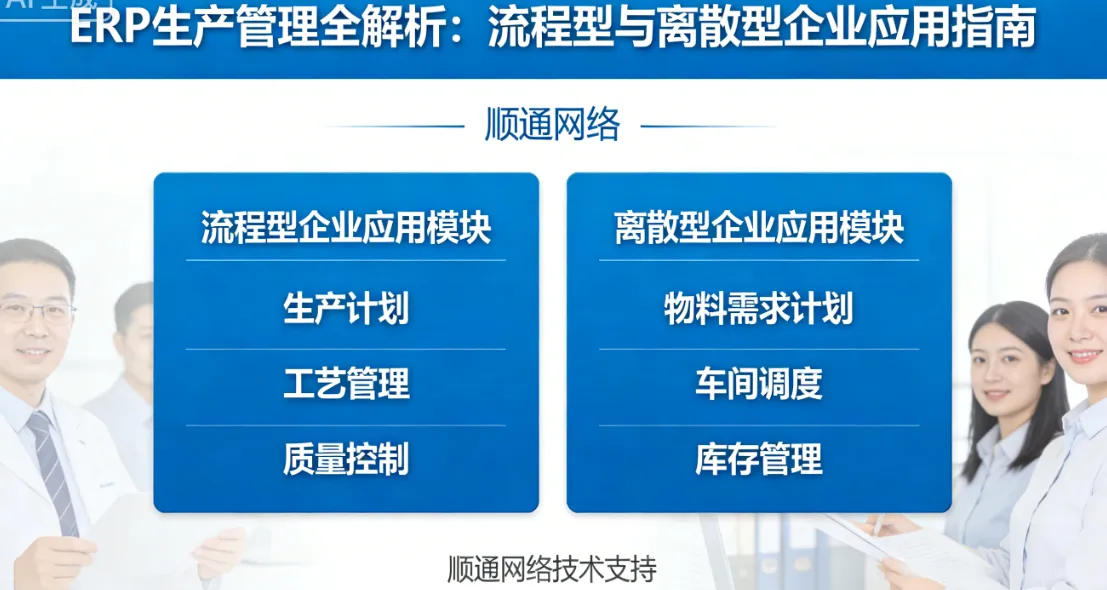
The division of production modes: continuous chemical changes and discrete physical assembly
The prerequisite for understanding the differences in ERP production management applications is to accurately grasp the fundamental differences between process based and discrete manufacturing.Process based manufacturingIn industries such as chemical, pharmaceutical, food and beverage, and steel, raw materials are transformed into final products through continuous chemical reactions, mixing, separation, or heat treatment processes with formulas or formulations as the core. Its production is usually carried out in batches or continuously, with output measured by volume or weight. The products have the characteristics of homogeneity, high traceability requirements, and relatively fixed production paths. For example, a pharmaceutical company producing antibiotics requires precise control of the temperature, pressure, time, and raw material ratio of the reaction vessel. Each batch must have complete production records to comply with strict GMP regulations.
Discrete manufacturingFor example, in the fields of automobiles, machinery, electronics, and furniture, the material list is the core, and different components are combined into the final product through a series of processing and assembly processes. Its production is carried out by piece or batch, and the output is measured by quantity. The product structure is complex, the process is flexible and varied, and production scheduling is a management difficulty. For example, a car parts company producing a gearbox needs to assemble hundreds of parts in strict process sequence, each part may come from different suppliers or internal workshops, and the production plan requires precise coordination of production capacity and material supply in each link. These two types of enterprises have systematic differences in BOM structure, production instructions, cost accounting, quality control, and other aspects, which determine that ERP solutions must be tailored.
ERP application in process oriented enterprises: formula accuracy, batch tracking, and compliance control
For process oriented manufacturing enterprises, the core functions of ERP systems must revolve around the three pillars of "formula management, batch lifecycle tracking, and strict compliance".Formula management moduleIt is not just a list of raw materials, but a comprehensive instruction set that includes precise ratios of main and auxiliary materials, process parameters (temperature, pressure, time), equipment requirements, quality inspection points, and output rates. The advanced ERP system supports formula version management, substitute material rules, and scaling (such as from laboratory trials to large-scale production). A specialty chemical company implemented an ERP system through Shuntong Network to digitize the management of thousands of formulas, achieving 100% accuracy in data transfer from research and development to mass production of new products, avoiding errors in traditional paper-based transmission.
Batch Tracking and GenealogyIt is the lifeline of the process industry, especially in the field of food and medicine. The ERP system needs to establish a unique identity for each batch of raw materials, work in progress, and finished products, and record all the processes, equipment, operators, quality inspection data, and associations between previous and subsequent batches that they have gone through during the production process. When a quality issue occurs, the system must be able to achieve full traceability from finished products to raw materials within a few minutes, or from a batch of problematic raw materials to all affected products. This' one click traceability 'capability is not only a requirement for quality control, but also an essential tool for responding to regulatory audits and product recalls.
In terms of compliance, the ERP system embeds the requirements of industry regulations (such as FDA 21 CFR Part 11, EU GMP) into the process. The system ensures the validity of electronic signatures, the integrity of audit trails, the immutability of data records, and automatically generates compliance reports. When deploying ERP for a pharmaceutical company, Shuntong Network specially strengthened the electronic batch recording function, reducing the average batch release review time from 5 days to 1 day, and successfully passed the flight inspection of the drug regulatory department.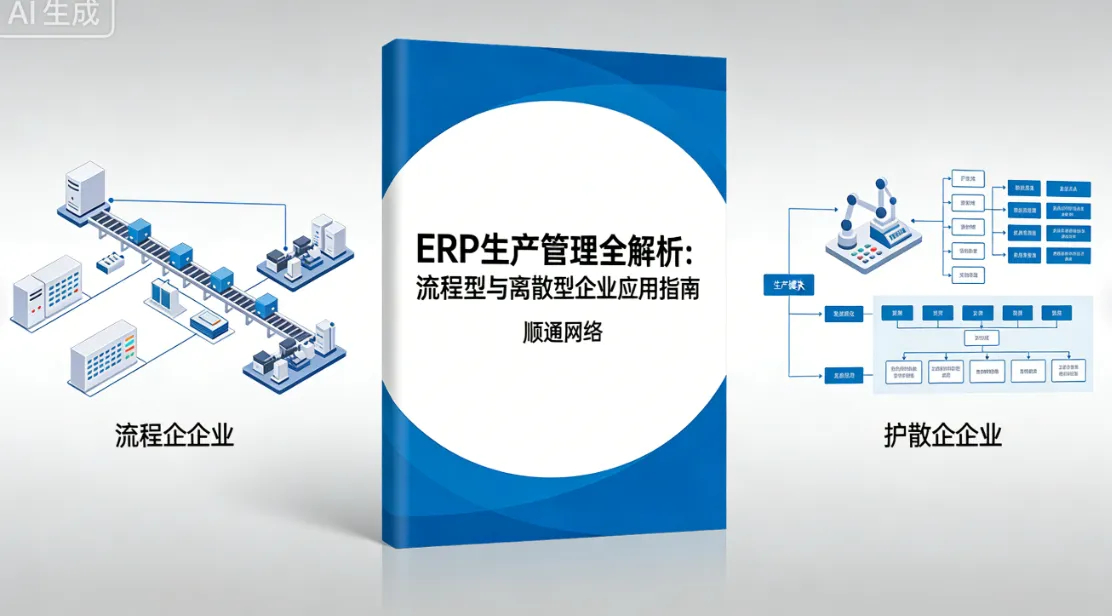
ERP application in discrete enterprises: multi-layer BOM, complex scheduling, and fine management of work in progress
The complexity of ERP application in discrete manufacturing enterprises mainly lies in the refined management of product structure and production scheduling.Multi layer material listIt is the starting point of management. The BOM of a complex product (such as a construction machinery) may contain tens of thousands of records, structured into seven or eight levels. ERP systems not only need to accurately maintain this static structure, but also need to manage its dynamic changes - how to timely and accurately transmit design changes to production, procurement, and inventory modules to avoid mixing old and new versions of materials. Shuntong Network helped an equipment manufacturing enterprise restructure its engineering BOM to manufacturing BOM conversion process, reducing the time for change notifications to the production line from one week to real-time, and reducing rework caused by version errors by 70%.
Advanced Planning and SchedulingIt is the core and soul of discrete manufacturing ERP. Faced with the challenges of multiple varieties, small batches, and tight order delivery times, the APS module of ERP needs to comprehensively consider various factors such as order priority, material availability, equipment and manpower capabilities, and tooling constraints to generate executable and optimized production plans. It not only needs to answer 'what to produce', but also 'when, on which device, and by whom to produce'. After an electronic manufacturing service enterprise introduced the APS system recommended by Shuntong Network, the comprehensive utilization rate of equipment increased by 25%, and the average delivery cycle of orders was shortened by 15%.
Transparency of Work in Progress and Fine Cost AccountingThis is another major challenge. The production cycle of discrete manufacturing is long, and the status of parts circulating, waiting, and processing in the workshop needs to be visualized in real time. ERP enables managers to have a clear understanding of where each order is located, how much has been completed, and any anomalies through process reporting, production dashboards, or integration with MES. Based on this, the system can achieve cost collection by work order or process, accurately calculate material costs, labor costs, and manufacturing costs, and provide real data for quotation and profit analysis.
Hybrid mode and industry-specific solutions
In reality, many enterprises belong to a mixed mode, such as simultaneous production of basic chemicals (process type) and subsequent customized packaging (discrete type). Modern ERP systems need to have sufficient flexibility to support managing two production modes within the same system. In addition, purely universal functions are no longer sufficient to meet the demand, and industry-specific solutions have become a trend. Shuntong Network has accumulated a solution library for multiple segmented industries such as fine chemicals, biopharmaceuticals, automotive parts, and mechanical equipment, containing industry-specific data models, business processes, and report templates, significantly reducing implementation risks and customization costs for enterprises.
Suggestions for the Implementation Path of Shuntong Network
Regardless of the type of enterprise, the successful implementation logic of Shuntong Network's recommendations is the same:Starting from strategic benchmarking, proficient in process adaptation, successful in data governance, and finally continuous optimizationEnterprises first need to clarify the business strategic goals that ERP projects should support, such as cost leadership, fast delivery, and excellent quality. Then, with an open mind and based on the advanced management logic of the ERP system, necessary optimization and reengineering of existing processes should be carried out, rather than simply automating outdated processes. Data is the lifeblood of the system, and it is necessary to invest heavily in materials and resources in the early stages of the project BOM、 Cleaning and standardization of master data such as process routes. Finally, the launch of ERP is not the end point. Enterprises should establish a continuous improvement mechanism and continuously optimize production operations based on system data.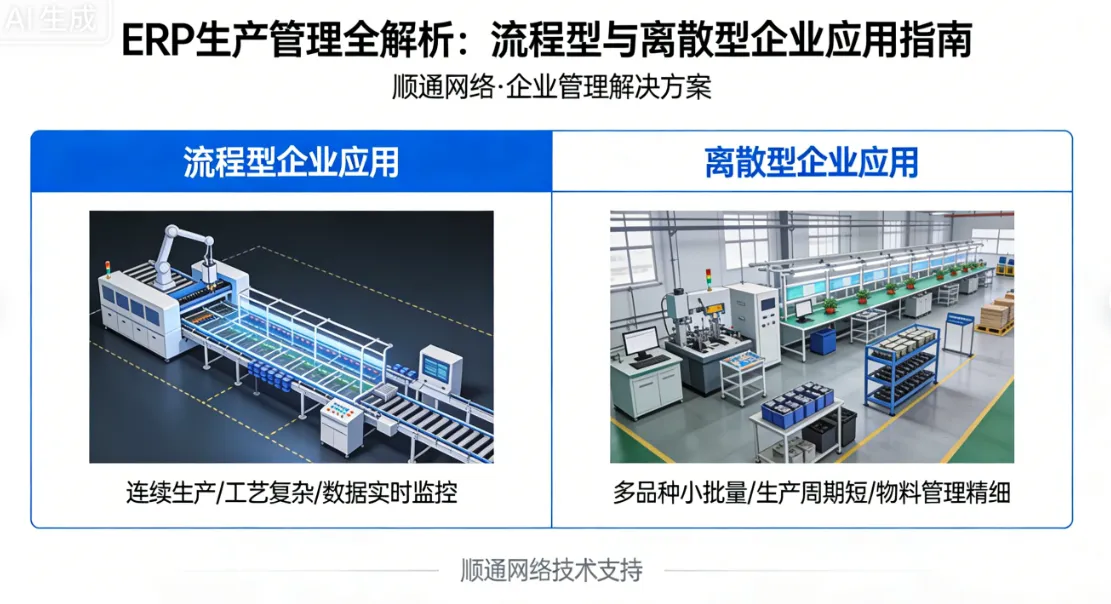
The digital transformation of the manufacturing industry is a profound change, and choosing and successfully applying ERP systems that are suitable for their own production models is a key step for enterprises to win this transformation. Whether it is a process oriented enterprise pursuing precise formula and batch traceability, or a discrete enterprise committed to complex scheduling and work in progress control, they can find the path to transform production management from experiential art to precise science in professional ERP solutions. Shuntong Network will continue to deeply cultivate the manufacturing industry and accompany Chinese manufacturing enterprises towards the future of intelligent manufacturing with professional solutions.