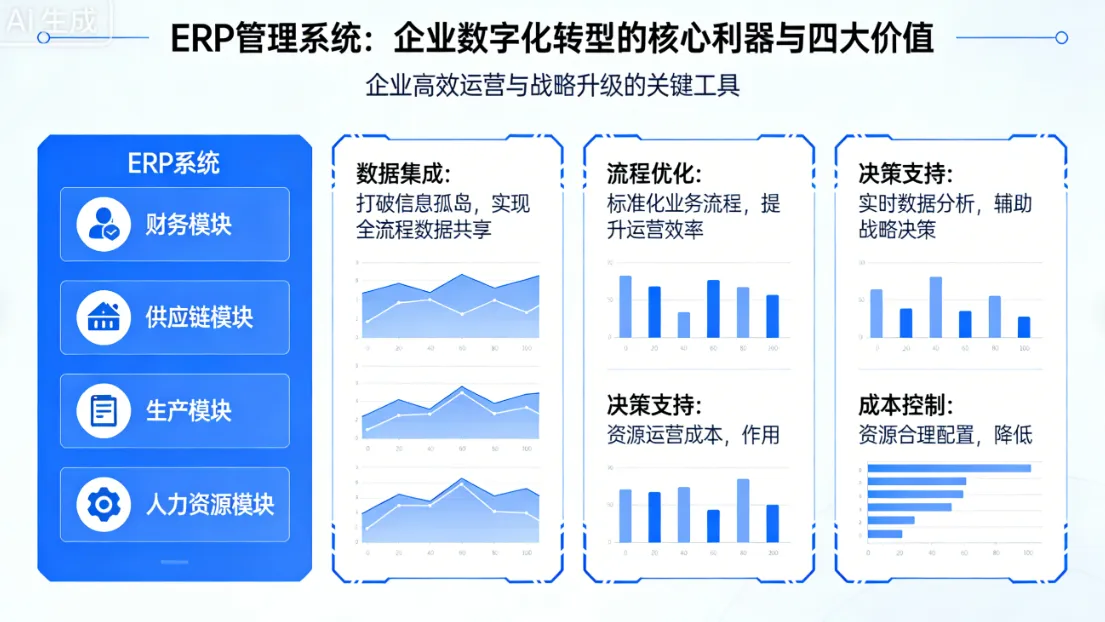
ERP Management System: The Core Tool and Four Major Values for Enterprise Digital Transformation
Strategic cornerstone in the wave of digital transformation
In today's global digital economy, digital transformation is no longer an optional choice for enterprises, but an inevitable choice for survival and development. This profound transformation requires not only technological upgrades, but also restructuring of management concepts and operational models. In this context, ERP management systems, as the central nervous system of enterprise informatization, are evolving from traditional business process support tools to core tools driving comprehensive digital transformation of enterprises. It is not only a technological system, but also a strategic platform that connects enterprise strategy and execution, integrates internal resources and external ecology, and creates multidimensional value for enterprises beyond traditional cognition.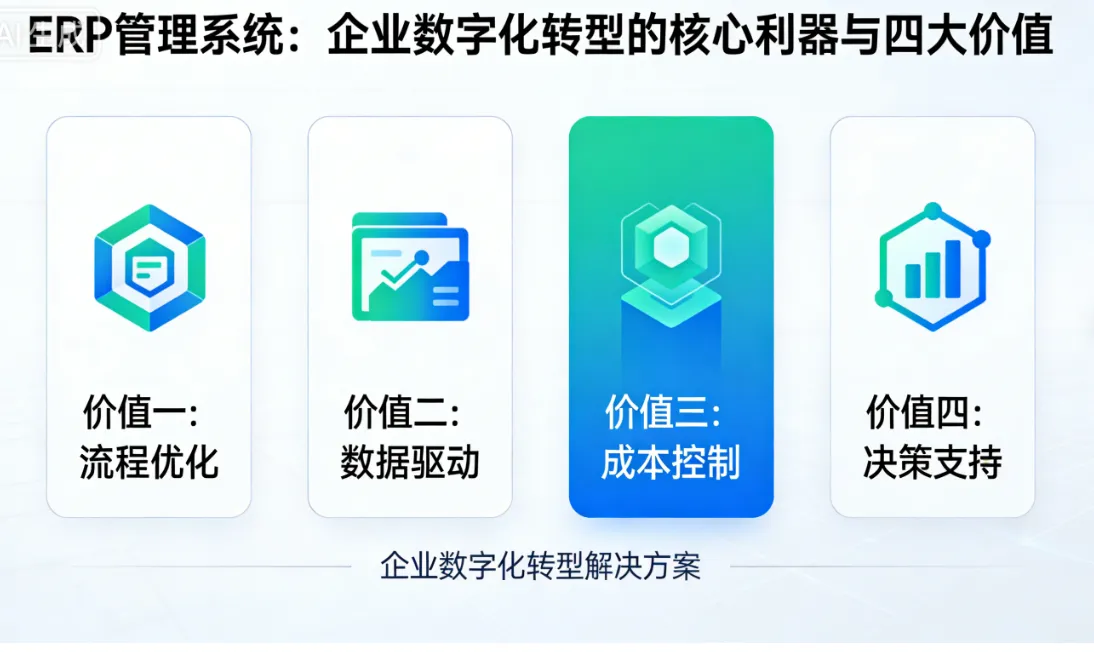
The value of data integration: breaking down information silos and building a unified data view
One of the most significant challenges faced by traditional enterprise management is the phenomenon of "information silos" - departments adopt independent systems, data standards are inconsistent, and it is difficult to circulate and share, resulting in decision-makers being unable to obtain a comprehensive and accurate business view. The primary value of an ERP system lies in building a unified data platform at the enterprise level, integrating data scattered across various departments such as sales, procurement, production, finance, and human resources to form a complete, consistent, and real-time data resource pool.
This integration eliminates data redundancy and inconsistency, enabling enterprises to make decisions based on a 'single source of facts'. When the sales department enters an order, the production department can immediately see the new demand, the procurement department can synchronously obtain material information, and the finance department can track changes in accounts receivable. After implementing ERP, a medium-sized manufacturing enterprise unified and integrated data that was originally scattered in seven independent systems, reducing the time for management to obtain comprehensive business reports from three days to real-time availability, and improving decision-making efficiency by more than 70%.
The deeper value lies in the fact that the integrated data, through analysis and mining, can reveal business patterns that are difficult to discover with traditional methods. Enterprises can analyze customer behavior patterns, identify supply chain bottlenecks, evaluate product profitability structures, transform data from passive records to active insights, and provide quantitative support for strategic decision-making. This data-driven decision-making model is one of the core features of digital transformation.
Value of Process Optimization: Standardization and Automation Enhance Operational Efficiency
The second greatest value of ERP systems lies in the standardization and automation of business processes. By combining industry best practices with specific enterprise needs, ERP helps businesses redesign and optimize core business processes, eliminate redundant links, reduce human errors, and achieve a qualitative improvement in operational efficiency.
The built-in workflow engine of the system can automatically route tasks, allocate resources, trigger notifications, and update status based on preset rules. Taking the procurement to payment process as an example, the traditional model requires the circulation of paper documents between multiple departments, which is time-consuming and prone to errors. In the ERP system, the entire process from demand application, supplier selection, order placement to acceptance and payment can be automated, reducing the average processing time from weeks to days. A certain engineering enterprise has standardized the project cost control process through an ERP system, reducing the average approval time for project changes from 7 days to 1 day, and reducing the proportion of cost overrun projects from 35% to 12%.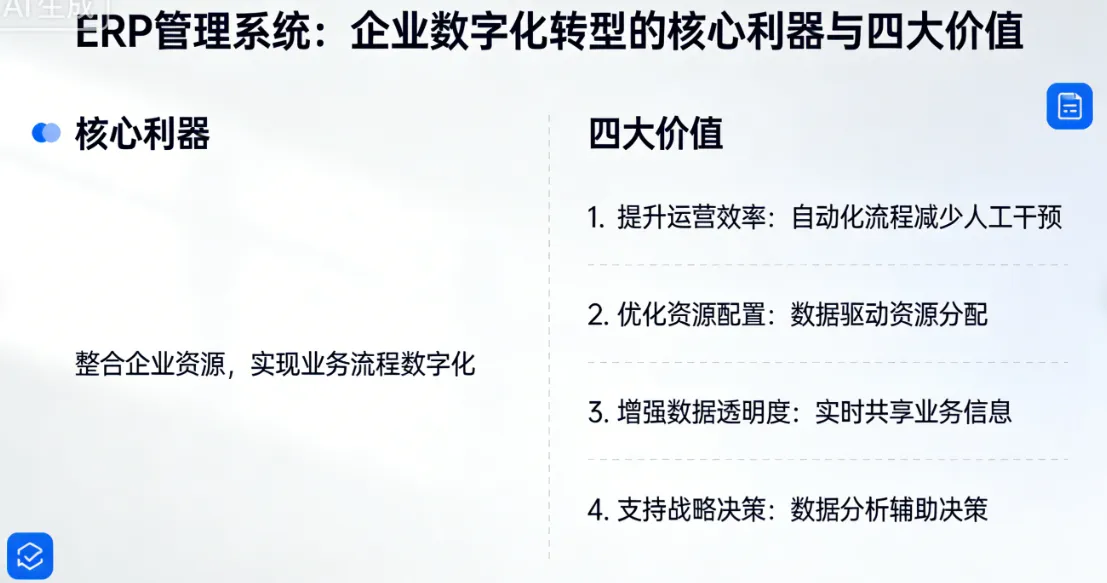
Standardization of processes also brings about enhanced operational controllability and compliance. All key operations have clear permission controls and complete audit trails to meet increasingly stringent regulatory requirements. Especially in highly regulated industries such as finance and pharmaceuticals, the compliance mechanism built into ERP systems has become an important guarantee for enterprise risk management.
Resource synergy value: global optimization enhances overall competitiveness
The effective allocation of enterprise resources is the core challenge of management, and the third greatest value of ERP systems lies in achieving global optimization of various resources such as manpower, materials, equipment, and funds. The system ensures the flow of resources to the most valuable and urgent business processes through comprehensive visualization and intelligent scheduling of enterprise resources, avoiding the phenomenon of local optimization and overall imbalance.
In the field of manufacturing, the advanced planning and scheduling module of ERP comprehensively considers order priority, equipment capacity, material supply, and delivery deadline to generate the optimal production plan, maximizing equipment utilization and on-time delivery of orders. A certain automotive parts manufacturer optimized production scheduling through an ERP system, increasing capacity utilization by 25% and shortening production cycles by 30%.
In terms of supply chain collaboration, ERP systems connect suppliers, manufacturers, distributors, and customers on the same platform, sharing demand forecasting, inventory levels, and production plans, greatly improving the responsiveness and resilience of the supply chain. A certain fast-moving consumer goods enterprise has shortened the average response time of its supply chain from the industry's common 6-8 weeks to 3-4 weeks through an ERP collaborative platform, significantly enhancing its market competitiveness.
Resource collaboration is also reflected in the deep integration of finance and business. The ERP system uses a business driven financial mechanism to ensure that every business activity generates corresponding financial records in real time, achieving the integration of business flow, logistics, and capital flow. This integration of business and finance enables enterprises to achieve truly comprehensive budget management and real-time cost control, laying the foundation for refined management.
Strategic Empowerment Value: From Operational Support to Innovation Driven
Modern ERP systems have surpassed the scope of operational support tools and become an empowering platform for enterprise strategic execution and continuous innovation. This constitutes the fourth largest and most forward-looking value dimension of ERP systems. By breaking down strategic goals into executable and measurable performance indicators and integrating them into daily business processes, ERP helps businesses ensure effective implementation of strategic intentions.
The deep integration of strategic management tools such as balanced scorecard and ERP system enables enterprises to monitor the completion of strategic goals in four dimensions: finance, customers, internal processes, and learning and growth in real time, detect deviations in a timely manner, and take corrective measures. A certain retail enterprise tracked the correlation between non-financial indicators such as "customer satisfaction" and "employee skill improvement" and sales revenue through an ERP system, adjusted the focus of resource investment, and increased the achievement rate of strategic goals by 40%.
In terms of innovation driven development, ERP systems provide a digital foundation for enterprises to adapt to changes and experiment with new business models. Open application programming interfaces and microservice architecture enable enterprises to quickly integrate new technologies, try new applications, and reduce innovation trial and error costs. A traditional manufacturing enterprise has integrated the Internet of Things and data analysis tools based on an ERP platform, achieving predictive maintenance and intelligent scheduling, opening up a new path for service-oriented transformation.
Furthermore, the data assets and process integration capabilities accumulated by ERP systems provide the possibility for fundamental innovation in business models. Personalized customization based on deep analysis of customer data, collaborative manufacturing based on supply chain transparency, and new retail models based on omnichannel integration all rely on the digital foundation provided by ERP systems.
The core engine of digital transformation
As a core tool for enterprise digital transformation, ERP management system's four major values - data integration, process optimization, resource collaboration, and strategic empowerment - are interrelated and mutually reinforcing, together forming a solid foundation for enterprise digital capabilities. In the digital economy era where data has become a key factor of production, ERP systems help enterprises transform dispersed data into unified information assets, integrate isolated processes into efficient operational systems, optimize limited resources into sustained competitive advantages, and transform macro strategies into executable daily actions.
However, the full realization of the value of ERP depends not only on the progressiveness of the technical system, but also on the recognition of the enterprise as a management change rather than a pure IT project. Successful digital transformation requires enterprises to reconstruct business processes with an open mind, drive organizational change with firm determination, and continuously invest in building a data culture. When ERP systems are deeply integrated with enterprise strategy, organizational capabilities, and innovative culture, they truly become the core engine driving digital transformation of enterprises, helping them build agility, resilience, and competitiveness in increasingly complex and uncertain business environments, and win a sustainable future.