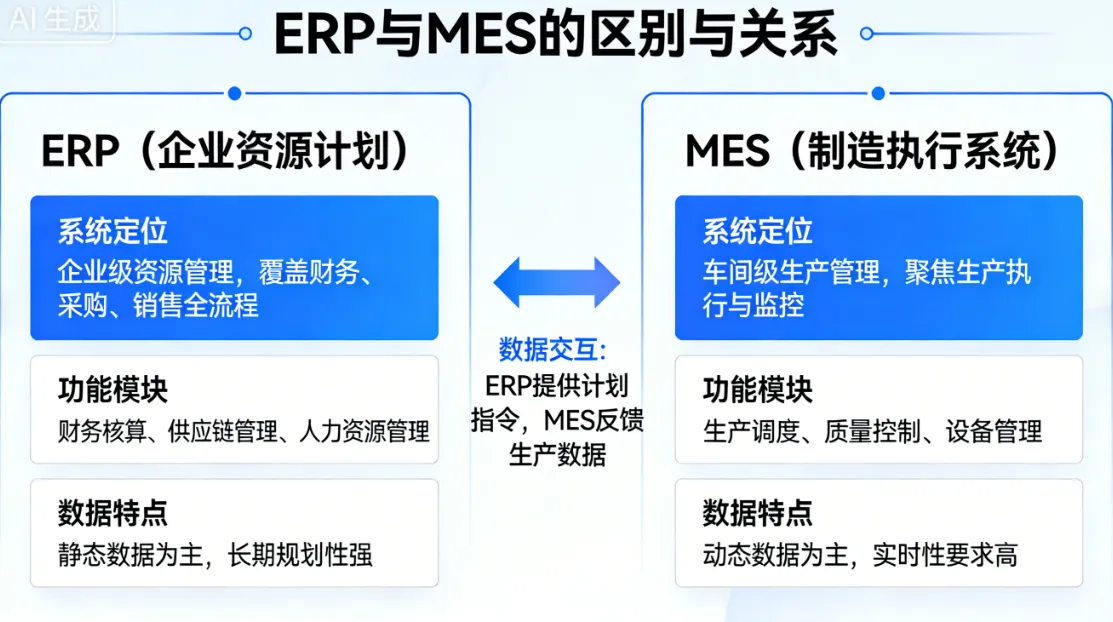
The difference and relationship between ERP and MES
In the process of digital transformation in manufacturing, enterprise resource planning system and manufacturing execution system are two crucial but often confused concepts. They are like the "brain" and "limbs" of enterprise operations, each responsible for unique functions, and must work closely together to maximize efficiency. Understanding the essential differences and intrinsic connections between the two is the foundation for manufacturing enterprises to build efficient and intelligent production systems.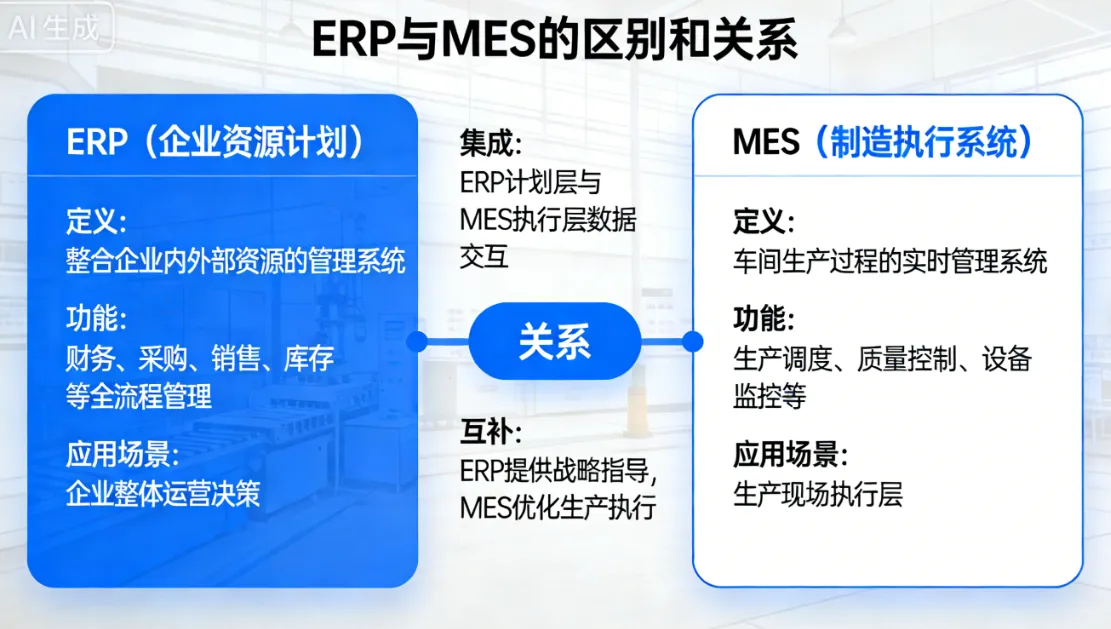
The essential difference between core positioning and attention hierarchy
The fundamental difference between ERP and MES lies in theirCore positioning and management hierarchyDifferent. ERP is positioned for enterprise level resource planning and collaboration, with a macro and strategic perspective. It focuses on the overall resource optimization and business process integration of enterprises, with core questions revolving around "what to produce? When to deliver? How many resources are needed? What are the costs and profits. The management cycle of ERP is usually on a weekly, monthly, or even annual basis, aiming to achieve cross departmental global collaboration in finance, supply chain, production, human resources, and other areas, ensuring the implementation of enterprise strategic goals. For example, ERP will develop a master production plan based on sales orders and forecasts, answering questions such as' 100000 units of Product A need to be produced next month '.
MES is positioned at the workshop level for execution and control, with a micro and operational perspective. It focuses on how production orders are executed on site in the workshop, with the core task being "how to produce? Who produces it? What equipment and materials are used? Is the quality up to standard. The management cycle of MES is real-time, measured in minutes, hours, and shifts. It is responsible for converting ERP production plans into detailed instructions at the process level, collecting, monitoring, and analyzing real-time data from the production site to ensure accurate and efficient execution of plans. Continuing from the previous example, MES needs to solve the problem of 'how to arrange this production line today to complete the task of 3000 units of product A'.
Clear distinction between core functions and application scenarios
This positioning difference is directly reflected in its core functional modules. The core functions of ERP are focused onEnterprise level resource planning and business integrationThis mainly includes: financial management, sales and distribution management, procurement and inventory management, master production planning, material requirement planning, human resource management, and cost and profit analysis. It provides a panoramic view of enterprise operations.
The core functions of MES focus onManagement and Control of Workshop Production ProcessThe 11 core functional modules defined by the International Manufacturing Execution Systems Association clearly define their scope, mainly including: detailed process scheduling, resource allocation and status management, production unit allocation, document management, data collection, human resource management (workshop level), quality management, process management, equipment maintenance management, performance analysis, and product tracking and lineage. It provides a "microscopic view" of workshop production.
Taking a common production scenario as an example: the ERP system generates a work order for "producing 1000 pieces of a certain model of product" based on customer orders, and determines the completion date and material requirements. MES is responsible for receiving this work order, decomposing it into specific process tasks (such as cutting, welding, spraying, assembly), scheduling corresponding personnel, equipment, and materials to specific workstations, collecting real-time completion quantities, working hours, quality inspection data, and equipment status for each process, and providing real-time feedback on progress and abnormalities. Once there is a shortage of materials or equipment failure, MES will immediately sound an alarm and attempt to schedule within the workshop. If the issue cannot be resolved, the information will be fed back to the ERP system, triggering the procurement or repair process.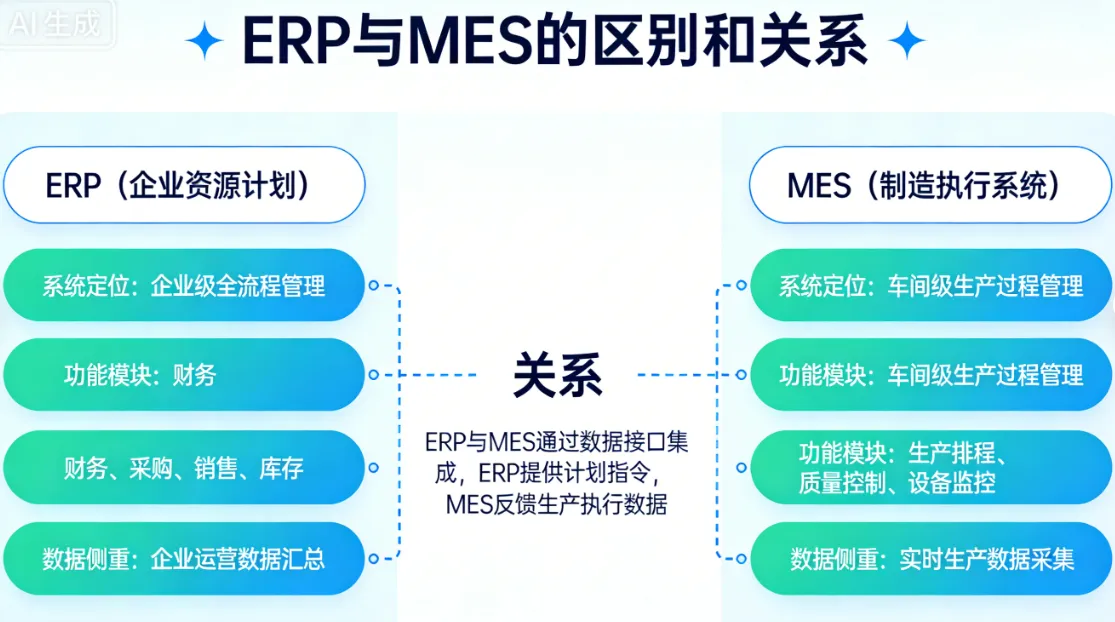
Data Flow and Closed Loop: A Spiral Rise from Planning to Execution
The relationship between ERP and MES is not simply hierarchical, but rather aA closed-loop system with bidirectional interaction and continuous optimizationData is the blood that links the two together.
Top down information flow (plan → execute)ERP is the source of planning, which distributes globally optimized master production plans, material requirement plans, corresponding production work orders, material lists, process routes (basic version), and other "planning instructions" to MES. This provides goals and framework for workshop execution.
Bottom up data flow (execution → feedback)MES is a data aware terminal. It collects real-time comprehensive data on personnel, equipment, materials, methods, and environment at the production site, including working hours, output, work in progress status, qualification rate, equipment utilization rate, etc. These precise and timely 'execution feedback' data are summarized, processed, and uploaded to the ERP system.
Closed loop valueThe uploaded real-time data is crucial for ERP. It enables planning modules in ERP, such as APS advanced scheduling, to simulate and schedule production more accurately based on actual capacity and efficiency; Enable the financial module to conduct more accurate cost accounting based on actual working hours and material consumption; Enable the inventory module to update the status of work in progress and finished products in real-time. In this way, ERP makes the next round of better plans based on more realistic data, forming a continuous improvement loop of "planning execution feedback optimization". Without precise feedback from MES, ERP plans are easily detached from reality; Without the macro guidance of ERP, the optimization of MES is partial and blind.
Summary: Collaborative symbiosis, building the digital mainline of intelligent manufacturing
In short, ERP and MES have a complementary and collaborative relationship.ERP excels in "planning" and "calculation"Focusing on enterprise level resource planning, business collaboration, and strategic decision support;MES excels in "control" and "management"Focusing on process control, real-time scheduling, and data collection at the workshop level.
In the architecture of modern smart factories, the integration of ERP and MES is the core of building the "digital mainline". They, together with the upper level product lifecycle management and the lower level equipment control system, constitute the complete digital nervous system of the manufacturing enterprise. Enterprises should not view the two as a substitute relationship, but should gradually build and improve it according to their own needs for refined management. Usually, enterprises will first implement ERP to streamline business processes and optimize resource allocation. With the increasing demand for workshop transparency and refined control, MES will be introduced to fill the information gap between the planning and control layers, ultimately achieving full process digitization, transparency, and optimized management from order to delivery.