
Analysis of the Seven Core Risks in ERP Projects: A Comprehensive Guide from Strategic Planning to System Security
The key battles and hidden challenges of enterprise digital transformation
In the global wave of digital transformation, the implementation of enterprise resource planning systems has become a key battle for enterprises to enhance their core competitiveness and achieve refined management. However, the success of this battle is by no means inevitable - according to statistics, over one-third of ERP projects failed to achieve their expected goals or even ended in failure. These projects are often not due to technical defects, but rather due to risks that have not been fully identified and effectively controlled at multiple levels such as strategy, management, organization, and security. A deep understanding of the seven core risks of ERP projects, from strategic planning to establishing a comprehensive prevention and control system for system security, has become a compulsory course for enterprises to ensure the successful return on this major investment.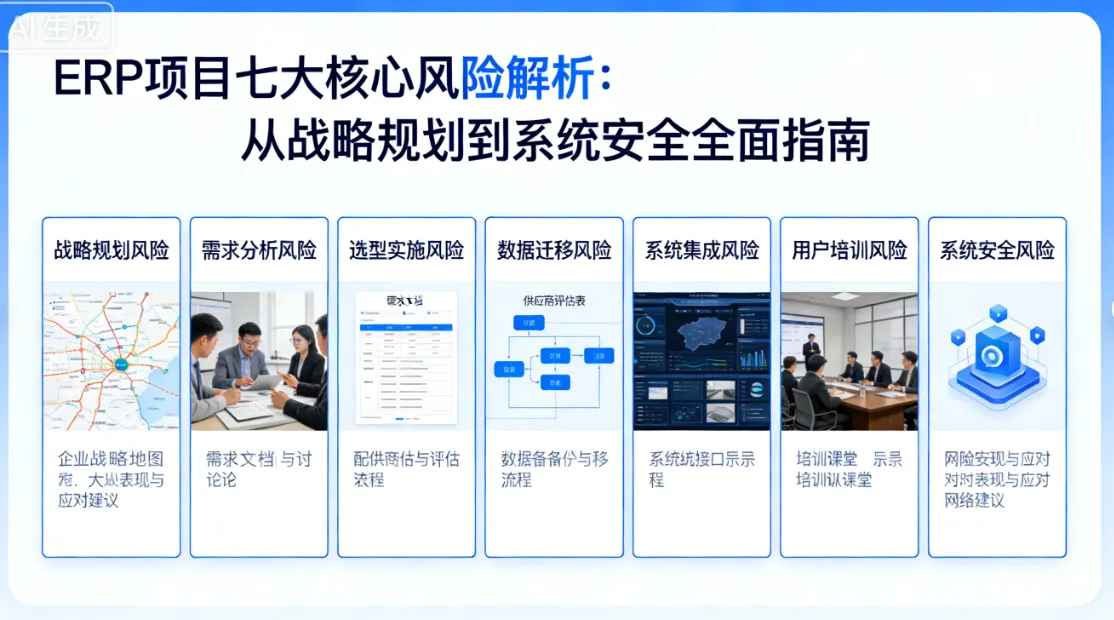
Strategic ambiguity and goal misalignment: lack of clear value orientation
The biggest risk of ERP projects is often buried at the beginning of their launch.Fuzzy strategic positioningThis is the primary challenge faced by enterprises. Many enterprises simply understand ERP projects as "software installation" and fail to deeply link them with their long-term development strategies and business transformation goals. The project goal setting is too vague, such as "improving management level" or "achieving informatization", lacking quantifiable and traceable specific business indicators. More seriously, some companies expect to solve all management problems through ERP systems in one go, and this unrealistic expectation will inevitably lead to the unlimited expansion of project scope and ultimately lose control.
The direct consequence of this strategic ambiguity isThe measurability of project valueWhen companies are unable to clearly define the specific criteria for 'success', project teams lose their sense of direction, and departments have different expectations for the system, leading to continuous disagreements and conflicts during the implementation process. A manufacturing company initially set the ERP project goal as "improving operational efficiency", but after two years of implementation, it was found that various departments had completely different understandings of efficiency improvement - the production department focused on equipment utilization, the finance department emphasized billing speed, and the sales department valued order processing time. Due to the lack of unified success criteria, the project ultimately fell into a dilemma of dissatisfaction among all parties.
Insufficient high-level support and resistance to organizational change
The essence of an ERP project is a profound oneorganizational changeNot just a simple technological upgrade. Therefore, the substantial participation and continuous support of senior management are the lifeline of project success. In many failed cases, although the top management of the enterprise expressed support at the start of the project, they failed to invest the necessary energy and authority in the implementation process. They completely entrust the project to the IT department or external consultants, becoming 'bystanders' themselves. However, when the project touches deep water areas such as departmental conflicts of interest, redistribution of responsibilities, or core process transformation, the lack of high-level decision-making power will cause the project to stagnate or even fail.
Accompanying the lack of high-level support is a strongResistance to organizational changeThe new processes and rules brought by ERP systems will inevitably change employees' work habits and vested interests. Lack of effective change management strategies can make employees feel threatened and confused, leading to negative resistance or even public opposition. After a certain retail enterprise launched its ERP system, due to insufficient training for procurement personnel and a lack of comparison and explanation of new and old processes, a large number of employees continued to work according to old habits, only supplementing data in the system to cope with inspections. The system gradually became an expensive "data entry tool". True change management requires systematic communication, training, incentives, and performance adjustments to guide organizations through the pains of transformation smoothly.
The disconnect between business processes and system design
The disconnect between business processes and system design is one of the most common pitfalls in ERP projects. Many companies make the mistake of "automating inefficient processes" by not taking advantage of the implementation of ERP to deeply diagnose and restructure inefficient and redundant existing processes, but instead requiring the system to fully mimic offline operations. This leads to ERP only becoming an electronic tool that solidifies old drawbacks, unable to bring about a leap in efficiency, and may instead highlight problems due to system rigidity. For example, an engineering company's original contract approval process required going through seven departments and twelve nodes. When implementing ERP, no optimization was made, only this tedious process was digitized, resulting in a decrease in approval efficiency rather than an increase.
On the other hand, excessive customization may also lead to catastrophic consequences. Making extensive modifications to the core code to meet the special needs of individual departments can disrupt the stability and upgradability of the system, resulting in a heavy 'technical debt'. When software vendors release new versions, enterprises are often forced to stay in old versions due to incompatible custom code, and cannot obtain security updates and feature enhancements. The ideal approach is to follow the "80/20 principle" -80% of the requirements are met through standard system functions or configurations, and only 20% of differentiated requirements that truly reflect the core competitiveness of the enterprise are subject to limited customization.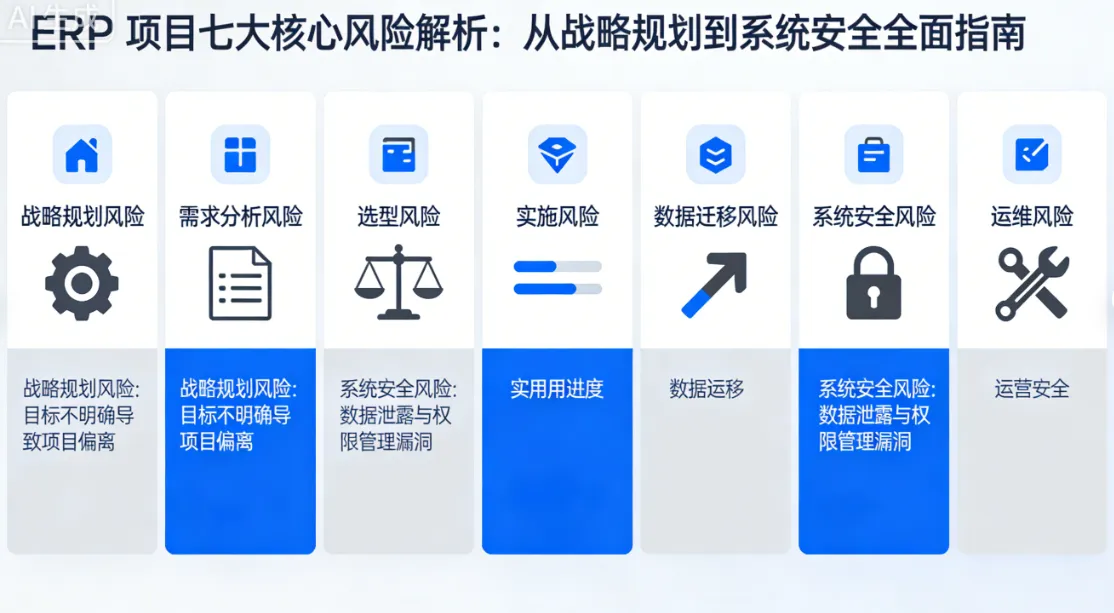
The hidden dangers of data quality and migration
Data is the lifeblood of ERP systems,Data quality crisisIt is the direct technical reason that causes the system to fail to run or even be abandoned after going online. Many companies only discover historical legacy issues such as confusion in material coding (one item with multiple codes, one code with multiple items), inaccurate BOM, and incomplete supplier information during project initiation. Under time pressure, only rough data cleaning and migration can be carried out, planting a "time bomb" for the system. After the system goes online, an incorrect material master data may lead to completely unreliable MRP calculation results, while errors in basic price information can distort the entire cost accounting.
The deeper problem lies in the lack of sustainedData governance mechanismThe launch of ERP is not the end point of data work, but the starting point. If data ownership, data quality standards, and daily maintenance processes are not established, the data quality within the system will rapidly deteriorate. For example, if warehouse personnel do not enter the warehouse receipt in a timely manner according to regulations, or if procurement personnel create new supplier files without checking for duplicates, the system will quickly lose credibility. Establishing an enterprise level data governance organization, clarifying data responsibilities, and incorporating data quality into performance evaluations are necessary guarantees for ensuring the long-term healthy operation of the system.
Mistakes in partner selection and knowledge transfer
Misselection and excessive reliance on implementation partnersIt is an external critical risk. Some companies focus too much on low software license fees and overlook the industry experience, methodological maturity, and long-term service capabilities of their implementation consulting teams. A consultant team lacking industry background may find it difficult to understand the core business processes and special needs of the enterprise, and their configured solutions may seriously deviate from reality. At the same time, the mentality of outsourcing the entire project to the enterprise itself is extremely dangerous, leading to insufficient internal knowledge transfer. Once the consultant leaves, no one can maintain and deepen the application of the system.
Effective knowledge transfer should be integrated throughout the project, rather than just 'centralized training' before going live. The best practice is to establish a "common team" model that allows key users of the enterprise to deeply participate in the entire process from requirement analysis, solution design to system testing. In the implementation of ERP in a certain food enterprise, more than ten business backbones were selected to participate in the project team full-time. They not only became internal experts after going online, but also put forward multiple important improvement suggestions that are in line with business reality during the process. This deep involvement ensures a high degree of alignment between the system and the actual needs of the enterprise, and also establishes sustainable internal support capabilities.
Systemic deficiencies in project management
At the project management level,Time pressure and scope out of control detached from realityIt is a common cause of failure. In order to meet the unrealistic online requirements of the management (such as "must go online before New Year's Day"), the project team compressed key links such as process testing, user training, and data verification, resulting in the system going online with problems and numerous issues. Another situation is that the business department constantly proposes new customized requirements during the implementation process, and the project team lacks a strict change control process, resulting in unlimited expansion of the project scope, budget overruns, and delays in core functions.
Scientific project management requires the establishment of a clear project governance structure, detailed work breakdown, rigorous milestone reviews, and effective communication mechanisms. Risk management should be integrated throughout, regularly identifying, assessing, and addressing potential issues. Adopting a phased and gradual implementation strategy, prioritizing the launch of core functions and quickly verifying their value, and then gradually expanding, can effectively reduce project risks and enhance the confidence of all parties involved. A medical device company divided its ERP project into three stages: "financial supply chain", "production quality", and "full module integration". Each stage had clear business value goals and acceptance criteria, and ultimately achieved a smooth transition and expected benefits.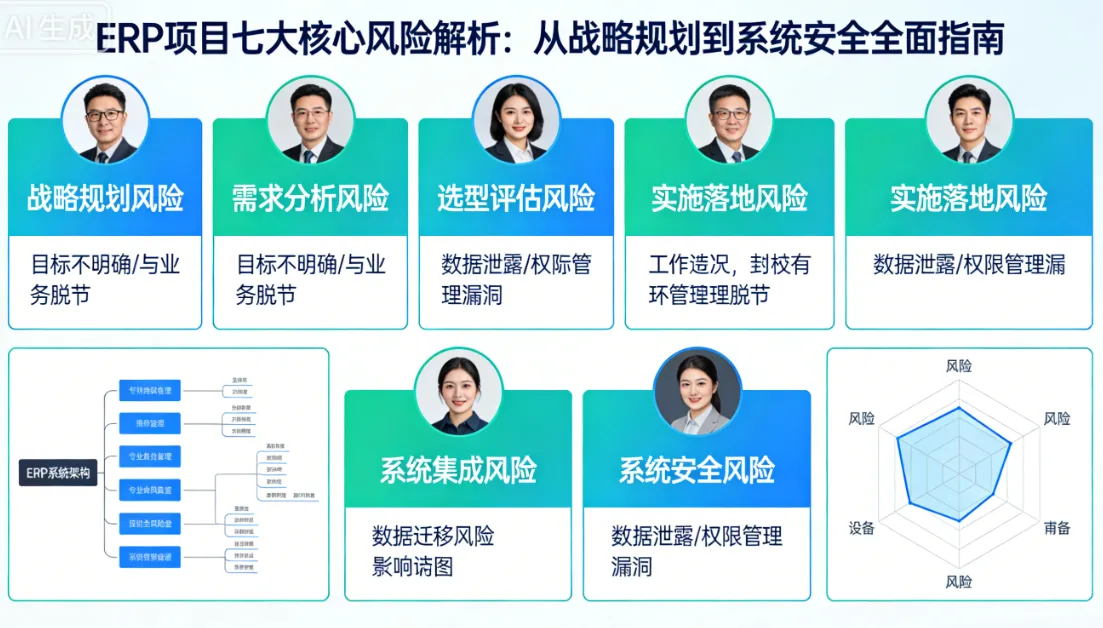
Potential threats to system security and compliance risks
With the increasing value of data and the complexity of network threats,System security risksIt has become an indispensable dimension in ERP projects. From a technical architecture perspective, the system may face various threats such as data breaches, unauthorized access, and service interruptions. Especially in the cloud ERP deployment model, enterprises need to have a clear understanding of the security responsibility sharing model with cloud service providers to ensure that critical data and applications are fully protected. From a management perspective, the lack of refined permission management may lead to improper access to sensitive information; Without establishing regular security audits and vulnerability scanning mechanisms, it is impossible to detect and fix security risks in a timely manner.
Compliance riskIt should not be underestimated either. Different industries and regions have strict regulatory requirements for data storage, processing, and cross-border transmission, such as GDPR, cybersecurity laws, and cybersecurity 2.0. As a core data platform for enterprises, the design of ERP systems must incorporate compliance considerations. For example, ERP systems in the financial industry must meet strict requirements for financial reporting and audit tracking; The pharmaceutical industry needs to comply with GMP/GSP standards to ensure product traceability throughout its entire lifecycle. During the project planning phase, enterprises should comprehensively identify applicable compliance requirements and use them as constraints for system design and implementation.
Building a comprehensive risk defense system
The seven major risks of ERP projects are interrelated and mutually influential. Strategic ambiguity can lead to misplaced goals; Insufficient high-level support can amplify organizational resistance; The disconnection between business processes and systems can lead to application difficulties; Data quality issues can erode system value; Choosing the wrong partner can drag down the entire project; Management deficiencies can cause risks to spiral out of control; Security vulnerabilities can threaten the lifeline of the enterprise. Successful businesses do not attempt to eliminate all risks - which is impossible - but rather control risks within an acceptable range by establishing systematic risk identification, assessment, response, and monitoring mechanisms.
This requires companies to establish cross functional governance teams and conduct comprehensive risk assessments before project initiation; Maintain strategic focus and tactical flexibility during implementation, balancing standardization and customization; Continuously optimize the system after its launch, using ERP as a platform for continuous improvement rather than a one-time project. Only when enterprises respond to the complexity of technology with rigorous management and adapt to the challenges of change with organizational resilience, can ERP projects truly become powerful engines of digital transformation, rather than costly lessons learned from failures. In a business environment full of uncertainty, a profound understanding and systematic management of ERP project risks is itself a valuable core competitiveness.