
ERP system application in the chemical industry: comprehensive management solutions for supply chain, production, quality, and other aspects
The particularity of chemical industry management and digital challenges
The chemical industry, as an important pillar industry of the national economy, has distinct industry characteristics in its operation and management: the production process involves complex chemical reactions and phase transitions, raw materials and products are often dangerous, quality control and batch traceability requirements are strict, environmental and safety regulations are highly restrictive, and the supply chain coordination complexity is high. These characteristics make it difficult for general ERP systems to be directly applicable and require deep industry-specific solutions. A professional ERP system for the chemical industry is not only a tool for enterprise resource planning, but also a core digital infrastructure for achieving safe production, compliant operation, and sustainable development. It embeds the unique management logic of chemical enterprises into the system, providing an integrated comprehensive management solution in supply chain collaboration, fine production control, quality traceability, and precise cost accounting.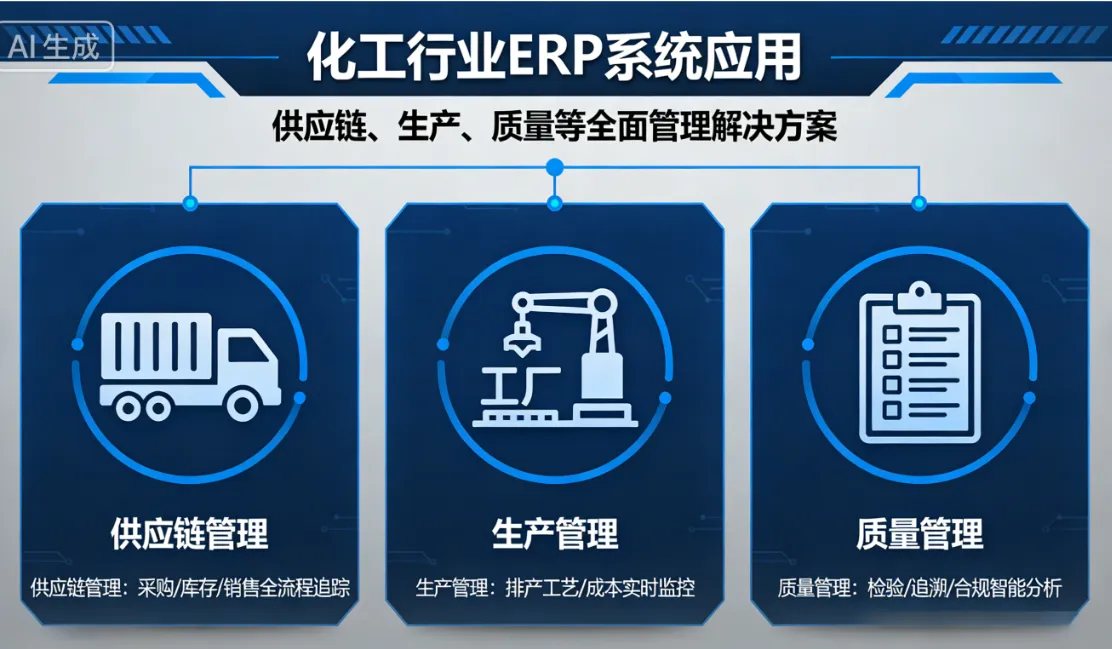
Supply Chain Management: From Risk Warning to Elastic Collaboration
The supply chain management in the chemical industry is extremely challenging: raw materials are mostly bulk commodities with volatile prices; Supplier qualifications and stability are crucial; There are special regulations for the transportation and storage of hazardous chemicals; Customer demand exhibits periodic fluctuations. The core value of the supply chain management module in chemical ERP lies in buildingControllable risk, flexible collaborationThe digital supply network.
The system achieves intelligent procurement decision-making by integrating market intelligence, historical procurement data, and production plans. It can not only automatically generate procurement suggestions based on material requirement planning, but also evaluate the delivery stability, quality qualification rate, and price trend of different suppliers, and comprehensively calculate the "total cost of ownership" rather than simply pursuing low prices. For key raw materials, the system supports the establishment of supplier management inventory or long-term agreement cooperation models to stabilize supply. A large petrochemical enterprise implemented a supplier collaboration plan through an ERP system, sharing demand forecasting with core suppliers, which increased the supply stability of key raw materials by 40% while reducing safety stock levels by 10%.
In the warehousing and logistics process, the system is designed strictly in accordance with the management regulations for hazardous chemicals. It supports graded and classified management of storage tanks, warehouses, and locations, records MSDS (Material Safety Data Sheets) for each material, and intelligently assigns storage locations based on their characteristics such as flammability, explosiveness, and corrosiveness. The inbound and outbound operations require strict compliance checks and approval processes, and all operations have complete audit trails. The transportation management module is integrated with qualified logistics company systems to achieve electronic waybills, real-time trajectory tracking, and emergency response support for dangerous goods transportation.
Production Management: Refinement of Process Control and Safety Compliance
Chemical production has the characteristics of continuity and device type, and the core of its ERP production management module isFormula management, batch tracking, and process controlDeep integration. The system converts the production process of each product into an accurate "digital formula", which not only includes the types and ratios of raw materials, but also integrates key process parameters such as reaction temperature, pressure, time, catalyst dosage, as well as indicators such as energy consumption and yield expectations.
At the production execution level, ERP systems are integrated with distributed control systems and manufacturing execution systems to achieve a closed loop of planning and execution. The production instructions issued by the system include complete formulas and process requirements, which can be viewed and executed by operators at the terminal. During the production process, the system collects key parameters such as temperature, pressure, and flow rate of each device in real-time and compares them with the standard range. Once any abnormalities are detected, an immediate warning is issued. At the same time, the system automatically records the amount of raw materials, intermediate products, and final production for each batch, calculates the actual yield, and compares it with the theoretical value, providing a data basis for process optimization. A certain fine chemical enterprise has improved the average yield of its main products by 2.5 percentage points and achieved annual efficiency gains of tens of millions of yuan through the refined management of yield through an ERP system.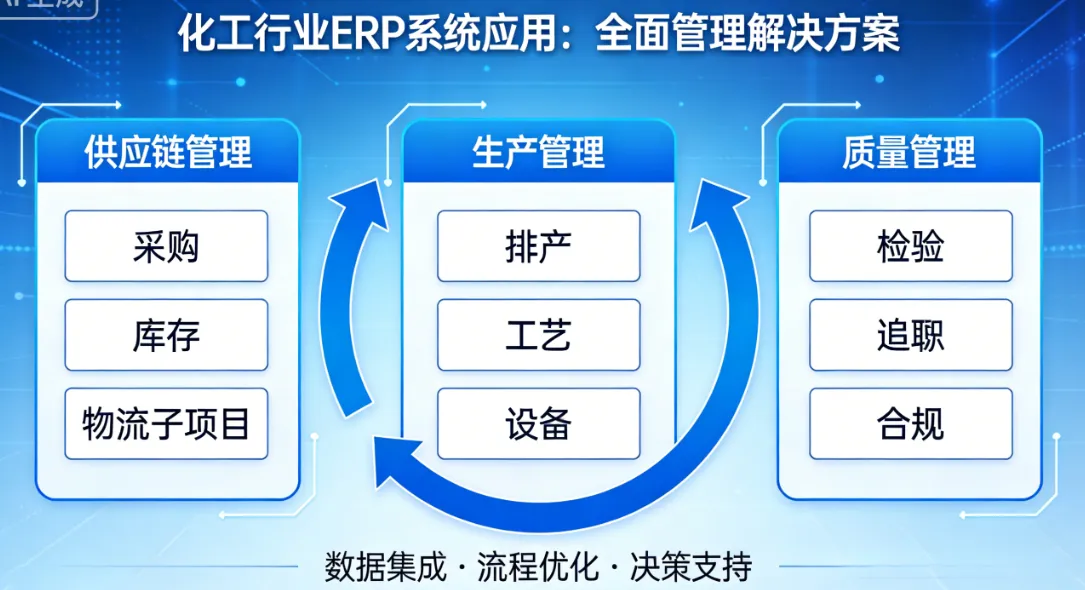
Safety and Environmental ManagementBuilt into the production process. The system automatically checks whether production tasks comply with safety operating procedures (SOP), and enforces electronic approval and confirmation for operations involving high-risk processes or materials. In terms of environmental protection, the system can measure the amount of "three wastes" (wastewater, exhaust gas, and waste residue) generated and associate them with production batches to ensure compliance with emission standards and assist enterprises in carbon footprint accounting and energy management.
Quality Management: Full traceability and compliance assurance throughout the process
In the context of increasingly strict regulatory oversight, the quality traceability of chemical products is not only a customer requirement, but also a legal responsibility. The quality management module of chemical ERP has been constructedA bidirectional traceability system from raw materials to finished productsThe system assigns a unique identification code to each batch of raw materials, intermediate products, and finished products, recording all their "history": from which supplier/previous process, which production equipment has been used, who operated it, which process parameters have been used, and which quality inspections have been passed.
Laboratory information management systems are usually deeply integrated with ERP. The inspection task is automatically issued to LIMS along with the production instruction, and after the inspection personnel complete it, the results are automatically transmitted back to the ERP system. The system automatically determines whether it is qualified based on preset quality standards (such as national standards, industry standards, enterprise standards, or customer standards), and triggers the corresponding process: qualified products are allowed to be released for storage or enter the next process; Unqualified products will trigger isolation, review, and disposal processes (such as rework, downgrading, or scrapping). All inspection reports and review records are electronically archived, tamper proof, and available for future reference at any time.
This full traceability capability highlights its value in responding to customer complaints or regulatory audits. When quality problems occur, enterprises can accurately locate the affected finished product batches, raw material batches used, relevant production teams and process conditions within a few minutes, and quickly take actions such as isolation and recall to minimize risks and losses. A certain pesticide production enterprise, relying on the powerful traceability function of its ERP system, successfully passed an on-site audit of an international top customer and won a long-term large order.
Deep integration of cost accounting and compliance control
The complex consumption of by-products, by-products, and energy in chemical production makes cost accounting extremely challenging. The chemical ERP system adoptsActivity based costing or step-by-step costingCan accurately calculate the true cost of each product, batch, and even production step. The system automatically collects direct materials (accurate to batch), direct labor, and manufacturing costs (such as equipment depreciation, energy consumption, and machine material consumption), and allocates them according to scientific reasons.
More importantly, the system has implementedIntegration of business, finance, and complianceEvery transaction (such as purchasing inventory, production material requisition, finished product completion, sales outbound) will generate financial vouchers in real time to ensure that the accounts match the actual situation. Cost data provides a real basis for product pricing, customer profitability analysis, and production decision-making. At the same time, the system embeds tax, customs (such as processing trade manual management), safety production, environmental protection and other regulatory requirements into the process, ensuring compliance through system control. For example, strict level approval control is applied to the purchase and use of highly toxic chemicals, and reports such as chemical registration and pollution declaration that meet the requirements are automatically generated.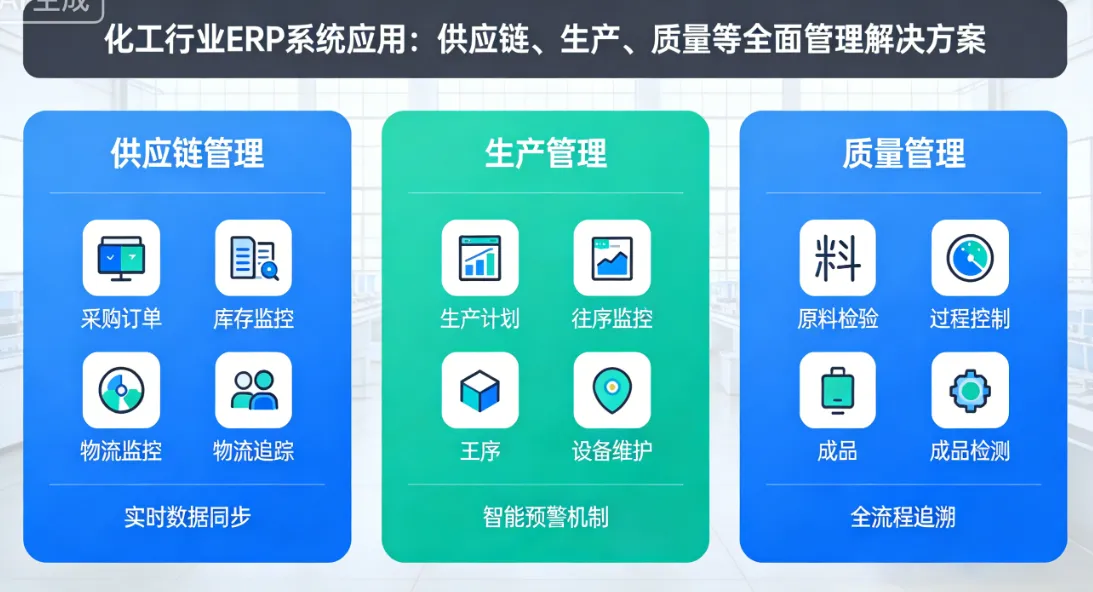
Integrated platform drives industry digital transformation
In summary, an excellent ERP system for the chemical industry provides comprehensive solutions for chemical enterprises to address complex challenges by deeply integrating supply chain collaboration, fine production control, quality traceability, precise cost accounting, and compliance control on an integrated digital platform. It not only optimizes operational efficiency and reduces costs, but also builds a solid digital defense line in terms of safety management, quality assurance, and compliance management. Today, as the industry transitions towards green, intelligent, and high-end directions, investing in and successfully applying such a deeply industry-specific ERP system has become a strategic choice for chemical enterprises to build core competitiveness and achieve sustainable development. When data flow, material flow, and capital flow seamlessly collaborate on the platform, chemical enterprises can move forward steadily in a market full of opportunities and challenges in a more agile, secure, and efficient way.