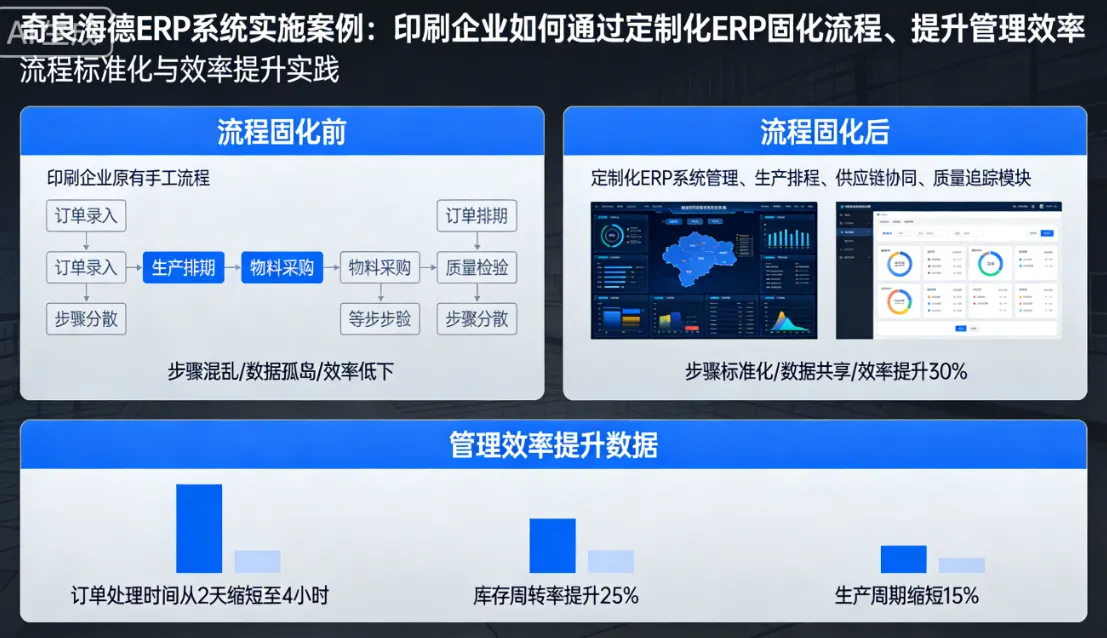
Implementation case of Qilianghaide ERP system: How printing enterprises can solidify processes and improve management efficiency through customized ERP
The era background and internal challenges of management transformation in the printing industry
In today's era of digital transformation sweeping traditional manufacturing, printing enterprises are facing unprecedented management challenges. From business printing to packaging printing, from traditional publishing to digital printing, the service boundaries of the industry are constantly expanding, while pressures such as order fragmentation, process complexity, delivery time compression, and cost transparency are increasing day by day. As a company deeply rooted in the printing industry for many years, Qilianghaide's ERP system implementation case vividly demonstrates how traditional printing enterprises can transform the management mode that originally relied on personal experience into a standardized and digital modern management system through a deeply customized enterprise resource planning system, ultimately achieving the dual goals of process solidification and efficiency improvement.
Business Process Diagnosis: Identifying Unique Management Pain Points in Printing Enterprises
Before implementing the ERP system, Qilianghaide, like most traditional printing companies, faced many management pain points. In the production process, from receiving orders, designing, plate making, printing to post-processing, and delivering finished products, the information transmission in each link mainly relies on paper work orders, telephone communication, and verbal handover, resulting in information distortion, opaque progress, and low collaboration efficiency. In terms of material management, there are various types of raw materials such as paper, ink, and printing plates, and inventory data is inaccurate, often resulting in the phenomenon of "urgently needed items not being available and unused items piling up". Cost accounting is even more challenging, as the lack of detailed data records often makes it difficult to accurately calculate the true profit of each order. Pricing is often based on experience, resulting in some orders being "clearly profitable but actually losing".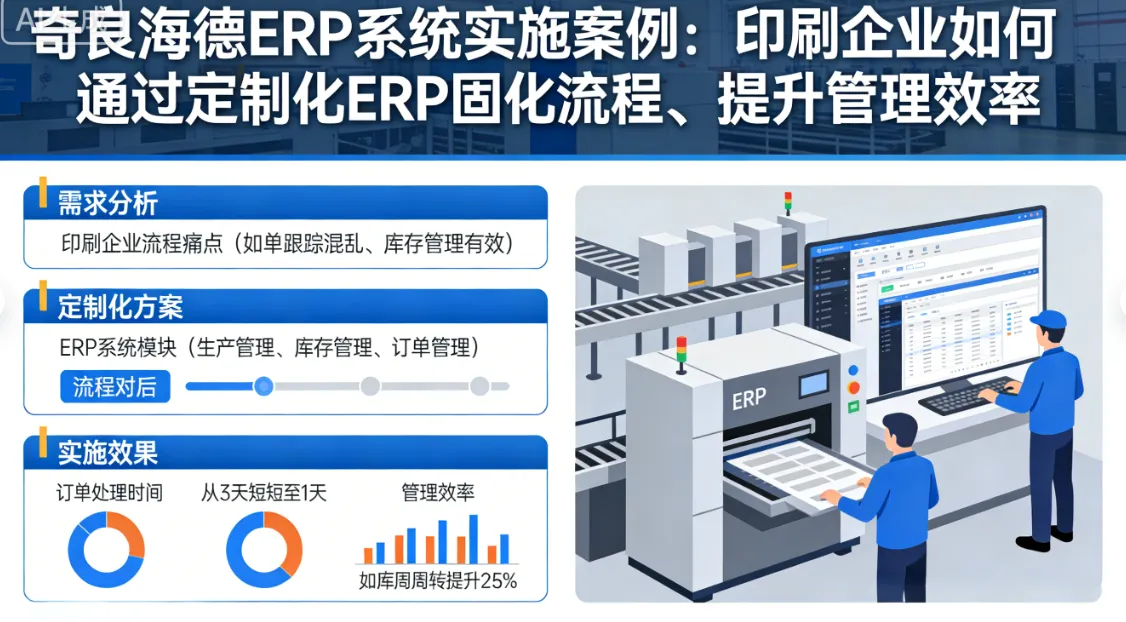
The deeper problem lies in the fact that the core competitiveness of enterprises, such as rapid response capability, process control level, and quality control standards, highly rely on the experience and sense of responsibility of individual senior employees, and have not formed replicable and inheritable organizational capabilities. Once key personnel move, there may be fluctuations in business quality. These pain points together constitute the fundamental motivation for Qilianghaide to launch the ERP project: they need not only a set of recording software, but also a system that can solidify best practices and transform management.
Customized design: Integrating the Know How of the printing industry into the system skeleton
Universal ERP is difficult to fully adapt to the special processes of the printing industry, so Qilianghaide chose to cooperate with implementation partners with industry experience and take the path of deep customization. The core of customization is not unlimited stacking of functions, butAccurately translate the unique business logic and management essence of the printing industry into systematic design rules and data models。
Firstly, at the source of the connection between sales and production, the system has been customizedIntelligent Chemical Order and Process Automatic Decomposition ModuleWhen the salesperson enters customer orders, the system automatically associates preset process route templates based on product types (such as hardcover books, brochures, packaging boxes), and decomposes specific processes such as design, layout, typesetting, printing, laminating, die-cutting, and binding. The standard working hours, required materials, equipment requirements, and quality control points for each process are predefined. When customers have special requirements for a certain process link (such as spot color printing, special binding), the system can easily adjust the parameters of that node and automatically recalculate the cost and delivery time. This design transforms the tedious work that previously required repeated communication and confirmation from production supervisors into standardized operations that can be completed by front-end salespersons.
Secondly, in response to the complexity of material management in the printing industry, the system has been establishedMulti dimensional material coding system and dynamic inventory modelPaper is no longer distinguished solely by name and weight, but has added attributes such as specifications, color, place of origin, batch, and is linked to supplier information and purchase price history. The system intelligently calculates the safety stock and procurement recommendations for each material based on historical consumption data and current production plans. More importantly, the system has introducedSurplus material management functionThe large paper edges and leftover rolls generated after printing are no longer "forgotten assets", but are accurately measured, recorded, and included in available inventory, and are recommended for use in suitable orders. With this alone, Qiliang Hyde reduces paper procurement costs by over 15% annually.
Process solidification and efficiency improvement: from data visualization to decision intelligence
With the launch of customized ERP systems, Qiliang Hyde's business processes have achieved unprecedented transparency and standardization. The production progress dashboard enables management and customer service personnel to track in real-time which process each order is in, who is operating it, and when it is expected to be completed, greatly reducing the communication costs of progress queries and reminders. Each machine in the production workshop reports real-time through terminal devices, and the system automatically records actual working hours, output, and material consumption, providing first-hand data for performance analysis and cost accounting.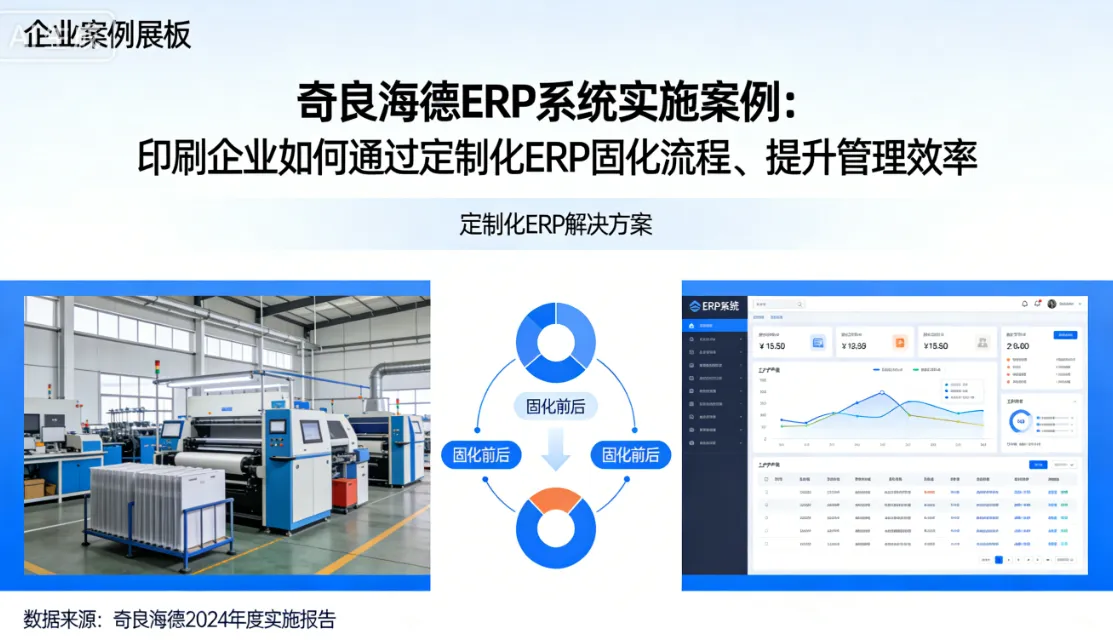
Data driven decision-making mechanismStarting to replace empirical judgment. The various reports generated automatically by the system, such as equipment utilization analysis, on-time delivery rate of orders, product category profit margin, supplier arrival qualification rate, etc., have become the core basis for management meetings. For example, by analyzing the average preparation time and yield of printing similar live parts on different machines, the enterprise identified improvement points in equipment maintenance and operation training; By tracking the profit margins of each customer's orders, we adjusted the customer structure and pricing strategy.
The refinement of cost control is the most direct manifestation of efficiency improvement. The system has been implementedFull cost accounting based on orders and processesThe direct materials such as paper, ink, and printing materials consumed in each order, the direct costs such as labor and machine hours occupied, as well as the indirect costs such as water, electricity, and factory depreciation shared, are all clearly collected. This enables companies to accurately identify which products and customers are truly making money, providing a scientific basis for pricing and order taking strategies. The financial monthly settlement time has also been shortened from several days in the past to a few hours.
Knowledge accumulation and organizational capability upgrading
The profound value of the Qilianghaide ERP project is further reflected inThe explicitization and solidification of organizational tacit knowledgeThe system has become the 'storage' of best practices for enterprises. Excellent process solutions, efficient production scheduling logic, and effective quality control points have all been established as standard templates and rules in the system. When new employees receive on-the-job training, they no longer rely solely on their master's "mentoring", but can quickly learn standard operating procedures through the system; The experience of process improvement can also be quickly promoted throughout the factory by updating system templates.
As a result, the core competitiveness of enterprises has gradually shifted from relying on individual "masters" to being rooted in the entire systemOrganizational Systems and Digital PlatformsThe sustainability capability. This has laid a solid foundation for the steady development and scale expansion of the enterprise.
Case Study: Feasible Path for Digital Transformation of Traditional Manufacturing Industry
The case of Qilianghaide shows that for traditional manufacturing industries with complex and highly customized processes such as printing, the key to successfully implementing ERP lies inDeep industrialization and moderate customizationThe combination. Enterprises need to collaborate with partners who truly understand the industry, transforming their unique business processes and management wisdom into the internal logic of the system, rather than forcing the business to adapt to rigid standardized software.
Its success also proves that the value chain of ERP is far more than just "going live", but lies in achieving it through the systemContinuous solidification of processes, deep utilization of data, and cyclic optimization of managementWhen the system is deeply integrated with the business and becomes an inseparable part of daily operations, the efficiency improvement and management empowerment it releases will become a key force for enterprises to build a moat in fierce market competition. The practice of Qilianghaide provides a clear and feasible upgrade path for many traditional printing and other manufacturing enterprises that are still waiting at the intersection of digital transformation.