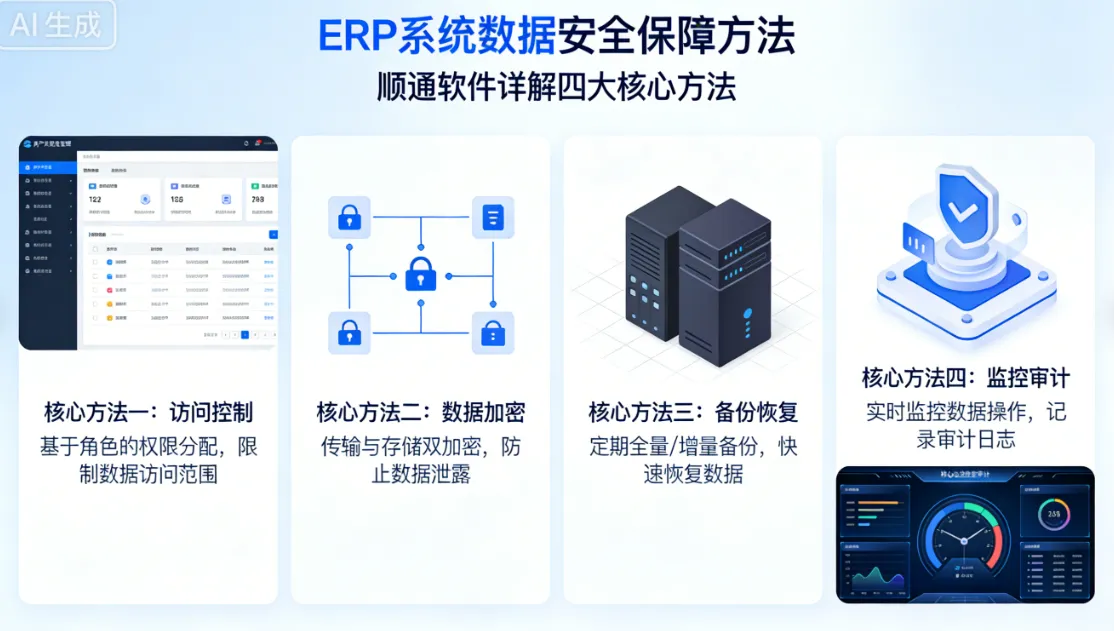
How to ensure the data security of ERP system? Shuntong Software explains four core methods in detail
In the digital age, enterprise resource planning systems carry the most core and sensitive business data and processes of enterprises, and their data security has become a strategic issue related to the survival and development of enterprises. Once data is leaked, tampered with, or destroyed, it will not only cause direct economic losses and operational interruptions, but may also trigger serious compliance risks and reputation crises. As a solution provider deeply involved in the field of enterprise informatization for many years, Shuntong Software has summarized four core methodologies for ensuring the security of ERP system data based on practical experience from hundreds of projects: technical defense system, permission governance model, data lifecycle management, and organizational culture cultivation. These four methods support each other and jointly build a multidimensional and three-dimensional security defense line from the technical bottom to the application top, from static storage to dynamic circulation.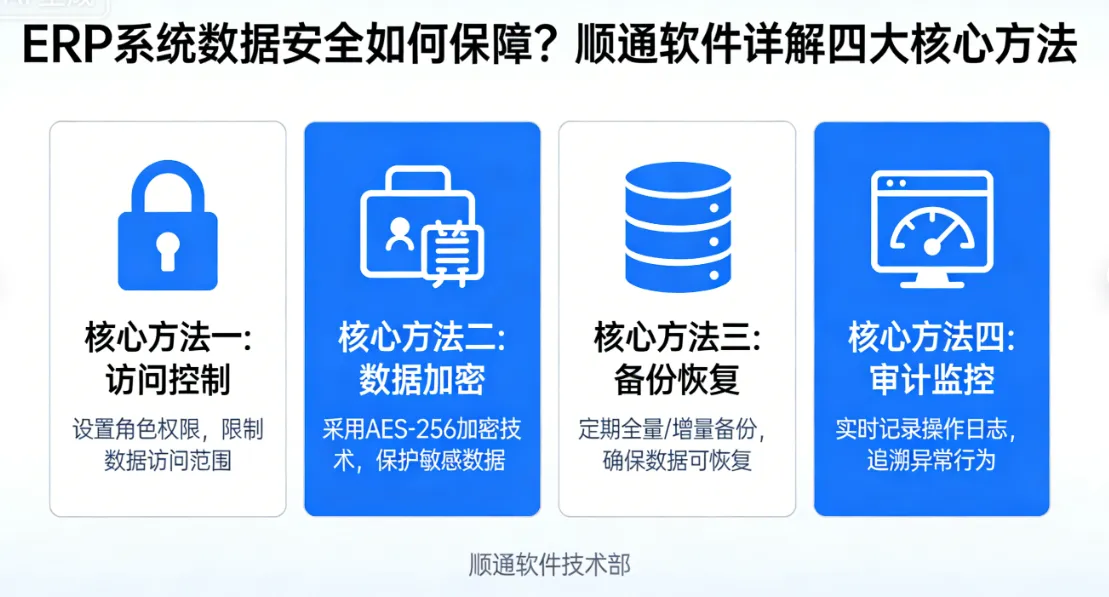
Multi level technical defense: building an indestructible 'digital castle'
The first line of defense to ensure the security of ERP system data is to build an advanced and in-depth technical defense system, which is like building a finely structured "digital castle" for the core data of the enterprise.Infrastructure SecurityIt is the foundation of the castle. Both on premises deployment and cloud based models require strengthened security isolation between physical and virtual environments. Locally, this includes strict physical access control, environmental monitoring, and redundant backups for data centers; In the cloud, it is necessary to choose a service provider with international top-level security certification and clarify their responsibilities in data encryption, network isolation, and physical security. Meanwhile, high-intensitycybersecurityIt is a moat that closely monitors and filters all network traffic entering and leaving the ERP system by deploying next-generation firewalls, intrusion detection and defense systems, web application firewalls, etc., to resist external threats such as DDoS attacks and vulnerability scanning.
Data encryption technologyIt is the 'armor' that guards the data itself. Implement end-to-end encryption for sensitive data to ensure that it is not eavesdropped during transmission and not illegally accessed in storage state. This includes using strong encryption algorithms to statically encrypt core business data, customer information, financial vouchers, etc. in the database, as well as ensuring dynamic security of data during network transmission through protocols such as SSL/TLS. More importantly, implementation is crucialFine grained access control and real-time monitoringAll access behaviors to the ERP system, including login, query, modification, export, etc., must pass strict identity authentication and leave complete and tamper proof audit logs. Through user and entity behavior analysis technology, the system can automatically learn and establish a baseline of normal behavior, provide real-time alerts for abnormal operations, and quickly respond to potential internal threats or security incidents that have occurred.
Refined Authority Governance: Implementing the Principle of "Least Necessary"
If technological defense is a sturdy city wall, then refined authority governance is the core system for managing the "city gate key". Its core lies in strict implementationMinimum Authority and Separation of Responsibilitiesprinciple. This means that every role and user within the system can only obtain the necessary data access and operation permissions to complete their job duties, and should not have any extra power. For example, a cost accountant can view and calculate the cost data of the products they are responsible for, but does not have access to the company wide compensation information; A warehouse administrator can operate inventory inbound and outbound, but cannot modify the financial properties of materials.
Shuntong software emphasizes the combination of role-based access control model and dynamic permission management in practice. Firstly, based on the organizational structure and business processes of the enterprise, define a clear job role matrix and configure permission sets precise to the field level for each role. Secondly, the granting of permissions is not fixed. The system should support regular review and automatic retrieval of permissions. When an employee's position changes or a project ends, their original permissions should be adjusted or revoked in a timely manner to prevent the risk of permission retention. Furthermore, for privileged accounts and super administrator privileges, the strictest approval and monitoring processes must be implemented to achieve "full traceability and dual person review" of their usage process, and to prevent abuse of power. This refined permission governance fundamentally limits the possibility of unauthorized access to data, and even if external attackers break through some of the defense lines, it is difficult to move horizontally to obtain more sensitive information.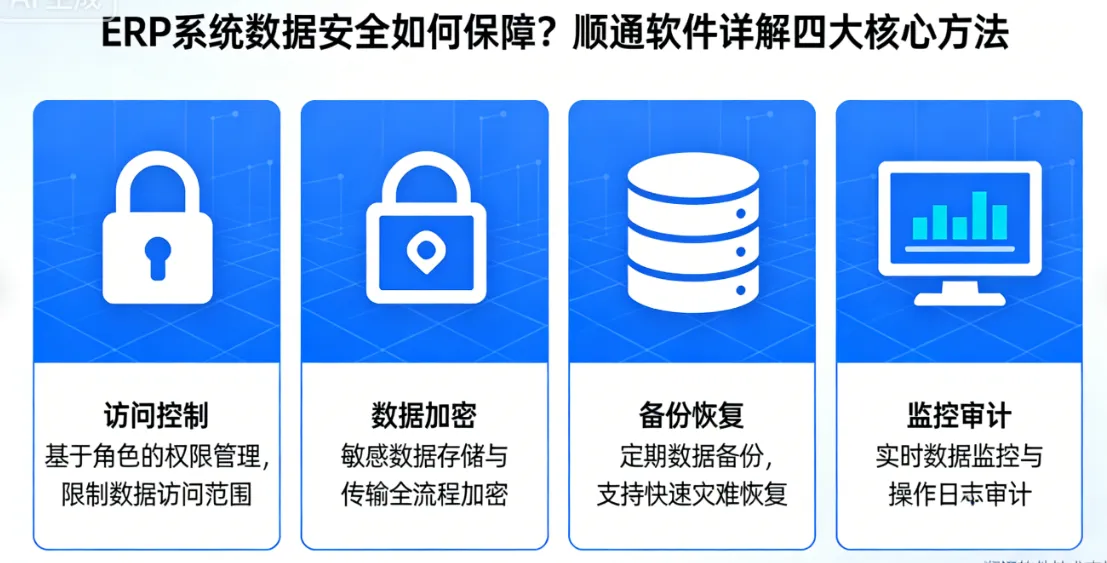
Data lifecycle security management: full protection from generation to destruction
Data security is not static protection, but dynamic management that accompanies the entire process of data generation, storage, use, sharing, archiving, and destruction.Data classification and gradingThis is the starting point of this management. Enterprises must establish a unified data classification and grading standard based on the importance and sensitivity of data, and identify all data in the ERP system. For example, mark core production processes, financial statements, and customer privacy information as "top secret", and mark general material descriptions and public product information as "public". Different levels of data have varying storage encryption strength, access control policies, backup frequency, and anonymization requirements.
In terms of dataUsage and circulationThe focus is on preventing sensitive data from being abused or leaked. The system should have strong data anonymization and leakage protection capabilities. De identification of real business data in non production environments such as development testing and data analysis; Automatically identify and filter sensitive fields when providing reports or exchanging data externally. At the same time, strict approval processes and technical interceptions are established for high-risk operations such as large-scale data exports and API interface calls. Finally, establish a standardized systemData destruction mechanismEqually important. For expired data or obsolete storage media that are no longer needed, they must be completely destroyed using irreversible methods that comply with security standards to ensure that data traces cannot be recovered and prevent information from leaking through "backdoors".
Security awareness and emergency culture: building a strong firewall for people
Technical means and management processes ultimately need to be executed and maintained by people. Therefore, cultivating a safety awareness among all employees and establishing an efficient emergency response culture are the cornerstone of ensuring ERP data security, and also the most easily overlooked "soft defense line". Enterprises need to carry out sustained and targetedSafety awareness education and skill trainingThe training content should not be dry policy promotion, but should be combined with specific business scenarios and real security cases, so that employees can deeply understand the serious consequences that data breaches may bring, and master basic skills such as identifying phishing emails, protecting account passwords, and securely handling data. The management should take the lead in setting an example and consider data security as part of their management responsibilities.
At the same time, it is necessary to establish and conduct regular drillsA comprehensive emergency response plan for security incidentsThis includes clarifying the emergency response organizational structure, job responsibilities, event grading standards, notification processes, and specific disposal and recovery steps. Regularly organizing red blue confrontation drills or simulating security incident handling can effectively verify the effectiveness of technical defense measures, enhance the team's practical capabilities, and continuously improve emergency plans. When a real security incident occurs, a well-trained team can act quickly and orderly, minimize the impact, reduce losses, and learn from it to achieve a spiral increase in security protection capabilities.
In summaryEnsuring the security of ERP system data is a systematic project involving technology, management, processes, and culture, and no single measure can provide complete protection. The four core methods advocated by Shuntong Software - building a deep technical defense system, implementing refined permission governance, managing data throughout the entire lifecycle, and cultivating security culture and emergency capabilities - together constitute a dynamic and three-dimensional security framework. Only by organically combining these four aspects and continuously investing, evaluating, and improving can enterprises enjoy the enormous operational value brought by ERP systems while ensuring that the core data assets that carry the lifeblood of the enterprise remain solid in the complex and ever-changing digital environment, laying a solid and reliable digital foundation for the sustainable development of the enterprise.