
How to maintain long-term operation of ERP software system after successful launch
The successful launch of an enterprise resource planning system is often seen as a major milestone, but it is far from the end of the digital transformation journey. In many enterprises, after the system goes online, it faces a more hidden and persistent challenge: how to ensure that this heavily invested system can operate continuously, stably, and efficiently, and continuously release expected value over time, rather than gradually becoming rigid, deviating from business, and ultimately becoming an expensive electronic decoration. The launch of the system only gives the enterprise a "digital shell", while long-term operation, maintenance, and continuous optimization are the key to injecting its "smart soul".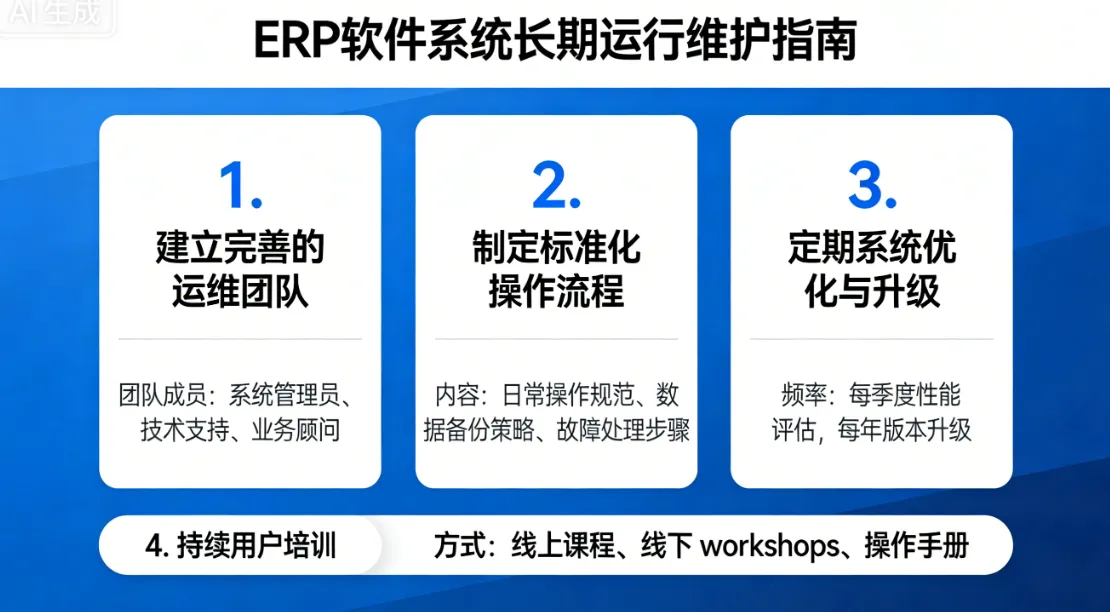
Establish a professional and efficient operation and maintenance support system
After the system goes online, the primary task is to achieve a smooth handover and role transition from the "project team" to the "operations team". Enterprises must establish a clear structure and well-defined responsibilitiesThree level operation and maintenance support systemFrontline support is undertaken by key users or service desks familiar with daily operations, responsible for answering basic operational questions and handling simple faults; Second line support is the responsibility of the internal IT team or ERP administrator of the enterprise to solve more complex technical configuration, user permission management, and business process issues; Third line support involves original manufacturers or core implementation partners to address deep-seated system defects, performance optimization, and major upgrade requirements. This grading mechanism ensures that problems can be quickly identified and directed to appropriate resources, avoiding all pressure flowing towards a small number of core personnel.
The core of operation and maintenance work lies inProactive monitoring and preventive maintenanceRather than passively 'putting out the fire'. Enterprises should deploy professional monitoring tools to continuously track key performance indicators of ERP systems 24/7, including database response time, server resource utilization, concurrent user numbers, and execution time of critical business transactions. By setting reasonable thresholds, the system can automatically alert before potential problems escalate into serious malfunctions. For example, when the concurrency surge during the month end closing period leads to a decrease in response speed, the monitoring system can provide early warning, and the IT team can optimize or temporarily expand in a timely manner. At the same time, establish a regular health check system, similar to equipment maintenance, to periodically review system logs, database indexes, backup integrity, etc., in order to prevent problems before they occur.
Ensure continuous governance of data quality and process compliance
Data is the lifeblood of ERP systems, and its quality directly determines the "health" of the system. After going online, data governance work not only cannot be relaxed, but also needs to be more institutionalized and normalized. Enterprises should establish cross departmentalData Governance CommitteeClarify the sole responsible department and maintenance process for various types of master data. For example, material master data is created and updated by the technical department, while supplier data is maintained by the procurement department. Establish regular data quality audit rules, such as checking work orders that have not been closed in a timely manner, stagnant materials that have not changed for a long time, and customer files with incomplete information, and require business departments to clean up and correct them.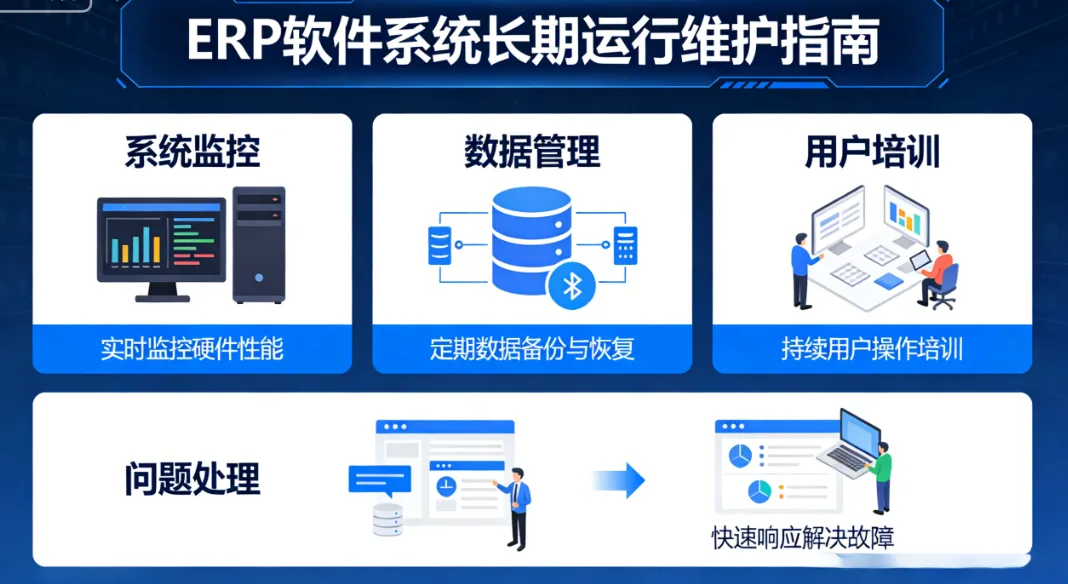
More importantly, ensure that business operations strictly follow the system settingsStandardized processThe value of the system going live lies in replacing past arbitrary operations with optimal processes. Therefore, it is necessary to ensure that employees do not bypass the system or engage in offline processing due to "trouble" or "habit" through continuous training, clear systems, and necessary system controls (such as mandatory fields, approval nodes). The head of the business department should become the first person responsible for process compliance and incorporate process compliance into performance evaluations. When everyone regards the system as the only and natural platform for carrying out work, data quality and process efficiency are fundamentally guaranteed.
Drive a value cycle of continuous optimization
ERP systems should not be static and rigid software, but should become a "living system" that accompanies the common growth of enterprises. This requires companies to establish a set ofContinuous optimization mechanism from feedback to improvementRegularly (e.g. quarterly) collect feedback from key users and business departments, hold optimization requirement workshops, identify new requirements arising from business changes, or pain points in existing processes that can further improve efficiency.
Optimization should followTake small steps and run quickly, value firstThe principle. Avoid initiating large-scale secondary development at will, but prioritize utilizing the system's own configuration functions, reporting tools, or workflow engines to quickly implement improvement points that require minimal investment and yield quick results. For example, developing a convenient report for high-frequency queries, or optimizing an approval process to shorten waiting times. Every small optimization can make users feel the vitality and value of the system, forming positive feedback on usage. At the same time, it is important to closely monitor the feature updates and patches released by ERP vendors, evaluate their value to the enterprise, and plan a smooth upgrade route for system versions to achieve more stable performance, stronger functionality, and enhanced security.
Cultivate future oriented internal capabilities and innovative culture
The ultimate guarantee for long-term operation lies in people. Enterprises must consciously cultivateInternal ERP professional competenceAvoid excessive reliance on external consultants. Establish an internal consultant or "super user" team, so that they are not only proficient in operations, but also able to understand business logic and system configuration principles. Through forms such as knowledge bases and case sharing sessions, we aim to consolidate and disseminate the best practices and solutions used in the system. The construction of such internal capabilities is the foundation for the system to quickly respond to business needs and conduct in-depth applications.
Furthermore, we should encourage aThe culture of data-driven and process innovationThe management should take the lead in utilizing the precise and real-time data provided by the ERP system to make decisions and demonstrate its value to all employees. Regularly release operational analysis reports based on system data, hold data analysis and application innovation competitions, and make employees realize that the system is not only a recording tool, but also a powerful assistant for improving work efficiency and discovering business opportunities. When the use and optimization of systems become a conscious and cultural aspect of an organization, ERP truly integrates into the operational genes of the enterprise, and its long-term and healthy operation has the deepest soil.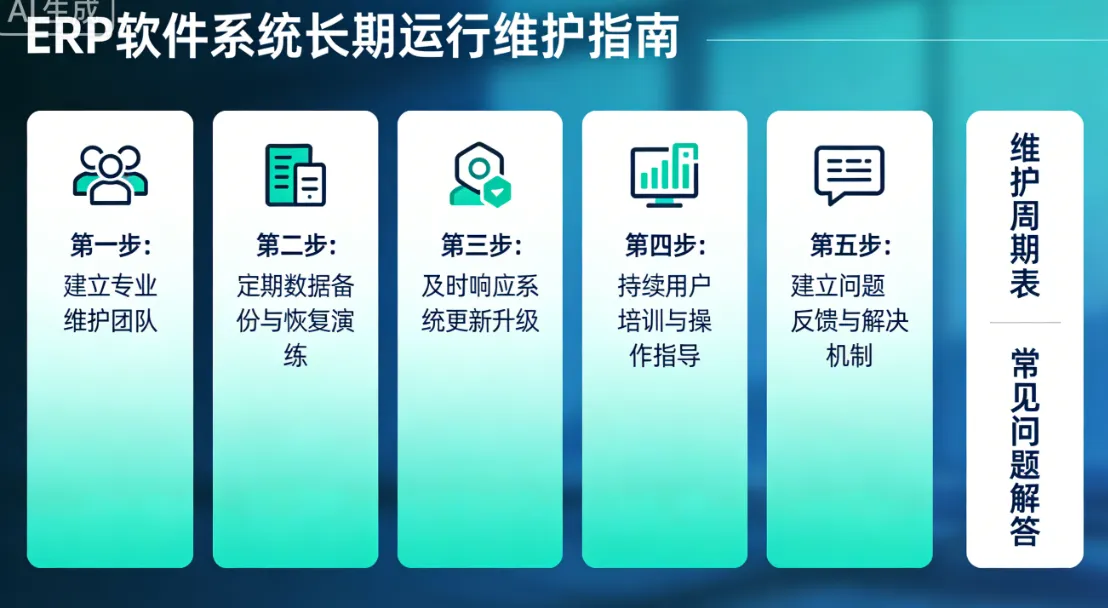
Overall, the long-term successful operation of an ERP system is a system engineering that integrates professional operation and maintenance, data governance, continuous optimization, and organizational culture.It requires enterprises to view ERP as a "core business capability" that requires continuous investment and careful cultivation, rather than a one-time "IT project". Only by establishing a scientific operation and maintenance system to ensure its stability, strict data and process management to ensure its reliability, continuous optimization and iteration to give it vitality, and building its foundation through capacity building and cultural cultivation, can enterprises ensure that this digital "core engine" will last for years or even decades, providing a powerful and stable driving force for the excellent operation and strategic development of the enterprise.