Not Subverting, Only Upgrading: The Transformation and Opportunities of Shoe and Clothing ERP under the AI Wave
The footwear and apparel industry naturally has the characteristics of fast style iteration, large SKU matrix, strong seasonal fluctuations, and scattered channels. Sizes, color codes, bands, futures, and fast reverse are intertwined, and it has long faced pain points such as shortage of codes and inventory backlog, heavy document input, dependence on experience for product decision-making, and difficulties in account verification. The essence of traditional ERP isPost event recording systemThe core values are document circulation, inventory accounting, cost accounting, and financial traceability. Skilled in rigid execution, but difficult to support advance prediction, intelligent allocation, and automatic identification of anomalies. With the rapid implementation of AI technology, shoe and clothing ERP is undergoing a profound transformation: AI will not replace ERP, but will be stacked on top of the ERP base, upgrading ERP from a "bookkeeping tool" to a collaborative brain for enterprise management; It amplifies the existing system capabilities, fills in decision-making gaps, and also drives ERP vendors and brand enterprises in the entire industry to redefine the boundaries of digital management.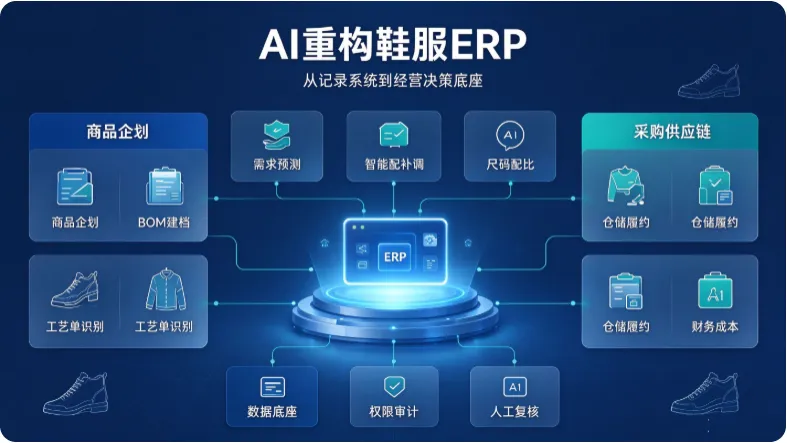
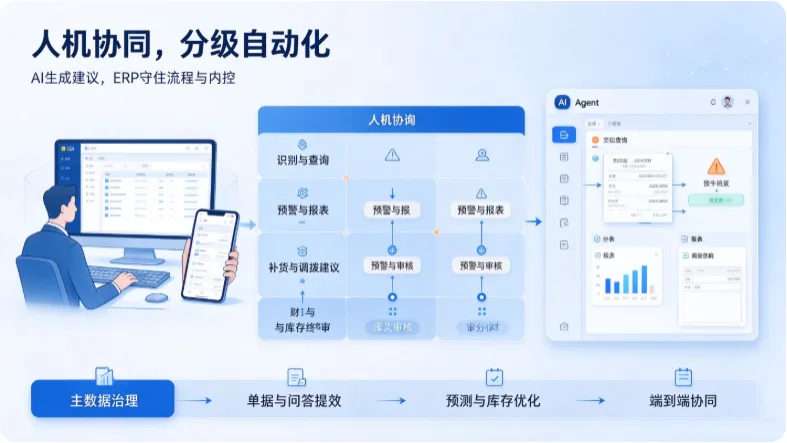
The current impact of AI on shoe and clothing ERP is not elimination, but a layered reshuffle. Old ERP systems that only focus on inventory management and lack product intelligence capabilities will continue to decline in competitiveness; ERP systems with open APIs, the ability to integrate with AI, or moving towards AI native architecture will become the mainstream choice for brands, factories, and wholesale enterprises. The division of labor between AI and ERP is very clear: AI is responsible for identifying, summarizing, predicting, providing solutions, and automatically generating draft documents; ERP maintains the bottom line of inventory general ledger, BOM version, financial vouchers, approval process, and business traceability. All AI outputs must be verifiable, traceable, and controllable, and high-risk operations cannot be directly reviewed by AI.
From the perspective of technical composition, the intelligentization of shoe and clothing ERP is not only supported by a general large model, but also by a multi technology combination system, including computer vision, temporal machine learning, operations research optimization, big language models, RAG retrieval enhancement, intelligent agents, vector retrieval and other technologies, which correspond to the pain points of different business processes and are applied throughout the entire chain of product planning, demand forecasting, supply chain production, warehousing performance, financial costs, data query, and master data governance.
In the process of product planning and BOM filing, multimodal modeling, OCR+Named Entity Recognition (NER), image vector retrieval, and text clustering techniques are the core. Designers' process sheets, TechPack documents, color card photos, and sample clothing images are automatically extracted through multimodal graphic and textual understanding capabilities, including style numbers, categories, colors, size differences, fabric accessories, loss rates, and process requirements. They quickly generate BOM, process routes, and size group drafts in ERP, greatly reducing errors in style numbers, fabric codes, and loss parameters caused by manual input. Image similarity retrieval can extract features from new product images, match similar styles in the historical style library, and provide reference for new product planning and prediction of new products without historical data. At the same time, with the help of text clustering and entity normalization, unified product labels are used to solve the confusion of master data caused by inconsistent terminology among business personnel, laying an accurate foundation for all subsequent data analysis, prediction, and reporting. Standardization of master data is the first prerequisite for the implementation of AI in shoe and clothing ERP. Once the color code, warehouse, and channel code are confused, even the most advanced models will output incorrect conclusions.
Demand forecasting, OTB planning, matching and adjustment, and size matching are the most valuable scenarios in the footwear and apparel industry, as well as the home ground for time series models and operational optimization algorithms. General large-scale models are not suitable for direct sales forecasting. TFT temporal fusion models, Prophet, LSTM, LightGBM temporal models, combined with transfer learning, anomaly detection, and integer programming optimization algorithms, jointly build intelligent product decision-making capabilities. The model integrates historical sales, inventory, in transit, returns, and futures order data from ERP, and overlays external weather, platform traffic, holidays, activity rhythms, and competitor information to outputStyle+Color+Code+Store/WarehouseDimensional daily and weekly sales forecast. To address the issue of cold start in new products, we rely on small sample transfer learning to reuse similar features; In response to disturbances such as live streaming orders and returns, abnormal data is automatically marked through anomaly detection algorithms to avoid contaminating the model. Based on the predicted results, relying on combinatorial optimization algorithms, under budget, inventory, and production capacity constraints, automatic OTB allocation, first store size ratio, cross warehouse transfer, and replenishment suggestions are generated. After manual review, the plan is written back to ERP with one click, generating replenishment orders, transfer orders, and purchase application drafts, alleviating the industry's chronic problems of "good product shortage, unsold inventory, and inventory pressure". In advanced scenarios, reinforcement learning can also be introduced to continuously iterate and adjust strategies based on sales feedback, adapting to DTC brands and fast response small order models.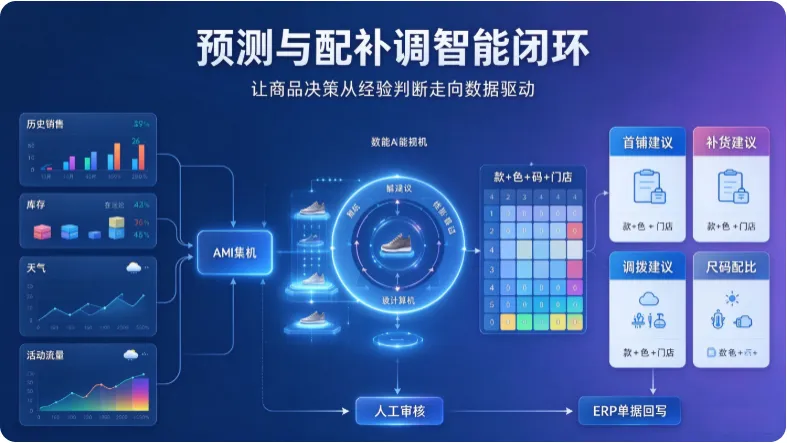
The procurement, supply chain, and outsourcing production processes rely on XGBoost, LightGBM risk prediction model, time-series price prediction, NLP text extraction, and graph neural network GNN to achieve risk prediction. AI reads ERP purchase orders, outsourcing work orders, and supplier performance records, identifies high-risk suppliers with high delays, material delivery conflicts, and order backlog risks, and provides early warnings; Based on historical cutting records, pattern, and fabric width, dynamically calculate losses and replace fixed loss rates, making ERP cost accounting more closely aligned with real production. Extract text from procurement contracts and incoming delivery notes, automatically extract delivery dates, quantities, and unit prices, and match them with ERP orders automatically; Enterprises with multiple suppliers and factories in a group can also use graph neural networks to sort out material dependencies, identify supply chain bottlenecks, and support flexible production of small and multiple batches.
Computer vision technology plays a key role in warehouse WMS, inbound and outbound, return quality inspection, and inventory scenarios. OCR、 Barcode recognition automatically parses delivery notes and express waybills, quickly generating ERP inbound and outbound documents; The image classification and defect detection model is used for return quality inspection. After uploading return photos, it automatically distinguishes quality defects, color differences, wrong shipments, and simply unsuitable sizes. It automatically classifies them as sellable, repairable, or scrapped, and generates corresponding return and loss reports. The time-series anomaly detection algorithm continuously scans the ERP inventory flow, automatically identifies anomalies such as negative inventory, over BOM requisition, and duplicate inventory, locates suspicious documents that do not match the actual inventory, and reduces the cost of manual inventory inspection; The collaborative filtering recommendation algorithm recommends the optimal warehouse location for ERP/WMS based on SKU turnover frequency, improving picking and outbound efficiency.
Financial reconciliation, cost accounting process, bill OCR+NER extraction, text classification, and RAG combination use. Automatically identify structured information for invoices, processing plant settlement statements, and logistics reconciliation statements, compare them with ERP warehouse receipts and work orders, highlight differences, and replace manual line by line reconciliation; The text classification model automatically allocates sample fees, courier fees, and marketing expenses to corresponding styles and channels, and writes them into the ERP cost module; The time-series prediction of fabric prices can also support gross profit simulation before accepting orders, identify loss making orders in advance, and improve the accuracy of quotation decisions.
Natural language BI and intelligent business assistants are the AI applications with the lowest implementation threshold and the fastest effectiveness. The core technologies include LLM big model, Text2SQL, RAG retrieval enhancement, intelligent agent, and speech recognition ASR. Business personnel do not need to learn complex filtering and exporting reports. They can directly ask questions about inventory, sales, gross profit, and code breakage in natural language. The system uses Text2SQL to translate the questions into executable query statements, reads ERP private data, and relies on RAG to access the shoe and clothing industry knowledge base, avoiding the illusion of big models and outputting results, charts, and interpretations. Complex tasks are automatically disassembled by multi-step agents, such as synchronously querying inventory, in transit, predicting sales, and integrating output transfer plans; Voice recognition is suitable for warehouse and shopping guide scenarios, enabling voice inventory checking and declaration, reducing the threshold for ERP usage. Vector Embedding technology supports master data plagiarism checking, supplier and style similarity matching, and continuous management of ERP data quality.
Empowering shoe and clothing ERP with AI must follow the risk control principle of hierarchical automation, safeguard internal control and financial bottom line: low-risk identification, query, warning, reporting, and draft documents should be automatically executed by AI; The replenishment and allocation plan belongs to medium risk, and AI only outputs draft suggestions, which will be manually reviewed before taking effect; Modify high-risk operations such as general ledger, cost, and financial vouchers, prohibit direct AI operations, and merge all AI operation logs into ERP audit logs for full traceability. At the same time, establish an error closed-loop mechanism to continuously track and identify error rates and prediction deviation rates, and regularly optimize the model, rather than letting it go after going live.
From the implementation path, enterprises can steadily advance in stages to avoid blindly adopting big models and pursuing gimmicks. The first stage prioritizes the implementation of document recognition, intelligent Q&A, and master data plagiarism verification, with small investment and fast results; In the second stage, SKU demand forecasting, size matching, and inventory variance investigation will be launched to directly address the pain points of product inventory; The third stage extends to supply chain lead time warning, dynamic loss accounting, and supplier profiling; In the fourth stage, we will explore AI native agents and connect planning BOM、 End to end closed-loop of prediction, procurement, production, and outbound. In terms of selection, small and medium-sized enterprises prioritize open interface ERP and gradually upgrade through external AI modules; Brand oriented and fast response enterprises need to evaluate AI native ERP solutions.
In the long run, the competitive logic of shoe and clothing ERP has changed. Have the BOM, finance, and inventory functions been fully compared in the past; The future competition will focus on the quality of data bases, AI product decision-making capabilities, and ecological openness. AI is not disrupting ERP, but reshaping the value center of ERP: the system is no longer just recording business results, but continuously outputting business suggestions, helping commodity, procurement, warehouse, and financial personnel reduce repetitive labor, reduce human errors, and transform experience decisions into data-driven decisions. For practitioners in the footwear and apparel industry, the true intelligent transformation lies not in piling up AI technology, but in consolidating the data foundation of ERP, finding AI scenarios that are suitable for their own business, establishing a human-machine collaborative management model, and making technology serve core business goals such as inventory turnover, gross profit improvement, and new product efficiency.