
ERP Digitalization Implementation Manual for Shoe Manufacturing Enterprises: Selection, Investment, and Implementation Management
The shoe-making industry has a long business chain and significant differences in form: there are traders who only accept orders and outsource them, industrial and trade factories that have their own workshops and outsource a large number of them, brands that make genuine leather shoes, and factories that produce injection molding volume. There are common problems such as fast style iteration, complex size matrix, independent management of last and mold, difficulty in standardizing leather material loss, and difficulty in outsourcing material reconciliation. Many shoe factories want to replace Excel with ERP, but it is easy to fall into pitfalls: being attracted by functional promotion, overestimating profits, underestimating implementation costs, and losing control of project schedules. In the end, the system is bought but still continues to use spreadsheets. This article objectively explains the evaluation methods for selection, cost-effectiveness, implementation cost, and implementation cycle based on the real implementation situation of the footwear industry. It does not exaggerate the effects and does not promise to automatically reduce costs and increase efficiency after going online.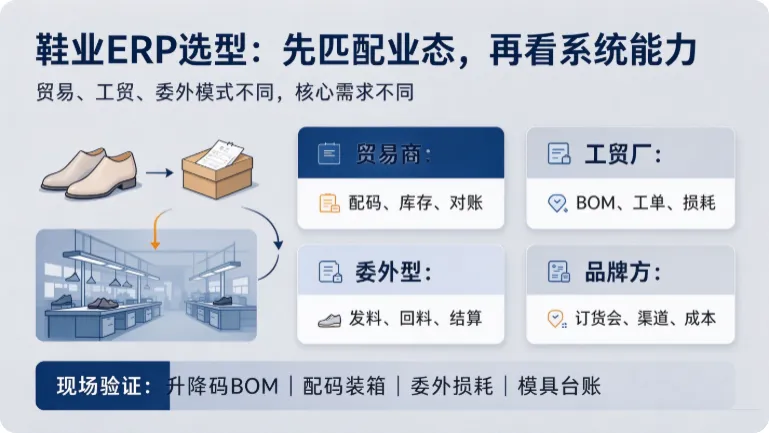
1、 Accurate selection: prioritize matching one's own business model and objectively evaluate system capabilities
There are significant differences between shoe ERP, general ERP, and clothing ERP, with the core differences being four-dimensional SKU (style+color+code+last shape), materials for lifting and lowering codes, shoe last knife mold ledger, matching and packing, leather material measurement, and outsourcing processing settlement. But not every shoe ERP is necessarily suitable for oneself. The core of selection is to first clarify one's own business, rather than prioritizing price comparison.
Pure trade oriented merchants without production workshops mainly place orders with downstream factories. Their daily pain points focus on coding and recording, packing, printing box labels, inventory management, accounts receivable and payable, and customer reconciliation. This type of scenario does not require workshop MES, process reporting, or fine production cost accounting. A lightweight SaaS inventory system for the footwear industry is sufficient, with simple functions and low entry barriers.
A factory integrating industry and trade, with its own cutting, needle sewing, bonding, and molding workshops, while outsourcing some processes. It is necessary to focus on confirming the functions of sample sampling management, BOM lifting code, material requirement calculation, work order, process reporting, material loss statistics, and order cost collection. Leather shoe factories have higher requirements for managing leather materials by square feet per sheet and sharing losses; Injection molding shoe factories focus on shoe sole raw materials and mold records.
The main mode is outsourcing, where we only do development, follow-up, and material distribution ourselves, and outsource all needle making and molding.Outsourcing modules are of utmost importanceIt is necessary to confirm whether the system can fully record the issuance, return, loss registration, processing fee reconciliation, and over consumption deduction. Many outsourcing functions of low-priced systems only involve simple inventory management without loss control, which cannot solve the old problem of mismatched outsourced materials.
For brands that participate in ordering events, focus on bulk coding and ordering, as well as channel inventory statistics; E-commerce shoe merchants need to confirm whether ERP can stably integrate with e-commerce OMS, synchronize orders, and handle returns and exchanges; Foreign trade enterprises need multiple currencies, packaging materials, and export related documents. At the same time, it should be noted that many domestic shoe industry ERP systems have basic foreign trade functions and limited support for complex landed costs and letter of credit accounting.
When selecting, it is necessary to distinguish between: native shoe version, clothing ERP secondary modified version, and general ERP with industry plugins. The ERP transformation version of clothing mostly has inherent deficiencies in last, lifting code BOM, and matching logic, resulting in a large workload and average stability for subsequent modifications. Therefore, careful selection is necessary. But there is no need to blindly believe in "native shoe ERP", as some manufacturers' native versions also have problems with rigid reports and weak customization capabilities.
The demonstration test only tests the business scenarios in which one is actually using it, with priority given to the following items: BOM maintenance for multiple last shapes of the same style, material calculation for size adjustment, automatic packing of matching orders, measurement of leather in and out of the warehouse, outsourcing material return and loss statistics, and mold borrowing and returning records. If possible, you can go to a similar factory for on-site inspection, focusing on whether the other party is really using it for daily use, rather than just for placing orders.
Deployment modes include SaaS cloud version, on premises deployment, and hybrid cloud: SaaS has low initial investment and does not require maintenance of servers, but may experience lag when the network is poor, limiting deep customization; The locally deployed data is stored on our own servers, which provides more customization space, but requires dedicated personnel to maintain the servers and networks. Subsequent upgrades are generally charged separately; Hybrid cloud is rarely used and is generally only considered by larger brands.
The selection scoring can be evaluated from several dimensions, including TCO total cost of ownership, functional compatibility, service provider implementation experience, after-sales response, and scalability. It is not just about pursuing the most comprehensive functionality, but also prioritizing sufficient and adaptable processes.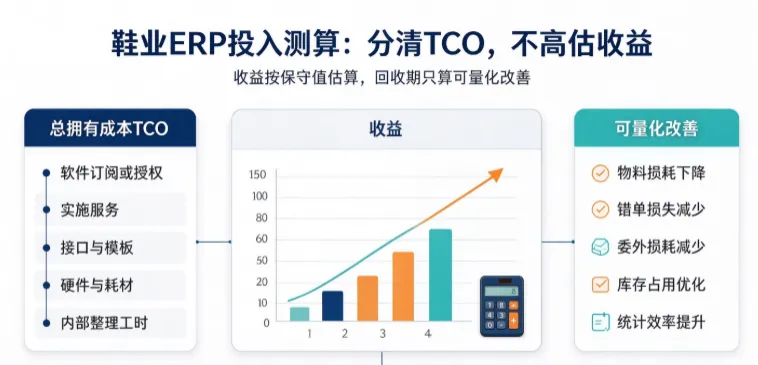
2、 Cost benefit evaluation: objectively account for inputs, rationally view benefits, and avoid inflated expectations
Many projects fail due to overestimating the benefits in the early stages and neglecting the difficulty of implementation. The improvement brought by ERP is based on standardized processes and the willingness of personnel to execute according to the system; If business habits remain unchanged, the system will not automatically save money.
Total Cost of Ownership (TCO) includes both one-time and annual continuous investments. Here, we need to distinguish between software fees and implementation service fees, which are independent. One time investment: software licensing fee or SaaS first-year subscription fee, implementation service fee, interface and template customization fee, hardware (PDA, barcode printer, etc.), initial inventory point, internal labor cost for material/BOM organization, temporary error cost for new and old switching period. Annual ongoing costs: SaaS annual fees or maintenance service fees, consumables (label paper, carbon ribbon), hardware depreciation, and labor costs for internal personnel to maintain the system.
Revenue is divided intoQuantifiable hard returnsWhen calculating investments based on soft management value, only hard income is used to calculate the payback period, while soft income is only used as an additional reference and not converted into cash to prevent expected distortion. Quantifiable hard returns (can only be obtained if management is in place, not necessarily achieved):
-
Material loss savings: mainly in genuine leather, fabrics, and accessories. The premise is that BOM is accurate, material requisition is controlled according to standards, and over consumption is registered in a timely manner. If the BOM itself is inaccurate and the workshop material requisition does not follow the system, this part of the revenue does not exist.
-
Reduced losses from incorrect orders: deductions, rework, and additional shipping costs due to incorrect sizing, packaging, and delivery of wrong sizes.
-
Outsourced material control: Reduce losses caused by the loss and inability to verify excessive consumption of outsourced materials.
-
Inventory capital optimization: After accurate inventory data, reduce blind stocking and lower the interest on stagnant inventory occupying funds. Attention: This is releasing funds, not directly earning cash.
-
Statistical manpower optimization: Reduce the time for manual Excel reconciliation and statistical reporting in document tracking, warehouse management, and finance. At the same time, it should be objectively stated that most factories do not directly lay off employees, but rather reduce overtime and transfer manpower to other tasks such as follow-up and quality control.
-
Order gross profit accounting: It can collect mold, development fees, and outsourcing fees, identify continuous low gross profit orders, and assist business order decision-making.
Soft income cannot be directly converted into money: order progress can be traced, mold last asset ledger is clear, material batches can be traced in reverse during customer complaints, accounts receivable and payable reconciliation is clearer, and business data can be queried. These belong to management improvements, and it is difficult to calculate the specific amount.
Static investment payback period formula: payback period=initial one-time total investment ÷ annual net income Annual net income=annual stable hard income ÷ annual continuous cost
Industry reference only for reference: projects with a payback period of ≤ 2 years and relatively good conditions; 2-3 years, strict control and implementation are required; Over 3 years, it is recommended to reduce demand and launch in stages, rather than investing in the entire set at once. When calculating, it is recommended to give a conservative estimate of 30% off the actual returns, while reserving risks such as employee resistance, inadequate execution, frequent changes in demand, and implementation delays, all of which can lead to actual returns being lower than the theoretical values.
At the same time, it is important to recognize the risks: ERP itself does not create profits. If the factory's processes are chaotic, documents are constantly missing, and personnel are unwilling to change their habits, no matter how expensive the system is, it is difficult to achieve expected returns.
3、 Implementing cost accounting: Distinguishing charging boundaries and identifying hidden charges
Implementation cost refers to the service fees incurred by service providers to help enterprises streamline processes, configure systems, initialize files, provide training, and provide online support,Excluding software licensing feesThe workload of shoe industry implementation is much higher than that of simple inventory, and the biggest variable is the workload of organizing BOM, last, and size information.
There are two mainstream billing methods:
-
Charged by person day: Industry and trade projects are the most common. External implementation cost=consultant person day unit price x estimated person day+template customization, interface development fees+travel, accommodation, and full implementation cost=external cost+internal personnel input labor cost for implementation consultants who understand the shoe-making process. The market price is approximately 1500-2500 yuan/person day; Ordinary general consultants have lower prices, but most of them are not familiar with cutting, sewing, outsourcing, and leather accounting, which can easily lead to solutions that deviate from reality. Reference person day range (standard implementation only, excluding extensive customized development): 5-12 person days for pure trade; 15-30 person days for small factories mainly outsourced; Complete set of samples BOM、MRP、 30-60 person days for work orders, outsourcing, and cost accounting; More than 60 person days for multi factory, foreign trade, and multi platform docking projects. Genuine leather styles and multi last designs will significantly increase the workload.
-
One size fits all pricing: commonly used for SaaS products. The package price is generally agreed upon within a fixed range, including basic configuration, limited quantity file import, and basic training. Exceeding the agreed scope, such as additional batch import of BOM, adding custom reports, and developing special processes, will be charged separately. Many low-priced packaging implementations only focus on basic inventory, without BOM and cost accounting, which is a high incidence point for later price increases.
The implementation cost includes: consulting services, initialization of files and BOM, customization of tag/box label templates, third-party interfaces, job training, on-site escort for online deployment, and travel expenses; And the implicit labor costs of internal building, warehouse, document tracking, financial data organization, and inventory verification within the enterprise.
Key points for cost control: Provide a SOW implementation scope statement before project initiation, clearly stating in black and white which modules are included, how many BOMs are imported, the number of training sessions, the duration of online escort, and which are additional charges; Payment will be made in stages, based on the blueprint confirmation, configuration testing, and online acceptance nodes; Add new requirements through a written change order and provide a separate quotation to avoid unlimited demand spread.
4、 Implementation cycle calculation: Internal data progress is the biggest bottleneck, reasonable scheduling
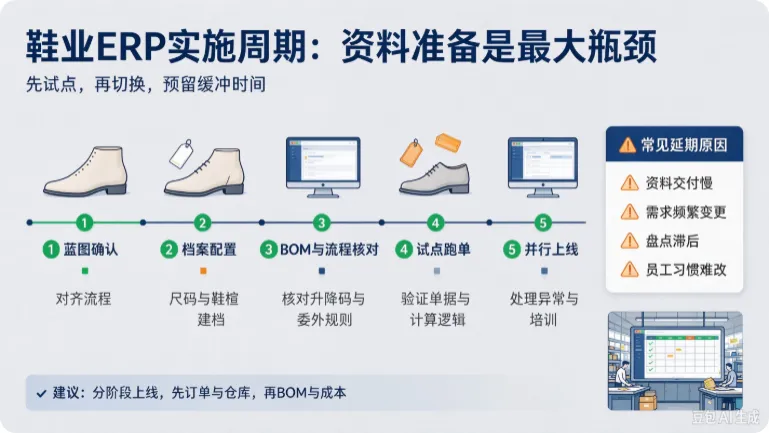
The delay in shoe ERP is mainly due to the delay in internal data delivery, lack of time for business leaders to confirm processes, and repeated delays in inventory counting, rather than slow system implementation by service providers. Total cycle=duration of each stage+buffer time, excluding long-term escort period after launch.
Standard implementation phase:
-
Blueprint research and scheme confirmation: Align existing processes with department heads to determine system processes. If the responsible person is unavailable and repeatedly changes the scheme, the cycle will be infinitely extended.
-
Basic file and document label template configuration: material, customer, supplier, size chart, label template construction.
-
BOM、 Sample, last shape, mold, and matching rule input verification: The most time-consuming process in the footwear industry, where every BOM with multiple lasts and multi color codes needs to be verified by business personnel, and the workload for verifying genuine leather products is even greater.
-
Process simulation, job training, small-scale pilot order running: Select 1-2 order pilots to verify if there are any issues with document flow and calculation logic.
-
Full switching online, new and old parallel, exception handling: During the parallel phase, consultants are generally required to provide online or on-site support to promptly handle errors and document exceptions.
Reference period (premise: timely delivery of materials within the enterprise, timely cooperation and confirmation): Pure trade projects: 20-40 days; Small factories with orders, warehouses, and outsourced settlements: 40-70 days; Complete set of industry and trade (sample PLM+BOM+MRP+work order+outsourcing+cost): 70-120 days; Multi factory, foreign trade, ordering conference, multi platform docking brand project: more than 120 days.
Common reasons for delays: insufficient internal manpower, delayed organization of BOM and inventory data, frequent changes in business requirements midway, inability to complete warehouse inventory on time, and resistance from frontline employees to use. Prudent approach: Set fixed data delivery nodes and clarify internal communication responsibilities; Prioritize pilot projects for small orders, verify that there are no issues before fully implementing them; Reserve buffer time and do not overload the schedule.
5、 Implementation suggestion: Implement step by step, gradually progress, and pragmatically view digitalization
It is not recommended to go all modules in one go, as the scope of one-time deployment is too large and the probability of failure is high. Recommended phased implementation: Phase 1: orders, warehouse, inventory, sales and inventory. First, solve the basic pain points of code recording, inventory, and reconciliation. This stage has the fastest effect and is convenient for various departments to adapt to the system; Phase 2: BOM, material requirements, outsourcing processing, control of material requisition, outsourcing reconciliation; Phase 3: Workshop process reporting, piece rate, and refined cost accounting.
Before going online, keep benchmark data: material loss, wrong order deduction, stagnant inventory, and manual labor hours in the past 12 months as a basis for subsequent comparison. After going online, compare the benchmark to see the real changes, rather than judging the system's value based on intuition.
ERP is essentially a set of management tools that standardize and digitize the existing processes of an enterprise. It cannot replace business management, nor can it automatically solve management loopholes. Selection, cost estimation, and schedule planning are all ultimately aimed at matching the true management capabilities of the enterprise. Only when the processes, personnel, and systems are synchronized and coordinated can ERP play a role in reducing repetitive work, clarifying data, and reducing controllable risks.