
Clothing ERP piece rate module: a core solution for digitalization of production and salary in clothing factories
In the textile processing industries such as clothing, shoes, hats, and knitting, fragmented production processes, dense assembly line personnel, fast style iteration, and complex salary accounting are common industry pain points. Traditional factories have long relied on paper invoices for manual bookkeeping and Excel for output and wage statistics, which commonly suffer from data omissions, large errors in manual accounting, frequent labor disputes, opaque production progress, and inaccurate calculation of order labor costs.
The garment ERP piece rate module, also known as the electronic work order or scanning fee piece rate module, is a digital core functional module tailored for the garment production process, running through the entire process of cutting, sewing, finishing, quality inspection, and settlement. This module is designed toElectronic piece rate code reporting, automatic data collection, intelligent salary accounting, production schedule linkage, precise cost collectionAs the core, it completely replaces the traditional manual accounting mode, realizes the visualization of workshop production, standardization of salary accounting, and refinement of order costs, which is the essential core module for the digital transformation of clothing factories.
1、 Module core positioning and industry value
Clothing production is a typical labor-intensive process based production, where each garment undergoes dozens of processing steps. The working hours, difficulty, and cost of each step vary greatly, and employee salaries are mostly calculated on a piece rate basis. The core positioning of the ERP piece rate module is to connect the entire data loop of "production operation output statistics salary settlement cost accounting" and solve the four core problems in the industry:
1. Solve the problems of traditional paper invoices being lost, missed, incorrectly recorded, and having low statistical efficiency, and achieve full traceability of production data throughout the process;
2. Standardize the pricing and accounting rules, eliminate month end salary reconciliation disputes and manual accounting errors, and achieve salary transparency;
3. Real time synchronization of the production progress of each process in the workshop, precise positioning of production bottlenecks, optimization of workshop scheduling and personnel scheduling;
4. Automatically collect labor costs into orders, style numbers, colors, and sizes, accurately calculate the true gross profit of orders, and provide data support for order quotations and production decisions.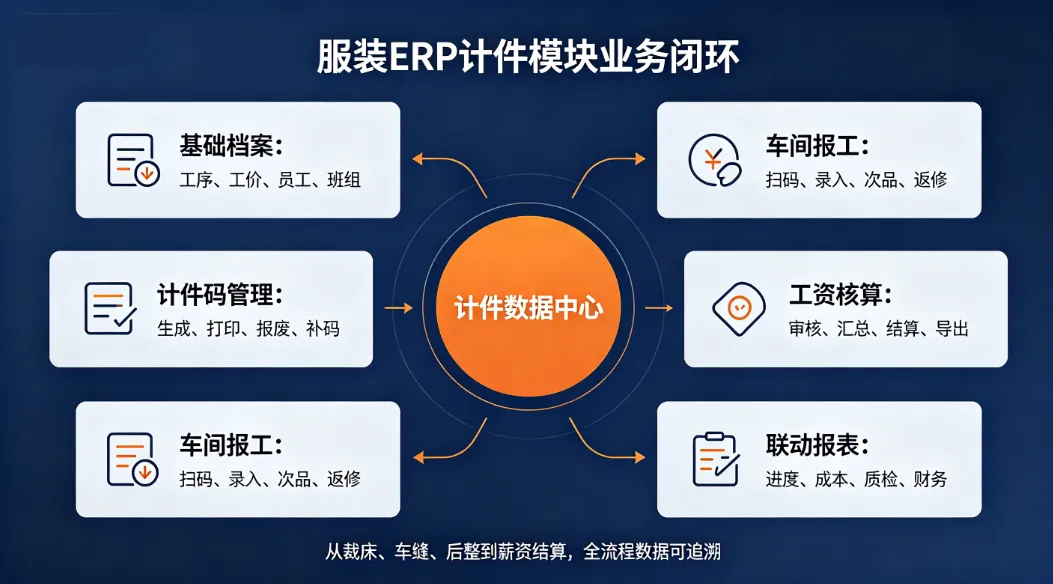
2、 Basic archive system: the core cornerstone of module operation
A standardized basic file is the prerequisite for accurate calculation of piece rate data. The system adapts to the production characteristics of multi style, multi process, and differentiated pricing of clothing through standardized file configuration. The core files include four categories:
1. Process archivesFully input the entire production process of clothing, covering all workshop processes such as lining, cutting, subcontracting, edging, shoulder fitting, sleeve fitting, collar fitting, zipper sewing, buttonhole fastening, ironing, packaging, etc. Simultaneously supporting the binding of process permissions, only employees in corresponding positions can report the corresponding process output, eliminating false and disorderly reporting; Batch processes such as cutting machines can be set to full code mode, supporting one-time batch reporting and adapting to batch production scenarios. In addition, process rules can be customized to set whether rework reporting is allowed, whether it is included in salary, and whether pre process completion is required before reporting.
2. Process templateFor conventional styles such as T-shirts, hoodies, pants, jackets, etc., preset standardized process templates. When the new model is put into production, it can generate a complete set of processes by calling templates with one click, without the need for repeated manual input, greatly reducing the preparation cycle for new product production and unifying the production process standards for products of the same category.
3. Process price warehouseEstablish a multi-level priority pricing system, with priority given to order specific pricing, style universal pricing, and template basic pricing, perfectly adapting to the differentiated pricing needs of different orders, fabrics, and process difficulties of the same product. The system supports multiple mainstream piece rate models in various industries, including individual piece rate, team collective piece rate, tiered piece rate, urgent order subsidy, difficult process markup, etc. At the same time, salary deduction rules for defective products, scrap, and repair can be preset, and all pricing rules are transparent, traceable, and fixed.
4. Employee team filesEnter employee basic information, team affiliation, job role, piece rate type, bind mini program reporting permissions, distinguish between regular workers, temporary workers, and resigned personnel, adapt to workshop team management mode, and provide basic data support for team salary sharing and personnel output statistics.
3、 Electronic piece rate code (electronic Philippine ticket): a carrier of production flow data
Electronic piece rate code is the core data carrier of the clothing piece rate module, replacing traditional paper invoices. Each bundle of cut pieces corresponds to a unique QR code/barcode, which is bound with exclusive production information and runs through the entire production process.
The piece rate code is mainly generated in batches from the production plan (production order), and supports manual patching to adapt to special scenarios such as lost Philippine tickets and replacement pieces. The document includes core information such as order number, style number, color, size, zip code, and total batch quantity. The system supports operations such as scrapping, voiding, reprinting, and tracing of piece codes. Scraping of cut pieces can directly freeze the corresponding code's reporting authority, while lost Philippine tickets can be replaced with one click and the old code can be invalidated, completely solving the problem of chaotic and untraceable management of traditional paper documents. At the same time, the system comes with an anti excess verification mechanism, and the total number of reported work for a single cut piece must not exceed the total batch quantity, thus eliminating the problem of false reporting of production volume from the source.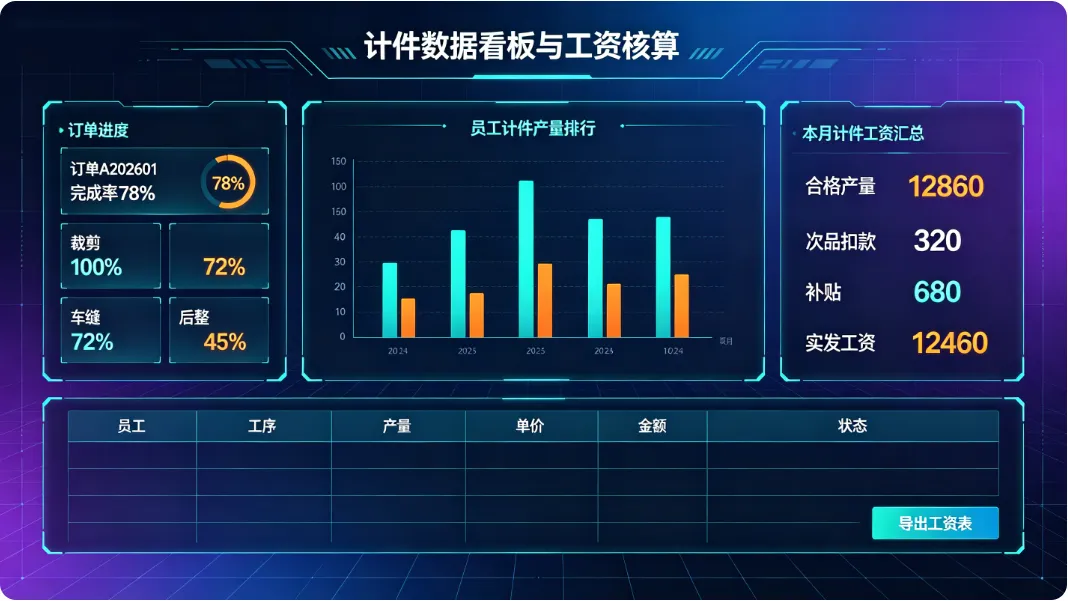
4、 Multi scenario workshop reporting: efficient collection of production data
The module is adapted to different production scenarios of large, medium, and small factories, providing three mainstream work reporting modes that balance convenience and accuracy, achieving real-time collection of workshop output:
1. WeChat Mini Program Scan Code to Report Work (Mainstream Mode)Workshop employees scan the piece rate QR code on the cutting piece with their mobile phones, select the corresponding process, and enter the qualified output and defective quantity to complete the work report. The system automatically verifies job and process permissions, intercepts illegal work reports; Support offline temporary storage and online automatic upload, suitable for unstable workshop network scenarios. Employees can view their daily output and estimated piece rate wages at any time, achieving salary transparency and enhancing work enthusiasm.
2. Manual input in PC backendAdapt to scenarios such as old workshops, lack of intelligent devices, or large-scale cutting and post-processing processes, with workshop statisticians uniformly inputting production data in batches to ensure flexibility in data entry.
3. PDA terminal scan code to report workAdapt to large-scale and standardized factories, use workstation barcode scanners and PDA devices to scan codes and report work, and adapt to the efficient operation requirements of assembly lines.
At the same time, the system has improved its exception handling mechanism, supporting the revocation, modification, and traceability of work report records. Unresolved records can be corrected at any time, while settled records need to be reversed and adjusted in red to avoid data confusion; Record the entire process of defective products, repairs, and scrap data, and coordinate with subsequent quality inspection and salary deduction processes.
5、 Intelligent review and salary accounting: precise avoidance of labor disputes
After the data collection is completed, the module achieves automatic and accurate salary calculation through standardized auditing and intelligent accounting system, completely eliminating manual statistical errors.
Firstly, the team leader reviews the workshop work report records, verifies the authenticity of production output, corrects abnormal data, filters out invalid work reports, and ensures the authenticity and effectiveness of production data. After the review is completed, the system automatically calculates the salary according to the preset rules, and the core calculation formula is:Single piece rate wage=qualified quantity x process unit price - deduction for defective products+various process subsidies。
For different production modes, the system supports differentiated accounting: individual piece rate is calculated based on the daily/monthly output of employees to calculate salaries; The collective piece rate of the team first calculates the total salary of the team, and then automatically distributes it to individuals according to the preset job coefficient and working hours; Step by step piece rate can automatically increase the unit price based on the production gradient, motivating employees to produce efficiently. At the same time, it can be linked to the attendance module, overlay guaranteed salary, overtime pay, and employee advance deductions, and generate complete payable wages.
After the salary accounting is completed, the system marks the piece rate record as "settled" to eliminate duplicate settlement issues. At the same time, it can export employee piece rate details, monthly salary statements, and bank payroll reports with one click, directly connecting with financial salary payment work, greatly reducing the workload of financial accounting.
6、 Full module linkage: achieving integration of business, finance, and production
The piece rate module of clothing ERP is not an independent function and can be deeply linked with the entire module of the ERP system to break down barriers in production, quality inspection, cost, finance, and warehousing data, achieving integrated management:
1. Linkage production progress moduleReal time writing of production work orders based on work report data, real-time display of various orders, completion rates of each process, quantity in progress, and production progress on the workshop electronic dashboard, accurate positioning of production bottlenecks, and assistance to managers in optimizing production scheduling and ensuring order delivery time;
2. Linkage quality inspection moduleSynchronize the data of defective products in the quality inspection system, and the data of unqualified quality inspection can be reverse linked to salary deduction. At the same time, settle the data of defective product rate, providing a basis for process optimization and quality control;
3. Linkage cost accounting moduleAutomatically collect piece rate labor costs into production orders, style numbers, colors, and sizes, accurately calculate the labor cost of a single garment and the overall gross profit of the order, and provide real data support for new product quotations, order profit and loss analysis, and production control;
4. Linkage finance salary moduleAutomatic synchronization of piece rate salary data with the financial system, one click generation of financial vouchers, seamless integration of production data and financial data, and elimination of data disconnection and duplicate entry;
5. Linkage outsourcing moduleSupport outsourcing processes, outsourced factory piece rate statistics and cost accounting, and adapt to the production mode of outsourcing some processes in the factory.
7、 Multidimensional data report: supporting refined management decision-making
The module is equipped with multi-dimensional standardized reports, which do not require manual summarization and can generate visual data reports with just one click, meeting various management needs such as workshop management, salary accounting, cost analysis, production control, etc. The core reports include:
1. Employee piece rate daily/monthly report: Clearly display the daily and monthly process output, unit price, piece rate salary, and subsidy deduction details of each employee;
2. Order piece rate summary report: Statistics the labor cost of the entire process of a single order, accurately calculating the production input of the order;
3. Process efficiency report: Analyze the per capita output, defect rate, and production efficiency of each process, providing a basis for personnel assessment and process optimization;
4. Piece rate code flow traceability report: Track the production flow and work report records of single bundle cutting pieces throughout the process to achieve problem traceability;
5. Salary Payment Special Report: Suitable for financial salary payment and bank agency scenarios, directly implemented for use.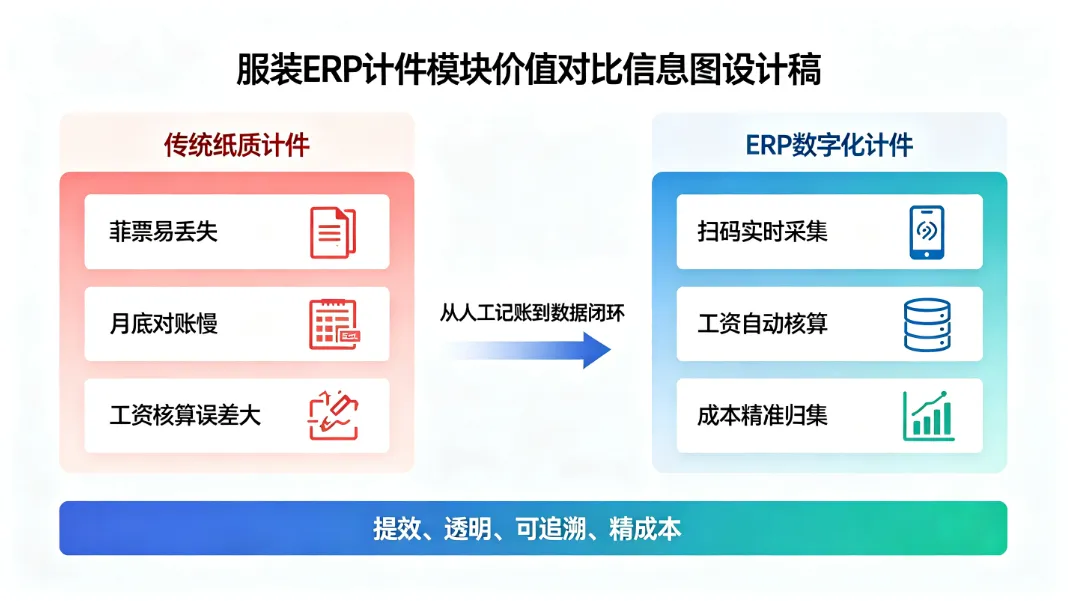
8、 Core advantages and landing value of module implementation
After being verified by numerous clothing production enterprises, the ERP piece rate module has completely revolutionized the traditional workshop management mode, and its practical value is clearly visible
1. Cost reduction and efficiency improvementCompletely bid farewell to paper accounting and manual accounting, improve salary accounting efficiency by over 90%, eliminate manual statistical errors, and reduce financial and workshop reconciliation costs;
2. Avoiding labor disputesAll production, piece rate, and salary data are traceable and transparent throughout the process, allowing employees to independently verify output and salary, reducing salary disputes at the root;
3. Production visualization controlReal time monitoring of workshop production progress, process bottlenecks, personnel capacity, precise scheduling of production, and effective shortening of order delivery cycles;
4. Precise cost controlRealize precise collection of labor costs, solve the pain points of "unclear cost calculation and uncertain profit" in the clothing industry, and optimize order taking and production decisions;
5. Standardize the factory management systemStandardize the procedures, labor prices, reporting, and settlement processes, break away from experiential management, and help factories achieve refinement, digitization, and standardization transformation and upgrading.
9、 Summary
The piece rate module of clothing ERP is a digital core tool that adapts to the production characteristics of the clothing industry, coveringBasic configuration, electronic invoice management, workshop reporting, salary accounting, production linkage, data analysisFull business scenario. It not only solves the basic problems of tedious salary accounting, inaccurate data, and frequent disputes in factories, but also achieves transparency in production progress, refinement of labor costs, and standardization of workshop management. It is an essential core module for labor-intensive clothing enterprises to reduce costs, increase efficiency, standardize management, and achieve digital lean production.