
In depth Analysis: Exclusive Features, Core Modules, and Industry Selection Points of Footwear ERP
In the process of digital transformation in the footwear industry, general inventory management and ordinary footwear ERP often struggle to adapt to the complex business logic of the footwear industry. The footwear industry chain covers multiple links such as research and development sampling, raw material procurement, multi process production, outsourcing processing, full box coding sales, and omni channel terminal operationComplex size system, full box matching transactions, multi-level material structure, cumbersome process flow, and uncontrollable loss of auxiliary materialsSuch unique characteristics. The shoe industry ERP customized for the industry is a core tool that connects the entire chain of shoe enterprise research and development, production, warehousing, sales, and finance, achieving refined control, cost reduction, and efficiency improvement. This article will comprehensively dissect the exclusive features, core functional modules, scenario differences, and selection guidelines of shoe ERP.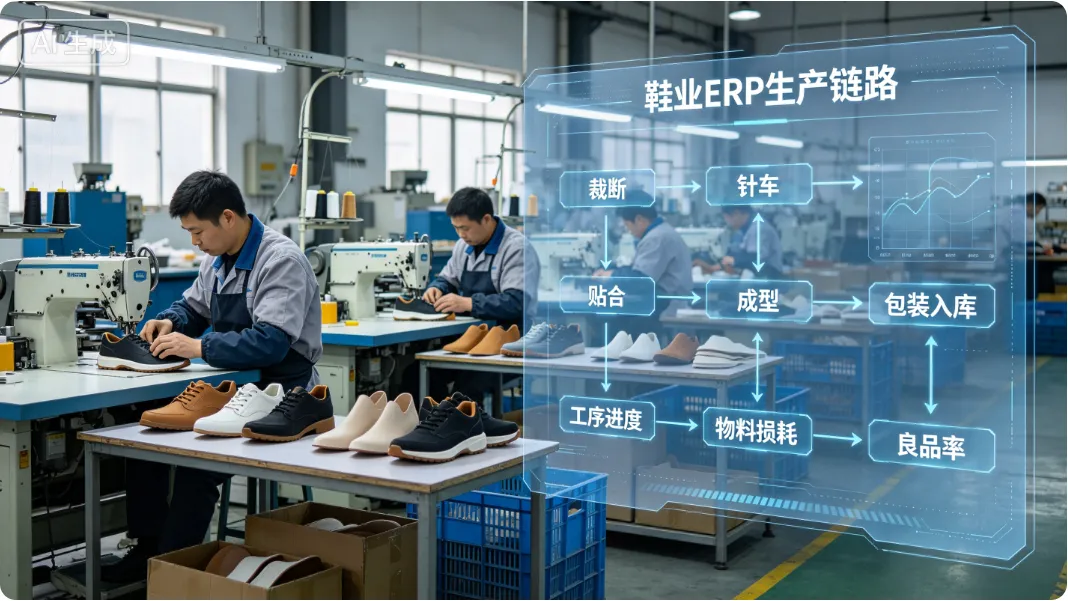
1、 The core essential differences between shoe ERP and ordinary clothing ERP
Many companies easily confuse footwear and clothing ERP, but in fact, the business logic of the two is vastly different. Clothing ERP cannot directly adapt to the operational needs of the footwear industry, and the core differences are concentrated in four dimensions:
Firstly, the specification system is more complex. The footwear industry has exclusiveLast, moldManagement system, shoes of the same style, color, and size, with different last shapes, mold specifications, and finished product parameters, are the core control dimensions that the clothing industry does not have; At the same time, shoe sizes include a large number of half size and boys' and girls' sizing systems, with higher requirements for specification accuracy.
Secondly, the sales model has exclusive coding box specifications. The mainstream of shoe wholesale and ordering events isFull container ratio shipmentEach shoe has a fixed size ratio standard and supports both full box delivery and split sales modes; However, clothing is mostly shipped in free codes without fixed box size constraints.
Thirdly, the material structure has a deeper hierarchical structure. The footwear industry adopts a 3-5 level multi-level BOM structure, covering finished products, semi-finished products, main materials, auxiliary materials, and packaging materials, with different sizes availableDifferences in materials used for lifting codesThere are more consumables in large sizes than in small sizes; The clothing is only a single-layer fabric BOM, without differentiated control of size consumables.
Fourthly, the production process is more complicated. Shoe manufacturing has five exclusive processes: cutting, sewing, fitting, forming, and packaging, and outsourcing processing is highly popular in the industry. The difficulty of rework, scrapping, and material loss control is much higher than that of the clothing industry.
2、 Core exclusive functional module of footwear ERP (full business chain)
(1) Multidimensional Product Archive: The Core Digital Foundation of Footwear Industry
Product archives are the foundation of footwear ERP, completely solving the pain points of SKU confusion and missing specifications in general systems, and buildingStyle number - Color - Size - Last numberFour dimensional management system. The system supports a multi size system for men's shoes, women's shoes, and children's shoes, adapting to the size rules of different categories such as sports shoes, leather shoes, slippers, etc., and fully recording material attributes such as upper, lining, outsole, and heel height.
Simultaneously equipped with exclusive featuresCode box specification filePreset standard box size ratios for various shoe styles, supporting synchronous statistics of box numbers and even numbers in pairs. Ordering, warehousing, and outbound can be switched to full box or split mode with just one click, perfectly adapting to mainstream shoe wholesale trading scenarios. In addition, the system can classify and label new products, best-selling, unsold, and out of season items, and provide data support for clearance, replenishment, and price adjustments based on seasonal, seasonal, and yearly dimensions.
(2) Sample R&D management: adapted to the high-frequency sampling needs of shoe companies
Shoe companies have fast product iteration and high sampling frequency, and the shoe ERP exclusive sample module can achieve full process control. The system supports the full stage recording of initial samples, confirmed samples, bulk samples, and customer confirmed samples, accurately retaining the shoe model number, last number, material and process, sample delivery time, and cost. Simultaneously building a sample exclusive BOM, calculating sampling costs, supporting the allocation of sampling expenses to bulk orders, supporting sample warehouse in and out management, and eliminating problems such as sample loss and chaotic process parameters are essential functions for industrial and trade shoe enterprises.
(3) Multi level differentiated BOM material management: precise control of production costs
This is the most core and complex module of footwear ERP, and also the key difference from ordinary ERP. Footwear ERP supportMulti level nested BOM architectureCovering all levels of materials including finished shoes, semi-finished uppers/soles, leather main materials, adhesives/stitching accessories, shoe box packaging materials, etc.
System support for industry pain pointsSize differentiation consumables configurationThe independent material consumption can be set according to different sizes, solving the practical problem of uniform consumables for all sizes in the universal system and large cost accounting deviations. Simultaneously supporting BOM version iteration and material substitution registration, the corresponding production version can be locked after changing materials and molds, avoiding the problem of process mixing and confusion; For volatile and high loss auxiliary materials such as adhesives and processing agents, accurate production loss data can be collected to help enterprises standardize material control and reduce waste. It should be noted that this feature is an industry standard refined configuration, not an original feature, and is a necessary basic ability for professional footwear ERP.
(4) Procurement and Outsourcing Management: Adapting to the Shoe Industry Supply Chain Model
Shoe companies have a wide range of raw material categories and diverse measurement units. Leather is measured by square feet, fabric by meters, and rubber by kilograms. The shoe industry ERP can adapt to automatic conversion of multiple units. Based on MRP calculation logic, the system can automatically calculate material requirements based on sales orders, production work orders, and BOM lists, deduct existing inventory, and generate accurate procurement plans to avoid material backlog or shortage.
In response to the widespread outsourcing mode in the industry, the system has established a complete outsourcing link, supporting the outsourcing of cutting, needle sewing, shoe soles and other processes. The entire process records the issuance, processing, recycling and storage, processing fee settlement, and material loss data, accurately collects outsourcing costs, controls risks such as material loss and processing delays, and is equipped with IQC quality inspection management for incoming materials to control the quality of raw materials from the source.
(5) Full process production management: tailored to the exclusive shoe-making process flow
The footwear ERP system is deeply adapted to the five core processes of shoe manufacturing: cutting, sewing, fitting, forming, and packaging. The system can generate exclusive production work orders based on customer orders, preset size matching production ratios, and define the process routes and standard working hours for each shoe style. The workshop supports scanning codes to report work, synchronizing the completion quantity, defective product quantity, and production progress of each process in real time, achieving visualization of the entire production process.
At the same time, improve workshop material control, support the full process registration of production material requisition, replenishment, and return, and automatically warn against excessive loss of materials; Classify and handle defective products, distinguish between repairable and scrapped categories, and form a closed-loop control. In addition, the system has built-in last and mold asset management modules that record mold ownership, service life, and maintenance records. During production, dedicated equipment resources are locked to prevent production errors.
(6) Refined multidimensional inventory management
Based on the four-dimensional specification system of footwear industry, system implementationStyle Color Code Last NumberRefine inventory control and visually display the inventory quantities of various specifications in the form of a matrix table. Support multi warehouse classification management, distinguish between general warehouse, sub warehouse, store warehouse, return warehouse, and defective goods warehouse, and isolate defective shoes such as defective, opened glue, and broken skin separately to avoid mixing with normal sellable inventory.
Inventory synchronization supports dual dimensional statistics of box number and even number, suitable for full box inbound and outbound, and split sales scenarios; At the same time, real-time statistics of available inventory, in transit inventory, and reserved inventory for orders are collected to accurately avoid overselling issues. Equipped with PDA scanning for inventory and inbound/outbound operations, it supports two inventory modes: by box and by double, significantly reducing the workload of shoe inventory. At the same time, it automatically identifies SKU codes that are broken, providing support for stock clearance and replenishment decisions.
(7) Closed loop of omnichannel sales business
The footwear ERP adapts to the omni channel business model of shoe enterprises, covering four core scenarios: wholesale franchising, ordering events, store retail, and e-commerce. The ordering meeting module supports customers to choose and place orders in two modes: by box and by double. It automatically matches the coding rules and generates orders that can be directly transferred to the procurement, production, and shipping processes. It synchronously implements marketing policies such as ordering discounts, full amount rebates, and stocking ratios.
The franchise wholesale scenario supports a multi-level price system, customer credit, account period management, and collection statistics; The store retail POS system natively supports exclusive shoe return and exchange, code exchange, and payment replacement services, avoiding the cumbersome and flexible operation of "return before sale" in general systems. At the same time, it seamlessly docks with e-commerce platforms such as Taobao, Pinduoduo and Tiktok, automatically synchronizes online orders, locks the warehouse in real time to prevent oversold, accurately verifies shoe specifications, and reduces the error rate.
(8) Shoe Industry Exclusive Data Analysis Report
The general ERP report cannot adapt to the analysis needs of shoe industry operations. The shoe industry ERP has built-in industry-specific reports to assist enterprises in making accurate decisions. The core reports include size sales proportion report, matching inventory report, material consumption and loss comparison report, production cost accounting report, BOM material difference report, outsourcing progress reconciliation report, and broken code and unsold analysis report. Through multidimensional data review, enterprises can optimize product coding, reduce material waste, clear unsold inventory, and improve order fulfillment efficiency.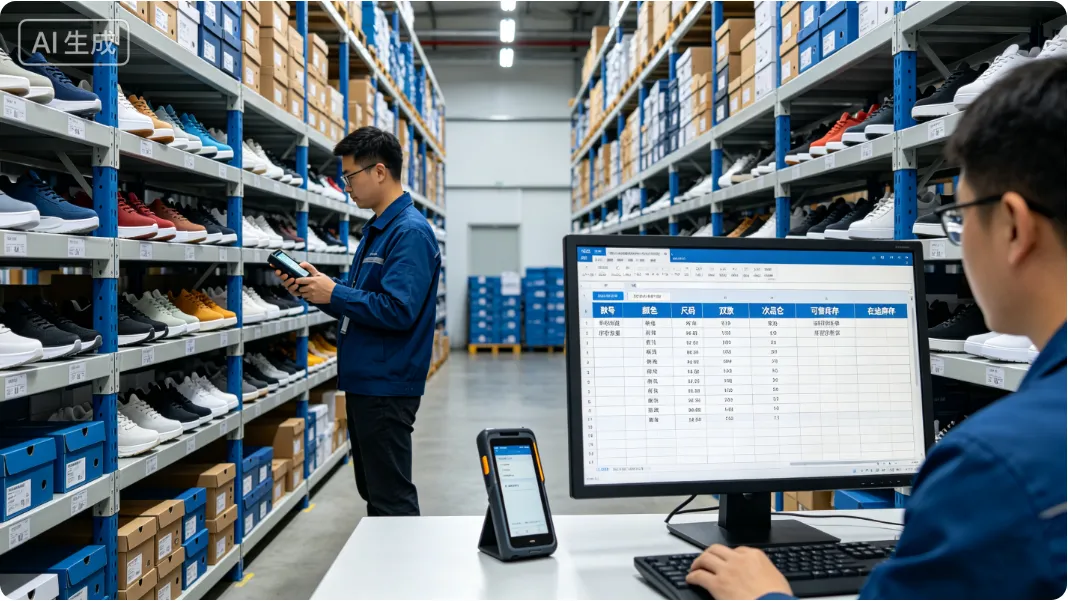
3、 The focus of ERP selection for two major shoe industry formats
1. Integrated industry and trade/OEM shoe factory
The core focuses on production and material control, with a particular emphasis on multi-level differentiated BOM, last mold management, full process workshop reporting, outsourcing full process control, MRP material calculation, precise production cost accounting, prioritizing production cost reduction, controllable delivery time, and traceable losses.
2. Brand trade/wholesale and retail shoe enterprises
The core focuses on channel and inventory control, with a particular emphasis on dual unit management of coding boxes, ordering meeting systems, multi-channel sales docking, inventory management of broken codes and defective products, and comprehensive sales data analysis. Priority is given to ensuring efficient channel performance, precise and controllable inventory, and rapid clearance of unsold products.
4、 Mainstream footwear ERP product adaptation positioning
1. Weichuang and Yangwang: We have been deeply involved in the field of footwear manufacturing for many years and are the exclusive ERP systems with high usage rates in domestic shoe factories. Our manufacturing functions are mature and stable in production processes, multi-level BOM, outsourcing processing, material accounting, and other aspects, highly suitable for small and medium-sized finished and semi-finished shoe factories in mainstream industrial belts such as Wenzhou and Quanzhou. The products are mainly deployed on local area networks, adapted to the local production control needs of factories. The functions of trade terminals such as brand franchising and online retail are relatively simplified, and are more inclined to be implemented in production scenarios.
2. Yum! Brands and Lijing: Domestic leading digital systems for footwear and apparel, with core advantages focused on brand franchise ordering, chain store management, omnichannel retail, e-commerce docking and other trade scenarios. With mature functions and rich implementation cases, they are the mainstream choice for medium and large footwear brands and chain retail enterprises. For the production scenario of footwear industry and trade, the native production module functions are relatively basic, with complex process control, fine material accounting and other functions that mostly require secondary development or industry plugin adaptation, and cannot directly meet the production needs of fine chemical plants.
3. Housekeeper's Shoe and Clothing Edition: Easy to operate, high cost performance, low entry threshold, focusing on the inventory, simple wholesale, and retail accounting scenarios of small and medium-sized shoe trading enterprises, suitable for individual businesses and small wholesalers who have no production and pure buying and selling. The system does not support core manufacturing functions such as multi-level BOM, fine chemical process production, and complete outsourcing cost collection in the footwear industry. It can only meet basic ledger management and is completely unsuitable for industrial and trade shoe factories.
4. Yonyou and Kingdee Footwear plugins: two leading financial digital systems with industry-leading capabilities in financial accounting, taxation, general ledger, and supply chain standardization. However, its exclusive business in the footwear industry is not a native core function, but rather a third-party or official supporting industry plugin. Its adaptability in specific scenarios such as last management, size lifting consumables, footwear matching box specifications, and exclusive production processes is limited. Some special businesses require customized development to land, making it more suitable for shoe companies with financial control as the core and simple production processes.
5. Purple Sun: Focusing on the digitalization of shoe and clothing chain retail, its core advantages include store cash register, member management, inventory allocation, retail promotion and other terminal scenarios, suitable for shoe chain stores and regional retail brands. The production and manufacturing module of the system has weak functions and cannot meet the production needs of shoe factories, such as process control, fine material accounting, and outsourcing full process management.
5、 Core Avoiding Pits Guide for Shoe ERP Selection
1. Do not replace professional footwear ERP with general inventory management or pure clothing ERP: General systems generally lack core capabilities such as last mold management, shoe exclusive coding box specifications, size differentiation consumables accounting, etc. Long term use can lead to practical problems such as SKU confusion, inventory data deviation, production cost accounting distortion, and production process matching errors.
2. Core functions that industrial and trade enterprises must verify: multi-level nested BOM, size differentiated consumables, full process control of processes, outsourcing cost collection, material loss accounting, and last mold asset management.
3. Core functions that trading enterprises must verify: even number of boxes and double units, whole box ordering and unpacking, native shoe exchange process, real-time e-commerce inventory locking to prevent overselling, and analysis reports on broken codes and unsold products.
4. Practical functional verification: It is necessary to demonstrate the four-dimensional inventory report, material consumption difference report, and workshop process reporting process of the color code last on site to avoid functional labeling.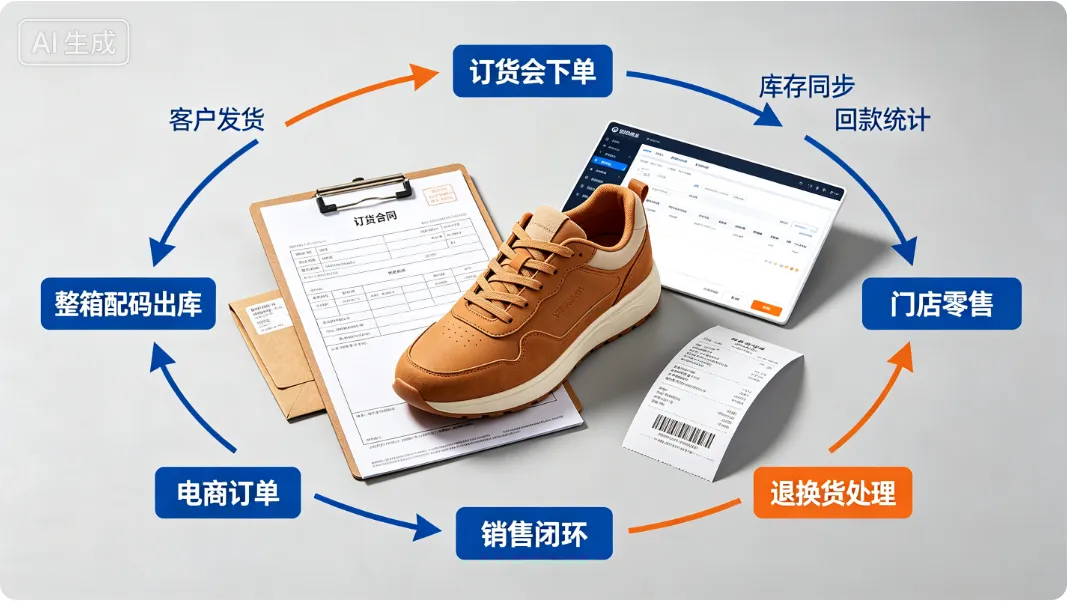
VI. Summary
The core value of footwear ERP isAdapt to the differentiated and fragmented real business scenarios of the footwear industry, connect the entire data chain of research and development, procurement, production, warehousing, sales, and finance, and achieve standardized, refined, and traceable digital controlCompared to standardized management systems with strong universality and no industry specificity, professional footwear ERP has been deeply adapted and optimized for the unique pain points of shoe enterprises, which can accurately match the two mainstream formats of industrial and trade factories and brand trade. It can help production-oriented shoe factories standardize material management, control production losses, accurately calculate costs, and ensure stable order delivery times; It can also help trade oriented shoe enterprises to connect online and offline omnichannel sales, optimize inventory structure, reduce the loss of unsold products due to broken codes, and improve channel performance and payment efficiency. It is a core tool for digital upgrading, cost reduction and efficiency improvement, and standardized operation of small and medium-sized shoe enterprises.