
Clothing ERP Financial Management Module: Integrated Management and Exclusive Cost Accounting Scheme for Business and Finance
The clothing industry has significant industry characteristics, such as multiple SKUs, multiple colors and sizes, fast seasonal iteration, outsourcing processing as the main focus, parallel franchise and direct sales channels, and depreciation of off-season inventory, which makes it difficult for general financial software to adapt to its refined management needs. The traditional financial model relies on manual bookkeeping, document consolidation, and cost estimation, which have many problems such as data lag, inaccurate accounting, disconnection between business and finance, and cumbersome reconciliation of transactions.
The financial management module of clothing ERP is different from independent financial accounting software, and its core value isDrive finance with business, achieve integrated integration of business flow, capital flow, and financial flowAutomatically convert front-end business data such as procurement, production, outsourcing, sales, and inventory into financial data, accurately calculate costs, control transaction risks, standardize fund and invoice management, and meet the full process management and control needs of clothing enterprises. This article combines the actual business scenarios of the clothing industry to objectively sort out the core positioning, core functions, landing application scenarios, and exclusive cost accounting methods of this module.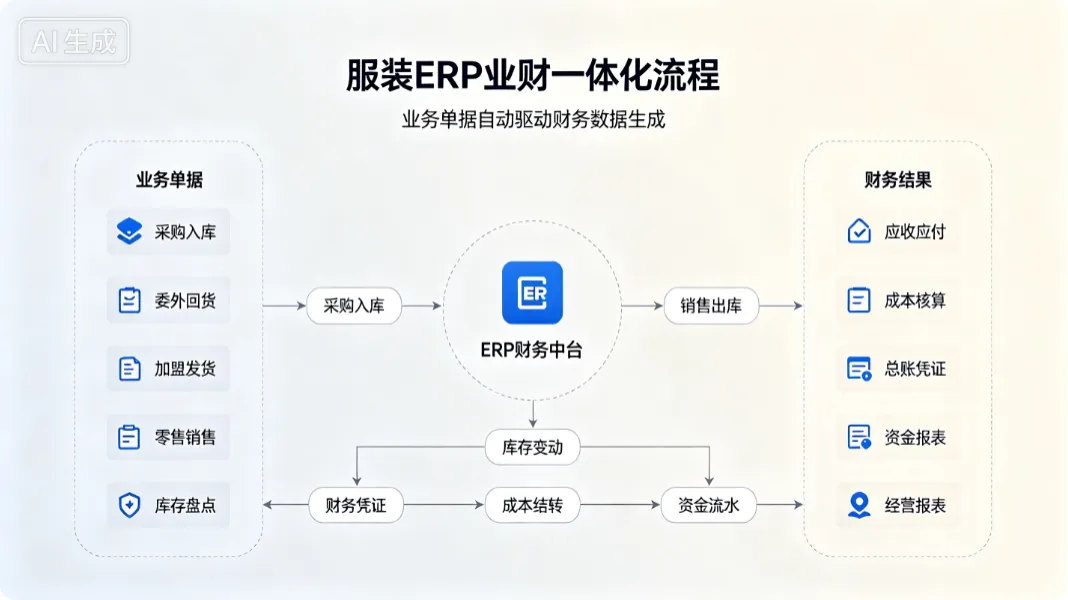
1、 Module core positioning
The clothing ERP financial management module is not simply an accounting tool, but an integrated management and control tool that is suitable for all business scenarios such as clothing industry and trade, brand franchising, direct retail, and inventory turnover. Its core positioning is to rely on all front-end business documents to automatically generate financial vouchers and accounting data, replacing manual input and statistics, solving pain points in the clothing industry such as complex style cost accounting, chaotic franchisee transactions, tedious outsourcing settlements, seasonal asset distortion, and fuzzy profit data. At the same time, it supports multi-dimensional financial data analysis, providing real data support for enterprise ordering, production, pricing, and payment control.
The module comprehensively covers basic financial capabilities such as general ledger accounting, transaction control, cost accounting, fund cashier, invoice management, end of period closing, and business analysis. At the same time, it also adds unique financial functions exclusive to the clothing industry, balancing financial compliance and business practicality.
Focus on the three core sales channels of clothing franchise, wholesale, and direct retail to achieve full chain accounts receivable control. The system can automatically generate accounts receivable based on franchise shipping orders, wholesale outbound orders, and store retail orders, without the need for manual bookkeeping. Built in customer credit limit control mechanism, which can intercept and issue orders to customers who exceed the limit, and control bad debt risks from the source.
At the same time, it supports industry-specific features such as pre deposit recharge for franchisees, pre deposit deduction for goods, order rebate, and sales compliance rebate. Rebates can be directly offset against accounts receivable, simplifying the reconciliation and settlement process. Supporting the provision of customer transaction ledger, monthly statement, accounts receivable aging analysis, overdue payment warning, bad debt write off and other functions, all accounts receivable business documents can automatically generate general ledger vouchers, and support reverse tracing of original business documents to ensure consistency between accounts and reality.
2. Accounts Payable Management (Procurement and Outsourcing Core)
Accurately adapting to the two core coping scenarios of clothing enterprises: fabric and accessory procurement, and garment outsourcing processing. The system automatically generates accounts payable based on purchase receipts and outsourced garment return orders, distinguishing between material costs and processing fees, with clear and traceable accounts.
Support supplier account period management, due payable warning, and can handle special business such as advance payment entry, advance payment offset against payable, processing rework deduction, fabric loss deduction, etc., accurately restoring the actual payable amount. Simultaneously providing supplier reconciliation statements and accounts payable aging reports, all payment and accounts payable documents are automatically synchronized to generate financial vouchers, standardizing the supply chain settlement process.
3. Industry specific cost accounting (module core differentiation capability)
This is the core function of the clothing ERP financial module that distinguishes it from general financial software. It specifically solves the cost accounting problems of multiple batches, styles, and seasonality of clothing, accurately collects the complete cost of a single garment, and eliminates the problems of vague cost estimation and distorted gross profit. Specifically, it can achieve automatic collection of outsourced garment costs, integrate the allocation of miscellaneous expenses such as fabric consumption, accessory consumption, processing fees, transportation fees, inspection fees, etc., and accurately calculate the cost of single item and single batch warehousing.
At the same time, it supports dynamic accounting of inventory costs, automatic transfer of sales costs, handling of inventory profit and loss costs, and provision for off-season inventory depreciation. It can calculate costs and gross profits from multiple dimensions such as item number, brand, season, and batch, truly reflecting the profitability of each product and providing a basis for product iteration and inventory clearance decisions.
4. General ledger and auxiliary accounting
Meeting the standardized financial accounting needs of enterprises, supporting a dual mode of manual voucher entry and automatic generation of vouchers from business documents, suitable for daily financial adjustments and batch accounting scenarios. Support custom maintenance of accounting subjects, with a focus on adapting to the clothing industryBrand, season, customer, supplier, warehouse, departmentMulti dimensional auxiliary accounting can accurately calculate the revenue, cost, and profit of a single brand or season.
At the same time, it covers basic functions such as regular account book queries, fixed asset entry and depreciation provision, end of period profit and loss carryover, and end of month and quarter closing. Before closing, the integrity of business documents can be automatically verified to avoid accounting deviations caused by missing or incorrect documents.
5. Fund cashier and expense management
Realize full closed-loop management of enterprise fund flow, with all receipts and payments automatically registered in cash and bank journals without the need for manual registration. Support importing bank statements and automatic reconciliation and verification, accurately checking fund flow. At the same time, it can collect due accounts receivable and payable data, achieve basic fund forecasting, and help enterprises predict funding gaps.
For exclusive expenses of clothing enterprises, such as ordering, exhibition and sales fees, store rent, logistics fees, brand promotion fees, etc., we support sharing and accounting by brand, store, and department, accurately calculating the true costs and profit levels of each business segment.
6. Invoice management and end of period processing
Covering the entire process of invoice control for input and output, output invoices can be associated with shipping orders, supporting partial invoicing and invoicing write back business documents; Input invoices can be matched with purchase receipt orders and outsourcing processing orders to handle discrepancies between invoices and goods, and automatically generate invoice ledgers and financial vouchers.
At the end of the period, it supports two-way reconciliation between business and finance, verifying the consistency of accounts receivable and payable, inventory costs, and sales data, automatically carrying forward profit and loss, issuing balance sheets and income statements, and outputting unique reports such as brand profit and loss, seasonal profit, and style gross profit for the clothing industry.
3、 Core landing application scenarios
1. Supply chain settlement scenario
After the purchase and storage of fabrics and accessories, accounts payable will be automatically linked, and payment settlement will be completed by combining input invoice verification and account period control; In the outsourcing production process, the material, processing, and miscellaneous costs of each batch of ready to wear clothing are automatically collected, and rework and loss deductions are processed. The reconciliation and payment with the processing factory are completed, completely solving the problems of large errors in manual calculation of processing costs and cumbersome reconciliation.
2. Business scenarios of franchise channels
Covering the entire process of ordering, daily replenishment, advance deposit deduction, rebate settlement, and overdue collection. Franchisees automatically generate accounts receivable for shipments, and pre deposits and rebates can be directly deducted from payments. The system automatically generates standardized reconciliation statements, which can be directly used for customer reconciliation, effectively reducing accounting disputes and controlling channel payment risks.
3. Direct retail control scenarios
Summarize retail sales data from multiple stores, automatically confirm revenue, carry forward sales costs, and support financial accounting for store stored value consumption and transfer business. Simultaneously sharing various operating expenses of the store, accurately calculating single store revenue, costs, and profits, and providing data support for optimizing store operations.
4. Inventory and Seasonal Financial Scenarios
Automatically carry forward costs and calculate gross profit for daily sales shipments; Inventory counting automatically processes inventory surplus and deficit accounting. In response to the seasonal characteristics of clothing, provisions for inventory depreciation can be made for unsold and out of season inventory, restoring the true asset value of the enterprise, avoiding inflated inventory assets, and accurately calculating profit and loss data for end of season clearance.
5. Final compliance accounting and business analysis scenarios
At the end of the month and quarter, batch completion of business document conversion, profit and loss transfer, and closing work is carried out, and multi-dimensional auxiliary accounting is used to statistically analyze brand, season, and channel operating data. At the same time, relying on aging reports, gross profit reports, and cost reports, identify overdue debts, loss making styles, and high cost batches to achieve dual empowerment of financial compliance control and business optimization.
4、 Standardized cost accounting method (industry standard, truly implemented)
The cost accounting of the clothing ERP financial module is divided intoInventory cost accounting和Valuation of outbound costThe two major sectors are both industry standard and mature methods, without fiction or exaggeration, suitable for clothing enterprises of different scales and models.
1. Accounting method for inventory cost
Batch Actual Cost Method (Industry Mainstream)Suitable for over 90% of outsourced garment enterprises. Collect the actual fabric and accessory consumption, processing fees, and miscellaneous expenses according to production batches. Different production batches of the same style can retain different warehousing costs, accurately matching the actual situation of fabric price fluctuations and processing fee differences. At the same time, support deduction of production losses and rework deductions to restore the real warehousing costs.
Standard cost method (applicable to niche markets)Only applicable to large standardized clothing brands, by maintaining style BOM standard materials, standard processing fees in advance, calculating standard warehousing costs, and recording the difference between actual costs and standard costs for cost assessment and control. Due to significant fluctuations in clothing fabric prices and losses, small and medium-sized clothing enterprises generally do not adopt it.
2. Valuation method for outbound sales cost
Moving Weighted Average Method (Industry Preferred)Update the weighted unit price of inventory in real-time every time the ready to wear clothing is received, and calculate the cost and gross profit in real-time during sales and delivery. Adapting to the high-frequency in/out and multi-channel sales business model of clothing, real-time viewing of business data is currently the most common and stable pricing method for clothing enterprises.
weighted average method Summarize the monthly inventory quantity and amount at the end of the month, calculate the average unit price, and uniformly carry forward the monthly outbound cost. Simple calculation, but unable to view gross profit in real time, only suitable for small clothing trading enterprises with simple business and mainly wholesale.
First in, first out method, individual pricing methodFirst in, first out method is suitable for enterprises that value batch management and prioritize clearing out out out of season inventory; The individual pricing method is only used for high-end customization and small batch high-end clothing, accurately matching the cost of a single batch. Due to the large number of SKUs in regular fast fashion, both methods are rarely used on a large scale.
3. Matching allocation and impairment treatment
For indirect miscellaneous expenses such as shipping and quality inspection fees, the system supports two common methods of allocating them to the cost of finished clothing: quantity and material amount, which are in line with actual settlement scenarios. At the same time, it has the function of inventory depreciation provision, which can calculate the net realizable value based on inventory season, inventory age, and selling price, provide depreciation reserves, and adapt to the industry characteristics of seasonal depreciation of clothing.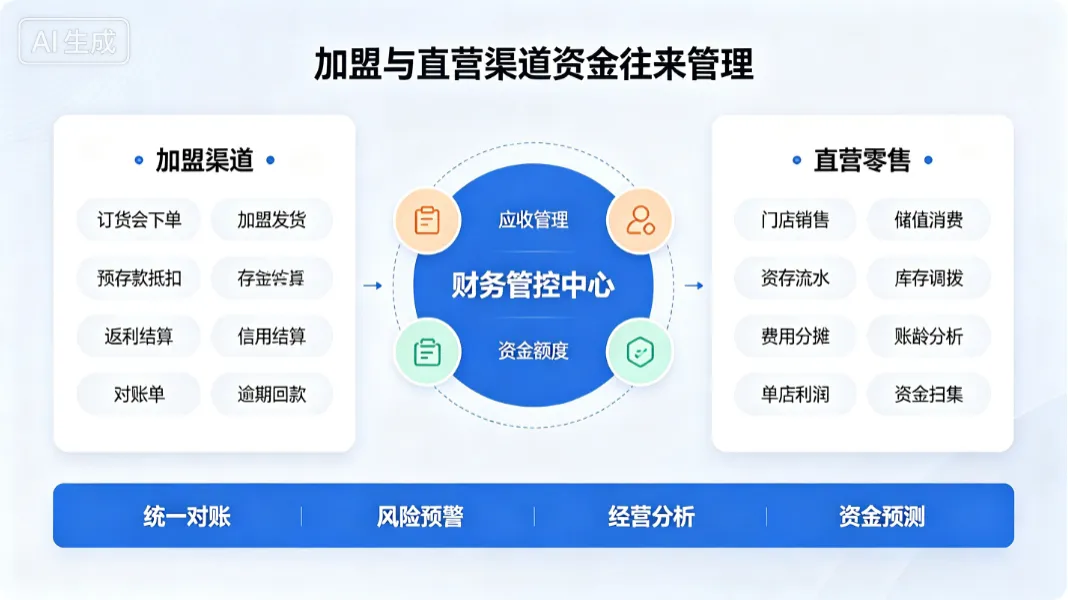
5、 Summary
The core advantage of the clothing ERP financial management module is to completely solve the shortcomings of general financial software, which only keeps accounts, does not control business, and cannot accurately calculate costs. Based on the core characteristics of the clothing industry, such as multi SKU, seasonality, outsourcing processing, and multi-channel operation, it achieves deep integration of business and financial data. All its functions, scenarios, and accounting methods are in line with the real business needs of clothing enterprises, without excessive intelligence or exaggerated effects. Its core function is to standardize transaction settlement, accurately calculate style costs, control inventory asset risks, output real business data, help clothing enterprises get rid of experiential management, and achieve financial refinement and standardized control.