
Analysis of the Core Process and Reconciliation Accuracy Control of Clothing ERP Procurement Module
The clothing industry belongs to a typical multi style, multi batch, seasonal production industry, with complex categories of fabrics and accessories, large differences in color and cylinder numbers, tight production lead times, and special problems such as natural size tolerances, cutting losses, and batch color differences in fabrics. The traditional manual procurement management model is prone to problems such as document confusion, data deviation, and cost control. As the core link of enterprise supply chain management, the clothing ERP procurement module is different from the general manufacturing procurement module. It deeply adapts to the exclusive business scenarios of the clothing industry, connects the entire chain of material requirements, procurement execution, warehouse quality inspection, and financial reconciliation, and is a key system tool to ensure smooth production, control procurement costs, and achieve accurate financial data for clothing enterprises.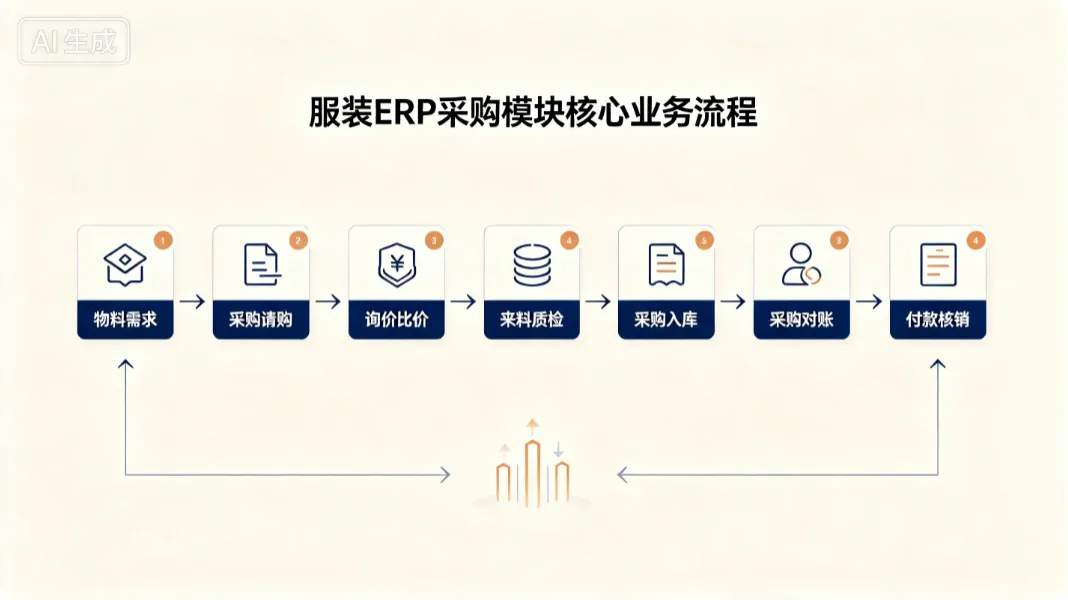
1、 Core Value and Adaptation Characteristics of Clothing ERP Procurement Module
The clothing ERP procurement module mainly focuses on fabric, accessories, outsourced materials, and clothing procurement management, covering the entire business cycle from demand initiation to payment verification. Compared to the general ERP procurement module, its core advantage lies in adapting to the differentiated pain points of the clothing industry: firstly, supporting the management of exclusive fabric attributes such as color number, cylinder number, width, and weight, effectively avoiding batch color difference problems; Secondly, it is compatible with automatic conversion of multiple units such as meters, yards, kilograms, and rolls, solving the problem of confusion in fabric measurement; The third is to adapt to special businesses such as fabric pre procurement, sample procurement, loss replenishment, and batch delivery, and to fit the seasonal and customized production mode of clothing; The fourth is to abandon the traditional order based reconciliation model and use actual incoming data as the core basis to solve the accounting deviation problem caused by fabric quantity tolerances.
2、 Standard Core Business Process of Clothing ERP Procurement Module
The clothing ERP procurement module follows the principle of "demand driven, fully controllable, and closed-loop of documents", forming a standardized and normalized business process. Each link of documents is interrelated and data is linked layer by layer. The specific process is as follows:
Firstly, initiate material requirements. The system relies on style BOM material list and production plan to automatically calculate inventory gaps and accurately calculate material procurement needs such as fabrics, lining, zippers, buttons, etc; At the same time, it supports manual addition of requirements, adapts to special scenarios such as sample procurement, production loss replenishment, and seasonal fabric stocking, and all requirements are bound with item numbers, colors, and material specifications to achieve precise traceability of requirements.
Secondly, procurement requisition and inquiry comparison. Generate a formal purchase requisition based on the material shortage, specifying the material specifications, purchase quantity, and demand timeline. Purchasing personnel can initiate multi-party inquiries through the system, recording core information such as supplier quotes, delivery times, minimum order quantities, and quality ratings. The system automatically generates comparison reports to assist enterprises in selecting the best cooperation. At the same time, inquiry forms can be directly circulated to generate purchase orders, reducing manual duplicate input errors.
Thirdly, place a purchase order. The purchase order is the core document of the procurement module, which needs to be fully bound with industry-specific fields such as item number, color, cylinder number, fabric width, weight, purchase quantity, loss factor, batch delivery date, settlement account period, etc. The system monitors the status of orders in real-time, including pending confirmation, issued, partially received, fully received, closed, etc. It also has functions such as delivery time warning, over purchase warning, and below minimum order quantity reminder to control procurement risks from the source.
Fourth, quality inspection of incoming materials and return of received goods. After the arrival of clothing materials, they cannot be directly stored in the warehouse. A dedicated quality inspection process must be carried out, and the fabric must be inspected to record fabric defects, actual meters, and cylinder number information. Auxiliary materials must undergo quality sampling. Qualified materials are received in batches and batches, while unqualified materials are automatically generated into purchase return orders, which are associated with the original purchase order and receipt records. The reconciliation base is synchronously deducted to form a complete reverse business loop.
Fifth, synchronize material warehousing with inventory. The fabrics and accessories that pass the quality inspection are stored separately, and the system automatically updates the inventory data. The inventory information is synchronized and bound with exclusive attributes such as batch, cylinder number, and color. Subsequent production and material requisition can accurately match the corresponding batch of materials, effectively avoiding the problem of color difference in finished clothing. At the same time, it supports independent management of single batch of rolled fabrics to ensure fine inventory control.
Sixth, procurement reconciliation and financial verification. Different from the general industry's order reconciliation model, the clothing industry uses "qualified inventory quantity - return quantity" as the core reconciliation base to properly resolve the tolerance difference between the fabric order quantity and the actual arrival quantity. After the reconciliation is completed, the system automatically generates a statement of account, calculates additional expenses such as price differences, price supplements, and dyeing fees, and synchronously pushes them to the finance module to generate accounts payable. Finally, the accounts are written off through payment orders, achieving interoperability between business and financial data.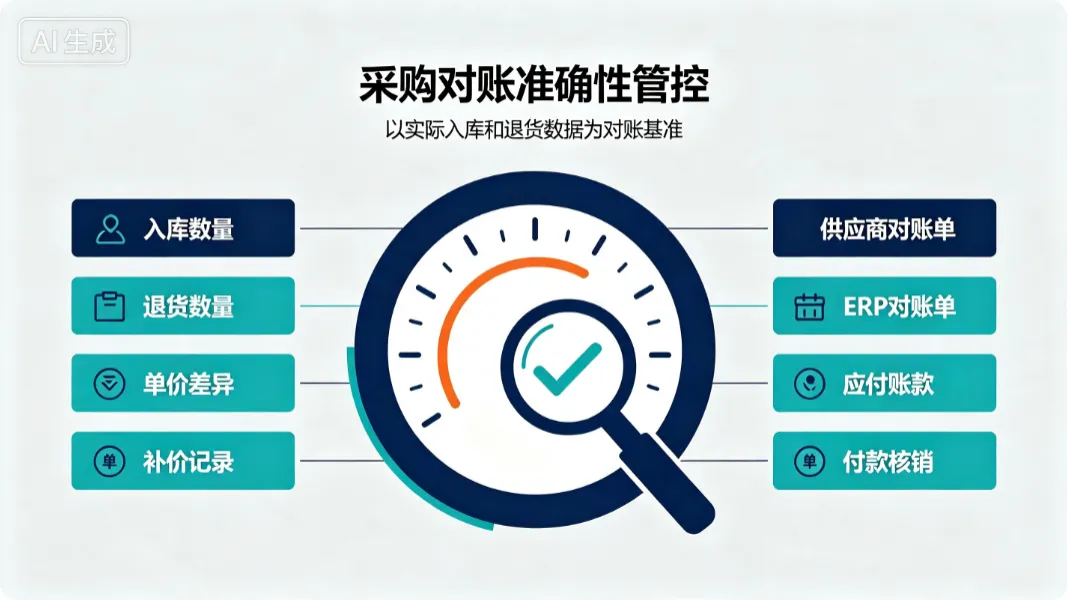
3、 Business Process of Clothing Special Procurement Branch
For personalized production scenarios in the clothing industry, the system adapts to three types of special procurement processes to compensate for the limitations of standardized processes. One is the sampling procurement process, which involves independently entering documents, storing them in a dedicated warehouse, and separately accounting for material costs without mixing them with mass production accounting; The second is the replenishment procurement process, which quickly initiates replenishment procurement and procurement for material gaps caused by cutting losses and fabric defects, ensuring production continuity; The third is the fabric pre procurement process, which involves seasonal stocking procurement without a fixed style number binding, and can be allocated to specific styles as needed to meet the seasonal stocking needs of the clothing industry.
4、 The core control strategy for the accuracy of procurement reconciliation
Procurement reconciliation is the most critical and error prone link in the clothing ERP procurement module, which directly determines the accuracy of enterprise procurement cost accounting and financial accounting. Considering pain points such as measurement tolerances for clothing fabrics, batch delivery, price fluctuations, and mixed business types, it is necessary to comprehensively ensure the accuracy of account reconciliation from four dimensions: source control, system configuration, process standardization, and data verification.
Firstly, strengthen the control of source documents and establish a solid foundation for reconciliation. Strictly establish the core principle of "actual acceptance and warehousing data as the sole reconciliation benchmark", eliminate using purchase orders and supplier delivery notes as the basis for reconciliation, and avoid accounting deviations caused by fabric quantity tolerances from the root. At the same time, standardize document management, strictly distinguish between bulk procurement, sampling procurement, and replenishment procurement documents, and all receipt and return documents must be associated with corresponding order numbers, cylinder numbers, and item numbers to eliminate the problem of headless warehousing and receipt without orders. Unified material measurement units, maintain conversion factors for meters, yards, and kilograms in the system in advance, fix cost accounting units, and avoid unit conversion errors.
Secondly, optimize the ERP system configuration to achieve intelligent risk control. Activate the system's anti duplicate reconciliation mechanism, automatically locking completed reconciliation documents and preventing duplicate selection for accounting, thus eliminating the problem of duplicate bookkeeping. Set a price warning threshold. When the discrepancy between the reconciliation unit price and the order unit price exceeds a reasonable range, the system will automatically pop up a warning window, forcing the verification of special expenses such as minimum order markup and dyeing compensation. At the same time, standardize permission management, and prohibit arbitrary modification of audited statements and original business documents. All data adjustments must be completed through red letter reversal and price adjustment forms, and complete operation logs and audit traces must be retained.
Once again, standardize the reconciliation process and unify operational standards. Establish a standardized process for "supplier reconciliation details - ERP data verification - discrepancy traceability - document adjustment - final confirmation". Reconciliation personnel need to match supplier bills with system inventory and return details one by one, classify and investigate quantity differences, price differences, and cost differences, and trace and rectify issues such as fabric tolerances, failure to enter documents, and batch markups one by one. It is strictly prohibited to manually modify the original document data, and all abnormal differences are recorded and archived through dedicated adjustment documents.
Finally, establish a normalized data verification mechanism to identify and fill in any gaps. Based on the system's procurement reconciliation tracking report, real-time verification of the total purchase order quantity, received quantity, returned quantity, reconciled quantity, and unreconciled quantity is carried out, and any missing reconciliation documents are promptly identified. Regularly conduct data reconciliation and verification to ensure that the accounts payable amount for the current period matches the confirmed reconciliation amount, and that the procurement and warehousing costs are basically consistent with the reconciliation material costs. Timely correct data deviations to ensure high consistency between business data and financial data.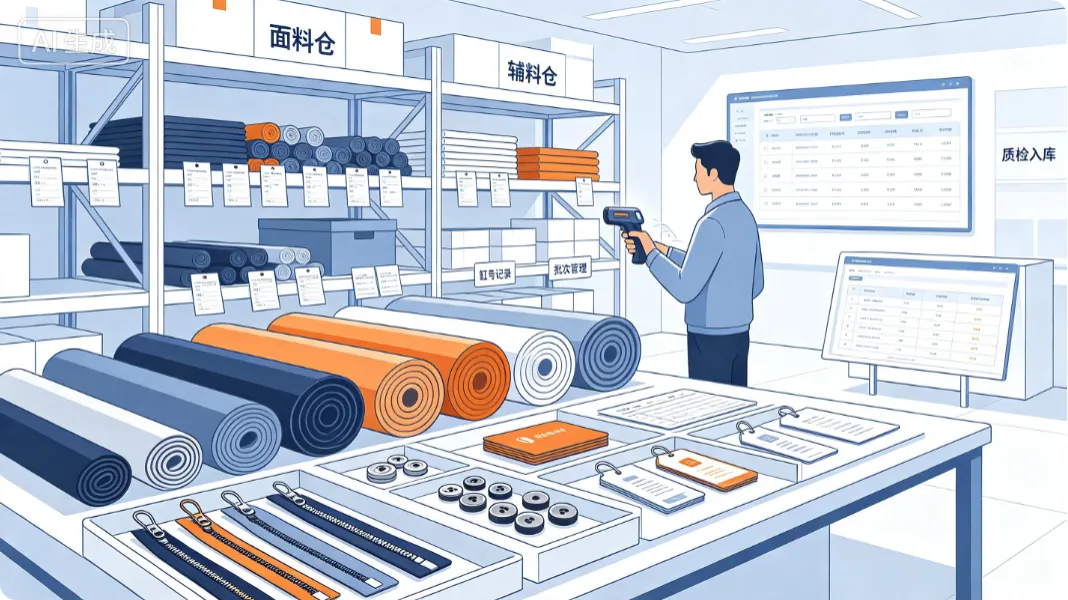
V. Conclusion
The core advantage of the clothing ERP procurement module lies in its precise adaptation to the material characteristics and business pain points of the clothing industry. Through standardized procurement process control, it achieves standardized and refined management of procurement business. The accuracy of procurement reconciliation is the key to the implementation of module value. Only by adhering to the control principles of "source controllability, system risk control, process standards, and verification closed loop", standardizing every business document and operation process, can enterprises effectively avoid problems such as quantity deviation, price chaos, and duplicate accounting, accurately calculate procurement costs, connect supply chain and financial data links, and provide solid data support for clothing enterprises to reduce costs, increase efficiency, and refine operations.