
Accurate digital empowerment: Select the right ERP based on industry characteristics to avoid system implementation failure
At present, digital transformation has become the core path for shoe and clothing enterprises to improve quality and efficiency, optimize management, and build market competitiveness. As the core hub of enterprise digital construction, the adaptability of ERP system directly determines the effectiveness of digital implementation. However, in the actual implementation process of the industry, a large number of enterprises have fallen into the cognitive misunderstanding of "universal system universal adaptation", simply applying universal shoe and clothing ERP, ultimately resulting in many problems such as functional mismatch, difficult process integration, data non closed loop, and idle system. Not only does it fail to empower business efficiency, but it also increases management and trial and error costs, making digital construction a mere formality and ineffective implementation.
In fact, although clothing and footwear belong to the footwear and apparel industry, there are differences in product attributes, material structure, production processes, and sales modelsFundamental industry differencesThe underlying architecture, functional modules, and control logic of clothing ERP and footwear ERP are completely different. The core key for enterprises to achieve real and effective digital empowerment is to base on their own industry characteristics, accurately select models that fit real business scenarios, choose industry-specific ERP systems, and truly connect the digital implementation loop.
1、 Eliminating selection misconceptions: Category attribute differences determine the underlying architecture of the system
The SKU specification system for products is the underlying foundation of ERP systems and the core distinguishing standard for clothing and footwear ERP. It directly runs through the entire chain management logic of production, inventory, sales, and accounting.
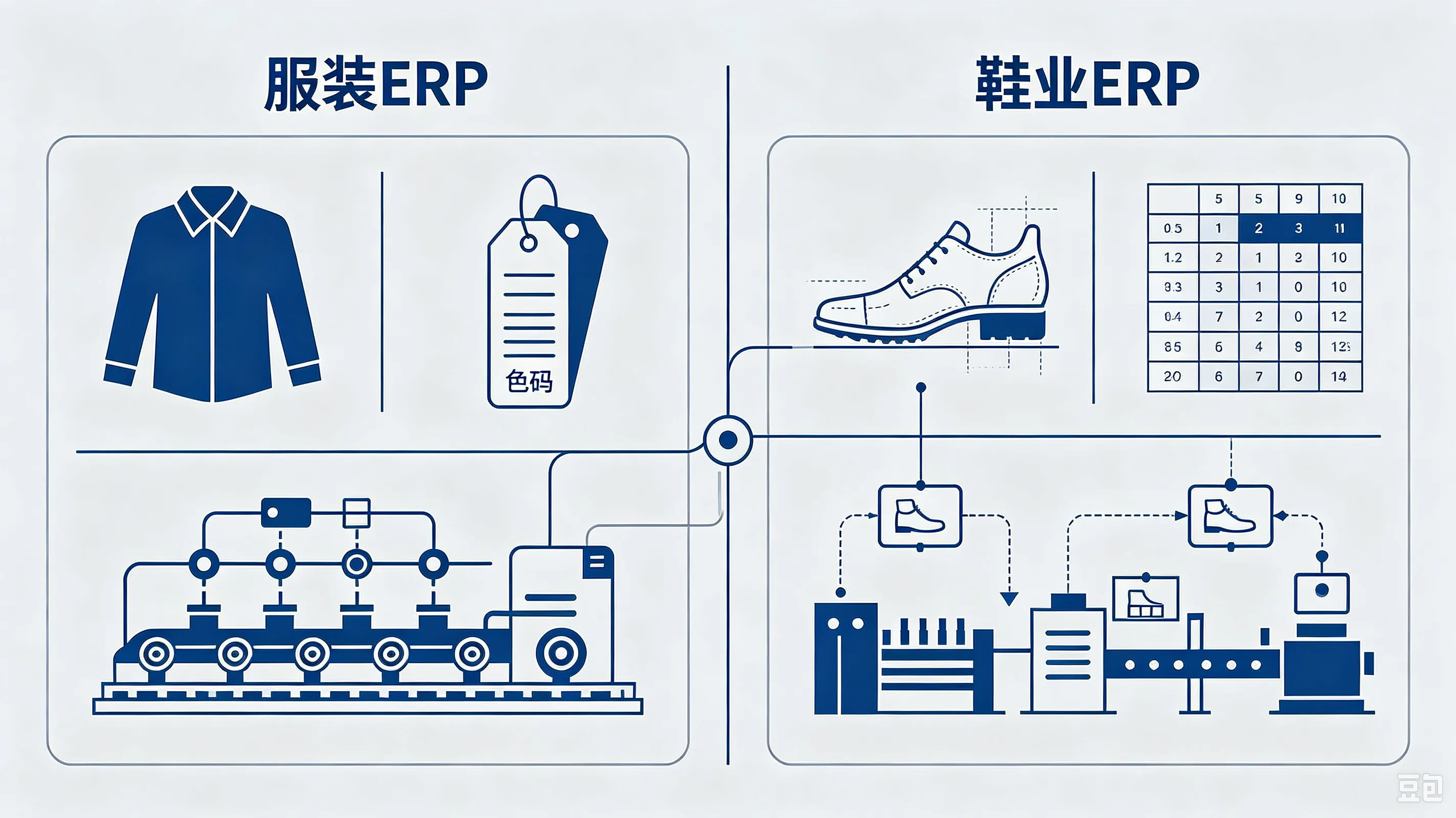
Clothing products have simple specifications and a high degree of standardizationAdopting the industry standard three-dimensional specification system of "style+color+size", with S/M/L/XL and other conventional clothing sizes as the core size standards. Different sizes of ready to wear clothing of the same style and color have completely unified fabric materials, production processes, and pattern structures, with only differences in size. The SKU rules are simple and the iteration is flexible. Therefore, clothing ERP focuses on lightweight and flexible management logic, highly adapted to the industry characteristics of fast fashion style iteration, frequent seasonal updates, and multi-channel flexible operation.
Footwear products have strong non-standard attributes and complex specification systemsAdopting a four-dimensional specification system of "style number+color+shoe size+shoe last", in addition to conventional parameters, a core dimension for controlling the fat and thin version of the shoe last has been added, and it is compatible with multiple international measurement standards such as European, American, and foot length. Shoes of the same style, color, and size cannot be replaced universally due to differences in the width and shape of the last. For this reason, shoe ERP needs to separately build exclusive files for shoe lasts and sole patterns. The difficulty and system complexity of SKU fine control are much higher than those of clothing ERP, which is also the core reason why general clothing ERP cannot adapt to fine shoe management.
2、 Digging into Production Differences: Material BOM and Production Process, Reshaping Control Logic
The difference between material BOM architecture and production process flow is the key to the functional separation of the two types of ERP systems, which directly affects the accuracy and standardization of enterprise cost accounting, production scheduling, and workshop control.
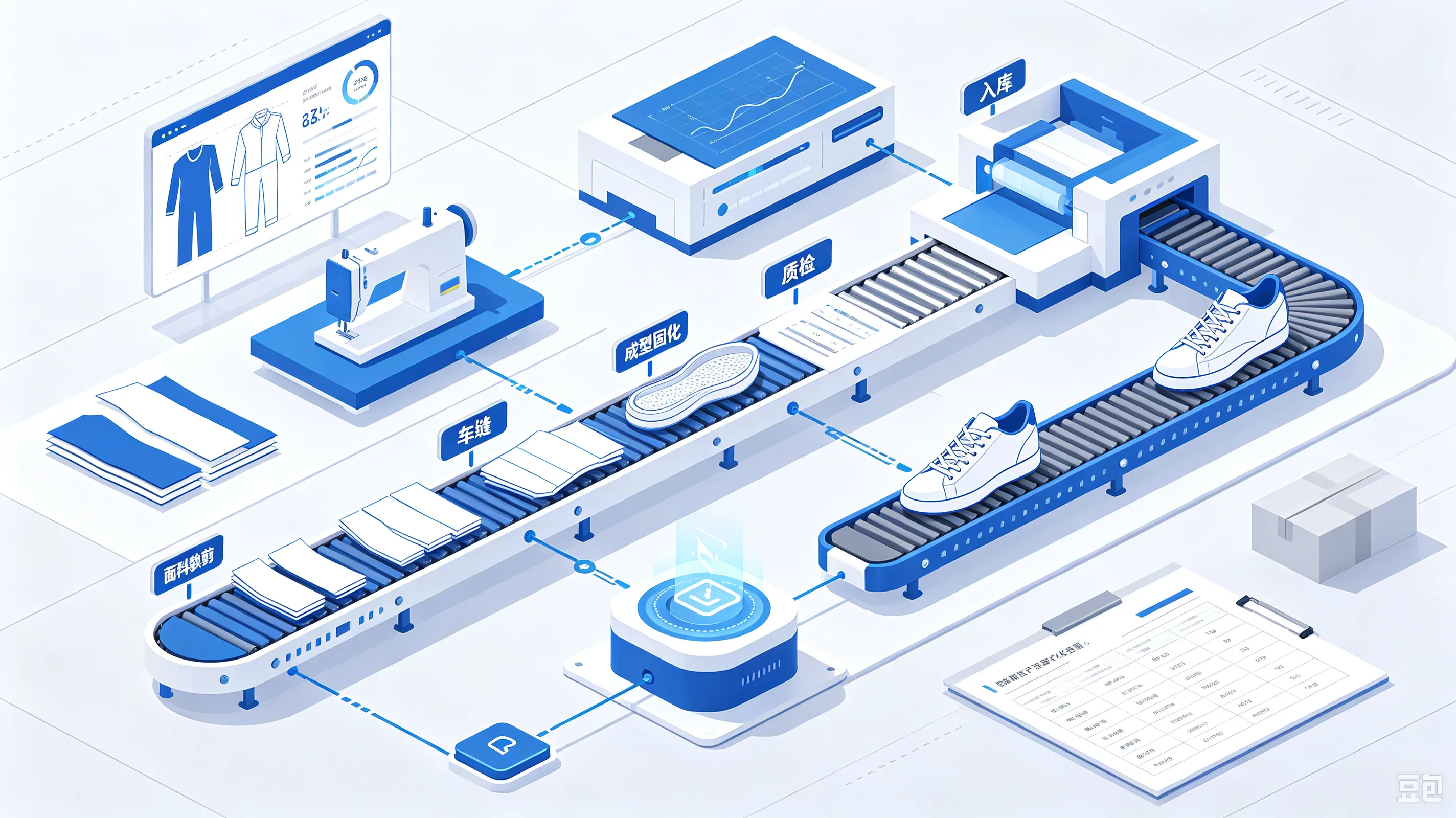
The clothing material structure is simple and clear, using a double-layer simple BOM structure of fabric and accessories, with few levels and uniform material consumption rules. Only fabric loss needs to be adjusted according to size, without the need to share fixed costs such as molds and patterns. The production process is a standardized linear process, from fabric cutting, cutting and subcontracting, sewing, ironing and shaping to finished product packaging. The assembly line is coherent and orderly, and the production method is flexible and free. The corresponding clothing ERP focuses on adapting to core scenarios such as fabric loss statistics, workshop piece rate accounting, and cutting in progress management, which can comprehensively cover the entire process requirements of clothing production.
The footwear material system is complex and has special rules. It adopts a four level nested composite BOM structure, which is divided into three core modules: upper BOM, bottom BOM, and chemical auxiliary BOM. Material control covers exclusive rules such as natural irregular wear and tear of genuine leather, volatilization and shelf life loss of chemical materials, and material consumption with increasing yards. At the same time, it is necessary to accurately allocate fixed asset costs such as shoe lasts and mold making. The production end has unique core processes such as molding and bonding, temperature controlled curing, and bottom pressing and shaping. Multi section cross operation and outsourcing processing are popular, and production must strictly follow the fixed coding ratio. The entire complex production and accounting logic can only be fully adapted by the exclusive footwear ERP, while the general clothing ERP has obvious functional shortcomings.
3、 Distinguishing business scenarios: terminal sales model, determining system adaptation standards
The differences in sales logic, ordering rules, and delivery modes for the terminal market create natural barriers for the order management, inventory control, and after-sales systems of the two types of ERP, which is an important basis for the adaptability of the system implementation.
Clothing terminal salesSingle code free orderingAs the core, each size can be independently ordered and freely combined, without fixed box size ratio restrictions. Store restocking, cross store transfers, returns and exchanges are all based on the minimum unit of a single item and size. The same style, color, and size are priced uniformly, and the control logic is simple and flexible. The lightweight clothing ERP can perfectly adapt to retail, franchise, and e-commerce omnichannel business scenarios.
Wholesale channels for footwear industryFixed code full box shipmentAs a standard in the industry, the system needs to have a dedicated box specification file built-in, supporting bulk ordering of whole boxes, terminal disassembly and replenishment, and automatically completing the conversion between box quantity and single/double quantity. At the same time, the footwear industry has exclusive pricing and inventory rules. Large sizes and special last shapes can be independently marked up. Inventory needs to distinguish between full box inventory, scattered inventory, and in transit inventory. Accurate verification of the number of sizes and last shapes is required for inventory, allocation, and after-sales returns and exchanges. The entire set of refined control system must rely on professional footwear ERP implementation.
4、 Accurate adaptation and selection, building a solid digital landing effect
The core of enterprise digital transformation lies not in "launching systems", but in "selecting the right system that fits the business". A universal system that deviates from industry characteristics and business scenarios will only result in a disconnect between business and systems, data gaps, and inefficient management, rendering digital construction virtually non-existent.
For shoe and clothing enterprises with different business models, the selection logic is clear and concise: pure clothing enterprises have standardized business and flexible processes, and professional clothing ERP can cover the entire production, inventory, sales, and finance chain at low cost and high efficiency, with low implementation difficulty and strong practicality; Due to the unique characteristics of products, processes, and sales, pure shoe enterprises must use professional shoe ERP to fully cover core necessities such as last management, mold cost amortization, coding production and sales, and molding process control, in order to completely avoid the problem of landing failure; Integrated shoe and clothing enterprises need to be equipped with a dual-mode compatible exclusive integrated ERP system, which can adapt to the differentiated management needs of two categories in both directions and achieve unified digital control of the entire business.
In the current era of refined competition in the industry, precise digital selection is the key to reducing costs, increasing efficiency, improving quality, and empowering enterprises. Based on industry characteristics and tailored to real business scenarios, choosing a dedicated ERP system can completely eliminate the adaptation shortcomings of general systems, allowing digital tools to deeply penetrate the entire production, operation, and management process, and helping footwear and apparel enterprises achieve efficient, stable, and long-term digital development.