
Say goodbye to inventory chaos: a complete solution for ERP intelligent inventory management in the clothing industry
The clothing industry is a typical track of "multiple styles, colors, sizes, and fast iterations". A piece of clothing comes in dozens of styles, multiple colors, and a full set of sizes, combined with business models such as seasonal updates, live streaming e-commerce, offline stores, multi warehouse shipments, and cross store transfers, making inventory management the core lifeline that determines a company's profitability.
The operational difficulties faced by many clothing companies are never due to a lack of orders or customers, but ratherInventory confusion accountThere is sufficient inventory on the books, but the store has no goods to sell; A large backlog of out of season goods in the warehouse goes unnoticed; There is no record of incoming and outgoing goods, no traceability for goods transfer, manual inventory, and profit and loss estimation. Inventory backlog occupies a large amount of funds, resulting in stockouts and missed sales opportunities. Data chaos leads to decision-making errors, ultimately causing the enterprise to fall into a vicious cycle of "selling more and losing more".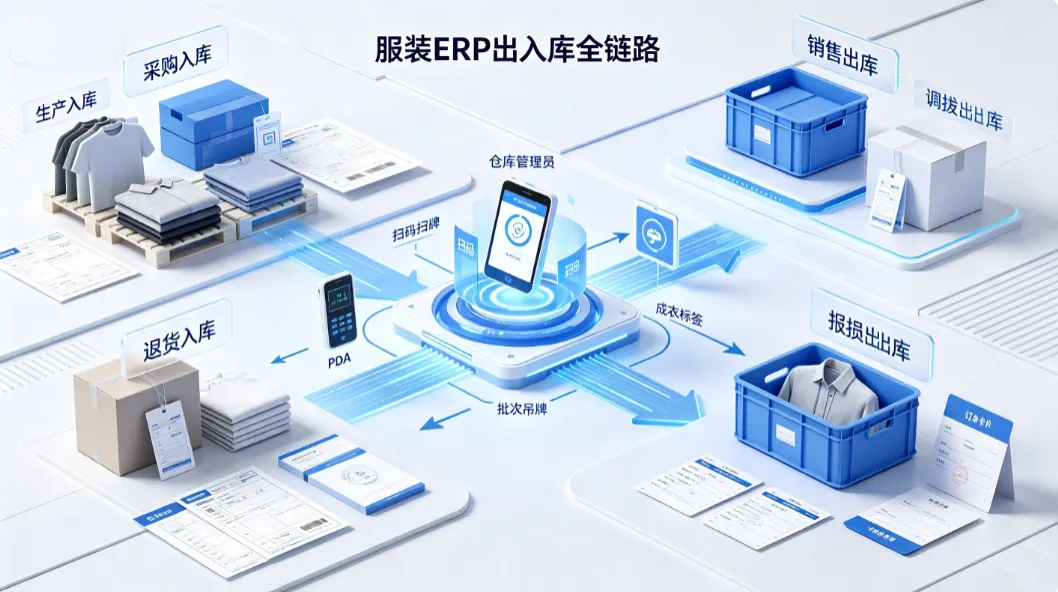
The traditional manual bookkeeping and Excel spreadsheet statistical models are no longer suitable for the operational needs of modern clothing enterprises. ButClothing ERP Inventory Management ModuleIt is a digital management tool designed specifically for the pain points of the clothing industry. Through its five core capabilities of inventory details, QR code control, real-time inventory ledger, intelligent inventory, and cross warehouse transfer, it connects the entire product flow chain, achieves inventory visibility, accurate management, fast adjustment, and clear inventory, and completely ends inventory chaos.
1、 Why does the clothing industry need to implement refined inventory management?
Unlike ordinary standardized products, clothing products haveStyle+Color+Size+Season+BatchWith its five dimensional attributes, the smallest inventory unit is refined to single color and single code, making management much more difficult than other industries. At the same time, clothing products have extremely strong timeliness, and the value of out of season goods has significantly decreased, resulting in unsold inventory directly equivalent to financial losses.
In the multi-channel and multi warehouse business model, the circulation of goods in the main warehouse, store warehouse, e-commerce cloud warehouse, and outsourced factory warehouse is frequent, with scenarios such as procurement and warehousing, sales and outbound, returns and exchanges, cross store transfers, and product losses overlapping and overlapping. Once inventory data lags behind, records are missing, and accounts are chaotic, a series of business problems will arise: best-selling items are out of stock and out of stock, there is a large backlog of unsold items, cross warehouse transfer efficiency is low, inventory errors are large, product losses cannot be traced back, and cost accounting is unclear.
The core value of ERP intelligent inventory management is to break the extensive mode of traditional inventory management, record the full life cycle flow data of goods in a digital, standardized, and intelligent way, so that the inbound, outbound, transfer, loss, and inventory status of each piece of clothing are traceable, accurate, and controllable, providing real data support for stocking strategies, store operations, new product planning, and cost control.
2、 Full chain traceability: detailed inventory records to establish a solid foundation for inventory data
The source of all inventory changes is the behavior of inbound and outbound inventory. The inventory details are the "first ledger" of inventory data, and also the core basis for product traceability, financial reconciliation, and profit and loss verification. The clothing ERP inventory module has integrated the inbound and outbound processes of all business scenarios, achievingEvery inventory change is automatically traced, permanently archived, and fully traceableCompletely eliminate problems such as manual bookkeeping errors, omissions, and unauthorized changes to accounts.
(1) Fully covering warehousing scenarios and standardizing the procurement process
The system supports all warehousing businesses of clothing enterprises, adapting to all scenarios such as production, procurement, transfer, and after-sales: procurement warehousing for supplier supply, production warehousing for factory finished clothing, transfer warehousing for cross warehouse circulation, sales return warehousing for customers and stores, as well as special warehousing for samples, gifts, inventory surplus, etc.
Each time the goods are received, a dedicated receipt will be generated, which automatically records core information such as item number, product name, color and size, quantity received, batch, season, cost unit price, warehouse, operator, and operation time. For defective goods, they can be separately classified and stored, distinguishing between intact inventory and defective inventory, to avoid mixing defective products into normal sales channels and reduce business losses.
(2) Standardize the outbound process and strictly control the outflow of goods
Corresponding to the warehousing scenario, the system fully covers various outbound businesses: sales outbound of online e-commerce, offline stores, and wholesale orders, transfer outbound of cross warehouse circulation, return outbound of defective goods from suppliers, reporting outbound of damaged and out of season goods, as well as special outbound such as sample lending, product gifting, and inventory loss.
All outbound operations are associated with corresponding business documents, and the corresponding warehouse inventory is automatically deducted after outbound. The inventory data is updated in real time to avoid oversold, wrong shipment, and missed shipment problems from the root. At the same time, detailed records of the purpose of outbound shipments, customer and salesperson information, and accurate traceability of goods outflow can be achieved.
(3) Multidimensional detailed query, data retrieval at will
The inventory details ledger supports multi-dimensional filtering and querying, and can be accurately searched based on warehouse, document type, product model number, listing season, operation time period, brand category, size and color, and other conditions. The ledger clearly displays complete data for each transaction, including document number, operating entity, product information, quantity changes, inventory before and after changes, cost amount, and business source. It supports Excel export and paper document printing, meeting daily reconciliation, audit verification, data archiving, and other requirements.
3、 Intelligent control: inventory QR code, realizing full scenario empowerment of one item, one code
The biggest drawback of traditional clothing inventory management is that product identification relies on manual memory and input, resulting in low efficiency, high errors, and high mismatch rates. In response to this pain point, the ERP system is equipped withClothing exclusive QR code management systemTo achieve "one item, one code, one code traceability", the QR code is integrated into the entire business scenario of warehousing, outbound, query, inventory, and transfer, greatly improving the efficiency and accuracy of inventory operations.
(1) Exclusive coding rules for precise matching of clothing attributes
System customized clothing industry exclusive QR code coding rules, the unique identifier of the QR code includesStyle number - Color - Size - Production batch - WarehouseCore information, perfectly adapting to the five dimensional product attributes of clothing, completely solving the problem of confusion between products of the same style but different colors and sizes. Each item and batch of goods has an exclusive "digital ID card" to prevent product confusion from the root.
(2) Dual code printing mode, suitable for different business scenarios
The system supports two types of QR code batch printing modes, which are suitable for different operational needs of enterprises: one is the single item tag QR code, which is bound to a single piece of clothing to achieve precise control of a single item, suitable for retail, return and exchange traceability scenarios; The second is the full box QR code, which generates a unified box code for bulk packaged goods. One box corresponds to multiple items of the same type, suitable for large-scale inbound and outbound, and full box transfer scenarios, greatly improving batch operation efficiency. At the same time, it supports reprinting damaged QR codes, unbinding and resetting, and is suitable for unexpected situations in daily operations.
(3) Full scene scanning operation, bidding farewell to manual inefficiency
The staff can complete the full scene scanning operation through devices such as mobile phones and PDA inventory guns: scanning the code automatically enters the warehouse and quickly exits the warehouse, without the need to manually enter product information, and complete data registration in seconds; Scan the QR code to check real-time inventory, circulation records, and cost information of goods, and keep track of the status of goods anytime, anywhere; Scan the code to quickly complete inventory and reconciliation, replacing manual item by item verification; Scan the code to confirm cross warehouse transfer and receipt, and accurately control the entire process of goods circulation. At the same time, the system automatically records all scanning logs, leaving traces of the operator, operation time, and operation content throughout the process, which can be verified and traced at any time.
4、 Real time ledger: inventory details, control of real inventory data
The inventory crisis of many clothing companies stems from the mismatch between book inventory and actual inventory. Construction of ERP Inventory Detail ModuleReal time dynamic inventory ledgerUsing the smallest dimension of color codes, real-time synchronization of inventory data from various warehouses and channels, accurately restoring the current inventory status of the enterprise, bidding farewell to false inventory and lagging data.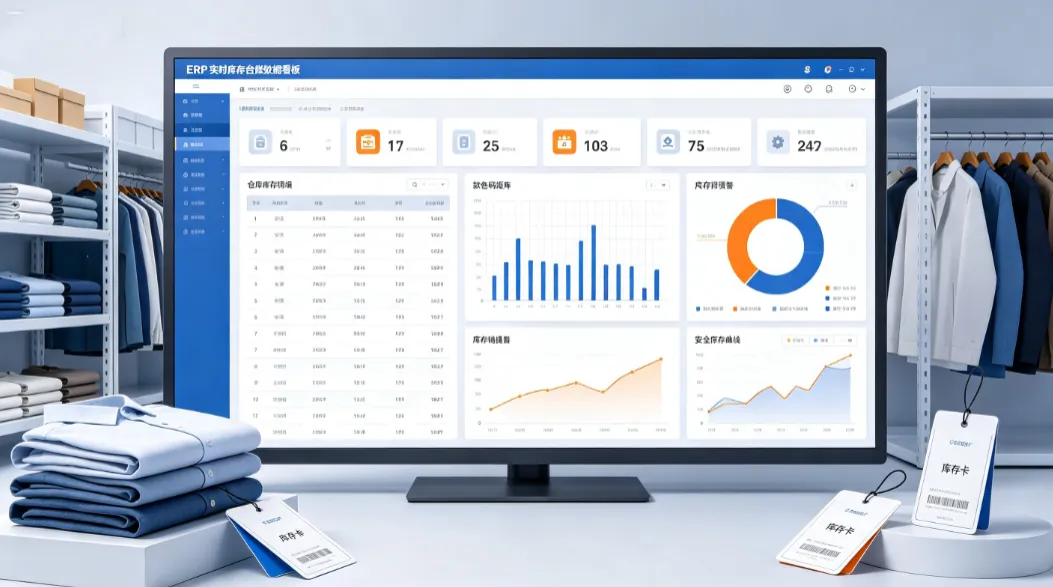
(1) Full dimensional inventory data display
The inventory detail ledger covers all core data dimensions, including warehouse ownership, brand, listing season, model number, product name, color and size, real-time available inventory, in transit transfer inventory, order locked inventory, total inventory cost, single item cost, safety stock threshold and other key information. Clearly distinguish between "sellable inventory, occupied inventory, and in transit inventory" to enable managers to accurately distinguish between effective inventory and ineffective inventory, avoiding blind stocking.
(2) Intelligent screening and hierarchical display
The system supports multi-dimensional flexible filtering, allowing for quick retrieval of goods by season, brand, category, warehouse, and inventory status. It also supports multi-dimensional data aggregation by single item, color, and warehouse, with one click switching of views to adapt to different management needs. Set up an intelligent warning mechanism for abnormal inventory: automatically mark the available inventory below the safety threshold with a red warning to remind timely replenishment and avoid out of stock best-selling products; Long term unsold inventory is automatically highlighted with yellow warning, reminding timely promotion clearance and activation of accumulated funds; Classify and screen out of season products separately to help enterprises optimize their product structure.
(3) Penetrating traceability and flexible adjustment
Click on any item to view the full lifecycle inventory details, circulation records, and profit and loss situation of the color coded product, achieving full traceability of the item. For a very small number of reasonable inventory differences between systems and physical objects, administrators can complete data correction through dedicated inventory adjustment forms. All adjustment operations should be noted with reasons and recorded throughout the process to prevent arbitrary tampering with inventory data and ensure the authenticity and rigor of ledger data.
5、 Standardized verification: inventory counting, precise correction of inventory profit and loss
Inventory counting is the core process of correcting inventory errors, verifying discrepancies between accounts and reality, clearing unsold goods, and investigating product losses. Traditional manual inventory is time-consuming, prone to errors, and inefficient, often requiring business closures for inventory, seriously affecting the normal operation of stores and warehouses. ERP system constructionIntelligent, streamlined, and lightweight inventory systemSupport multiple inventory modes to achieve efficient, accurate, and uninterrupted inventory.
(1) Diversified inventory mode, adapted to different scenarios
The system supports three modes: full inventory, sampling, and dynamic inventory, adapting to the diverse needs of enterprises: full inventory is suitable for quarterly and annual inventory review, covering all goods in the warehouse and comprehensively verifying inventory data; Sampling is suitable for daily spot checks and can be used for targeted inventory of best-selling, high-value, and perishable goods, reducing inventory workload; Dynamic inventory is suitable for offline stores, without the need for closure or affecting normal sales, and can be conducted at any time for partial inventory.
(2) Standardized inventory process, fully standardized and controllable throughout the process
The complete inventory process is scientifically rigorous and closed-loop: first, create an inventory task, select the inventory warehouse, inventory category, and seasonal range, and the system automatically locks the inventory interval inventory to avoid data confusion caused by inventory operations during the inventory period; Secondly, it supports two types of inventory entry methods, with QR code scanning being the preferred method. Through batch scanning with PDA devices, the book quantity and actual inventory quantity can be automatically matched without manual entry, which is efficient and accurate. It also supports manual entry modes for offline inventory and online import of Excel blank inventory forms; After the inventory is completed, the system automatically reconciles and accurately distinguishes between inventory surplus and inventory deficit goods, clearly displaying the book number, actual inventory number, difference quantity, and difference amount of each product; Finally, after being reviewed by both the administrator and the finance department, the reasons for the differences are filled in. After the review is approved, the system automatically generates inventory surplus and deficit in/out documents, synchronously corrects the inventory ledger, and completes the inventory loop.
(3) Inventory data retention to support long-term management
All inventory records are permanently archived, generating inventory difference detail tables, inventory summary reports, and historical inventory ledgers. Managers can view the profit and loss situation, loss reasons, and data differences of each inventory at any time. Through long-term data review, inventory management loopholes can be sorted out, and the processes of inbound, outbound, and storage can be optimized to reduce inventory errors and product losses from the root.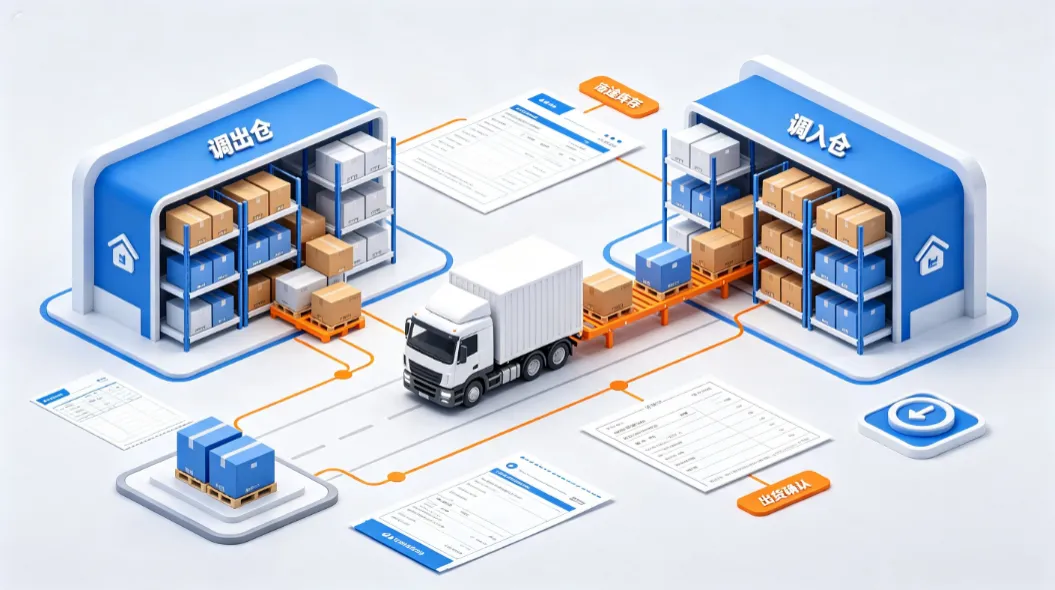
6、 Efficient circulation: inventory allocation, connecting multiple warehouses for goods exchange
For clothing companies with a main warehouse, multiple offline stores, and e-commerce warehouses, cross warehouse and cross store product allocation is a daily high-frequency operation. The traditional transfer model has a chaotic process and outdated information, often resulting in problems such as "no record of transfer, no verification of receipt, no tracking in transit, and no handling of differences", leading to uneven inventory allocation, shortage of best-selling stores, and backlog of unsold stores. ERPIntelligent inventory transfer moduleEstablish a standardized transfer process to achieve efficient circulation of goods across multiple warehouses and real-time data synchronization.
(1) Full coverage of transfer scenarios
The system adapts to all transfer requirements of clothing enterprises, supports bidirectional transfer between the general warehouse and stores, stores and stores, general warehouse and e-commerce warehouse, enterprise warehouse and outsourced processing plants, and also supports special scenarios such as transfer returns and abnormal replenishment, covering daily transfer, allocation, and return flow business in all aspects.
(2) Closed loop transfer process, fully controllable and traceable throughout the entire process
The entire transfer process is layered and closed-loop, with clear rights and responsibilities: the transfer warehouse initiates a transfer request based on inventory and sales demand, specifying the transferred goods, styles, sizes, quantities, transfers to and from the warehouse, and the reasons for the transfer; After receiving the application from the transfer out warehouse, the inventory balance is reviewed. If the inventory is sufficient, the shipment is confirmed and a transfer out order is generated. The transfer out warehouse inventory is automatically deducted. If the inventory is insufficient, the application is rejected and the reason is noted; During the transportation of goods, the system automatically marks them as in transit inventory and displays the real-time quantity, category, and flow of goods in transit; After the goods are delivered, the transfer in warehouse verifies the actually received quantity by scanning the code, completes the receipt after confirmation, generates the transfer receipt document, and synchronously increases the transfer in warehouse; For abnormal situations such as transportation damage and shortage of goods, the system supports one click recording of differences, automatic generation of inventory loss documents, and completion of closed-loop abnormal processing.
(3) Visualize transfer data and optimize product configuration
The system automatically generates transfer detail ledger, in transit inventory report, and transfer summary report, clearly recording all transfer documents, circulation time, product information, and differences. Managers can analyze the frequency and supply and demand situation of goods circulation in each store and warehouse through data analysis, accurately optimize the allocation strategy of goods, allocate goods from unsold stores to best-selling stores, activate inventory resources, improve product turnover, and maximize inventory value.
7、 Digital empowerment: comprehensive supporting capabilities, building a solid management system
In addition to the five core functions, the clothing ERP inventory management module is equipped with complete supporting capabilities, forming a comprehensive digital inventory management system that takes into account compliance, safety, and practicality.
One is hierarchical permission controlThe system sets hierarchical permissions for all operations such as inbound and outbound, inventory counting, transfer, and inventory adjustment. Ordinary warehouse managers can only complete data entry and scanning operations, while supervisors are responsible for document review and exception handling. Finance can view cost data, reconcile accounts, separate responsibilities, and balance each other to avoid operational risks.
The second is full link data traceabilityEvery inventory change and operation behavior is associated with documents, personnel, time, and scenarios, forming a complete data link that meets all traceability requirements for internal management, financial accounting, and external auditing of the enterprise.
Thirdly, intelligent cost accountingThe system automatically uses the weighted average method to calculate the inventory cost of goods. All operations such as inbound and outbound, transfer, and inventory are synchronized to update cost data, accurately calculating the total inventory amount, individual product cost, and loss cost. It automatically connects with the financial module to generate vouchers, solving the problem of vague cost accounting and inaccurate profit statistics in clothing enterprises.
The fourth is custom data outputAll detailed ledgers, statistical reports, and document vouchers support custom export and printing, adapting to various scenarios such as daily office work, reporting, archiving, and reconciliation needs of enterprises.
8、 Summary: Digital inventory management is the key to profitability for clothing enterprises
For the clothing industry, inventory is not simply a storage of goods, but a core asset of the enterprise. The inventory management capability directly determines the enterprise's capital utilization rate, operational efficiency, and profitability. The extensive manual management mode is no longer suitable for the fast-paced, multi-channel, and refined competition in the current clothing market.
Clothing ERP inventory management module, toBased on inventory details, using QR code control as the lever, real-time ledger as the core, intelligent inventory as the guarantee, and inventory transfer as the empowermentThoroughly solve the core pain points of inventory chaos, data lag, low efficiency, unclear profits and losses, and capital backlog in the clothing industry. Through digital, standardized, and intelligent management methods, inventory data can be made more accurate, goods circulation more efficient, and capital utilization more fully, helping enterprises achieve "reducing inventory, improving efficiency, controlling costs, and increasing profits", and achieving long-term stable development in fierce market competition.