
Core content, maintenance standards, and full production process application of BOM list in clothing ERP system
In the digital management system of clothing enterprises, BOM (Bill of Materials) is the core basic data of ERP system, which is the core link connecting product design, material procurement, workshop production, warehouse control, and cost accounting. Unlike traditional mechanical manufacturing BOM, the clothing industry BOM hasMulti style, multi color, multi size, differentiated usage, dynamic fluctuation of lossThe exclusive characteristics of its data, including accuracy, standardization, and timeliness, directly determine the precision of material control, production efficiency, and cost control level of the enterprise. This article will systematically sort out the core components of clothing ERP BOM, standardized maintenance and update rules, as well as the landing application scenarios of the entire production process.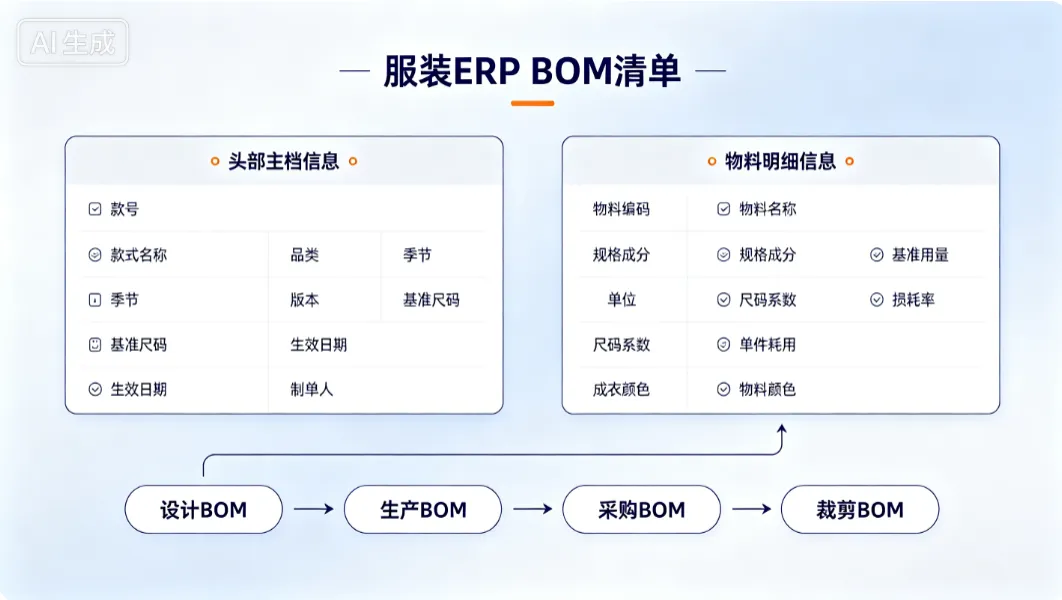
1、 Core Classification of Clothing ERP BOM
Based on the business characteristics of clothing enterprises such as sampling, redesign, and mass production, the BOM in the ERP system is mainly divided into four categories, each with its own responsibilities and hierarchical connections, forming a complete product material data system:
1. Design BOM (EBOM)The final draft is entered by the designer and is mainly used for new product sampling and preliminary pricing. It only calculates the theoretical materials used for the product and does not include production and cutting losses. It is the basic material basis for the new product development stage and cannot be directly used for mass production.
2. Production BOM (MBOM)The core BOM type of ERP system is the only standard for mass production. On the basis of designing BOM, overlaying parameters such as fabric pre shrinking, cutting, sewing, and auxiliary material loss to accurately match the actual production scenario is the core basis for material accounting, work order issuance, and limited material requisition.
3. Procurement BOM (PBOM)Based on the production BOM summary, integrate the total demand quantity of all fabrics, accessories, and packaging materials, deduct the existing inventory in the warehouse, and directly use it for purchasing orders and material preparation to ensure timely supply of production materials.
4. Cutting BOMThe exclusive BOM adapted for cutting bed production, combined with clothing color, size ratio, fabric width, and cutting process, refines color separation, coding material data, and cutting loss, which is the precise basis for workshop cutting operations.
2、 Complete core information of clothing ERP BOM list
The standard clothing ERP BOM is divided intoBasic information of the head和Material details informationTwo major modules, covering product attributes, material parameters, usage standards, loss rules, business control, and other comprehensive content, are the foundation for ensuring accurate system calculations.
(1) BOM header main file information
The unique identifier for a single product, used to distinguish styles, versions, and applicable scenarios, mainly including: style number, style name, product category, season and year, BOM version, BOM status, reference size, effective/expired date, creator, reviewer, etc. Among them, BOM version is the core control field, used to distinguish between sample version, bulk version, and revised version, to avoid confusion of new and old material data; The benchmark size generally defaults to size M, which is used to calculate the material factor for each size.
(2) BOM material detail information
The detailed parameters for each production material are the core data for ERP calculations, mainly including five categories of fields:
1. Material identification fieldMaterial code, material name, specification and composition, material classification, measurement unit, all materials need to be filed in ERP in advance to prevent manual temporary entry and ensure data consistency.
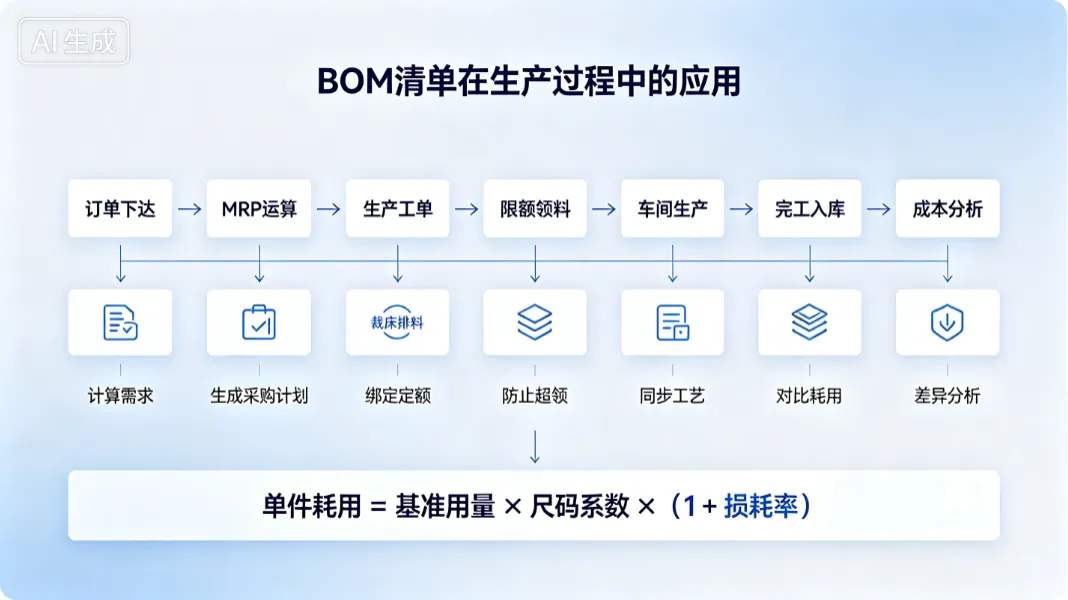
2. Usage Core FieldsBenchmark unit usage, size factor, loss rate, actual consumption per unit. The system automatically calculates the actual material usage of each size of ready to wear clothing through "benchmark usage x size factor x (1+loss rate)", adapting to the differentiated material requirements of clothing in multiple sizes.
3. Color matching fieldReady to wear colors and material colors, achieving precise binding between different colored ready to wear garments of the same style and corresponding fabrics and accessories, avoiding material errors and mixing problems from the source.
4. Business control fieldsSupply method, material requisition station, over issuance authority, special process remarks, clarify material procurement method and requisition workshop, make annotations for special processes such as pre shrinking, printing, hot stamping, etc., and guide production operations.
5. Cost accounting fieldsUnit price of materials and cost of individual materials, used for the system to automatically calculate the standard production cost of finished garments.
3、 Standardization Maintenance and Update Specification for Clothing ERP BOM
Clothing products have fast iteration, frequent process changes, and high material replacement rates. BOM is strictly prohibited from being modified arbitrarily, and a standardized maintenance mechanism needs to be established to balance data accuracy and traceability. The industry's core principles are:Approved, ordered, and produced BOMs are prohibited from being directly overwritten or modified, and version iteration management is preferred。
(1) Basic daily maintenance
Before launching a new product, BOM creation, verification, and review must be completed: complete the style header information, accurately enter the details of fabric, lining, accessories, and packaging materials, match the corresponding relationship of colorants, and label special process requirements. The draft status BOM can be freely edited, and after approval, it will officially participate in MRP calculation, material requisition control, and cost accounting; Expired styles and obsolete versions should be promptly marked as discontinued and archived, and invalid draft data should be cleared. At the same time, it is necessary to improve the material file in advance to ensure the accuracy of basic data such as material code, door width, weight, conversion ratio, etc., in order to avoid BOM calculation errors from the source.
(2) Common scenario update rules
1. Convert sample BOM to bulk BOMCopy the original sample BOM, create a new bulk version, supplement cutting and production loss parameters, correct actual usage, and deactivate the old sample BOM after it is approved and effective.
2. Material replacement updateWhen fabrics and accessories are out of stock or materials are upgraded, long-term replacement requires the addition of BOM versions and replacement material details; Temporary replacement can be done through system maintenance of alternative material solutions without changing the original standard BOM.
3. Process and material changesWhen adding or removing accessories, adjusting processes, modifying size factors or loss rates, the styles that have already been ordered must be iterated to a new version. The draft status that has not been ordered can be directly modified, and the procurement, production, and warehouse departments should be notified simultaneously.
(3) Change approval and permission control
Formal BOM changes require a standardized process: the technical department issues a change notice, specifying the change content, reason, and effective scope. After verification and review, the system version update is completed and archived for record keeping. At the same time, hierarchical permissions are set: the version room is responsible for new construction and draft editing, the supervisor is responsible for reviewing and approving the effectiveness, and the procurement and warehouse only open query permissions to prevent multiple people from arbitrarily modifying data.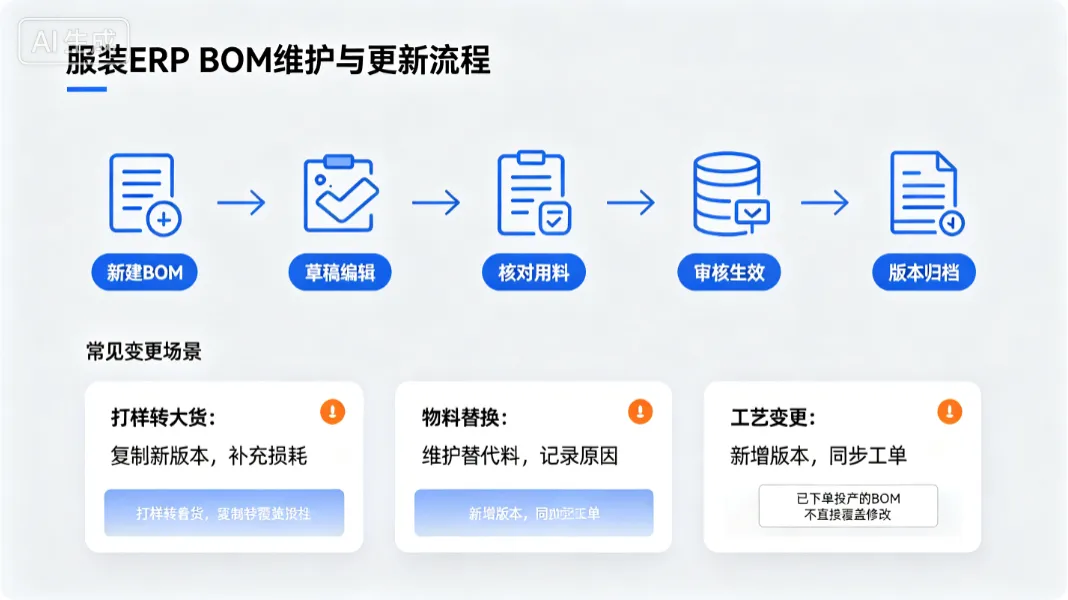
4、 The core application of BOM list in the entire process of clothing production
The BOM list runs through the entire chain of clothing production, from order acceptance to completion and warehousing, and cost accounting. It is the core basis for digital production control, and the application scenarios of each link are as follows:
(1) Order Material Requirements Calculation (MRP Calculation)
After the sales order and production order are issued, ERP automatically matches the effective bulk BOM of the corresponding style. Based on the order size, color, and quantity, the total demand for fabrics, accessories, and packaging materials is automatically calculated. After deducting warehouse inventory, purchase requests and material preparation plans are generated to accurately solve the problems of production shortage and blind stocking.
(2) Production work order issuance control
When the production planner splits the work order, the system automatically binds the corresponding BOM version, pre brings the total quota consumption of all materials, clarifies the requisition workshop and requisition standards of each material, and implements the BOM material standards to each production work order, providing a basis for subsequent quota requisition and production control.
(3) Fabric control for cutting beds
The theoretical fabric usage provided by BOM can serve as a reference standard for CAD nesting. After nesting is completed, the theoretical usage can be compared with the actual nesting usage to verify the rationality of the loss. At the same time, the warehouse distributes fabrics based on BOM quotas, calculates actual losses after production completion, compares and analyzes them with BOM standard losses, and continuously optimizes the discharge process and BOM loss parameters.
(4) Warehouse limit material requisition control
All material requisition in the workshop is based on BOM quota as the upper limit, achieving limited issuance and precise control. Normal material requisition must not exceed the standard usage. If material requisition needs to be exceeded due to production abnormalities, the approval process for over requisition must be initiated, and the system will automatically record the excess data as the core basis for workshop loss assessment. At the same time, relying on the BOM color matching relationship, it effectively avoids the problem of sending wrong colors and materials.
(5) Workshop production and post production control
The accessories such as zippers, buttons, and rubber bands in the sewing workshop, as well as the packaging materials such as hang tags, washing labels, and packaging bags in the entire workshop, are strictly distributed according to the BOM single item quota and total order quantity. If there is a process change during the production process, the BOM version and work order quota must be updated synchronously to prevent the problem of arbitrary process changes and disconnection between data and actual operation on site.
(6) Finished inventory and tail control
After the work order is completed and stored, ERP automatically compares the BOM standard consumption with the actual material consumption in the workshop, calculates the material surplus, and guides the return of remaining fabrics and accessories to the warehouse. For production tail end orders, BOM can be used to accurately calculate the materials required to fill in the tail end, avoiding material waste and tail end backlog.
(7) Analysis of Production Cost Accounting
The system calculates the standard production cost of ready to wear clothing based on BOM quota usage and material unit price; Based on the actual material requisition data of the work order, calculate the actual production cost. By comparing the differences between standard costs and actual costs, we can accurately identify the reasons for cost deviations, including excessive wear and tear, oversized accessories, material replacement, BOM data errors, etc., providing data support for enterprises to reduce costs and increase efficiency.
5、 Common Misconceptions and Avoidance Points in the Application of Clothing BOM
1. It is prohibited to directly use the sample BOM for mass production. The sample BOM has no production loss parameters, which can easily lead to insufficient material preparation;
2. It is prohibited to directly modify BOM that has already taken effect or been ordered. Version iteration management must be implemented to ensure data traceability;
3. Eliminate BOM without color matching or size coefficient, to avoid problems such as wrong materials and material accounting deviations;
4. Avoid work orders not being bound to BOM, which may result in the inability to achieve limited material requisition, loss of auxiliary materials, and uncontrolled material waste;
5. Regularly verify BOM loss parameters, optimize data based on actual cutting machine losses, and avoid a disconnect between standard data and production practices.
VI. Summary
The clothing ERP BOM list is not a simple material statistics table, but a digital control core that runs through product design, procurement, production, warehousing, and cost. Standardized BOM data, standardized maintenance and update mechanisms, and full process implementation can effectively solve pain points such as inaccurate material accounting, chaotic material requisition, loss control, and unclear costs in clothing enterprises. Only by establishing a BOM management system of "precise order creation, standardized updates, full implementation, and regular optimization" can enterprises fully leverage the digital value of ERP systems, improve production control efficiency, and refine management levels.