Full analysis of the core differences between clothing ERP and footwear ERP (including product, production, and sales dimensions)
In the digital management of the footwear industry, apparel ERP and footwear ERP seem to belong to the same category of apparel industry management systems. However, due to the vastly different product structures, production processes, and market sales models of apparel and shoes, there are essential differences in their core architecture, functional logic, and control focus. The core reason why many companies make mistakes in selecting products and fail to implement their systems online is that they confuse the industry-specific characteristics of the two types of systems. This article comprehensively breaks down the differentiation between clothing ERP and footwear ERP from four core dimensions: product architecture, material BOM, production management, and sales system, providing accurate references for enterprise digital selection and operation management.
1、 Core Foundation: The Fundamental Differences in SKU Architecture of Products
The product specification architecture is the fundamental and core difference between two types of systems, directly determining all management logic for subsequent materials, production, inventory, and sales.
Clothing ERP adopts a three-dimensional specification system: style number+color+sizeThe sizes are mainly S, M, L, XL and other clothing sizes, and the unit of measurement is "piece, set". Clothing products have no differences in form, weight, or size adaptation. Different sizes of the same style and color have the same core fabric material, but only different sizes. The SKU generation rules are simple, the size dimension is single, and there are no special adaptation parameters.
The footwear ERP adopts a four-dimensional specification system: style number+color+shoe size+shoe last (fat and thin type)The unit of measurement is "double". Footwear products have strong exclusive characteristics. Shoes of the same size and style can distinguish between wide and narrow versions such as 2.5 last and 3.0 last, and are compatible with various size standards such as European, American, and inner length. Materials of different last shapes and sizes cannot be used interchangeably. Therefore, the footwear ERP has built-in exclusive shoe last files and sole pattern files, with more complex SKU dimensions and much higher requirements for specification accuracy than clothing.
2、 Materials and BOM System: Simple Single Layer Structure vs. Multi Layer Composite Structure
The Bill of Materials (BOM) is the core of production accounting, and the raw material composition and consumption rules of clothing and footwear are vastly different, creating completely different material management logics for the two systems.
The BOM structure of clothing ERP is simpleSingle layer/double-layer structure of fabric and accessoriesThe hierarchy should not exceed 3 levels. The core main materials are various types of fabrics, and the usage is calculated by meters and sizes. Only the material loss needs to be adjusted according to the size of the size. The overall loss is uniform and the rules are simple. The auxiliary materials only include conventional small items such as buttons, zippers, and elastic bands, without complex disassembly or the need to share mold and pattern costs.
Footwear ERP adoptsFour level nested composite BOMIt is divided into three major modules: upper BOM, bottom BOM, and chemical auxiliary BOM, with a more complex material system. Firstly, the raw materials for footwear include genuine leather, microfiber, rubber outsole, EVA midsole, heel, glue, hardware accessories, etc., with a wide range of categories; Secondly, uniqueCode upgrade material consumption rulesThe larger the shoe size, the higher the material quota for leather and sole; Thirdly, genuine leather is calculated by sheet and square feet, and there are natural irregular losses. Chemical materials such as glue and treated water need to be controlled for shelf life and volatilization losses; Fourthly, the system needs to separately calculate and allocate the cost of mold making for shoe lasts and soles, which is a function that clothing ERP does not have at all.
3、 Production Management: Linear Production Line vs. Multi Section Composite Process
Production management is the sector with the greatest difference between the two systems, and the production processes, workshop control, in-process management, and production modes of clothing and footwear are completely different.
The clothing production process is simple and standardized in a linear manner. The core procedures are: fabric cutting → cutting and subcontracting → sewing and sewing → edge locking → ironing → packaging and storage. The entire production only revolves around the two core sections of cutting and sewing, with a coherent and unified assembly line. The production control of clothing ERP focuses on cutting bed layout, fabric loss statistics, workshop piece rate wages, and in process cutting management. The production mode is based onProduction by colorMainly, all sizes of the same color are cut uniformly and produced synchronously, with fewer processes and lower difficulty in control.
Shoe production belongs to a multi section composite process, which is cumbersome and has dedicated core links. The complete process is: leather/substrate cutting → needle sewing surface → bottom preparation processing → molding (brushing, drying, pressing, shaping, cooling) → polishing and quality inspection → packaging and warehousing. among whichThe molding section is a unique core process in the footwear industryThe clothing ERP system does not have a corresponding control module, which includes exclusive parameters such as temperature control, curing, and bonding.
At the same time, shoe production has two exclusive characteristics: firstly, outsourcing processing is common, with shoe upper sewing and outsole mold making mostly outsourced. The system must support the full process management of outsourcing material issuance, processing reconciliation, and outsourcing warehousing; The second is the extremely detailed process breakdown, with independent division of labor for cutting, needle sewing, glue brushing, bottom pressing, and polishing. There are both individual piece rate and forming team co production piece rate models. In addition, the footwear industry has been put into productionProduce according to the matching codeAs the core, production, material requisition, and completion all need to be matched with a fixed size ratio. Work in progress products need to be separately controlled for three types of inventory: shoe uppers, substrates, and finished and semi-finished products, which is far more complex than clothing production management.
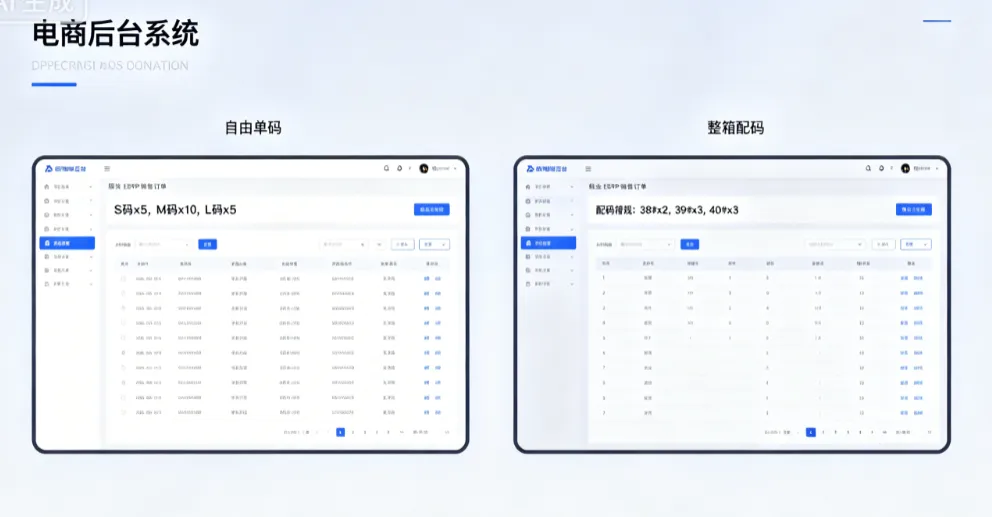
4、 Sales Management: Free Single Code Mode vs. Matching Full Box Mode
Facing the terminal wholesale, franchise, and retail markets, there are significant differences in the ordering, outbound, inventory, and promotion logic between clothing and footwear, with the core difference being "free single size" and "matching full box".
Clothing ERP SalesSingle code free orderingAs the core, S, M, L, and XL sizes can be ordered separately and matched freely, without fixed box size ratio constraints, allowing for flexible and free loading and unloading. The pricing rules are simple, and the same style, color, size, and size are basically priced uniformly. Promotions, restocking, and transfers are all based on individual sizes and products. Customers can restock separately for any missing size. Inventory counting and returns only require checking the three-dimensional information of the style, color, and size.
ERP sales in the footwear industryFull box coding is standard in the industryThis is the core logic of shoe sales. Wholesale orders are matched with fixed box sizes, such as 38 # × 2, 39 # × 3, 40 # × 3, and 41 # × 2. The system has a dedicated box size file built-in, which supports whole box ordering, disassembly and replenishment, and automatically converts the number of boxes to even numbers. Priority will be given to full box shipment upon delivery, and the system will automatically verify the accuracy of the code count and last shape to prevent any errors or omissions.
At the pricing level, the footwear industry supports separate markups for special plus sizes and special last shapes; Inventory management requires simultaneous counting of both full container count and scattered even numbers, supporting rapid inventory and allocation of full containers; Returns and exchanges require precise differentiation of sizes and last shapes. Products with quality defects are separately classified as defective products in the warehouse. Clearance promotions also differentiate between full box discounts and broken shoe discounts, with more refined sales control dimensions.
5、 Summary: Core Logic of System Selection
Overall, clothing ERP isLightweight, linearized, and freely adaptableThe management system is adapted to the industry characteristics of simple garment technology, single specifications, and flexible sales; Shoe ERP isComplexity, multidimensionality, standardizationThe exclusive system is built around the industry characteristics of shoe last specifications, multi-layer materials, composite production, and matching sales.
Enterprise selection can be directly referred to: For pure clothing production and sales enterprises, choosing a universal clothing ERP can meet their needs and provide higher cost-effectiveness; Pure footwear enterprises must use professional footwear ERP. Ordinary clothing ERP cannot cover core necessities such as molding process, last management, matching sales, and mold amortization; Shoe and clothing integrated management enterprises need to use dedicated shoe and clothing integrated ERP, taking into account the differentiated management needs of the two types of products.