
How can ERP systems reduce enterprise costs? Comprehensive analysis of the five core areas
In a business environment full of uncertainty, the pursuit of cost control by enterprises has never stopped, and has even become increasingly urgent. Cost has long surpassed the simple concept of expense reduction and become a comprehensive yardstick for measuring the operational efficiency and resource utilization level of enterprises. As the core hub of enterprise digitization, the value of ERP system is not only limited to process automation, but also lies in optimizing the cost structure of enterprises from the root through data integration and process reshaping, driving sustainable cost reduction and efficiency improvement. This cost reduction is not a "subtraction" at the cost of sacrificing quality or efficiency, but a lean "value creation" achieved by improving the overall operational "health". Its influence permeates the five core areas of enterprise operation, jointly building a systematic cost advantage.
1、 Procurement Cost Management: From Price Negotiation to Total Cost of Ownership Optimization
Procurement is often the primary battlefield for cost control in enterprises, but traditional procurement management is often limited to "price negotiation", while ERP systems broaden this perspective to "total cost of ownership" management throughout the entire lifecycle. The system integrates historical procurement data, material requirement planning, and supplier performance information to build an intelligent procurement decision support system. It can automatically analyze the expenditure patterns of purchased materials, identify opportunities for integrated procurement, transform scattered sporadic purchases into more bargaining power bulk purchases, and directly reduce the purchase unit price.
More importantly, the ERP system has established a systematic supplier collaboration and evaluation mechanism. It not only records orders and payments, but also tracks key performance indicators such as supplier on-time delivery, quality compliance, and response speed. Through dynamic supplier ratings, companies can optimize their supplier structure and tilt orders towards partners with better performance, thereby reducing downtime losses, rework costs, and hidden risks caused by delivery delays or quality defects. In addition, the system supports full process automation and transparency from demand application, procurement sourcing, order execution to payment reconciliation, significantly reducing the administrative and communication costs of the procurement department, eliminating human operational errors and potential compliance risks.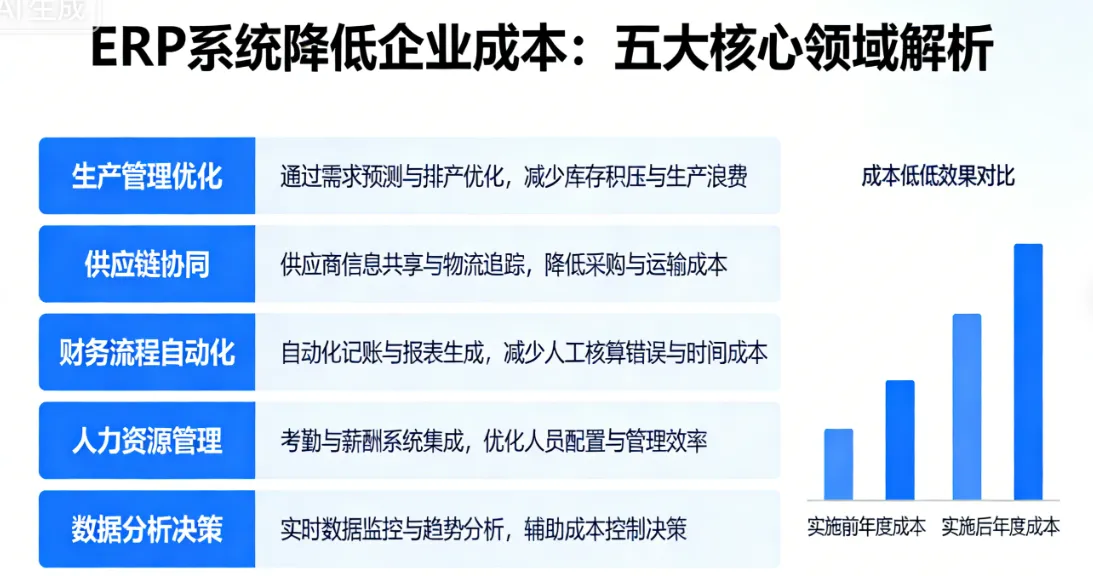
2、 Inventory cost control: finding the best balance between ensuring supply and reducing backlog
Inventory is the "coagulant" of enterprise liquidity, and the cost of inventory is composed of explicit capital occupation, storage costs, and implicit depreciation losses and obsolescence risks. The ERP system has found a dynamic balance between "ensuring supply" and "reducing backlog" through precise material requirement planning and real-time inventory visualization management. The system automatically calculates when to purchase and how much to purchase based on sales forecasts, production plans, and accurate material lists, and sets safety stock warnings, fundamentally avoiding excess inventory or shortages caused by experience based stocking.
ERP system promotes the transformation of inventory management mode from "static reserve" to "dynamic flow". By utilizing functions such as first in first out and batch tracking, material expiration and depreciation losses have been reduced; By analyzing material turnover, identifying and clearing stagnant inventory, releasing storage space and working capital. For manufacturing enterprises, the system can finely manage work in progress, shorten production cycles, and reduce the "dormant" materials and semi-finished products on the production line. After implementing ERP, an equipment manufacturing enterprise's overall inventory turnover rate increased by over 30%, which is equivalent to releasing millions of working capital and significantly reducing inventory holding costs.
3、 Optimization of Production Efficiency and Operating Costs: Eliminating All Waste in the Production Process
The production process is the core of cost occurrence and also the 'disaster area' of waste. The ERP system systematically reduces operating costs by optimizing production planning and scheduling, refining production process management, and improving equipment performance. The advanced planning and scheduling module can comprehensively consider order priority, equipment capacity, material completeness, and personnel skills to generate the optimal production sequence, minimize equipment switching time, waiting time, and handling distance, and directly improve equipment comprehensive efficiency and per capita output.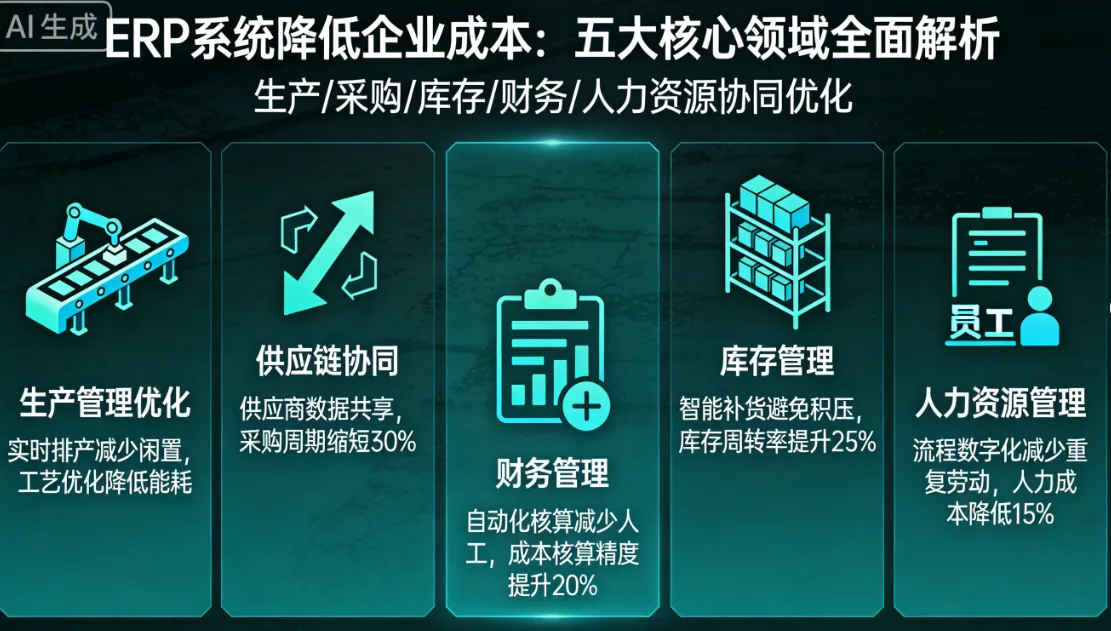
At the production execution level, the ERP system integrates with the manufacturing execution system to achieve real-time monitoring and data collection of the production process. Any production abnormalities (such as quality deviations, equipment downtime) can be promptly recorded and responded to, reducing the defect rate and rework costs. The comparative analysis of standard working hours and actual working hours provided by the system can help managers identify efficiency bottlenecks. At the same time, by integrating preventive maintenance plans, the system can arrange maintenance based on equipment operation data, reducing production capacity losses and high emergency repair costs caused by unplanned shutdowns, shifting from "firefighting" maintenance to "preventive" maintenance, and significantly reducing maintenance costs.
4、 Financial and human cost intensification: automated processing and precise control
Although the finance and human resources departments are considered cost centers, their operational efficiency directly affects the management costs of the entire company. The ERP system automates business processes, freeing financial personnel from heavy data entry, manual reconciliation, and report preparation. For example, in the procurement to payment process, the system can automatically match and verify invoices; Credit management and account collection can be automated in the sales to payment process. This not only reduces manual operation costs and error rates, but also shortens monthly and annual settlement time from days to hours, improving the timeliness and decision-making value of financial information.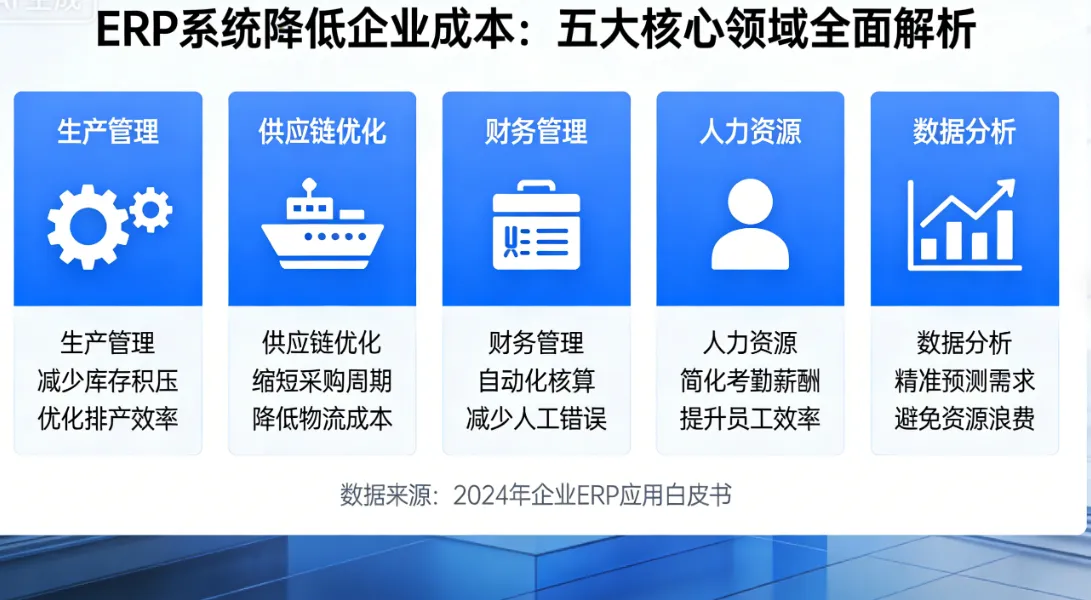
In terms of labor costs, the human resource management module of the ERP system optimizes the entire process from recruitment, onboarding, attendance, compensation to performance. Accurate attendance and work hour management eliminate "personal work hours" and calculation errors; The linkage between performance data and salary calculation ensures the fairness and efficiency of incentives. More importantly, the human resource structure analysis and cost simulation provided by the system can help enterprises scientifically formulate human resource planning during business fluctuations, avoid redundancy or shortage, and achieve optimal allocation of human capital.
5、 Management and Decision Cost Reduction: From Empiricism to Data Driven Scientific Decision Making
The hidden and high costs often lie in inefficient communication, slow decision-making, and strategic errors. ERP systems provide enterprises with a unique and trustworthy data source and a unified collaboration platform by breaking down information silos. The management can obtain real-time comprehensive operational data across departments, quickly gain insights into the overall operation through an intuitive dashboard, without the need to convene lengthy meetings or wait for departments to organize inconsistent reports. This greatly reduces the cost of internal communication and coordination.
More profoundly, ERP systems upgrade enterprise management from "experience driven" to "data-driven". Based on the accumulated historical and real-time data of the system, enterprises can conduct accurate demand forecasting, customer profit analysis, product lifecycle cost accounting, and simulation of different business scenarios. This provides a quantitative basis for strategic decisions such as new product investment, market expansion, and capacity investment, greatly reducing strategic waste and opportunity costs caused by incomplete information or misjudgment. The improvement of decision quality is the most rewarding aspect of all cost controls.
Conclusion
In summary, reducing enterprise costs through ERP systems is a systematic project. It is not achieved through a single "cost saving" approach, but rather by improving procurement collaboration, inventory liquidity, lean production, process automation, and scientific management. It simultaneously works in multiple core operational areas to build sustainable cost competitive advantages. It transforms cost control from the "post accounting" of the finance department to the "pre planning and in-process control" integrated into the daily operations of the enterprise. In today's era where digital transformation has become a necessary topic, investing in ERP is no longer just about purchasing a set of software, but also investing in a modern governance system that drives enterprises to continuously reduce costs, improve quality, and increase efficiency. It is the key cornerstone for enterprises to build resilience and competitiveness in complex economic environments.