
Medical industry ERP system
Against the backdrop of accelerated development and deepening reforms in the healthcare industry, medical institutions - from large comprehensive hospitals to specialized clinics, from pharmaceutical companies to medical device companies - are facing multiple challenges in improving operational efficiency, controlling medical costs, ensuring service quality, and responding to strict supervision. Traditional and decentralized management information systems are no longer able to support modern medical and health institutions in achieving refined operations and high-quality development. The ERP system in the medical industry is a comprehensive solution designed to meet a series of complex needs. It integrates core modules such as financial management, supply chain, clinical business support, and compliance control to build a unified, intelligent, and compliant digital operation center for medical and health institutions.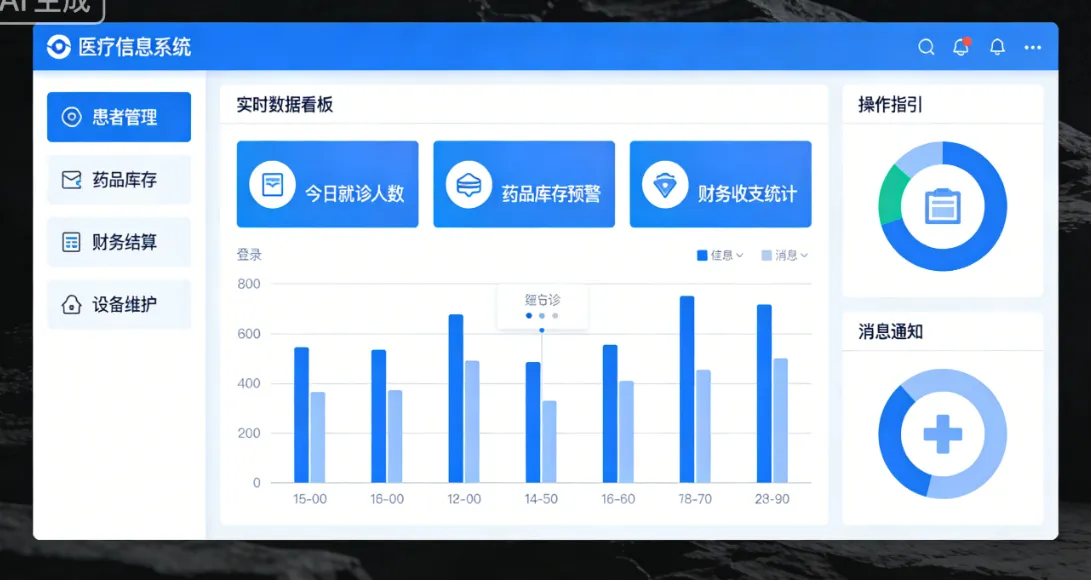
Integrated resource integration platform for complex businesses
The operation and management of medical institutions are highly complex, involving multidimensional business flows such as clinical services, drug and consumables management, equipment assets, human resources, and financial accounting. Under traditional models, these systems often operate independently of each other, forming "information islands" that result in inconsistent data, disjointed processes, and high management costs. The core value of ERP systems in the medical industry lies primarily in buildingIntegrated resource integration platformIt integrates the core resource information of hospitals, such as finance, materials, assets, and manpower, into a unified database, achieving unified data standards and real-time sharing.
For example, in the critical and cost sensitive management of drugs and medical consumables, ERP systems have achieved a closed-loop management of the entire process from procurement, inventory, distribution to clinical use and billing. The system can generate intelligent procurement plans and inventory alerts based on historical consumption data, disease structure, and clinical department requirements. High value consumables and drugs can be finely managed with "one item, one code", and their circulation process is automatically associated with patient orders and billing items, ensuringThe accounts match the actual situation and the traceability is clearEffectively preventing leakage and significantly reducing the cost of medical supplies. After a certain tertiary hospital introduced an ERP system, its inventory turnover rate of medical consumables increased by 30%, and expired losses decreased by more than 50%. While ensuring clinical supply, it also released a large amount of working capital.
Integration of business and finance that runs through clinical practice and management
The particularity of medical services lies in the close connection and real-time occurrence of their business activities (diagnosis and treatment behavior) and financial activities (fees, costs). The medical ERP system is implemented throughDeep integration design of business and financeBreaking down the barriers between clinical pathways and financial accounting. When doctors issue medical orders and perform diagnosis and treatment projects in the information system, relevant cost information (such as drugs, consumables, equipment depreciation, personnel hours) is collected in real time, and income information (such as medical service fees, medical insurance settlements) is also generated synchronously.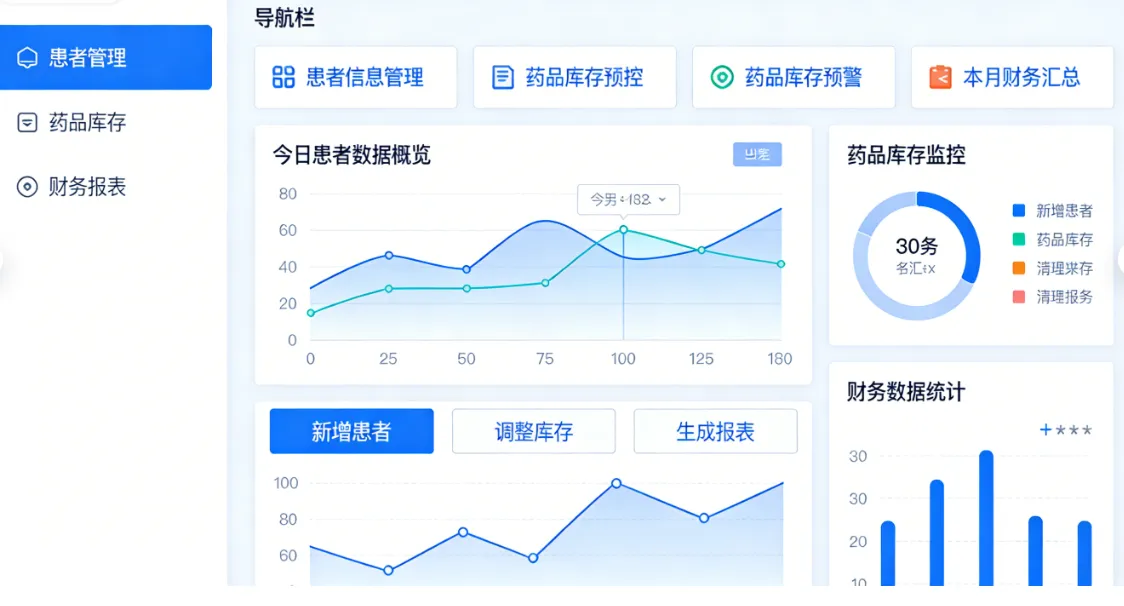
This integration into the hospitalFull cost accounting and refined performance managementProvided possibilities. The system is capable of conducting multidimensional cost-benefit analysis based on disease diagnosis related grouping, medical projects, departments, and even primary physicians, accurately revealing the true resource consumption and profitability of various medical services. This provides a solid data foundation for hospitals to optimize disease structure, control unreasonable medical expenses, and implement scientific performance allocation. Meanwhile, the ability to connect with the medical insurance payment system is crucial. ERP systems can perform pre settlement and simulation analysis based on complex medical insurance policies (such as DRG/DIP payment methods), helping hospitals predict profits and losses in advance, adjust clinical and management strategies, and ensure the rational use of medical insurance funds and the sustainable development of hospitals while ensuring medical quality.
Strict compliance and quality and safety traceability system
The healthcare industry is one of the most strictly regulated fields, and compliance is the lifeline of healthcare ERP systems. The system embeds relevant domestic and international laws, regulations, industry standards (such as the Drug Administration Law, GMP/GSP, HIPAA, etc.) into business processes and control nodes. inDrug and Medical Device ManagementIn terms of quality, the system supports complete supplier qualification management, batch expiration tracking, and cold chain transportation monitoring to ensure traceable sources, traceable destinations, and controllable quality. For clinical trial drugs or special management drugs, the system can implement stricter "double person double lock" electronic process control.
在Financial and Audit ComplianceIn terms of aspects, the system ensures that all business operations (such as procurement bidding, contract signing, payment settlement) have complete and tamper proof electronic audit trails. It can automatically generate various reports that meet regulatory requirements and respond to internal and external audit inspections. For patient privacy protection, the system ensures that sensitive medical and health information is only accessed within the authorized scope through strict permission grading and access log monitoring, fully complying with regulatory requirements such as the Personal Information Protection Law.
Empowering strategic decision-making and continuous improvement
Beyond daily operations, medical ERP systems are even more important for medical institutionsEmpowering platform for strategic decision-making and continuous improvementThe massive data assets gathered by the system are transformed into valuable insights for management through built-in business intelligence tools.
Hospital managers can use the comprehensive operation command center to real-time monitor key performance indicators such as outpatient and emergency volume, utilization rate of hospital beds, average length of stay, proportion of medication, and proportion of consumables. Identify operational bottlenecks and management weaknesses through trend analysis and benchmarking management. For example, by analyzing the disease cost structure and efficacy data of different departments, it can promote the optimization of clinical pathways; By evaluating the operating rate, profitability, and maintenance costs of large medical equipment, equipment procurement and usage planning can be optimized.
Under the requirement of high-quality development in public hospitals, ERP systems also support data-driven budget management, resource allocation, and performance evaluation. It decomposes strategic objectives into executable and monitored operational indicators, promoting the transformation of hospitals from extensive scale expansion to refined and connotative development. After utilizing an ERP system for big data analysis, a provincial-level cancer hospital optimized the process of the daytime chemotherapy center, reducing the average waiting time of patients by 40% and significantly improving the efficiency of medical services and patient satisfaction.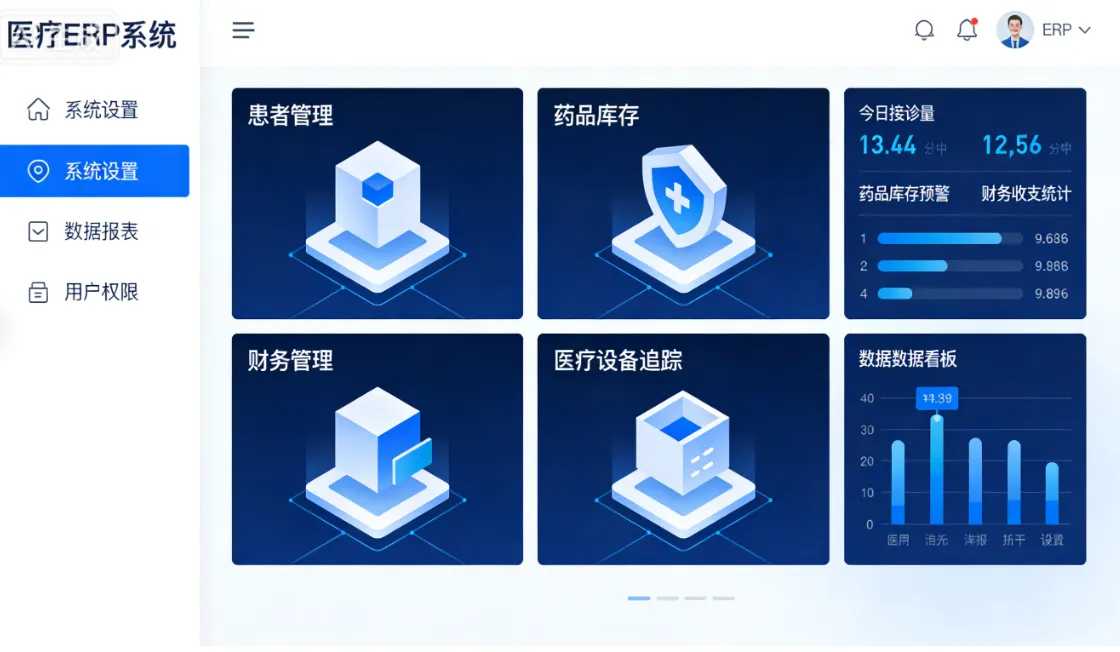
Flexibility to adapt to diverse business formats
The medical industry has a diverse ecosystem, covering public hospitals, private medical institutions, pharmaceutical companies, R&D outsourcing organizations, medical device distributors, and more. Modern medical ERP systems usually adopt modular and platform design, with high flexibility and configurability, and can adapt to the unique needs of different business formats.
For large group hospitals or medical consortia, the system supports the group management and control mode of multi hospital districts and multi legal persons to realize centralized allocation and standardized management of resources. For innovative biopharmaceutical companies, the system may focus more on R&D project management, experimental data management, and compliance declaration support. This flexibility ensures that ERP systems can continue to evolve with the development and changes of medical institutions, becoming a solid digital foundation to support their long-term development.
in a wordThe ERP system in the medical industry has evolved from a single backend management tool to a core infrastructure that supports modern medical institutions to achieve excellent operations, compliance governance, and strategic transformation. It helps medical institutions achieve a balance between social benefits and operational efficiency while providing high-quality medical services by integrating resources, integrating businesses, ensuring compliance, and empowering decision-making. In today's era of deep integration between the Healthy China strategy and digital technology, investing in and successfully applying professional medical ERP systems has become a key choice for various medical and health institutions to enhance their core competitiveness and achieve sustainable development.