
The Difference and Collaboration between ERP and CRM: Analysis of Enterprise Resource Management and Customer Relationship Management
The two pillar systems of enterprise digital transformation
In today's customer-centric and data-driven business environment, enterprise resource planning systems and customer relationship management systems together form the core architecture of digital operations for enterprises. These two systems not only perform their respective duties, but also depend on each other, jointly supporting the entire process of enterprises from internal resource optimization to external customer value creation. A deep understanding of the essential differences and collaborative logic between ERP and CRM is of crucial strategic significance for enterprises to build efficient digital operation systems and achieve sustainable development.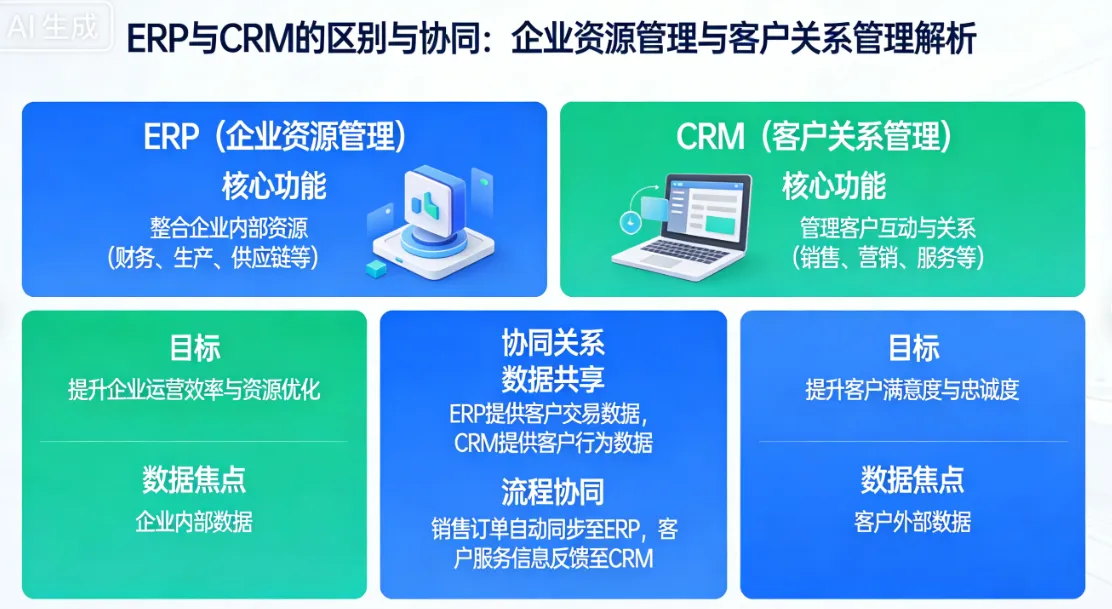
The fundamental difference in core positioning: inward optimization and outward expansion
The fundamental difference between ERP and CRM lies in their core positioning and design intent.The core of ERP lies in the integration and optimization of internal resources within the enterpriseThe focus is on how to efficiently allocate internal resources such as people, finance, materials, and information of the enterprise to support the achievement of strategic goals. The design concept of ERP system originates from the concept of supply chain management, emphasizing the standardization of business processes, integration of data, and support for decision-making. It attempts to answer fundamental economic questions in business operations: what to produce, how much to produce, when to produce, what resources are needed, and how to control costs.
By contrast,The core of CRM lies in the management of customer relationships and value miningIts focus is on how to acquire, maintain, and enhance relationships with customers to maximize their lifecycle value. The design concept of CRM system originates from marketing management and relationship marketing theory, focusing on customer interaction, sales process, service support, and value analysis. It mainly solves the problem of connecting enterprises with external markets: how to identify potential customers, how to promote sales conversion, how to improve customer satisfaction and loyalty, and how to tap into customers' deep needs.
This positioning difference directly determines the functional architecture and application scenarios of the two systems. ERP systems are usually the "operational hub" within an enterprise, connecting backend departments such as production, procurement, finance, and inventory; The CRM system is the "front-end market" of the enterprise, connecting departments such as sales, marketing, customer service, etc. that have direct contact with customers. The practice of a manufacturing enterprise shows that the daily active users of its ERP system are mainly concentrated in departments such as production, procurement, and finance, accounting for about 35% of the total number of employees; The active users of CRM systems are mainly concentrated in the sales, marketing, and service departments, accounting for about 45% of the total number of employees.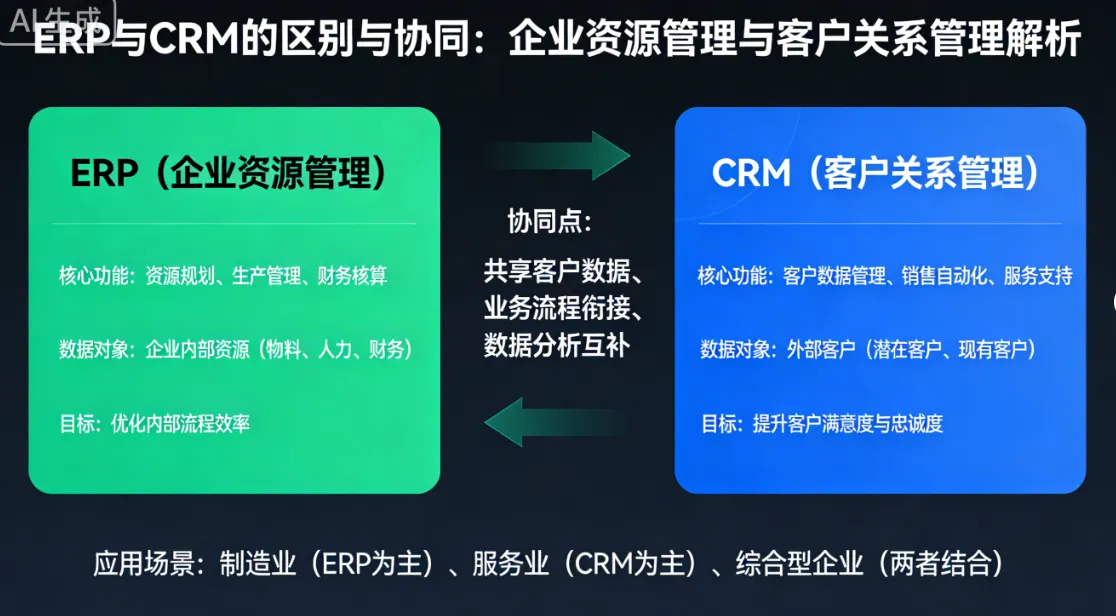
Comparison of Functional Architecture: Process Driven and Customer Centered
From a functional architecture perspective, ERP systems and CRM systems exhibit completely different design logics.The ERP system adopts a process driven architectureBuild functional modules around the core value chain of the enterprise. A typical ERP system includes modules such as finance, procurement, inventory, production, sales, and human resources, which are deeply integrated and share unified master data and business rules. When a sales order enters the ERP system, it will automatically trigger a series of chain reactions: inventory inspection, production planning, material procurement, financial accounting, etc., forming a complete automated business assembly line.
The CRM system follows a customer-centric architectureBuild a functional system centered around the customer lifecycle. A typical CRM system includes modules such as marketing automation, sales pipeline management, customer service support, and analytical insights. These modules focus on integrating customer data, with a particular emphasis on customer interaction history, purchasing behavior, service requests, and value contributions. When potential customers enter the system through marketing activities, CRM will record all their interaction trajectories, track their complete process from leads to opportunities to transactions, and continue to manage service requests and cross selling opportunities after transactions.
These two architectures are particularly evident in handling customer related business. In the ERP system, customers are mainly regarded as the source of "accounts receivable" and the initiator of "sales orders". The system focuses on transaction execution, product delivery, and payment collection; In CRM systems, customers are regarded as valuable assets that require long-term cultivation and exploration, and the system focuses on customer experience, relationship maintenance, and value enhancement. The practice of a certain consumer goods enterprise shows that its ERP system manages the transaction history and credit status of over 20000 customers, while the CRM system focuses on maintaining relationships and deep demand mining for the most valuable 500 strategic customers.
Difference in Data Structures: Transaction Records and Interaction Panorama
ERP systems and CRM systems exhibit distinct differences in data structure.The ERP system is centered around highly structured transaction dataEmphasize neatness, accuracy, and consistency. Every piece of data in the system - whether it's a sales order, purchase invoice, or production work order - has clear formatting standards, validation rules, and associations. The value of ERP data lies in supporting accurate financial accounting, inventory management, and production planning, and its integrity and reliability are directly related to the stability of enterprise operations.
CRM systems are centered around customer interaction and behavioral dataIt covers both structured and unstructured information. These data include basic customer information, communication records, purchase history, service requests, feedback, behavior trajectories, etc., with diverse forms and complex correlations. The value of CRM data lies in building a complete customer profile, revealing customer preferences and behavior patterns, and supporting personalized marketing and service strategies. A customer profile may contain various forms of information such as call recordings, email exchanges, surveys, social media interactions, etc., which contrasts sharply with the fixed format of sales contracts in ERP systems.
This difference in data structure determines the different choices in technical implementation between the two systems. ERP systems typically require powerful relational databases to ensure ACID properties in transaction processing; CRM systems require more flexible data models to store and correlate diverse customer information, often using a hybrid database architecture combined with full-text search engines to optimize the query experience. Modern enterprises are increasingly focusing on the integration of these two types of data, such as viewing customer order fulfillment and payment credit in CRM, or understanding customer purchase preferences and service history in ERP.
The inevitability of collaborative integration: creating a closed-loop business value chain
Although ERP and CRM have significant differences in positioning, functionality, and data, modern enterprise operations require deep collaboration between the two, forming a complete closed loop from customer demand perception to internal resource allocation. The core of this collaboration lies inSeamless integration of business processes and consistent sharing of data。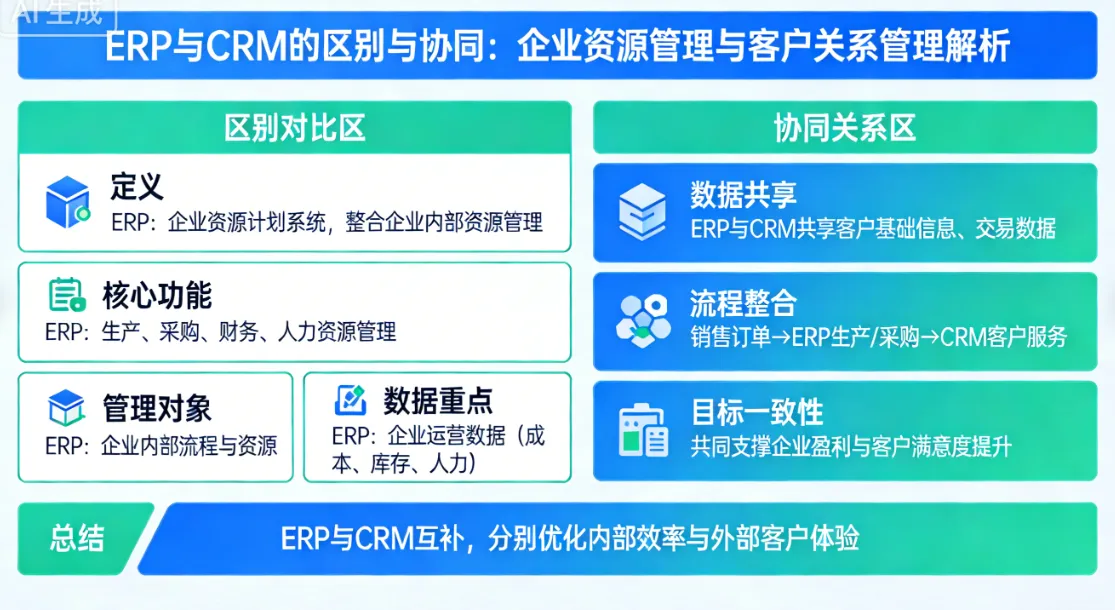
In the end-to-end process from sales to delivery, the CRM system is responsible for front-end business opportunity management and order acquisition, while the ERP system is responsible for back-end order execution and product delivery. When sales personnel confirm orders in CRM, relevant information should be automatically transmitted to the ERP system, triggering production planning, material procurement, and financial accounting processes; At the same time, the order status, shipping information, and inventory status in ERP should also be fed back in real-time to the CRM system for sales and customer service personnel to view. This collaboration ensures the integrity of customer information and the coherence of business processes, avoiding information disconnection and duplicate entries.
In terms of customer service, the CRM system records customer service requests and complaints, while the ERP system provides relevant product information, warranty status, and repair records. When customers raise product issues, customer service personnel can simultaneously view customer history interaction records, product production batches, and shipping information through the integrated interface, quickly locate the root cause of the problem, and provide solutions. A certain equipment manufacturing enterprise has reduced the average response time for customer service requests by 60% and increased customer satisfaction by 25 percentage points through ERP-CRM integration.
The consistency of financial and sales data is another key synergy point. The sales forecast and order information in the CRM system should be consistent with the financial budget and revenue recognition process of the ERP system to ensure the accuracy of the enterprise's financial forecast and the scientificity of its business decisions. Salespeople should be able to view customers' credit status and payment history in CRM to avoid trading with high-risk customers; Financial personnel should be able to understand the input-output situation of sales activities in ERP and optimize fund allocation.
Implementation Strategy and Value Creation
Enterprises should adopt scientific implementation strategies when deploying ERP and CRM systems. ForEnterprises with high operational complexity and strong internal collaboration requirementsIndustries such as manufacturing, retail, and logistics should usually prioritize the implementation of ERP systems, establish a solid internal operational foundation, and gradually introduce CRM systems to strengthen customer relationship management. ForCustomer intensive and service driven enterprises, such as finance, consulting, Internet and other industries, can give priority to deploying CRM systems, quickly improve customer acquisition and service capabilities, and then introduce specific modules of ERP to strengthen internal management according to development needs.
Regardless of the path taken, integration and data consistency between systems should be a key focus of planning. Modern technology platforms typically provide standardized application programming interfaces and middleware solutions, supporting the loosely coupled integration of ERP and CRM. Enterprises should establish unified master data management standards for customers, products, organizations, etc., to ensure that the core data in the two systems remains consistent.
When ERP and CRM are effectively integrated, enterprises will achieve significant value enhancement:Market response speed acceleratesCustomer needs can be quickly converted into internal actions;Improved operational efficiencyReduced latency and errors in cross system data flow;Customer experience improvementEnterprises can provide more consistent and personalized products and services;Improvement of Decision QualityManagement can make more informed decisions based on complete internal operations and external market data.
Conclusion
ERP and CRM represent two fundamental dimensions of digitalization in enterprise management: inward resource optimization and outward customer expansion. Their differences stem from different management focuses and design concepts, while their synergy stems from the overall operation of the enterprise and the full process of customer value. In the new era of customer driven and data-driven business, understanding and utilizing the differences and synergies between these two systems is a key capability for enterprises to build competitive advantages and achieve sustainable development. Only when there is a positive interaction between internal operational efficiency and external customer value creation ability, can enterprises stand out in the increasingly fierce market competition and win long-term survival and development.