How to save profits for small and medium-sized clothing foreign trade factories when raw material prices jump and broken orders become denser? Shuntong Shoe and Clothing ERP
Recently, many clothing foreign trade bosses have been lamenting two problems: fabric and accessory prices rise at will, and customers break down large orders into a bunch of small orders, multiple SKUs, and short delivery times.
The old path of relying on large quantities of goods, diluting losses and labor costs is becoming increasingly unsustainable. We can't control the external market. The unit price of fabrics and the rules of customer orders are not up to the factory the final say. The places where profits can be held are mostly internal: fabric wear and tear, ineffective replacement time, hidden inventory, unclear single product costs, and blindly accepting loss making broken orders.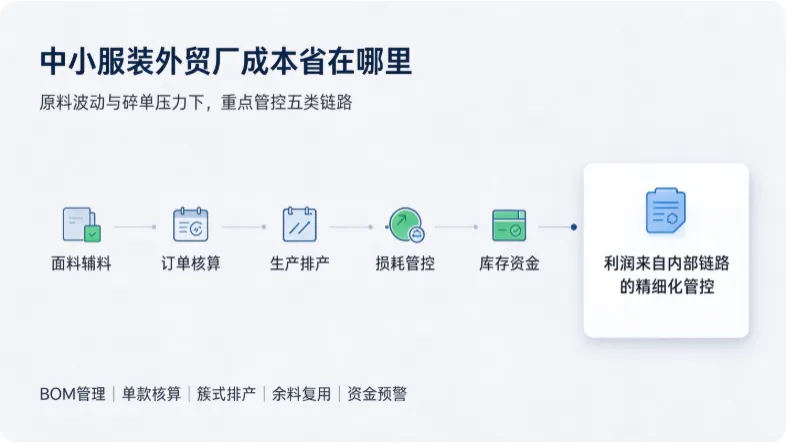
Shuntong Shoe and Clothing ERP does not directly lower the fabric price for you, nor can it guarantee that every order will make money. Its core function is to turn invisible and inaccurate waste in the factory into visible and traceable data, assisting the factory in fine control, controlling costs and preventing losses in the existing business chain.
1、 Fabric and accessories: manage BOM and demand well, reduce waste in scattered procurement
The cost of raw materials accounts for the majority of clothing costs and is also the most volatile factor in price fluctuations. After a large number of broken orders, the most common problems are: each customer has different specifications for auxiliary materials, opens separate molds, purchases multiple times in small quantities, and there is no one to manage the remaining materials and scraps in the warehouse, resulting in repeated purchases.
Shuntong Shoe and Clothing ERP can uniformly maintain BOM files for fabrics and accessories, and build the enterprise's own material standard library. When accepting business orders, customers can quickly view existing common auxiliary materials, guide them to prioritize the use of standard materials, and reduce the cost of mold opening and small order procurement premiums for new auxiliary materials.
The system will summarize material requirements by item number and color code. When multiple broken orders of the same fabric come in, management personnel can directly retrieve and summarize the demand, evaluate the feasibility of consolidated procurement and combined orders, facilitate negotiations with the fabric for batch pickup and floating range prices, and reduce the risk of one-time stockpiling.
Record online for material requisition, return, and surplus materials, and support setting up loss warnings. Once the actual material usage exceeds the standard BOM, the system will promptly remind and verify to reduce unrecorded fabric waste; The leftover fabric and scraps from the cutting bed can also be classified and archived, and matched with suitable styles for reuse in the future to improve fabric utilization.
2、 Orders and Customers: Understanding Which Orders Make Money and Which Orders Consume Capacity
Many factories lose money not because of low quotes, but because they cannot distinguish between good and bad orders. A small order of one or two hundred items may appear to generate revenue, but if the costs of sampling, sample modification, model change, machine adjustment, and rework are allocated, it is likely to result in losses. It is difficult to quickly calculate the true gross profit of inventory items by relying on manual tables.
Each order in ERP is independently archived, bound with customer, item number, process, sampling records, number of sample changes, and agreed upon payment terms. Fabric, accessories, labor costs, quality inspection deductions, rework losses and other expenses are automatically collected to form a single gross profit ledger.
With data, the boss can do customer and order segmentation: distinguish high-quality customers with stable return orders, few sample changes, and timely payment collection; It can also quickly identify orders with frequent sample changes, small batch sizes, and high deduction risks, providing a basis for small order premiums, sample change fees, and capacity allocation, without relying on intuition to accept orders. Multiple SKU orders from the same customer can be viewed centrally, facilitating communication between business and customers to merge fabric procurement and cutting machines, reducing additional losses caused by repeated orders.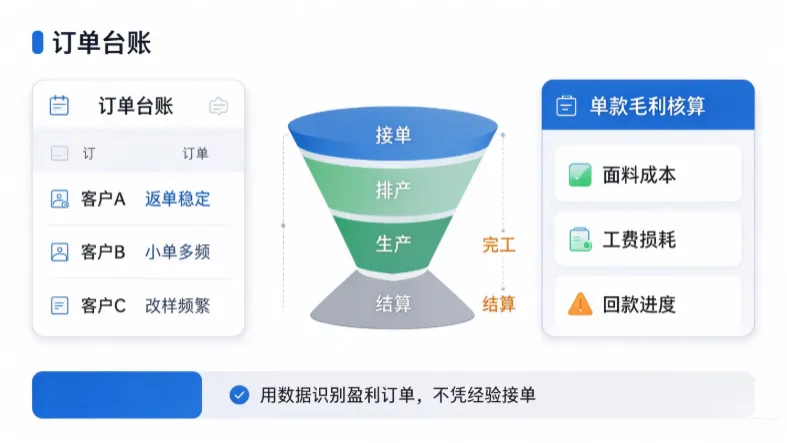
3、 Workshop production: reduce the waste of working hours caused by frequent product changes
It is common for the workshop to change several styles in a day due to the high density of broken orders. Replacing models, changing pressure feet, changing templates, and familiarizing workers with the process are all invisible costs. There is a lot of rework, which will result in a double loss of fabric and labor hours.
Shuntong Shoe and Clothing ERP supports work order collection and visual production scheduling. Similar orders can be centrally scheduled according to fabric and process types, reducing frequent cross category product jumps and minimizing ineffective work hours caused by product changes.
First article inspection, process inspection, and rework records are all bound to the work line and retained. The reasons for rework can be traced, and the loss and defect data can be coordinated with the team for statistics, helping the production end to implement loss and defect control. Outsourced processes such as printing, embroidery, and washing can also be registered in the system for material issuance, return, and acceptance records, facilitating the calculation of outsourcing costs and keeping our factory's production capacity in high value-added processes.
4、 Inventory and funds: avoid hoarding materials and reduce the cost of capital occupation
When raw material prices rise, many factories will stock up in advance to bet on the market. Once the customer changes or cancels the order, the fabric becomes stagnant inventory and funds are tightly suppressed. Purchasing auxiliary materials in small quantities can easily result in buying too much and not being able to use them.
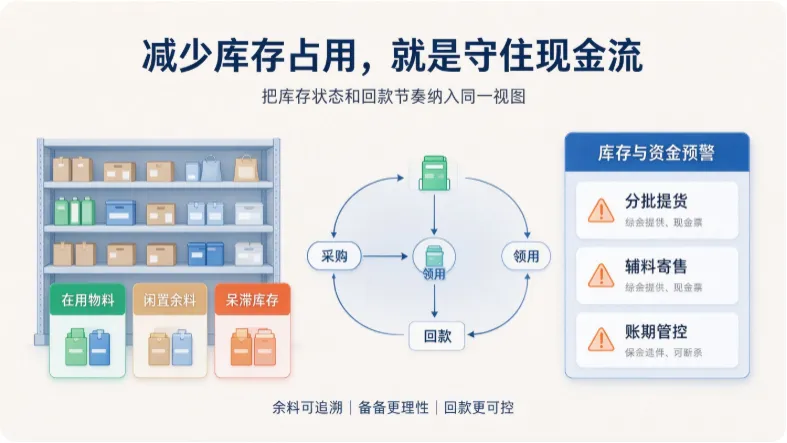
The system manages the inventory of fabrics, accessories, semi-finished products, and finished products by style, color, and batch, distinguishing between materials in use, idle surplus materials, and stagnant inventory. The inventory status can be checked in real-time. Factories can rely on inventory data to rationally evaluate stocking levels and reduce blind hoarding; Accessories can also be managed in conjunction with consignment mode, with on-demand requisition and settlement to reduce the risk of accessory backlog.
Simultaneously supporting the management of payment terms, deposits, and collection progress, setting differentiated collection rules for new customers and small broken orders, assisting in controlling the pace of collection, and reducing bad debts and capital occupation costs.
5、 Cost accounting: Say goodbye to estimating and quoting, data assisted decision-making
Many small and medium-sized factories have been using Excel for bookkeeping, with vague cost allocation and a rough review at the end of the month. Quotations are solely based on experience.
ERP automatically collects material consumption, wear and tear, piece rate labor hours, and various additional costs. By comparing standard costs with actual costs, cost differences can be seen upon completion of orders. It won't directly decide the quotation for you, but it can fill in the data gaps: clarify which styles and customers can generate stable profits, which orders continue to consume production capacity, and provide reference for quotation, order acceptance, and production scheduling.
In conclusion
Market fluctuations and fragmented orders are the external environment that the clothing foreign trade industry must face together. Shuntong Shoe and Clothing ERP cannot change the market price of fabrics, nor can it eliminate the uncertainty of foreign trade orders. Its value lies in connecting the internal data links of the factory, allowing losses, working hours, inventory, and single item gross profit to be transformed from vague empirical judgments into verifiable and traceable data. In the current era of rising raw material prices and increasing order density, the profits of clothing factories often do not rely on external price suppression, but are hidden in every aspect of refined control and conservation.