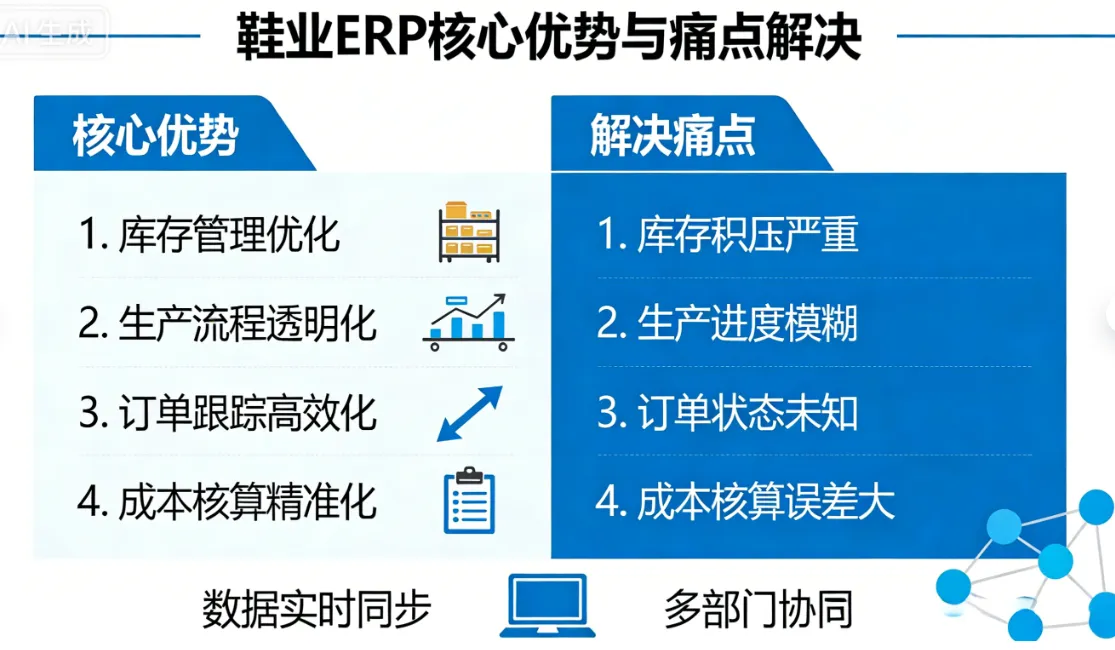
The advantages of shoe ERP and the pain points it solves
The footwear industry combines labor-intensive and multi category operation characteristics, from raw material procurement, multi process production, to multi size and multi color inventory management, multi-channel sales settlement, the entire process is complex and pain points are prominent. Under the traditional management mode, the shortcomings of manual recording and decentralized control have led to low efficiency, high costs, and lagging decision-making, becoming the core bottleneck restricting the scale development of shoe enterprises. A customized ERP system for the footwear industry, relying on digital and integrated control capabilities, accurately adapts to industry characteristics, and targetedly solves the problems of full chain operation. It is not only a tool for shoe enterprises to reduce costs and increase efficiency, but also the core support for digital transformation. Its advantages and pain point solving capabilities are highly in line with the operational needs of shoe enterprises.
1、 Cracking the chaos of inventory control and achieving precise inventory management
Inventory chaos is the most common pain point for shoe companies, manifested as "discrepancies between books and reality, coexistence of missing codes and backlog, and disconnection from multi warehouse control". Shoe products need to be segmented into SKUs based on style, color, and size. A shoe often has dozens of segmented specifications, and manual recording can easily result in omissions or errors, leading to "inventory on paper but actual missing sizes" that cannot deliver orders, or unsold styles that accumulate and occupy funds for a long time. At the same time, inventory from multiple warehouses and stores cannot be synchronized in real time, resulting in low efficiency in cross regional inventory transfer, further exacerbating inventory waste and stockout risks. According to statistics, under traditional management models, the accuracy rate of shoe companies' inventory is less than 75%, and stagnant materials often occupy more than 5% of revenue.
The core advantage of the footwear ERP system is to achieve comprehensive inventory refinement control and adapt to the segmentation characteristics of footwear SKUs. The system supports grading coding based on "style color size", and all material inbound, outbound, transfer, and inventory are entered into the system in real-time. Inventory data is automatically synchronized and updated to ensure that accounts match reality, and inventory accuracy can be improved to over 99%. By setting a safety stock threshold, the system can automatically trigger replenishment alerts to avoid stockouts and supply disruptions; At the same time, relying on inventory analysis function, accurately identify stagnant materials, push clearance suggestions, and reduce capital occupation. In addition, inventory from multiple warehouses and stores can be centrally controlled. The system automatically recommends nearby warehouse shipments or cross regional transfer plans based on sales orders, reducing the response time for transfer from 72 hours to 4 hours, significantly improving inventory turnover and helping shoe companies optimize inventory structure and activate funds.
2、 Cracking the production process disconnect and improving flexible production and delivery capabilities
The production process of the footwear industry is complex, covering multiple steps such as shoe upper cutting, sewing, fitting, sole forming, and finished product assembly. Moreover, there are significant differences in the process routes of different shoe styles. Under the traditional management mode, problems such as "chaotic production scheduling, poor process connection, and downtime for materials" are prone to occur. Under the trend of fragmented orders, there is an increasing demand for multi variety and small batch production. Manual scheduling is difficult to balance order priority, equipment capacity, and material completeness, resulting in production plans being disconnected, urgent orders being unable to respond quickly, and regular order delivery cycles being lengthy. At the same time, the production process lacks real-time monitoring, making it difficult to quickly identify process bottlenecks, resulting in a high defect rate, which further affects delivery efficiency and product quality.
In response to this pain point, the footwear ERP system highlights the advantages of flexible production and full process visualization control. The system supports custom process routes and can automatically generate production plans based on order priority, equipment load, and material availability. It clarifies the task allocation, time nodes, and responsible persons for each process and adapts to the production needs of multiple varieties and small batches. During the production process, real-time process progress data is collected by scanning QR codes to report work progress. Management personnel can monitor the production status in real-time in the system, quickly identify bottleneck processes, allocate production resources, and avoid downtime and material shortages. At the same time, the system can input production process parameters to achieve product quality traceability and reduce the rate of defective products. With the production control capability of ERP system, the accuracy of production planning for shoe enterprises can be improved to 95%, the delivery cycle of orders can be shortened by more than 30%, and the production efficiency can be increased by 30%, effectively solving the problems of production disconnection and delivery lag.
3、 Cracking the complexity of cost accounting, achieving refined cost control and profit traceability
The cost structure of the footwear industry is complex, with raw material losses, labor costs, equipment depreciation, process losses, etc. needing to be accurately allocated to a single product. Under the traditional manual accounting model, data statistics are lagging and allocation standards are not unified, resulting in significant cost accounting errors and inability to accurately grasp the true profit of a single product, making it difficult to support pricing decisions and cost optimization. In addition, the lack of effective control over procurement costs and production losses further drives up operating costs, with some small and medium-sized shoe enterprises having raw material costs 8% -12% higher than their competitors.
One of the core advantages of the footwear ERP system is to achieve automatic cost accounting and precise traceability throughout the entire chain, adapting to the cost segmentation needs of the footwear industry. The system can automatically associate BOM lists, material requisition records, and process reporting data, accurately allocating raw material costs, labor costs, and manufacturing expenses to each batch and product based on actual consumption. The cost calculation accuracy reaches 99%, completely replacing tedious manual accounting and saving more than 40 hours of financial reconciliation time per month. At the same time, the system can monitor raw material and production losses in real time, set loss thresholds, and automatically warn when the threshold is exceeded, helping shoe companies control losses and reduce costs. Through cost analysis reports, enterprises can clearly grasp the profit situation of a single product, provide accurate data support for product pricing and category optimization, and further improve profitability.
4、 Cracking the lack of multi-channel collaboration and achieving full link data integration
With the diversified development of shoe companies' channels, multiple channels such as offline stores, e-commerce platforms, distributors, and customized orders coexist. Under the traditional management model, data from each channel is fragmented, and sales data, order information, and customer information cannot be shared in real time, resulting in chaotic order processing, delayed customer response, and cumbersome financial reconciliation. At the same time, the departments of procurement, production, sales, and finance are subject to decentralized control, resulting in data silos and a lack of precise data support for decision-making. This often leads to imbalances in production and sales, as well as a disconnect between procurement and production.
The core advantage of the footwear ERP system lies in building an integrated collaborative platform, breaking down data silos, and achieving full chain data synchronization. The system can connect multiple sales channels, and all channel orders are automatically synchronized to the system, achieving full process tracking of orders from ordering, payment, shipping to after-sales, and improving order processing efficiency by 40%. At the same time, core modules such as procurement, production, inventory, sales, and finance are integrated to achieve automatic flow and real-time sharing of business data and financial data. Procurement plans can be automatically generated based on production needs and inventory conditions to avoid blind procurement; The automation of financial settlement has been completed, reducing manual input errors and significantly shortening the month end reconciliation time. In addition, the system can generate multi-dimensional business reports, visually presenting sales trends, cost structures, and profit situations, providing accurate data support for enterprise decision-making, allowing management to grasp the operational status of the enterprise in real time, and improving decision-making efficiency and accuracy.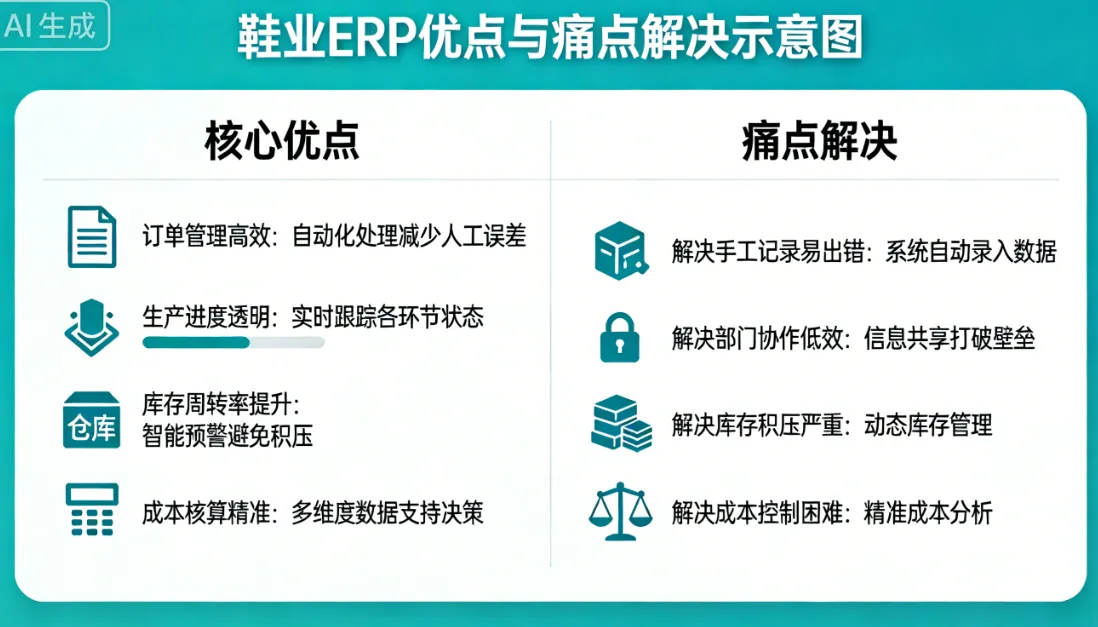
5、 Cracking the inefficiency of management and adapting to the full lifecycle development of shoe enterprises
Shoe companies at different stages of development face pain points in differentiated management: early-stage shoe companies have limited funds and lack management experience, which can lead to inventory chaos, difficulties in capital turnover, and lagging sales data; During the growth period, shoe companies are expanding their product lines and increasing their channels, facing problems such as chaotic warehouse management, inefficient supplier collaboration, and price conflicts between online and offline channels; During the expansion period, shoe companies need to address challenges such as cross regional inventory allocation, unified control by franchisees, and loss of control over procurement costs when operating across regions. The traditional management model cannot adapt to the development needs of enterprises at different stages, and is prone to management disconnection.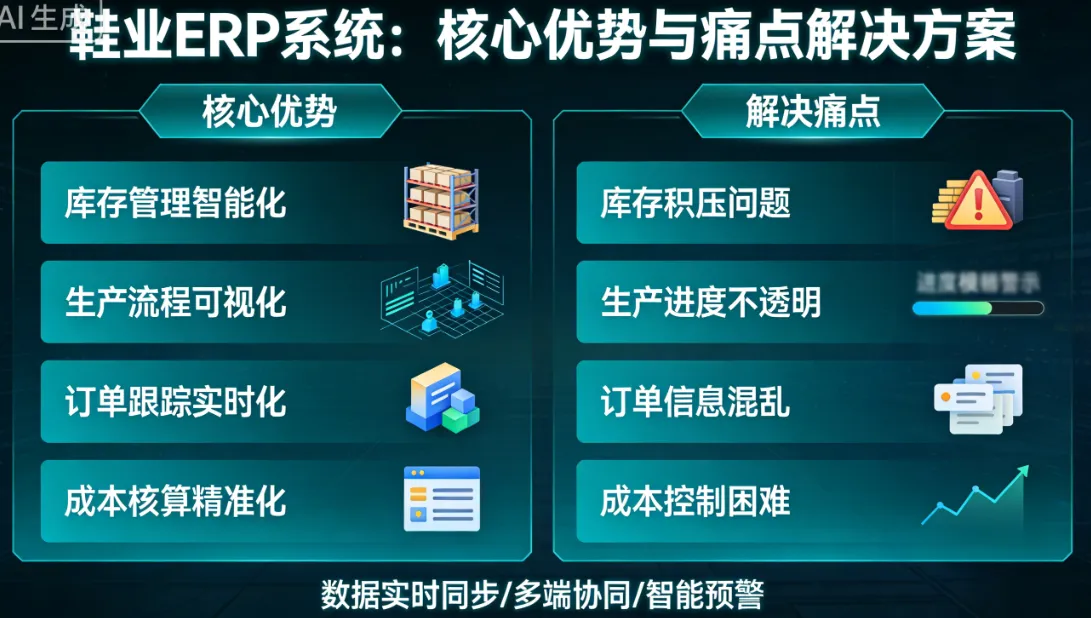
The outstanding advantage of footwear ERP system is its high adaptability and scalability, which can meet the full life cycle development needs of shoe enterprises. For start-up shoe companies, we provide lightweight control functions that are easy to operate, have low investment costs, and quickly solve inventory and order management problems; For shoe companies in the growth and expansion stages, functions such as multi-channel collaboration, supplier lifecycle management, and unified control of franchisees can be expanded. A supplier scoring system and price comparison mechanism can be established to achieve intelligent procurement prediction, and annual procurement costs can be reduced by 8.5%. At the same time, the system supports multi terminal synchronous operation, and management personnel can view business data and process business anytime and anywhere, breaking the limitations of time and space and comprehensively improving management efficiency. In addition, the system can meet additional requirements such as environmental compliance and quality traceability, adapt to industry policy guidance, and help shoe companies avoid compliance risks.
In summary, the advantages of a footwear ERP system are not simply the adaptation of universal digital tools, but rather a deep fit with the industry characteristics of footwear SKU segmentation, multi process production, and multi-channel operation, achieving "precise pain point cracking, full chain collaboration, and data-driven decision-making". From core control of inventory, production, and cost, to multi-channel collaboration and long-term development adaptation, ERP systems comprehensively address the shortcomings of traditional management in shoe companies, helping them reduce operating costs and enhance their core competitiveness. Under the wave of digital transformation, whether it is small and medium-sized shoe enterprises or large shoe enterprise groups, relying on shoe ERP systems to solve operational pain points and activate development momentum has become an inevitable choice for achieving large-scale and high-quality development.