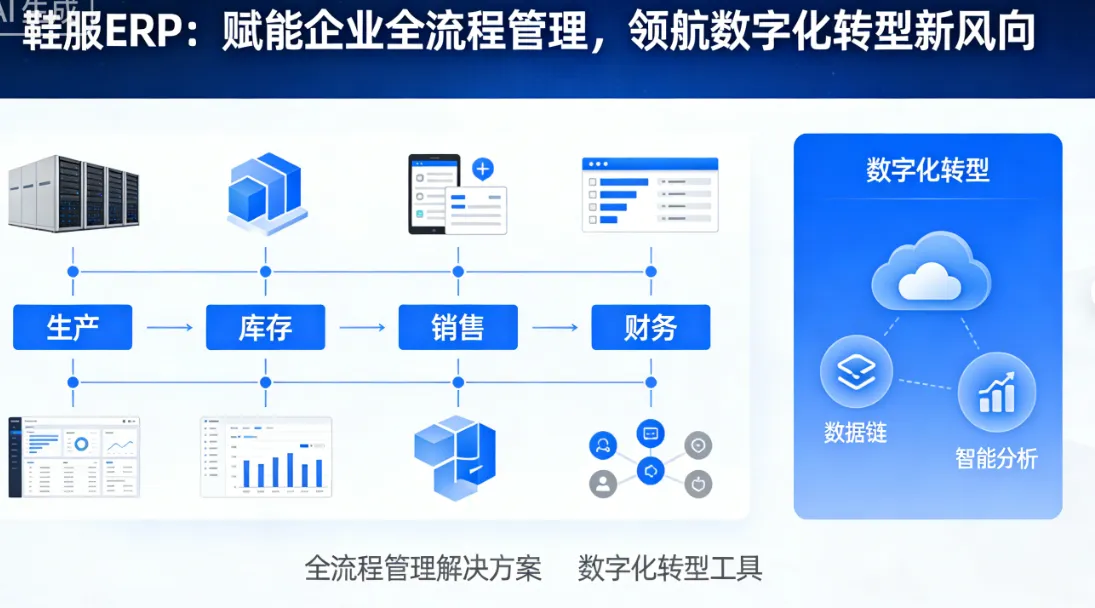
Shoe and Clothing ERP: Empowering Enterprise Full Process Management, Leading the New Trend of Digital Transformation
In the current era of accelerated consumption iteration and diversified channel upgrading, the footwear and apparel industry is facing a "half slope dilemma" of digital transformation - most enterprises have invested heavily in introducing digital tools, but are trapped in the embarrassment of "system fragmentation, data disconnection, and decision-making based on experience". Pain points such as shortage of best-selling products and backlog of unsold products, multi-channel data barriers, and weak full process control seriously restrict enterprises from reducing costs, increasing efficiency, and expanding their scale. In the era of digital economy, the competition among footwear and apparel enterprises has been upgraded to a competition of full process operational efficiency. The footwear and apparel dedicated ERP system, with deep adaptation to industry characteristics, connects the entire business chain of research and development, procurement, production, inventory, sales, finance, and membership, becoming the core support for solving transformation difficulties and leading digital upgrading, promoting footwear and apparel enterprises to leap from "experience driven" to "data-driven".
The core value of shoe and clothing ERP lies in breaking down departmental barriers and data silos, achieving full process collaborative control, which is also its key advantage over general ERP. The footwear and apparel industry combines the characteristics of "fast fashion iteration, multi SKU control, and strong seasonal periodicity". A product needs to derive multiple sizes and color sub specifications, making it extremely difficult to manage the entire lifecycle from design sampling to delisting and clearance. The traditional decentralized management model is difficult to adapt to. The dedicated ERP system is based on industry pain points, building an integrated management platform to enable real-time flow and seamless connection of data throughout the entire chain, completely changing the fragmented situation of "system has, business has no", and achieving traceability, controllability, and optimization of every business link.
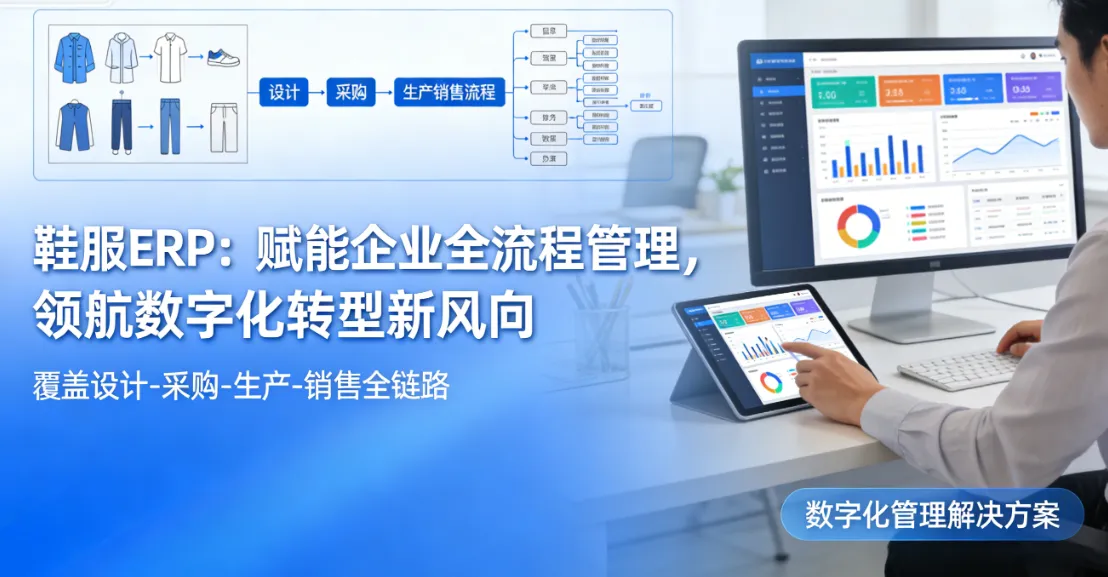
Empowering R&D and procurement collaboration, solving the pain points of "production disconnection and high cost enterprises", and building a solid foundation for digital transformation. The iteration speed of new products in the footwear and apparel industry directly determines market competitiveness. Under the traditional model, R&D design is out of touch with market demand and production capacity, blind ordering in the procurement process, and insufficient fabric quality control often lead to problems such as "design hot items cannot be mass-produced, and purchased fabrics do not meet demand". The shoe and clothing ERP system integrates the R&D module and the procurement module. The R&D department can retrieve historical sales data and user preference data through the system, accurately capture market trends, optimize design schemes and version iterations; Simultaneously linking production plans to ensure that R&D solutions are compatible with production capacity layout. In the procurement process, the system can automatically match high-quality suppliers, compare procurement prices, track the procurement progress and quality inspection results of fabrics and accessories in real time, establish a supplier rating system, which not only guarantees the quality of raw materials but also reduces procurement costs. According to industry data, the average procurement cost of shoe and clothing enterprises deploying ERP is reduced by more than 15%, and the adaptation rate of new product research and development is increased by 40%.
Refine production and inventory control, solve the problem of "capacity waste and inventory chaos", and improve operational efficiency. Shoe and clothing production often involves multi process collaboration and small batch flexible production. Traditional manual scheduling is difficult to balance order priority and equipment load, and is prone to problems such as downtime and long production cycles; In inventory management, precise control of multi size and multi color SKUs is difficult, and manual recording is prone to errors and omissions, resulting in discrepancies between the book and actual inventory, and funds being occupied by stagnant inventory. The shoe and clothing ERP system is equipped with intelligent scheduling function, which can automatically generate the optimal production plan based on order requirements and process complexity, clarify the task nodes and responsible persons of each process, collect real-time production progress data, quickly identify bottleneck links, and shorten the production cycle by 25% -30%; The inventory module supports multi-dimensional management of "style color size", synchronizes inventory dynamics in real time, sets safety stock warnings and alerts for stagnant inventory, achieves precise replenishment and clearance scheduling, and connects inventory data between the general warehouse, various stores, and online channels to achieve "global one inventory". ANTA optimizes inventory and production control through the ERP system, not only controlling the out of stock rate below 3%, but also saving logistics costs of over 400 million yuan annually.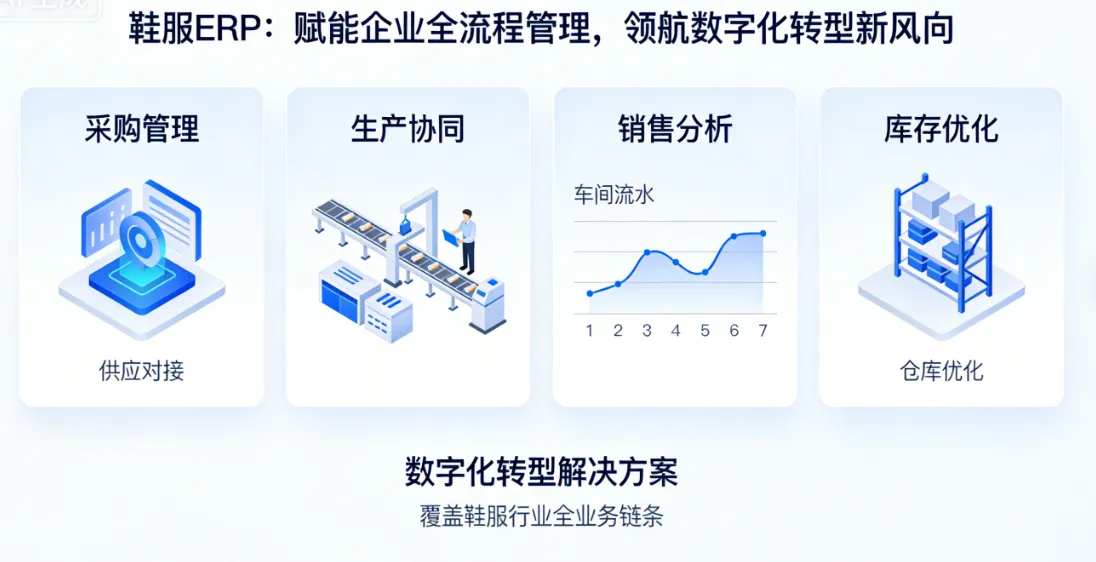
Global linkage between sales and membership, solving the dilemma of "channel fragmentation and insufficient repeat purchases", and activating market growth momentum. At present, shoe and clothing enterprises are mostly laying out multiple channels such as online e-commerce, offline stores, distributors, and live streaming sales. Under the traditional model, the data of each channel is isolated, making it impossible to achieve unified control and precise operation, and personalized marketing cannot be discussed. The shoe and clothing ERP system connects all channels of sales data, achieving unified order processing, synchronized inventory allocation, and unified price control, avoiding cross channel smuggling, overselling, and shortage problems, and improving order processing efficiency by more than 50%; At the same time, integrate member data, build a unified user profile, record user consumption preferences, purchase frequency, size requirements and other information, help enterprises carry out personalized push, exclusive rights operation and other precise marketing activities, and improve member stickiness and repurchase rate. Many growth oriented shoe and clothing enterprises have leveraged the membership and sales collaboration capabilities of ERP to overcome the dilemma of "marketing pepper" and achieve a significant increase in input-output ratio.
Financial and end-to-end data integration, solving the problem of "inefficient accounting and blind decision-making", supporting scientific decision-making. In the era of digital economy, data has become the core asset of footwear and clothing enterprises, while traditional financial accounting relies on manual input, which is inefficient, has a high error rate, and cannot quickly connect with business data, making it difficult to support accurate decision-making. The shoe and clothing ERP system realizes the integration of business and finance. The business data of sales, procurement, production and other links are automatically synchronized to the financial module, and financial vouchers, cost reports, and profit reports are automatically generated without manual duplicate input. It can save more than 40 hours of financial reconciliation time per month and improve cost accounting accuracy to 99%. At the same time, the system presents core information such as product lifecycle performance, revenue proportion of various channels, and cost structure through multi-dimensional data analysis, providing accurate data support for enterprise ordering decisions, category optimization, and production capacity adjustment, transforming ordering from a "gambling game" to a "precise layout" and completely eliminating experience dependence.
The modularity and scalability of shoe and clothing ERP adapt to the transformation needs of enterprises of different scales, demonstrating its leading value. For large footwear and apparel enterprises, ERP can support collaborative control across regions, multiple brands, and the entire industry chain, integrate group resources, optimize resource allocation, and adapt to large-scale expansion; For small and medium-sized shoe and clothing enterprises, lightweight ERP solutions can avoid high investment, focus on improving the efficiency of core business processes, prioritize solving immediate pain points such as inventory chaos and low order efficiency, gradually achieve digital upgrading, and avoid falling into the trap of "heavy customization and difficult implementation". Compared with general ERP, the shoe and clothing specific ERP has accumulated industry best practices and can quickly adapt to industry specific needs such as seasonal band management and franchise settlement. It is ready to use and reduces the threshold for transformation.
Currently, the digital transformation of the footwear and apparel industry has entered a deepening stage, and simple single point digital tools are no longer sufficient to meet development needs. Integrated control of the entire process has become an inevitable trend. Shoe and clothing ERP is not only a management tool, but also the "core hub" of enterprise digital transformation. It not only solves the pain points of long-term process redundancy and data fragmentation in the industry, but also promotes the full chain digital upgrade of enterprises from research and development, production to sales, and decision-making, adapting to new trends such as fast fashion iteration, green transformation, and intelligent production. In the future, with the deep integration of ERP, AI, IoT and other technologies, the value of data will be further released to help more footwear and apparel enterprises break through transformation bottlenecks, achieve cost reduction and efficiency improvement, brand upgrading, and lead the digital transformation of the footwear and apparel industry into a new stage.