
New Generation ERP System: The Core Engine of Digital Transformation - Technical Features and Enterprise Applications
In the wave of digital economy, the digital transformation of enterprises has evolved from a strategic option to a necessity for survival. The core engine driving this profound transformation is the new generation ERP system that has undergone fundamental reshaping. It not only subverts the technological paradigm of traditional management software, but also reconstructs the operational mode and value creation logic of enterprises at a deeper level, becoming an important source of competitiveness for enterprises in the digital age.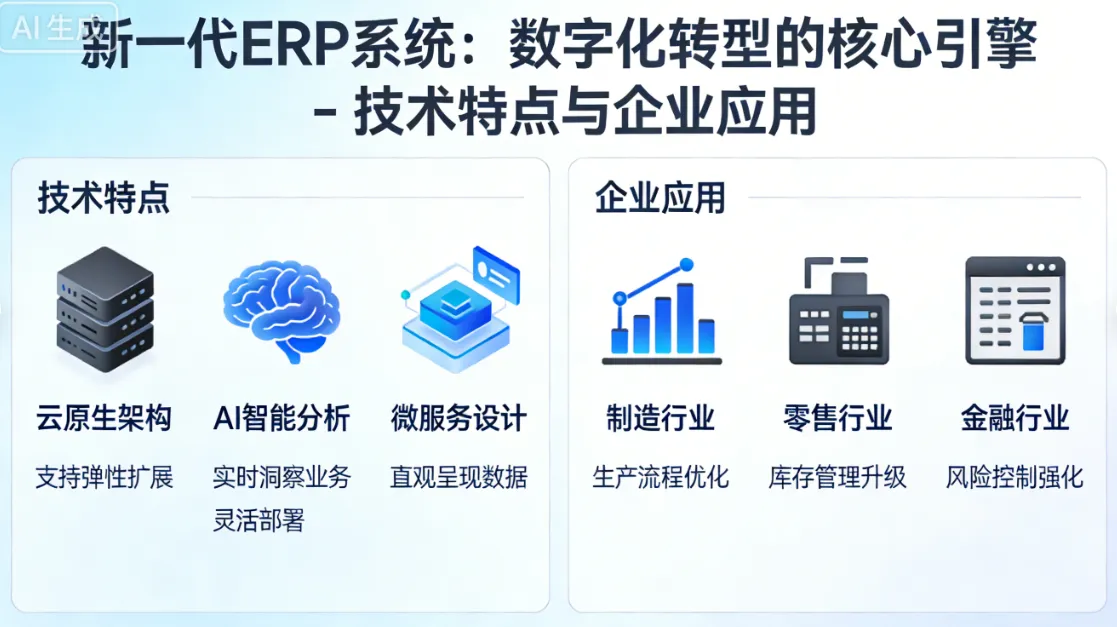
The revolutionary evolution of technological architecture
The fundamental change of the new generation ERP system lies in the completely new design of its technical architecture. The cloud native microservice architecture has completely replaced traditional monolithic architecture, decoupling complex business functions into independent and flexibly combinable service units. This architectural revolution has brought three core advantages: firstly, elastic scalability, where enterprises can dynamically adjust system resources according to business needs and cope with business peaks and valleys with ease; Secondly, there is the ability for continuous delivery and iteration. New features can be quickly developed, tested, and launched, keeping the system's evolution speed in sync with business innovation; Finally, there is a significant improvement in system resilience, as a single service failure will not cause the entire system to crash.
The integration of containerization and serverless computing technology further strengthens the advantages of this architecture. Containerization ensures consistent operation of applications in different environments, simplifying the complexity of deployment and operation; Serverless computing enables enterprises to truly implement pay per use, greatly optimizing the IT cost structure. These technological features together form the "technical foundation" of the new generation ERP system, enabling it to support rapid adaptation and innovation of enterprises in dynamic market environments.
Deep embedding of data intelligence
If cloud native architecture is the "skeleton" of the new generation ERP, then deeply embedded data intelligence is its "brain". Unlike in the past where business intelligence was used as an additional module, the new generation of ERP systems integrates artificial intelligence and machine learning capabilities natively into various business processes.
In the field of production planning, intelligent algorithms can comprehensively analyze historical sales data, market trends, supply chain conditions, and even weather factors to generate accurate demand forecasts and dynamically optimize production schedules. When raw material prices fluctuate or equipment malfunctions suddenly, the system can simulate multiple response plans in real time, evaluate the impact of different decisions on cost, delivery time, and quality, and provide optimal solution recommendations.
In financial management, intelligent accounts receivable management can automatically analyze customer payment history, industry credit status, and macroeconomic indicators, predict the probability and time of each accounts receivable collection, proactively alert risks, and recommend collection strategies. With the assistance of machine learning models, the automation rate of the financial reconciliation process can reach over 90%, freeing financial personnel from repetitive work and allowing them to focus on higher value analytical decisions.
End to end process automation
The new generation of ERP systems is redefining the boundaries and depth of business process automation. Traditional rule-based automation is being replaced by context aware intelligent automation. The system is able to understand the complete context of business processes and make automated decisions that are closer to human judgment.
In the procurement to payment process, the system can not only automatically match invoices and orders, but also intelligently recommend the best payment time and method based on supplier performance, market price fluctuations, and company cash flow status. When abnormal trading patterns are detected, the system will automatically trigger an investigation process while ensuring compliance requirements are met.
Cross enterprise process automation is a prominent feature of the new generation ERP. By deeply integrating with suppliers, logistics partners, and customers, enterprises can build end-to-end digital supply chains. Real time sharing of information such as order status, inventory levels, and logistics trajectories among all parties greatly enhances the transparency and response speed of the entire value chain.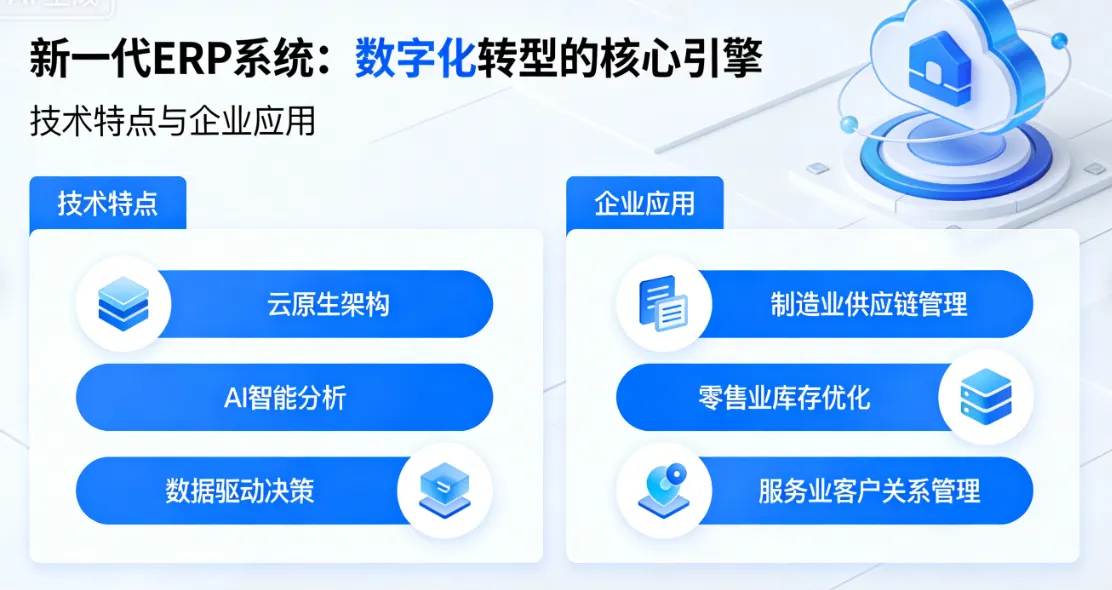
Fundamental reshaping of user experience
The innovation of user interaction methods is an important driving force for the popularization of the new generation of ERP systems. The maturity of natural language processing technology enables employees to interact with the system through dialogue, using everyday language to inquire about business data, generate analysis reports, or initiate business processes, significantly reducing the threshold for system usage.
Personalized workspaces dynamically present the most relevant information and functions based on each employee's role, responsibilities, and usage habits. The mobile experience is no longer a simplified porting of desktop versions, but a native application specifically designed for mobile scenarios, supporting offline operations and real-time synchronization, ensuring that employees can work efficiently anywhere.
The introduction of augmented reality technology is changing the way ERP is used in industrial environments. When maintenance personnel view the device through AR glasses, the system can overlay and display the device's historical maintenance records, current operating parameters, and recommended maintenance steps, seamlessly integrating digital information into the physical world.
The strategic value of enterprise applications
The application of the new generation ERP system has surpassed the traditional scope of efficiency improvement and become a strategic pivot for enterprise digital transformation. It first promotes the transformation of enterprises from "process driven" to "data-driven". A unified data platform breaks down departmental barriers, enabling enterprises to make decisions based on complete and real-time data, rather than relying on local experience or lagging reports.
Secondly, it reconstructs the innovation cycle of enterprises. Traditional ERP systems often become a resistance to change, while the modular architecture and open interfaces of the new generation ERP enable enterprises to quickly try new business models, successfully validate them on a small scale, and then promote them comprehensively, greatly reducing innovation risks.
In terms of ecological construction, the new generation ERP system is becoming the core hub of enterprise digital ecology. Through standardized APIs, enterprises can easily connect various SaaS applications, IoT platforms, and partner systems, build a digital ecosystem centered on themselves, and enhance their discourse power in the industry chain.
Implementation Path and Success Factors
The successful deployment of a new generation ERP system requires a different implementation method from traditional methods. Enterprises should adopt a strategy of "agile implementation and iterative delivery", prioritize the launch of core functions, quickly generate business value, and then continuously optimize and expand based on user feedback.
Organizational change is also the key to success. Enterprises need to cultivate "digital translators" who understand both business and technology, who can bridge the gap between business needs and technological implementation. At the same time, establish a data-driven decision-making culture, so that managers at all levels are accustomed to making decisions based on the data insights provided by the system.
Security and compliance must be integrated into every aspect of system design. The new generation of ERP systems requires built-in privacy protection design to ensure compliance with global data protection regulations such as GDPR and CCPA. The application of blockchain technology in certain scenarios can enhance the credibility and traceability of supply chain data.
Future Evolution Direction
Looking ahead to the future, the new generation of ERP systems will continue to evolve towards intelligence, ecology, and sustainability. The deep integration of edge computing and cloud ERP will enable the system to handle more localized real-time decisions; The maturity of digital twin technology will allow enterprises to simulate and optimize their entire operational system in a virtual environment; The deep integration of environmental, social, and governance indicators will make sustainable development the core dimension of enterprise operations.
The new generation ERP system is not only a tool for enterprise digital transformation, but also the core engine of this transformation. It redefines the potential boundaries of enterprise operations through technological innovation, unleashes buried insights in organizations through data intelligence, and connects broader business opportunities through an open ecosystem. For companies aspiring to maintain competitiveness in the digital age, understanding and mastering this core engine will be a key strategy that determines future success or failure.