Definition and Pattern Analysis of SaaS (Software as a Service)
Redefine the delivery and consumption of software
Among the many innovations in the era of cloud computing, SaaS is the paradigm that is closest to end-users and most profoundly changes the software industry landscape. Its core idea is concise yet highly disruptive: software is no longer a "product" that needs to be purchased, installed, and maintained, but a "service" that requires on-demand subscription, availability, and continuous updates. This transformation goes far beyond the one-time payment to installment payment, fundamentally restructuring the relationship between software suppliers and customers, the architecture logic of software technology, and the business rules of the entire industry. Understanding the definition and model of SaaS is essentially understanding the most thorough evolution of software in the 200 year industrial history it is undergoing.
Definition of SaaS: A Business Philosophy Beyond Technical Terminology
From a technical perspective, SaaS is a deployment model for delivering software applications over the Internet. Suppliers are responsible for developing, operating, and maintaining software and its underlying infrastructure. Users can access it remotely through web browsers or lightweight clients and pay fees based on usage or usage cycles. But this definition only describes appearances. A deeper definition points to a business philosophy: the value of software should shift from "ownership" to "right to use", and from "delivery as the endpoint" to "subscription as the starting point".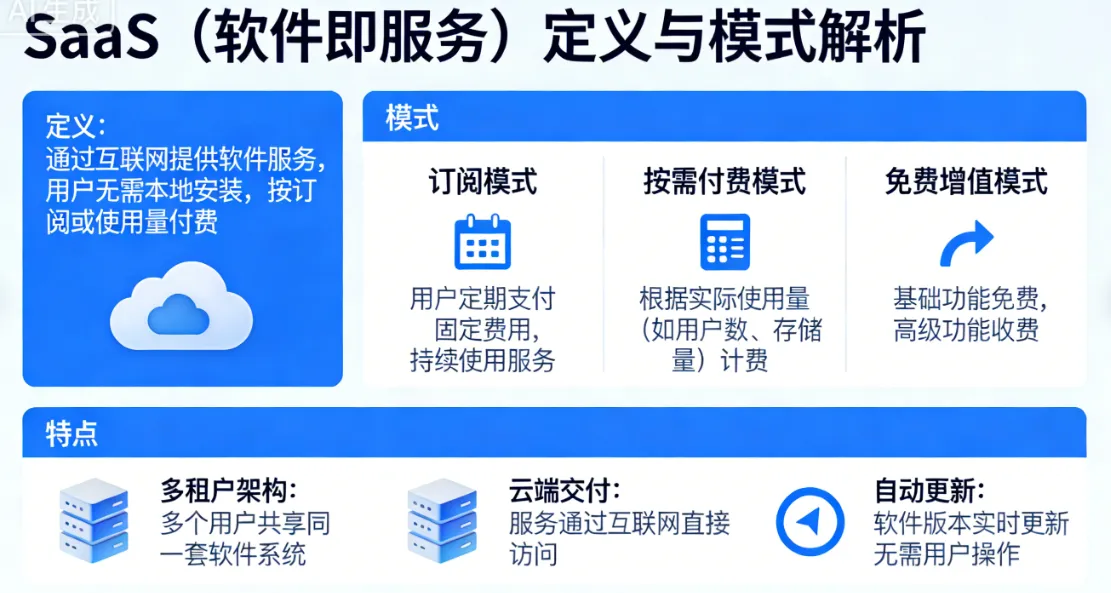
In the traditional software model, transactions are basically completed at the time of delivery - the customer pays, receives the installation package, and the contract is fulfilled. The supplier's revenue is realized at a certain point in time, and subsequent maintenance and upgrades are either charged separately or indefinitely suspended. The SaaS model extends this single transaction into a continuous partnership. When customers subscribe for the first time, the system may only have basic functions, but over the course of three to five years of continuous use, the product continues to iterate, optimize, add new capabilities, and adapt to new scenarios. Customers not only pay for the right of use, but also for the ticket to continuous value enhancement. The revenue of suppliers is uniformly recognized during the subscription period, forcing companies to continuously prove their value in order to win renewals. The reconstruction of this contractual relationship is an essential characteristic that distinguishes SaaS from traditional software.
Multi tenant architecture: cost sharing and efficiency revolution
The underlying technical logic that supports the SaaS model is a multi tenant architecture. Under the traditional software deployment model, each enterprise customer requires an independent set of servers, databases, and application instances that are isolated and not shared with each other. This' single tenant 'model brings heavy resource waste - hardware needs to be configured according to peak load and is mostly idle for most of the time; Software upgrades need to be executed separately in hundreds or thousands of customer environments, which is time-consuming, laborious, and difficult to unify versions.
The SaaS model adopts a multi tenant architecture, where all customers share the same set of core code libraries and infrastructure instances. The data between tenants is logically isolated rather than physically isolated, with strict differentiation of access permissions, but the underlying computing resources are centrally used and dynamically allocated. The scale effect of this architecture is exponential: as the number of customers increases from one hundred to ten thousand, the marginal service cost of suppliers approaches zero. The multi tenant architecture also achieves the ideal state of "all customers always using the latest version" that cannot be achieved in the traditional software era. Suppliers deploy small version updates on a daily and weekly basis, without requiring any action from customers. Security patches, performance optimizations, and feature enhancements are silently injected into the user experience. A globally renowned SaaS vendor updates its products over 300 times a year, yet its customers are completely unaware of the upgrade process.
Subscription model: revenue smoothing and value alignment
The core business model of SaaS is subscription based. Unlike traditional software that charges high licensing fees at once, SaaS providers charge customers annually, monthly, or based on actual usage. This transformation has a profound impact on the financial models of both supply and demand sides.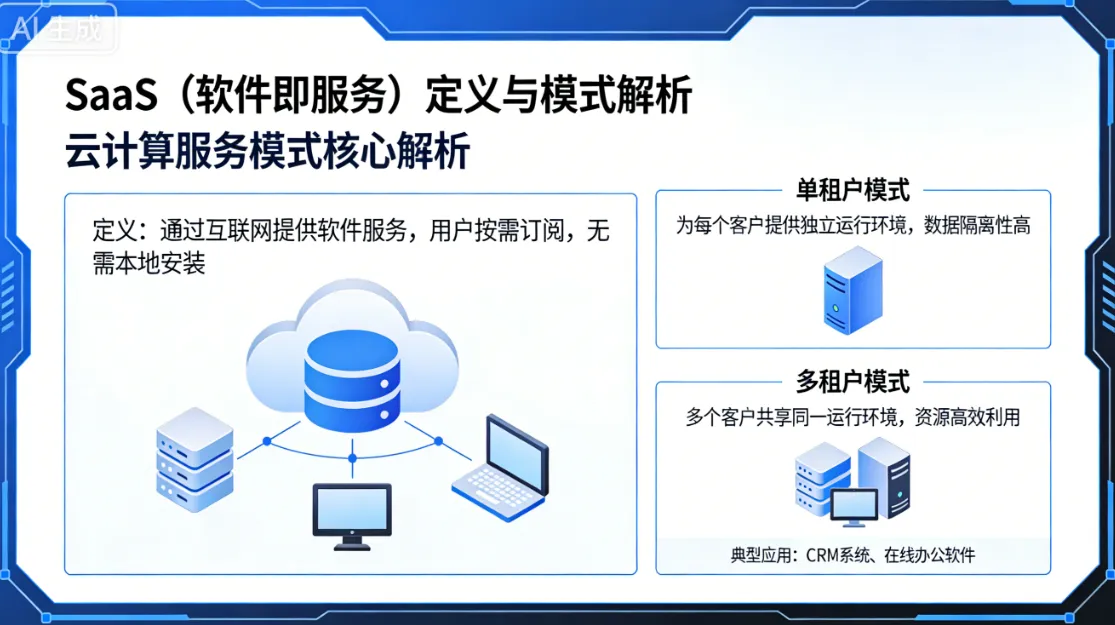
For customers, software procurement is transformed from capital expenditure to operational expenditure. In the past, deploying a large enterprise resource planning system required a one-time payment of millions of software license fees and an equivalent level of implementation service fees in the year of project initiation, which put enormous pressure on cash flow. Under the SaaS subscription model, enterprises can pay tens of thousands of yuan per month without any hardware investment or maintenance manpower, converting heavy asset investment into lightweight costs. A medium-sized manufacturing enterprise estimates that under the same functional scale, the total five-year ownership cost of SaaS model is only 43% of that of traditional deployment model.
For suppliers, the subscription model has changed the pace of revenue recognition and cash flow curve. The revenue of traditional software vendors is highly concentrated in the "backlog period" at the end of each quarter, with severe financial fluctuations. In the SaaS model, customers' prepaid annual fees are recognized as income in monthly installments, and although cash flow flows in at the beginning of the year, income is evenly distributed throughout the year. This smooth revenue curve greatly improves the predictability of business operations and forces suppliers to shift from a "signing culture" to a "renewal culture" - customer acquisition is just the beginning, continuous service and value creation to win renewals are the true engines of long-term growth. The valuation logic of SaaS enterprises in the capital market is also based on this, where the multiple of market to sales ratio is highly positively correlated with customer success indicators such as renewal rate and net revenue retention rate.
Continuous Delivery: Democratization of Technology to End Version Separatism
In the era of traditional software, version fragmentation is a huge obstacle to technological progress. The same software runs dozens of different versions in different customer environments, and some customers may stay in old versions for ten years due to deep customization or high upgrade costs. The new features and security patches released by suppliers are not available to these customers, and their technical debt is increasing day by day. When enterprises are finally forced to upgrade, data migration and process adaptation across multiple versions have become almost impossible tasks.
The continuous delivery model of SaaS has completely ended this dilemma. Suppliers maintain a unique backbone version in the cloud, where all feature development, performance optimization, and security fixes are completed and deployed in real-time. Customers do not need to decide whether or when to upgrade, and may not even be aware of the upgrade process, yet they always run on the latest and most secure software version. This technological democratization puts small and medium-sized enterprises and large corporations on the same digital starting line - the former can obtain world-class software capabilities without huge budgets, while the latter do not have to pay expensive secondary implementation costs for technological updates.
Customer Success: From After sales Support to Value Assurance
In the SaaS model, the importance of the customer success department has surpassed traditional sales and technical support, becoming a core function of the enterprise. After the completion of traditional software transactions, the relationship between suppliers and customers shifts to a low-frequency maintenance mode. Suppliers are neither in control nor responsible for how customers use and whether they achieve expected value. The renewal pressure of SaaS subscription model forces suppliers to be responsible for the effectiveness of their customers' applications.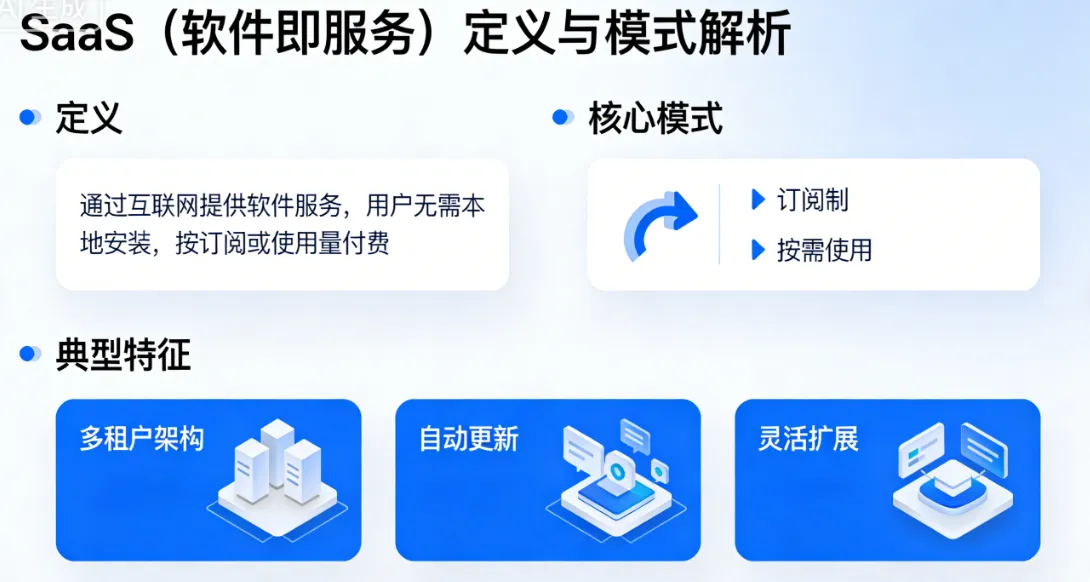
The customer success team intervenes immediately after the customer signs the contract, assisting in data initialization, business process configuration, and employee training to help the customer realize value in the shortest possible time. In daily operations, the customer success manager actively identifies value troughs and risk signals by monitoring customer usage frequency, functional penetration rate, abnormal operations, and other behavioral data through the system. If a customer's login frequency drops for three consecutive weeks, it may indicate that key personnel have resigned or the system experience has been hindered; A customer who has not used a certain core module for a long time may need to arrange specialized training. This proactive and data-driven customer success system elevates the relationship between suppliers and customers from a "buyer seller" to a "value community". A SaaS company disclosed data that after configuring a dedicated customer success team, the core customer renewal rate increased from 76% to 92%, and the lifecycle value tripled.
Ecological integration: from information silos to value networks
At the beginning of its birth, SaaS was limited by its integration capabilities. Enterprises purchase multiple sets of SaaS products, but it is difficult to connect data and form new information silos. Modern SaaS comes standard with open application programming interfaces, seamlessly integrating with various third-party systems through standardized interfaces. Customers can combine professional SaaS services from different fields like building blocks based on business characteristics - customer relationship management connects to e-commerce platforms to capture orders, enterprise resource planning systems synchronize inventory data, project management systems associate with financial software to generate accounts receivable reports, and all data flows automatically without the need for manual export or import.
The more advanced ecological forms are PaaS platforms and SaaS application stores. Top SaaS vendors open up underlying development frameworks, allowing customers and third-party developers to build customized applications on their platforms and upload them to app stores for use by other tenants. This ecological development has enabled SaaS to evolve from a single tool to a core component of enterprise digital operating systems, with value boundaries constantly expanding.
The essence of SaaS is the reconstruction of the relationship between software and customers
The impact of SaaS on the human software industry will eventually be recorded as a paradigm revolution in history. The technological manifestation of this revolution is multi tenant architecture and continuous delivery, while the commercial manifestation is subscription model and customer success. However, its underlying essence is the fundamental reconstruction of the relationship between software and customers - from "one hit buy and sell" to "lifetime service", from "product orientation" to "value orientation", from "version fragmentation" to "continuous evolution". In this new paradigm, software is no longer an asset that gradually depreciates after purchase, but a service that continuously increases in value through continuous use. What users pay is no longer the consideration for acquiring rights, but the ticket to continuously obtain ability iterations. This transformation is reshaping the trillion dollar global enterprise software market and redefining the direction of technology and business integration evolution.