
Enterprise Classic CRM System: Customer Relationship Management Solution and Function Detailed Explanation
In the field of customer relationship management, a long-standing paradox is that standardized software is difficult to adapt to personalized processes of enterprises, while customized development means high costs and long cycles. The emergence of the Enterprise Code CRM system is an attempt to break through this dilemma. It is not a traditional universal CRM tool, but a customer relationship management solution based on a low code platform, with integrated management as the perspective, and the concept of "linkage" collaboration. To understand Enterprise Classic CRM, one needs to start with this underlying logic, rather than just listing functional modules.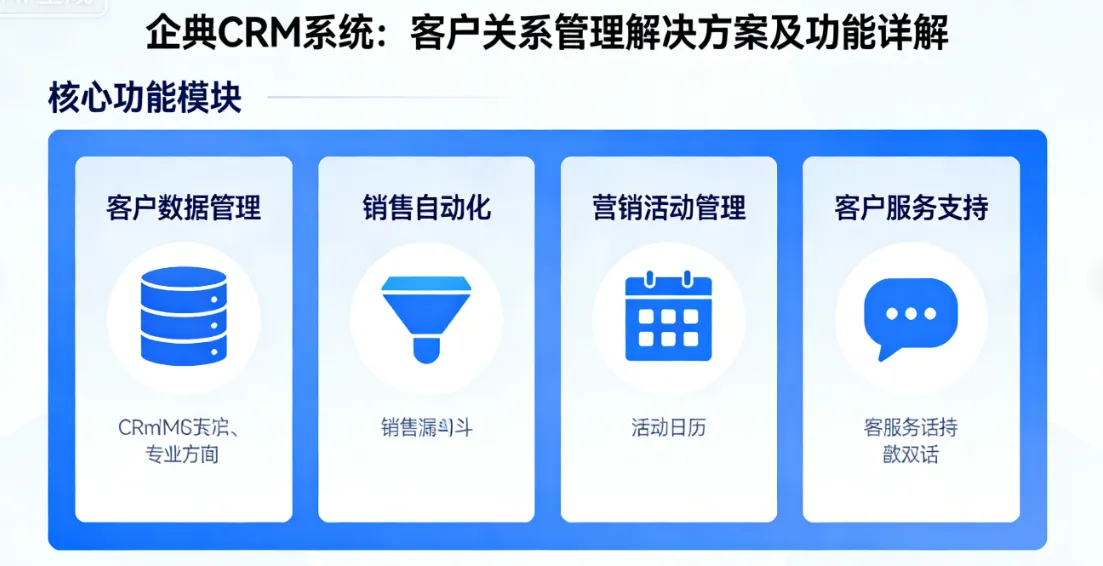
Qidian CRM is launched by Teamface Qidian software, a brand under Shenzhen Juhua Enterprise Technology Co., Ltd. It is a digital platform service provider that integrates enterprise management consulting and software technology services. Unlike most CRM products on the market, Enterprise Classic CRM is not an isolated sales tool, but a core component embedded in the enterprise information digital integrated management platform. This means that enterprises can simultaneously run over 200 application modules such as CRM, HR, OA, project management, supply chain management, asset management, etc. in the same system, with natural connectivity and data sharing between each module, rather than post integration. The difference in this underlying architecture determines that Enterprise Code CRM was not designed as a monitoring tool to control sales teams from the beginning, but rather as a business operating system built to support full chain collaboration within and outside the enterprise.
The core positioning of Enterprise Classic CRM solution is accurately expressed in the concept of "linked CRM". The traditional CRM perspective is inward looking and control oriented, focusing on sales funnel, follow-up records, and performance reports, essentially recording sales behavior afterwards. And Enterprise Classic CRM attempts to extend its perspective outward, integrating external agents, suppliers, partners, and even end customers into the same collaborative network, achieving end-to-end connectivity of business flow, capital flow, information flow, and data flow within and outside the enterprise. This paradigm shift from "control" to "linkage" responds to the increasingly complex marketing ecology of B2B enterprises: leads may come from channel partners, business opportunities require multi-party joint follow-up, project delivery involves cross organizational collaboration, and after-sales service relies more on continuous interaction between customers and vendors. Enterprise Classic CRM is designed for this type of business scenario where internal and external factors are intertwined, roles are diverse, and processes are non-standard.
At the level of customer lifecycle management, Enterprise Code CRM has built a complete closed loop from front-end customer acquisition to back-end service. The customer acquisition process is its advantage in depth. The system supports omnichannel lead access, and potential customers can be automatically added to a unified customer pool through QR code scanning, online forms, business card scanning, market activities, social fission, and other methods. More noteworthy is its social customer acquisition capability: a digital business card that integrates personal, corporate, and product information, paired with daily updates of hot news and customer acquisition posters. Employees bring their own sales identities when sharing, and customers view behavior in real-time, evolving traditional one-way outreach into two-way perception. This design of embedding marketing touchpoints into daily social scenarios significantly reduces the threshold for B2B companies to obtain leads.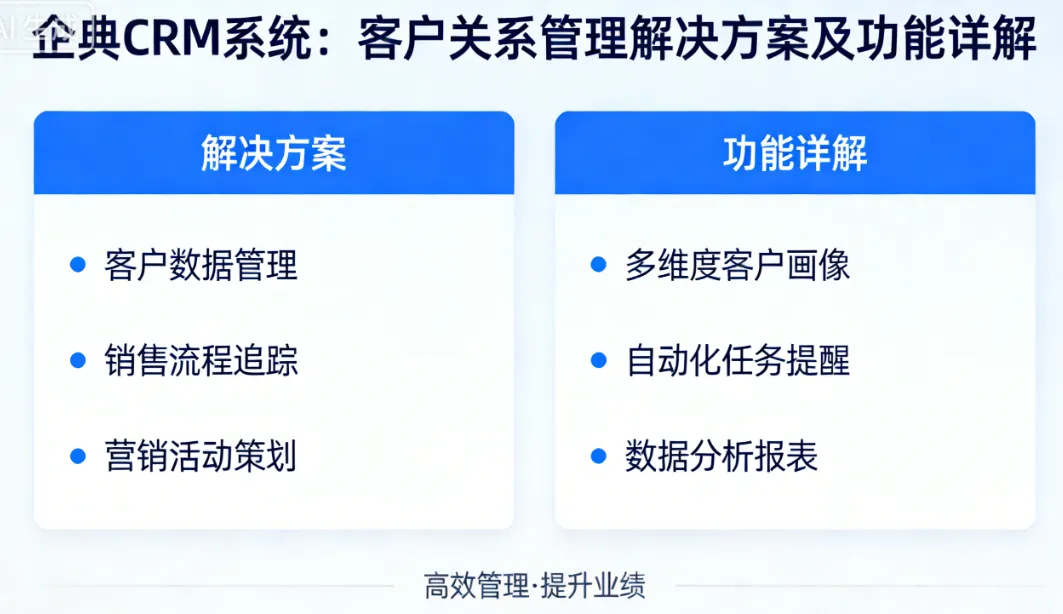
The depth of management of customer information after it is stored is another technical moat of Enterprise Code CRM. The system not only records basic fields such as name, company, and contact information, but also uses enterprise graph and relationship chain visualization technology to restore single point customers to networked enterprise relationships. Is there an equity relationship between a target customer and an existing customer? What is the collaborative relationship between the key figures in its decision-making chain? These questions that traditional CRM cannot answer are clear at a glance in the enterprise graph of Enterprise Classic CRM. The intelligent plagiarism detection and business information backfilling functions eliminate data dirtiness and ensure the cleanliness of customer pools from the source.
The sales process management module abandons rigid stage divisions and instead provides a highly customizable process engine. Enterprises can use low code platforms to flexibly drag and drop sales stages, configure approval nodes, and define field permissions based on their own business characteristics, without the need for secondary code development to complete process adjustments. The entire process of identifying and closing sales opportunities is presented transparently, and the sales funnel chart dynamically reflects the conversion rate and duration of each stage. Managers can accurately locate which link is blocked. For team collaboration scenarios, the system supports the formation of virtual project teams around specific business opportunities, with members updating progress in real-time and information synchronization no longer relying on meetings and emails.
The field management capability extends the tentacles of sales process management beyond the office. Based on LBS location services and mobile camera functions, sales personnel's visit plans, execution trajectories, and on-site feedback are fully recorded and associated with customer profiles. Managers no longer need to ask 'where did you go today?' The system's automatically generated field daily report quantifies dimensions such as visit density, conversion efficiency, and regional coverage. The performance and goal management module further integrates behavioral data with result data, calculates real-time performance achievement rates, automatically pushes delayed warnings, and evolves goal management from quarterly end of year general ledger to daily dynamic calibration.
In the service and after-sales process, Enterprise Classic CRM also continues the design concept of full process visualization. Customers can submit service requests through various channels such as online forms, customer service hotlines, WeChat service accounts, etc. The system automatically generates work orders and assigns them to corresponding customer service or technical teams according to preset rules. The progress of work order processing is synchronized in real-time with customers, leaving complete traces of the processing process and results. Service quality no longer depends on the personal responsibility of customer service personnel, but is rigidly constrained by the system. The satisfaction survey and customer feedback management module feeds back after-sales service data to customer files, forming a closed loop of service, insight, and improvement. When a customer repeatedly submits a work order for the same type of issue, the system will automatically issue a warning to the manager, indicating the possibility of product defects or training blind spots.
The ability to make data decisions is a key exit for Enterprise CRM to transform business value into management value. The system has a built-in multi-dimensional statistical analysis model, and key indicators such as customer source channel efficiency, sales opportunity conversion rate, order payment cycle, and service response time are presented in real-time in the form of a visual dashboard. Decision makers no longer need to wait for monthly reports to be compiled layer by layer, and can view current business opportunity reserves, performance completion progress, and risk warnings on their mobile devices at any time. It is worth emphasizing that BI data engines not only serve management, but are also open to frontline sales. Every salesperson can see personalized data such as their lead conversion rate, average duration of business opportunities, and customer activity. Self improvement no longer relies on the instructions of supervisors, but on proactive adjustments based on facts.
The deployment plan of Enterprise Classic CRM fully reflects its sincerity in adapting to enterprises of different scales and industries. The system supports three modes simultaneously: public cloud, private cloud, and localized deployment. Small and medium-sized enterprises can choose public cloud solutions without having to bear the cost of hardware procurement and operation teams, and can quickly go online and subscribe annually; Large enterprises or classified units with strict requirements for data security can choose private cloud or localized deployment, with data completely placed within the enterprise firewall, one-time deployment and installation, and permanent free use. This deployment level flexibility enables Enterprise Classic CRM to simultaneously cover the differentiated needs of start-up teams and group headquarters.
What truly sets Enterprise Classic CRM apart from its competitors is the low code PaaS capability hidden beneath all functional modules. After the launch of traditional CRM, almost all enterprises that need to adjust fields, add processes, or integrate new systems must pay secondary development fees to the original factory, and the cycle is long. Enterprise Classic CRM delegates application building capabilities to enterprise users, and business personnel can complete the launch of a new functional module within a few hours by dragging and dropping forms, configuring rules, and designing processes. When the business model of an enterprise changes, the system can iterate synchronously instead of becoming a shackle that solidifies outdated processes. This on-demand, change and use capability transforms the CRM system from a one-time purchase of assets to a business infrastructure that can evolve independently for enterprises.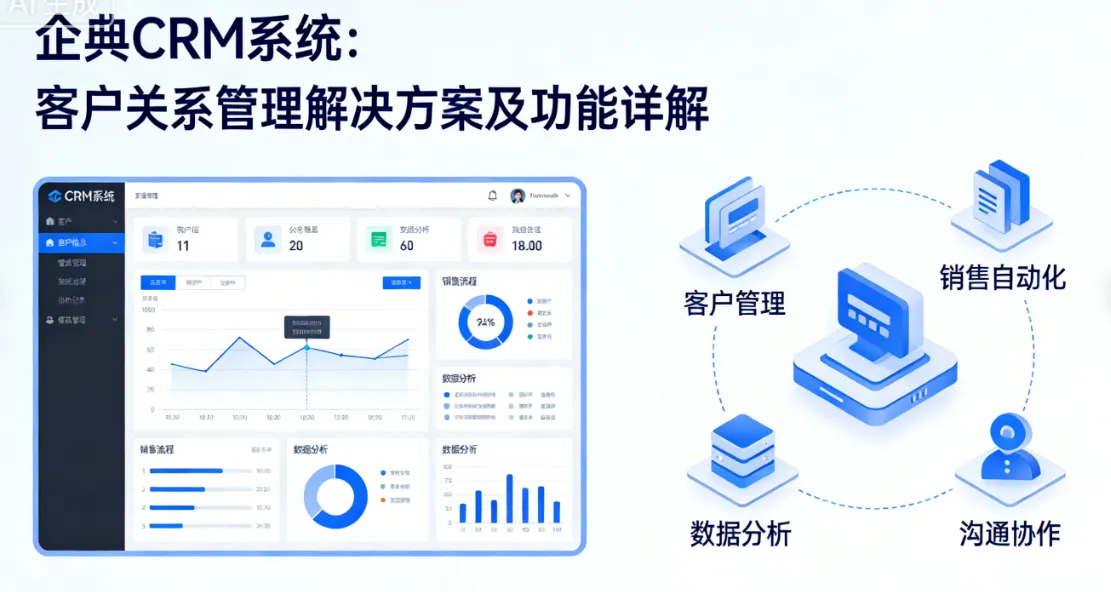
Looking back at the solution of Enterprise Classic CRM, its true value proposition is not the accumulation of functional quantities, but the reconstruction of the cost structure of enterprise digital construction. It returns the initiative of customer relationship management from suppliers to enterprises, allowing frontline business personnel to participate in system construction, enabling managers to adjust processes according to market changes at any time, and freeing IT departments from endless customized development. In this sense, Enterprise Classic CRM is more of an empowering tool than a software product. It does not define what good customer management is for enterprises, but it enables them to define and continuously iterate in their own way. For growth enterprises that are facing fierce competition, frequent adjustments to business models, and prominent personalized needs, this initiative may have more long-term value than any ready-made functional module.