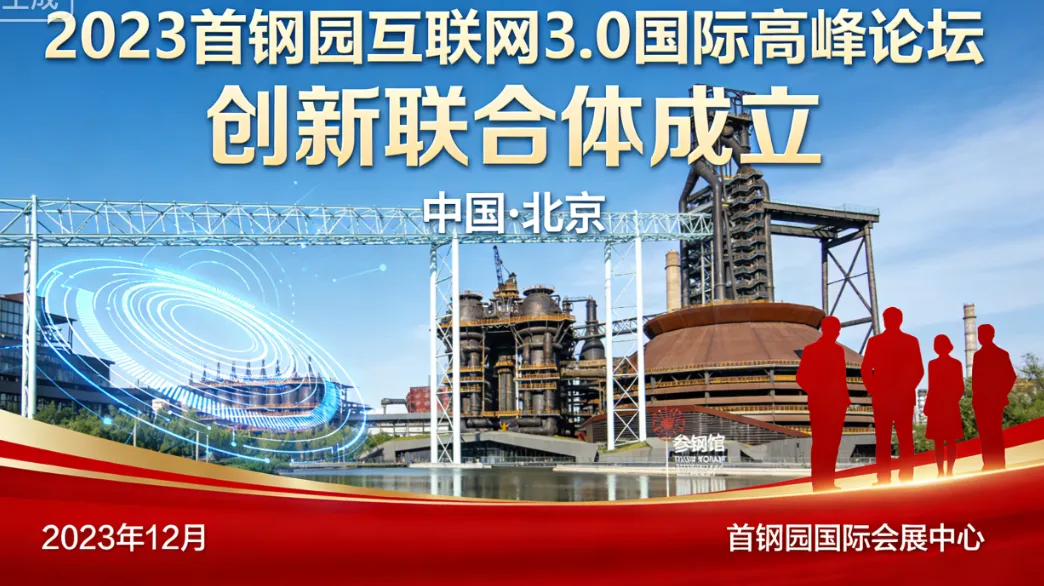
2023 Shougang Park Internet 3.0 International Summit Forum was held in Beijing, and the innovation consortium was established
The Shougang Park in early winter, with the cooling tower outside the three high furnaces standing quietly, is now the most iconic digital landmark in the west of Beijing, an industrial giant that once handled molten iron. In November, 2013, the Internet 3.0 International Summit Forum, under the guidance of the Beijing Municipal Commission of Science and Technology and the Zhongguancun Science Park Management Committee, and hosted by Shougang Group, opened here. Experts, scholars, business representatives, and investors from over ten countries and regions including China, the United States, Germany, and Singapore gathered together to discuss topics related to the future world, such as digital assets, spatial computing, distributed ledgers, and virtual real integration, within the industrial heritage enclosure of the 9.7-meter platform of the Three Blast Furnace. At the closing of the forum, an initiative called "Internet 3.0 Application Innovation Consortium" was officially released. The list of initiators includes national teams such as the Chinese Academy of Information and Communications and the National Industrial Information Security Development Research Center, as well as industrial main forces such as Blue Cursor, Qitian, Baidu and Huawei Cloud. This is another key piece in the hot land of West Beijing after Beijing issued the white paper on Internet 3.0 innovation and development in March this year.
Choosing Shougang Park as the permanent venue for the forum is itself a profound metaphor. Ten years ago, the last blast furnace here shut down, representing the end of the traditional industrial era; Ten years later, a virtual reality world, a science fiction industry cluster, and an autonomous driving demonstration zone will grow in the same factory area. The code for the digital twin city operating system will be debugged in the cement silo. Liang Jie, Deputy General Manager of Shougang Group, calculated in his speech that in the past five years, Shougang Park has introduced more than 120 digital technology enterprises, the concentration of Internet 3.0 related industries has exceeded 60%, and the average annual growth rate of the park's digital economic income has remained above 25%. She pointed from the podium to the old factory building wrapped in a glass curtain wall outside the window, saying that it is now the Metaverse Experience Center, which just received an inspection team from the German Industrial Heritage Protection Association last month. My German colleague asked her if there is a reference frame for transforming industrial sites into digital highlands. She said no, Shougang crossed the river by feeling the stones, but with so many international friends on the forum today, we will no longer feel the stones, but follow the map to cross the river in the future.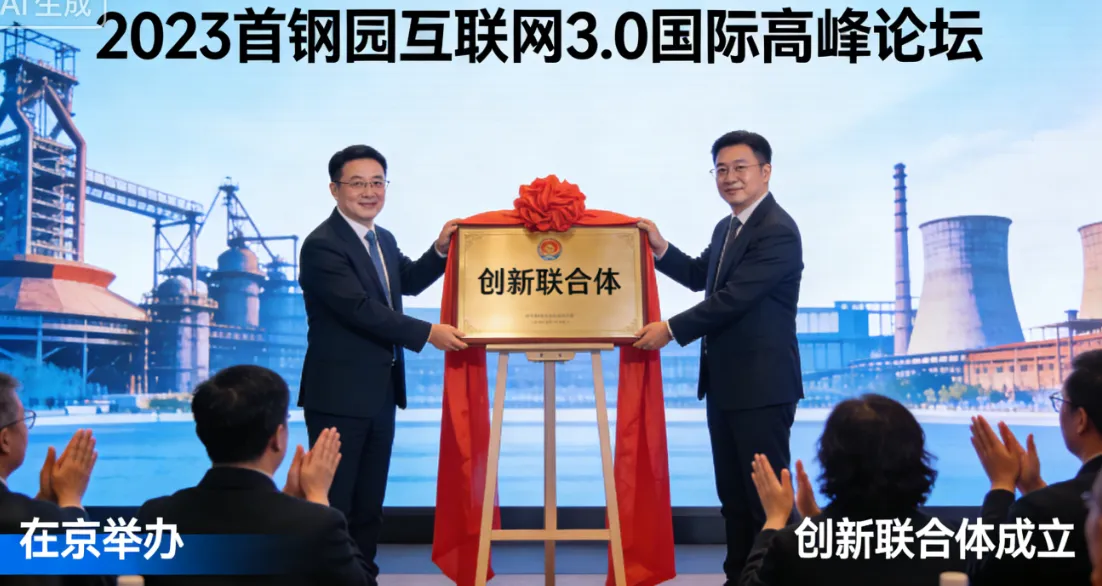
In the keynote speech segment of the forum, many scholars coincidentally defined Internet 3.0 as "the transition from information interconnection to value interconnection". Professor Shenyang from the School of Journalism and Communication at Tsinghua University showcased the latest digital twin project of the National Cultural Park completed by his team. The historical features of 32 cultural nodes along the Grand Canal have been replicated into a three-dimensional space, allowing visitors to "travel" along the river on their mobile phones. Each monument, ancient bridge, and dock is overlaid with metadata annotations and digital copyright certificates. He believes that the core of Internet 3.0 is not a more immersive experience, but a digital asset system that can be confirmed, circulated and programmed. This viewpoint was echoed by the industry in the subsequent roundtable dialogue. Pan Fei, CEO of BlueFocus Group, revealed that over 15% of BlueFocus's revenue this year comes from virtual content production and digital human marketing. Customers are no longer satisfied with shooting a TVC, but demand that the brand have its own metaverse space, virtual image ambassadors, and digital collection distribution plans. He stressed that the foam is receding, and the truly valuable projects are low-key polishing the underlying ability, rather than hyping the concept.
The perspective of international guests provides another layer of reference. Drake O'Halloran, the head of the digital economy of the World Economic Forum, pointed out in a video speech that Internet 3.0 is not only a technological iteration, but also a renegotiation of digital governance rules. The digital identity wallet, data bill and artificial intelligence bill being promoted by the EU are all trying to delimit the boundary for the next wave of Internet waves. He specifically mentioned the impressive investment of Chinese cities in the field of digital public infrastructure, with large-scale digital twin pilot zones emerging in Beijing's urban sub center, Shanghai Lingang, and Shenzhen Qianhai. The output of these experimental fields will affect the pace of global standard setting. Huang Shuting, Assistant Director of Singapore Information and Communication Media Development Authority, shared the layout idea of Internet 3.0 under the framework of "Smart Country 2.0": open digital identity and trusted data exchange base funded by the government, and free innovation of enterprises in the upper layer. She believes that the government cannot be absent or overstepping its authority, and the best role is to become the first user.
The establishment of the innovation consortium was the highlight of the afternoon agenda that day. Unlike common government enterprise cooperation agreements, there is no red silk or signing platform at the joint venture release site. Representatives of the initiating units take the stage one by one, and each person uses one sentence to clarify their commitment to the joint venture. He Baohong, Director of the Institute of Cloud Computing and Big Data at the China Academy of Information and Communications Technology, said that standards come first to prevent innovation from becoming isolated islands. Huawei Cloud Chief Strategy Officer Wang Feng said that computing power should be universally accessible, and small and medium-sized enterprises should not be unable to afford space computing. Qi Xiao, founder of the popular Qitian Group, said that with an open environment, the 100000 square meter industrial remains in Shougang Park are the best testing ground. After twelve sentences, a decentralized collaborative network graph pops up on the screen, with nodes not in a radial hierarchical relationship, but in a network parallel connection. The host said that this is the practice of Internet 3.0 spirit in organizational form.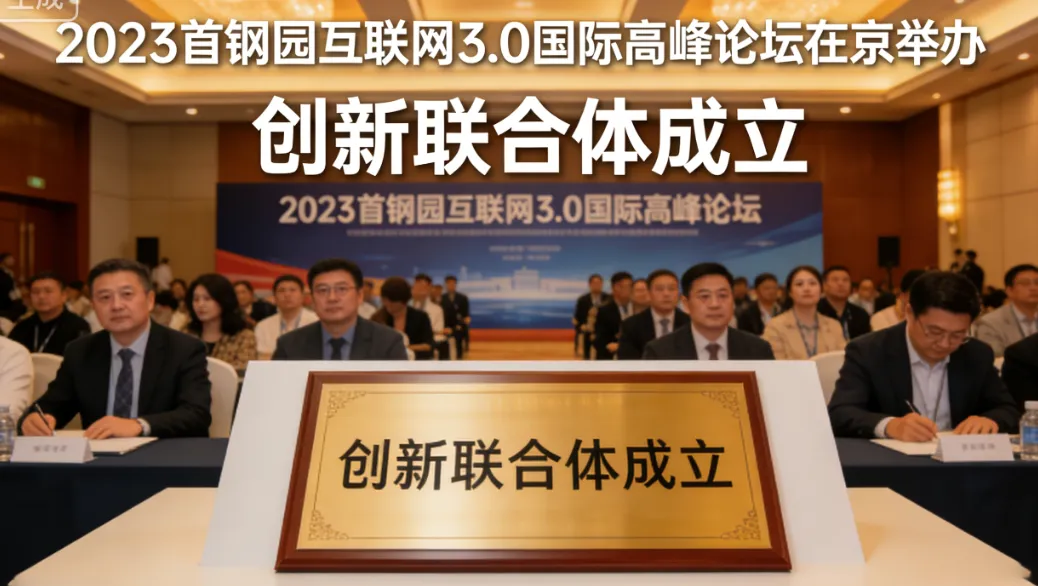
The four major action directions first announced by the consortium clearly point to the implementation: digital asset circulation infrastructure, cultural tourism meta universe scene open platform, industrial digital twin common technology, and Internet 3.0 talent joint training. Shougang Construction Investment Co., Ltd. and Beijing Mobile announced that they will deploy 5G-A network throughout the park, supporting real-time cloud rendering and concurrent interaction with hundreds of people; Baidu AI Cloud and popular Qitian signed a contract to jointly build a large model driven virtual human agent platform; Blue cursor and the School of Animation and Digital Arts at Communication University of China have launched a school enterprise training base, aiming to cultivate 100 composite talents with artistic aesthetics and technical development abilities annually. These projects do not have a grand narrative packaging, each with a specific delivery schedule and quantifiable output indicators.
During the media group interview after the closing of the forum, a reporter asked Li Xiaoping, the head of the Strategic Development Department of Shougang Group, when the Internet 3.0 will be truly profitable. Li Xiaoping did not avoid it. He said that the current rental income of Shougang Park cannot cover the previous renovation investment, but to measure the transformation of the old industrial area, we cannot only look at the income statement of that year. We need to look at how many young engineers are gathered here, how many innovative projects from scratch are implemented, and how many solutions can be output to the outside world. He gave an example that a startup company in the park developed a digital twin training system for the Winter Olympics, which was purchased by Saudi Aramco this year for emergency drills in oil fields with a contract amount of 30 million yuan. This is not an account of real estate rent, it is an account of new quality productivity.
At six o'clock in the evening, the lights of Shougang Park gradually lit up. The 40 meter high furnace body of the Three Highs Furnace is projected into a huge digital canvas, playing in a loop the quotes of the forum guests on that day. The evening rush hour traffic outside the west gate of the park is jammed under the Fourth Ring Bridge. People in the car may not know that the future of the Internet has just been discussed in this old factory, but the 3D road conditions real-time rendered on their mobile phone maps, the package tracks delivered by nearby restaurants accurately recommended in social software, and e-commerce platforms the next day are all fruits of the evolution of the Internet from 1.0 to 3.0. From steelmaking to smelting, from molten iron to data flow, Shougang Park has completed a physical form reconstruction in ten years. The proposition of Internet 3.0 is to make this reconstruction from space to rules, from hardware to protocols, and from assets to equity. This forum and the consortium it has spawned are just stops in a long journey to confirm direction.