Shoe and Clothing ERP System | Integrated Management Software for Research, Production, Supply, Marketing, and Finance in the Shoe and Clothing Industry
The footwear and apparel industry has its own unique business characteristics: fast style updates, and products thatStyle, color, and sizeCombine to form a large number of SKUs; The types of fabrics, accessories, and shoe materials are diverse; The business forms are diverse, including sampling, procurement, self-produced, and outsourced processing; Simultaneously operating online e-commerce, offline stores, and wholesale customers through multiple channels. Many shoe and clothing companies have long relied on Excel, independent spreadsheets, and multiple backend manual data aggregation, and continue to encounter management difficulties in their daily operations.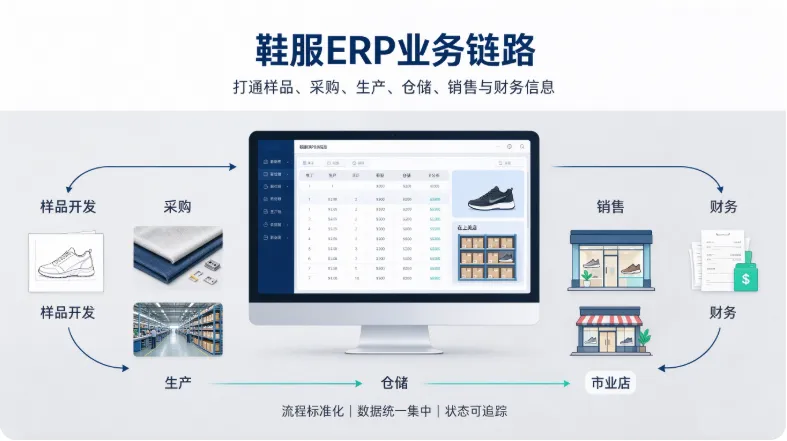
Universal ERP is a standardized product that does not have business logic such as native adaptation of shoe and clothing color code matrix, sample development, and outsourcing processing. Forcefully using a universal system often requires a lot of secondary modifications, and the operation process is disconnected from the actual business. In the end, the system only uses a part of the modules, and most of the business still relies on table flow. Shoe and clothing exclusive ERP is a management system designed based on the real business processes of the shoe and clothing industry, covering the complete business chain from sample development, material procurement, production and processing, warehousing and warehousing, multi-channel sales to financial reconciliation.
Common pain points in daily management of shoe and clothing enterprises
-
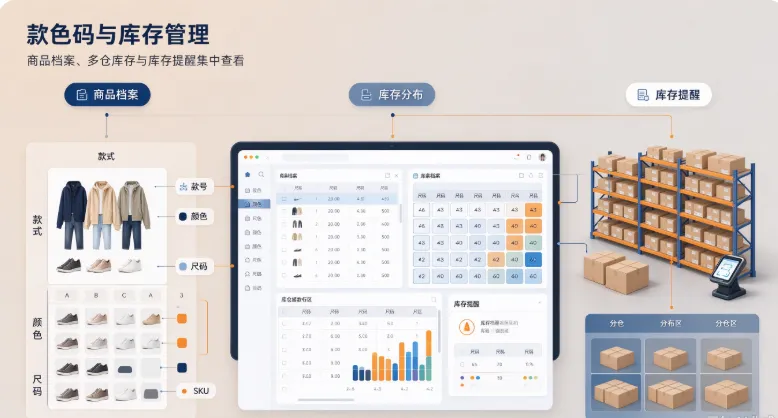
Product SKU management is cumbersomeA product comes in multiple colors and sizes, and manual maintenance of the table can easily result in color code errors, coding confusion, and discrepancies between accounts and reality during inventory.
-
Multi channel data is isolated from each otherE-commerce platforms, offline stores, and wholesale customers each record orders and inventory, requiring manual export and import of data, which can easily lead to delayed inventory updates, overselling, and incorrect shipments.
-
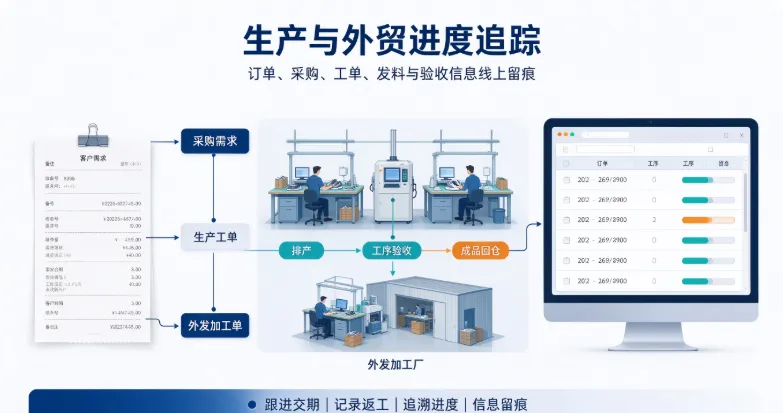
The production and outsourcing processes are not transparentThe order, fabric procurement, and outsourcing processing information are scattered, and the follow-up personnel need to repeatedly communicate with the workshop and processing plant; It is difficult to quickly trace the causes of material shortages, rework, and delivery delays.
-
Difficulty in material and inventory controlThere are many specifications for fabrics, accessories, and shoe materials, which can easily lead to over procurement or under procurement; Finished product inventory is scattered across multiple warehouses and stores, and unsold and out of stock goods can only be manually counted, occupying working capital.
-
The workload of cost accounting is heavyFabric loss, processing fees, shipping costs, and accessory costs are scattered across various documents, and finance needs to manually summarize them, making it difficult to quickly calculate the true gross profit of a single product.
-
Lag in summarizing business dataSales, inventory, and payment data require manual report organization by various departments, and managers can only rely on experience to judge selection, replenishment, and production plans.
Core functions of shoe and clothing ERP (objectively described, without exaggerating the effect)
1. BOM management for color coded products and samples
Native support for style+color+size 3D SKU file management, unified archiving of sample sampling records, process information, BOM material list. Fabric, accessories, and shoe materials are separately archived, supporting BOM version change records, making it convenient for order and procurement personnel to view material usage, and reducing material information transmission errors.
2. Order, procurement, and production outsourcing management
After the customer order is entered into the system, it can automatically generate purchase requirements, production work orders, or outsourcing processing orders. All production in the workshop, outsourcing of materials, process acceptance, and return of finished products to the warehouse are marked online. Management personnel can check the current order progress at any time, facilitate follow-up on delivery dates, and record rework and quality inspection information.
3. Multi warehouse, omni channel inventory management with one pallet
Support unified management of inventory in multiple warehouses and stores, scan codes to complete inbound and outbound, transfer, and inventory operations. Online e-commerce, offline stores, and wholesale channels share a set of inventory data, with real-time updates on inventory changes. The system can set inventory reminders, which automatically remind management personnel to pay attention to replenishment or unsold clearance when the goods are below or above the set quantity. The system can be integrated with mainstream e-commerce platforms to automatically pull orders and reduce manual order recording.
4. Document circulation and integration of business and finance
Purchase orders, production orders, inbound and outbound orders, and sales orders are automatically circulated in the system, and various business documents are retained and traceable. The system automatically collects cost information such as fabric, processing, and logistics to assist in financial accounting of individual costs, accounts receivable, and accounts payable, reducing manual reconciliation workload and making it convenient for enterprises to view the business situation of each account and customer.
5. Business data report
The system automatically summarizes sales, inventory, orders, receipts, and other data to generate visual reports. Managers do not need to wait for departments to manually summarize tables, but can directly view existing business data as a reference for selecting, scheduling, and allocating goods.
What types of shoe and clothing enterprises are suitable for
Shoe factories, clothing processing factories, independent brands, shoe and clothing wholesale traders, online and offline chain shoe and clothing merchants. The system supports modular selection, allowing enterprises to choose the required functional modules based on their own business scale, without the need to purchase all functions at once.
Objective Explanation on System Implementation
ERP is just a management tool, and its effectiveness depends on the enterprise's own process organization, basic data sorting, personnel training, and standardized entry of daily documents. The system cannot directly guarantee profit increase, but it can help enterprises standardize business processes, centralize data, reduce manual duplicate input, reduce information transmission errors, and make business status more transparent.