
The Product Management Function and Enterprise Application Value of the Clothing ERP Mall Module
The clothing industry has typical characteristics of fast style iteration, short season change cycle, complex SKU specifications, high return and exchange rate, and multi-channel operation both online and offline. Under the traditional business model, most clothing companies face problems such as data fragmentation between online shopping malls and offline inventory systems, duplicate maintenance of product information, chaotic pricing systems, asynchronous inventory data, and lack of standardized product control. These problems directly lead to low operational efficiency, frequent customer disputes, serious inventory backlog, and uncontrolled channel management.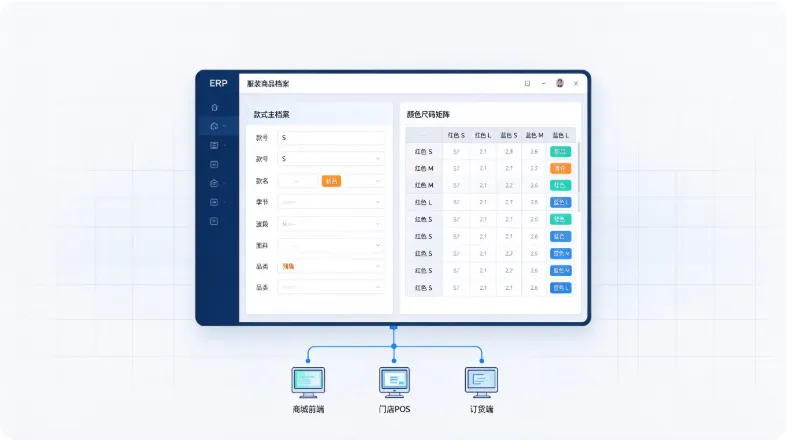
The product management function of the clothing ERP mall module is an integrated product control system tailored to the unique characteristics of the clothing industry, with a core implementationOne set of product data, unified reuse across all channelsIntegrate the product, price, inventory, and material data between the ERP backend and online shopping mall, abandoning the traditional dual system independent operation and maintenance model. This function is tailored to the industry needs of clothing color code size matrix, seasonal bands, and dual line operation of wholesale and retail. It can effectively solve the pain points of clothing enterprise product management from multiple dimensions such as operational efficiency, cost control, channel standardization, inventory turnover, and business decision-making, and has extremely high practicality.
1、 The core adaptation function of clothing ERP mall product management
Different from the commodity management of general e-commerce systems, the clothing ERP mall commodity management fully conforms to the product attributes of the clothing industry, with "style" as the core subject and color and size as auxiliary SKU dimensions, to build a standardized and integrated commodity management system, with core functions covering the entire lifecycle of goods.
In terms of basic product file management, the system supports enterprises to uniformly enter clothing exclusive attributes such as style number, style name, brand, category, season, band, fabric, pattern, and applicable population. At the same time, it also provides detailed information such as size parameters, washing instructions, and material composition to form standardized style files. Enterprises can upload bulk product main images, detail images, promotional videos, and other materials to maintain the front-end display content of the mall. At the same time, it supports customizing tags for new products, popular items, clearance, pre-sales, etc., and is suitable for regular business scenarios such as seasonal updates and clearance of final goods. The system can control the status of products in real time, support the listing and removal of the entire product, and can also separately start and stop the display permissions of individual color and size SKUs in the mall, finely controlling the sales status of products.
In terms of SKU matrix management, the system adapts to the core requirements of the clothing industry and supports one click batch generation of SKUs through a two-dimensional matrix of color and size, without the need for staff to enter them one by one, greatly simplifying the process of adding new products of multiple specifications. Each independent SKU can be individually bound with barcode, selling price, and inventory data, supporting independent control of single specification. For clothing wholesale franchise business, exclusive coding ratios can also be configured to meet the industry demand of franchisees for whole box coding ordering, and to adapt to B2B and B2C dual line business models.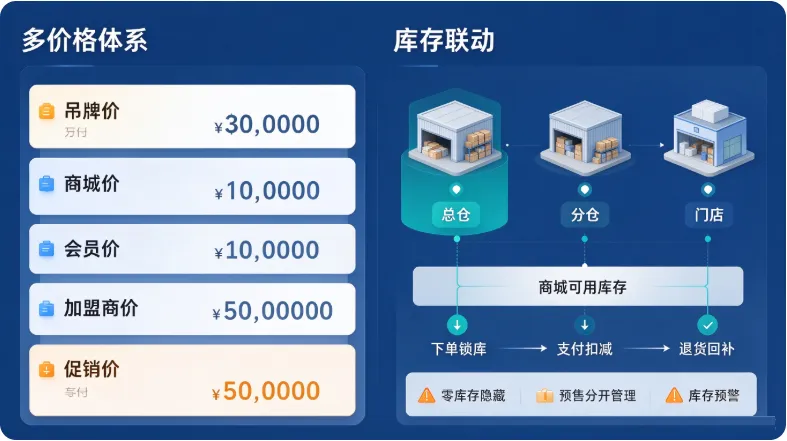
2、 The practical application value of commodity management function for clothing enterprises
(1) Simplify the operation and maintenance process, reduce manual operating costs
Under the traditional model, clothing companies need to repeatedly enter styles in the ERP inventory system and online shopping mall backend SKU、 Price, material and other product information require bidirectional operation during seasonal updates, product price adjustments, and inventory updates, which not only involves a large workload but also easily leads to inconsistent information and input errors. The integrated product management system of ERP mall enables one-time entry of product information and synchronous reuse across all channels. All product data in the online mall comes from a unified data source in the ERP backend, without the need for repeated operation and maintenance. The simultaneous batch operation function can significantly improve the efficiency of seasonal updates, final inventory clearance, and price adjustments, effectively reducing manual operation errors and lowering the labor and time costs of enterprise product operation and maintenance.
(2) Standardized product control, adapted to the characteristics of the clothing industry
Most general e-commerce systems manage each color and size separately as an independent product, resulting in messy SKU data, difficult statistics, and cumbersome operation and maintenance for clothing companies. The clothing ERP manages goods in a matrix mode of "main style+sub SKU", which unifies the management of different colors and sizes of the same style. New, updated, and discontinued products only require the operation of the main style file, without the need to process segmented SKUs one by one, fully adapting to the characteristics of clothing with multiple specifications and categories. At the same time, standardized size charts, fabric parameters, and washing instructions are displayed uniformly, which can standardize the external display standards of products and solve the problem of confusion in online product information display.
(3) Standardize the pricing system and avoid channel operation risks
In the process of multi-channel operation, inconsistent online and offline prices, unauthorized price adjustments by franchisees, and chaotic control of promotional prices are common business risks for clothing enterprises. Based on the multi-level pricing system of ERP product management, enterprises can establish unified pricing standards for all channels. The online mall selling price, store retail price, and franchisee wholesale price are all controlled by the backend to prevent unauthorized price adjustments and disorderly pricing. Simultaneously differentiated customer prices and product display permissions can effectively protect the brand pricing system, prevent product collusion and low price dumping, standardize franchise channel management order, and reduce brand management risks.
(4) Accurately control inventory, reduce product loss and after-sales disputes
The asynchronous inventory data is the core pain point of clothing online operation, which is prone to oversold, out of stock, and out of stock issues, leading to customer refund complaints and after-sales disputes. The real-time inventory linkage mechanism of the ERP mall can synchronize the actual available inventory of the ERP to the front-end of the mall. Through the closed-loop logic of order locking, payment deduction, and return to the warehouse, it can avoid oversold problems from the root. The automatic hiding function of zero inventory SKUs can reduce customers' invalid orders, significantly reduce after-sales communication costs and complaint rates. At the same time, multi warehouse inventory linkage and store inventory display functions can activate idle inventory in offline stores, improve product utilization, and reduce inventory backlog and loss.
(5) Accelerate the turnover of goods and improve the operational efficiency of new products
The clothing industry changes seasons quickly and new products iterate frequently, which directly affects market revenue in terms of new product launch efficiency. The system supports the replication and reuse of basic information for the same product, and can quickly complete the new product launch by simply replacing images and new parameters, greatly shortening the new product launch cycle. At the same time, through the classification of product tags and the customization of front-end sorting functions, enterprises can quickly create new product zones, popular product zones, and clearance zones, accurately promote new product promotion and clearance of final goods, effectively accelerate the turnover speed of goods, reduce the capital occupation of out of season unsold goods, and improve the overall operational efficiency of goods.
(6) Accumulate accurate data to support business decision-making
The product management module can integrate mall browsing, add ons, transactions, after-sales data with ERP inventory, cost, and gross profit data, forming refined data reports divided by style, color, size, season, and channel. Enterprises can use data to intuitively determine unsold goods, analyze the sell out rate and return rate of goods, and provide real data support for new product development, replenishment production, seasonal clearance, and product pricing, bidding farewell to traditional experiential decision-making and improving the scientific nature of enterprise product planning and inventory control.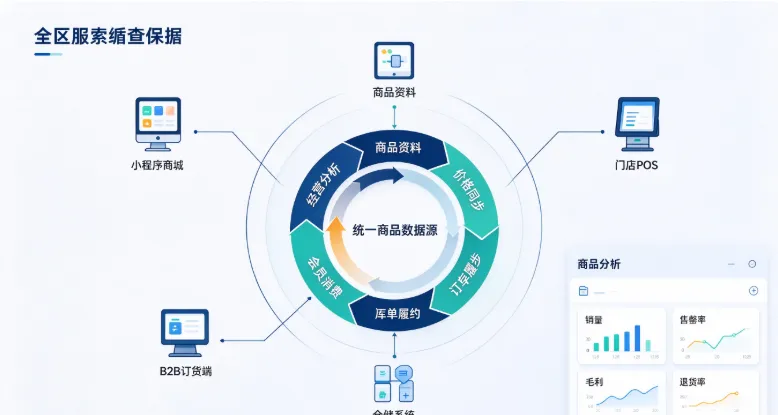
(7) Connect all channel data to support business scale expansion
The integrated product data system has achieved unified product data for offline store POS, private domain mall, and B2B ordering mall. The specifications, prices, parameters, and inventory of online and offline products are completely consistent, improving customer consumption experience while building an all channel integrated management system. The standardized commodity data interface can seamlessly connect with third-party e-commerce platforms such as Tiktok, Taobao, Pinduoduo, etc. Enterprises can quickly expand sales channels without rebuilding commodity systems, providing stable support for business scale development.
3、 Summary
The product management function of the clothing ERP mall module is not a simple online product display tool, but is in line with the business logic of the clothing industryOmnichannel Product Control SolutionIts core value lies in solving the core pain points of clothing enterprises, such as difficult multi SKU management, chaotic multi-channel data, loose inventory control, and lack of decision-making basis, through data integration, standardized control, and intelligent operation and maintenance. On the premise of not exaggerating functions or fabricating effects, effectively helping enterprises reduce costs and increase efficiency, standardize channels, activate inventory, and make accurate decisions is the fundamental core module for clothing enterprises to achieve online offline integration and refined digital management.